

Written by: Matt Beucler, CEO, Plura AI
Updated June 2026
Key Takeaways for High-Volume Teams
- Predictive lead scoring automation uses machine learning on behavioral, firmographic, and conversation signals to rank leads by conversion probability and trigger outreach in under five seconds.
- Traditional rules-based scoring freezes at form fill and cannot adapt, while conversation-driven, stateful scoring updates continuously across voice, SMS, RCS, and webchat.
- Implementation requires mapped data sources and consent fields, real-time enrichment, stateful scoring rules, automated outreach with TCPA/DNC checks, and continuous-learning loops.
- Organizations see 3–5× higher connection rates, 89% scoring accuracy, and lower cost per qualified lead when the full scoring-to-outreach loop runs on compliant U.S. infrastructure.3
- Plura AI delivers this end-to-end capability with AI Lead Intelligence, the AI Predictive Dialer, and AI Conversation Intelligence. Start your free trial today.
Who Should Use This Playbook
This guide serves contact-center leaders, marketing directors, agency owners, and enterprise operators running 500 or more daily interactions or at least $5,000 in monthly paid-media spend. It assumes you already use CRM lead scoring, maintain lead sources and consent records, and run a dialer or messaging platform.
Why Response Time Dictates Your Scoring Strategy
The industry average first-contact time sits at 47 hours. Velocify’s analysis of roughly 3.5 million leads found that calling within one minute of lead submission lifts conversion rates by 391%.3 The MIT/InsideSales.com Lead Response Management study found that the odds of contacting a lead drop 100 times when calling at 30 minutes versus 5 minutes after form submission.3 Landbase’s 2026 articles report ~13% average MQL-to-SQL conversion and 4–7× conversion improvements from AI tools, but do not cite 40% versus 11% rates for scored versus unqualified leads.4 The math is clear: scoring without near-instant outreach leaves most of the value on the table.
Rules-Based vs. Conversation-Driven Scoring Models
Traditional rules-based scoring assigns fixed point values to predetermined fields, such as job title, company size, or form submission, and never recalculates unless a human rewrites the rules. These systems rely heavily on manual input and subjective assessments, which limits adaptability and fails to account for changing patterns in buyer behavior or market shifts. Conversation-driven, stateful scoring treats every voice call, SMS exchange, RCS message, and webchat session as a live data point. Plura treats every interaction as a data point for Lead Intelligence, scoring before calls, and Conversation Intelligence, learning after them, so the model updates continuously instead of waiting for a quarterly rules review. The practical difference is simple: a rules-based system scores a lead at form fill and freezes. A stateful model rescores that same lead after every subsequent touchpoint and surfaces intent signals that a static threshold would never catch.
Build vs. Buy for Predictive Lead Scoring Infrastructure
Building predictive lead scoring in-house requires an FCC-licensed audio bridging carrier, STIR/SHAKEN-authenticated origination, real-time DNC scrubbing against federal and state registries, immutable TCPA consent logging, a stateful database that holds context across channels, and conversation engineering that keeps an AI agent on-script under pressure. Companies succeeding with AI outbound calling typically own or control their telephony infrastructure as registered FCC carriers and handle compliance at a granular level rather than bolting it on after the fact. Most Twilio-based API resellers rent those layers from a third party, which means branded caller ID is not issued at the carrier level, real-time DNC scrubbing is an add-on, and compliance posture lives outside the platform.4 Plura owns the full carrier stack, so the scoring-to-outreach loop closes in seconds without routing through a third-party CPaaS (Communications Platform as a Service: the API-only telecom layer that providers like Twilio sell to AI vendors who do not own their own carrier).
How to Implement Predictive Lead Scoring Automation
Step 1: Map Every Data Source and Consent Field
The first step creates a complete inventory of every data source feeding the scoring model and every consent record governing outreach. Required inputs include CRM records, form-fill data, prior call transcripts, and third-party enrichment sources. Common input categories for AI lead scoring include demographic data, behavioral data, firmographic data, and engagement data, often supplemented with third-party intent data, firmographics, and technographics to improve prediction accuracy. Map consent timestamps, opt-in language, and channel permissions to each lead record before any scoring logic runs. This mapping is critical because consent records that cannot be tied to a specific lead token create a compliance liability under TCPA frameworks; consult qualified counsel on your specific obligations.2 Batch mapping works at this stage, since the goal is a clean, auditable data foundation before enrichment begins.
Step 2: Configure Real-Time Enrichment at First Touch
This step enriches each lead with firmographic, behavioral, and intent signals at the moment of first contact, not in a downstream batch job. Plura AI enables real-time AI lead scoring alongside lead response times under 60 seconds, multichannel engagement via voice, SMS, RCS, and webchat, and cost per qualified lead of $25 to $60. Plura’s AI Lead Intelligence pings 30-plus data sources, including IP and property data, email validation, contact data, intent signals, and business firmographics, during the live conversation so context arrives in real time instead of hours later. The latency threshold that matters here is sub-second API response. Enrichment sources that return data in more than two seconds should be queued for post-call scoring updates instead of injected mid-conversation.
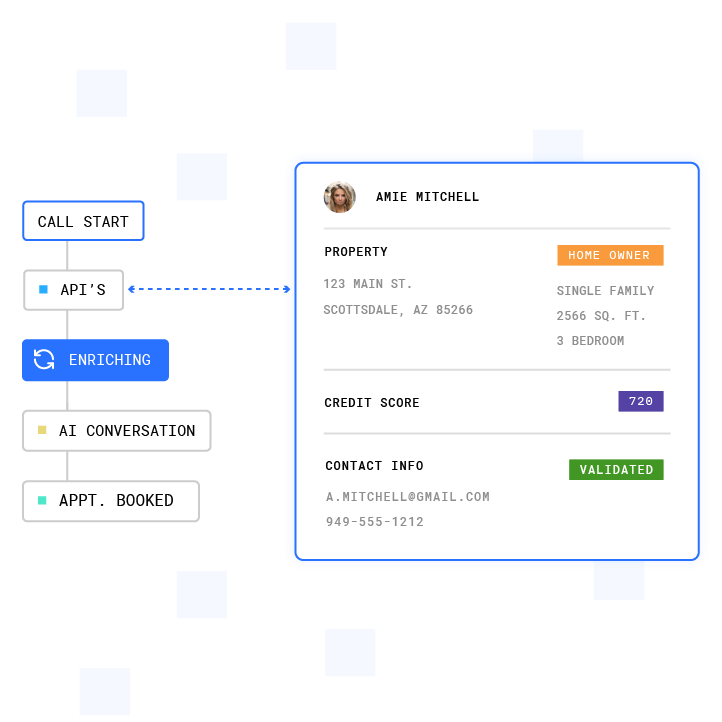
Step 3: Build Stateful Scoring That Follows Every Conversation
This step maintains a single lead score that reflects every channel interaction, not a siloed score per channel. Sophisticated predictive lead scoring models integrate CRM data with product usage analytics, support ticket histories, billing records, and content interaction logs as connected relational tables rather than isolated CRM exports. Plura’s Stateful Conversation Database keys every interaction to a customer token, whether phone number, email, or ID, so a lead that texted at 9 a.m. carries that context into the noon call without re-qualification. Configure scoring rules to increment or decrement on objection signals, offer-acceptance bands, and channel engagement depth. Streaming updates work best for high-velocity lead sources, while batch recalculation fits overnight list refreshes where sub-minute latency is not required.
Step 4: Tie Scores to Automated Outreach with TCPA and DNC Checks
This step fires outreach the moment a lead crosses a score threshold, with compliance checks running before every dial. FTC rules describe DNC scrubs that are no more than 31 days old, with separate checks referenced for state registries in eleven states including California, Texas, and Florida.2 Plura’s Compliance Engine checks every outbound contact against federal and state DNC registries in real time before dial, enforces quiet-hours rules through time-zone detection, and timestamps consent records as immutable entries. The AI Predictive Dialer then routes the call over Plura’s FCC-licensed carrier with SHAKEN/STIR caller ID verification and branded caller ID, reaching the lead in under five seconds from score trigger. Organizations deploying AI for speed to lead see the connection-rate improvements described earlier, with response times dropping from hours to seconds. Customers are responsible for their own TCPA and DNC compliance obligations; Plura provides infrastructure that supports those obligations.2
Step 5: Feed Conversation Outcomes Back into the Model
This step uses every completed conversation as a training signal so the model improves with volume instead of drifting. Plura’s AI Lead Intelligence scores and prioritizes leads in real time using behavioral signals, conversation context, and predictive intent modeling, while AI Conversation Intelligence analyzes every interaction across voice, SMS, RCS, and webchat to surface patterns in what scripts close, what objections recur, and what conversion paths win. A 150-company Optifai study found that AI predictive lead scoring achieves 89% accuracy vs. 60–68% for traditional models, reducing false positives by 40%.3 Configure the feedback loop to write outcome labels, such as converted, disqualified, no-answer, and objection-type, back to the scoring model on a cadence matched to your lead volume. High-volume operations benefit from daily updates, while lower-volume deployments may use weekly batch retraining. With all five steps in place, the full scoring-to-outreach loop runs automatically.
Run your numbers through Plura’s calculator to check your ROI in real time. plura.ai/calculator
Side-by-Side Scoring Method Comparison
| Scoring Method | Data Inputs | Adaptability | Compliance Enforcement |
|---|---|---|---|
| Traditional rules-based | Fixed fields: job title, company size, form submission, email opens; no third-party enrichment by default | Static, requires manual rule rewrites to reflect buyer-behavior shifts | Manual DNC scrubs and consent logging, no real-time enforcement at the carrier level |
| Predictive AI scoring (Plura) | 30-plus real-time sources: behavioral signals, conversation context, firmographics, intent signals, IP and property data, email validation | Continuous, model weights update from new lead outcomes and engagement signals across every channel | Real-time DNC scrubbing, immutable TCPA consent ledger, SHAKEN/STIR authentication, and quiet-hours enforcement built into the carrier layer |
Common Challenges and How Teams Address Them
Data-quality drift. Enrichment sources return stale or mismatched records over time, which causes scores to diverge from actual lead quality. Observable symptom: contact rate holds steady while conversion rate drops. To catch this drift before it impacts conversion, audit enrichment API response freshness monthly and flag records older than 30 days for re-enrichment before the next outreach cycle.
Consent-record fragmentation. Leads captured across multiple landing pages, webforms, and third-party sources carry inconsistent opt-in language. Observable symptom: compliance audit reveals gaps in consent timestamps or missing channel-specific permissions. Remediation involves consolidating consent records into a single immutable ledger keyed to the lead token before routing to any outreach channel. Consult qualified counsel on consent-record requirements applicable to your campaigns.
Spam-label impact. Outbound calls present as “Spam Likely” on recipient devices, which collapses pickup rates before the score-to-outreach loop can function. Observable symptom: dial volume holds steady while contact rate drops below 12%. Effective remediation requires outreach that originates from a carrier issuing branded caller ID directly and authenticating calls through SHAKEN/STIR at origination, not through a third-party reseller. Plura issues branded caller ID through its own FCC-licensed carrier and communicates with Apple’s iOS 26 call-screening layer so calls present with the company name and call purpose.
Regulatory exposure under FCC NPRM CG Docket No. 26-52.2 The FCC’s Notice of Proposed Rulemaking, CG Docket No. 26-52, describes potential caps on offshore customer-service calls and potential limits on offshore handling of sensitive consumer data. AI tools with foreign infrastructure dependencies may intersect with this rule. Observable symptom: vendor contracts reference non-U.S. data centers or third-party CPaaS routing. Many organizations respond by confirming that voice origination, model hosting, data storage, and call recording all sit on domestic infrastructure. Plura runs on 100% U.S. infrastructure by architecture. Consult qualified counsel on your specific regulatory obligations under the NPRM and applicable state onshoring laws.2
Measuring Success at 30 and 90 Days
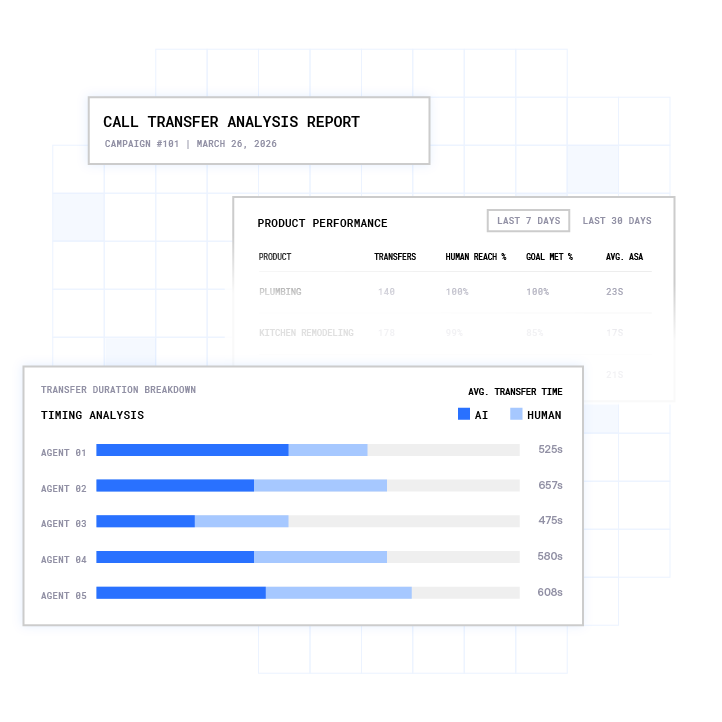
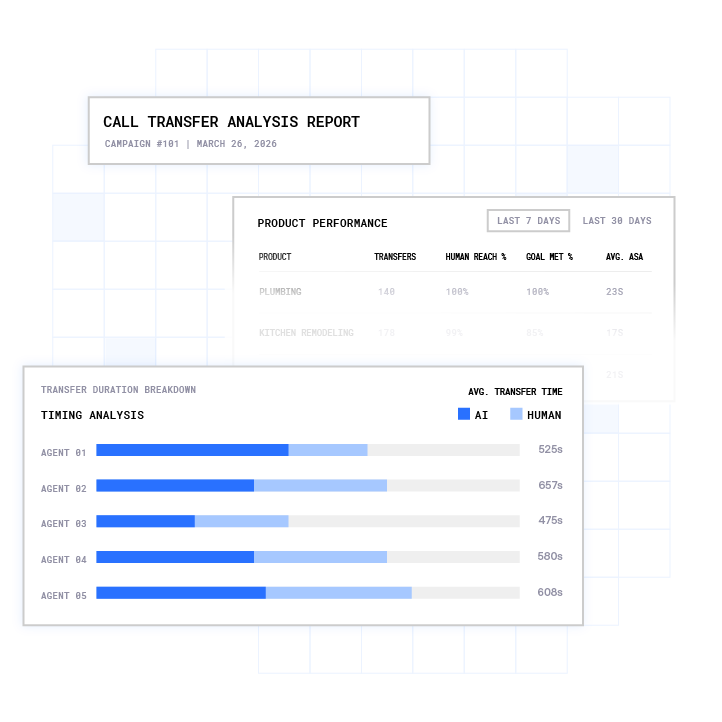
At 30 days, track four operational metrics: first-contact response time (target: outreach fires in under five seconds from score trigger), contact rate per dial, DNC-scrub pass rate (target: 100% of dials pre-checked), and conversation-to-qualified-handoff rate. At 90 days, layer in business metrics, including pipeline growth, cost per qualified lead, and conversion rate from first contact to closed deal. Plura’s AI Conversation Intelligence generates this reporting automatically, including per-channel breakdown and objection-pattern analysis, so the 30-day and 90-day reviews pull from live data instead of manual exports.
Advanced Configuration for Multi-Channel Operations
Cross-channel orchestration keeps the same lead score governing outreach priority across voice, SMS, RCS, and webchat at the same time. Plura’s Stateful Conversation Database ensures every channel reads the same score and the same prior-conversation context, so a lead who declined an offer via SMS does not receive the same offer again on the next voice call. No-code canvas tuning in Plura’s Workflows feature lets operators adjust scoring thresholds, negotiation guardrails (BATNA floors and ceilings: the boundaries inside which the AI is permitted to negotiate), and transfer rules without engineering involvement. For agencies and multi-location operators scaling across clients or franchise units, Plura supports multi-tenant configuration with per-client consent records, audit trails, and campaign-level compliance rule sets.
Compare plans and rates side by side at plura.ai/pricing
Frequently Asked Questions
How long does it take to implement predictive lead scoring automation with Plura?
A simple inbound qualification flow typically goes live within days. A complex multi-step workflow, such as a 25-question intake with branching qualification logic, runs closer to one to two months because the conversation design and validation require careful work. Plura’s onboarding sequence covers a discovery audit, intake of sample calls and existing scripts, an overnight build of a dynamic conversation mockup, a review session, engineering build of the production workflow, a pilot test on a subset of real calls, and full go-live. Every annual contract includes a 90-day opt-out window if the deployment is not delivering.
What systems do I need in place before starting?
You need a CRM with lead records and closed-won deal history, documented consent records with timestamps and channel permissions, a defined ideal customer profile, and an existing dialer or messaging platform to replace or augment. Plura integrates with HubSpot, Salesforce, Zoho, and 50-plus other tools across CRM, calendar, attribution, enrichment, and payment categories.4 The scoring model stabilizes faster with higher lead volume, so operations running fewer than 500 daily interactions will see slower model convergence.
How does Plura handle integration with existing CRMs and marketing platforms?
Plura connects bi-directionally with HubSpot, Salesforce, and Zoho, pushing enriched lead data and conversation outcomes back into the CRM in real time. It also integrates with attribution platforms including Cometly, Retreaver, and Ringba, and with automation tools including Go High Level, Make, and Zapier.4 The AI Lead Intelligence layer pings enrichment sources during the live conversation, so the CRM record updates with real-time signals instead of waiting for a post-call batch sync. The full integration directory is at plura.ai/integrations.
What does Plura cost, and how is it structured?
Plura offers three pricing tiers: Multi at $5,000 per month, Agency at $7,500 per month, and Enterprise at custom pricing. All tiers run on annual contracts billed monthly. Agent build fees are $2,500 to $2,750 per agent. The illustrative ROI scenario at the default calculator inputs: a 15-agent operation at $20 per hour costs $60,000 per month; replacing that team with Plura drops the monthly cost to $14,400, producing $45,600 in 30-day savings and $547,200 over 12 months.3 Full plan details are at plura.ai/pricing.
How does Plura support compliance across TCPA, DNC, HIPAA, and state-level rules?
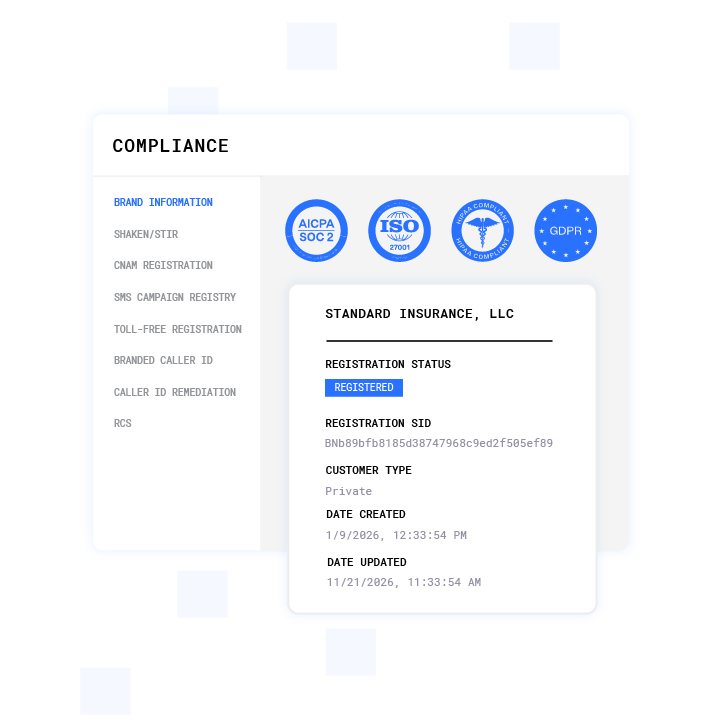
Plura’s Compliance Engine checks every outbound contact against federal and state DNC registries in real time before dial. Consent records are timestamped and immutable. Quiet-hours rules enforce automatically through time-zone detection. HIPAA-aligned encryption, access controls, and audit logging cover protected health information across all four channels.1 SOC 2, HIPAA, ISO certification, GDPR, SHAKEN/STIR caller ID verification, TCPA compliance, and DNC compliance are the compliance frameworks Plura’s infrastructure is built around.1 Customers are responsible for their own regulatory obligations and certifications; Plura provides infrastructure that supports those obligations.2 Consult qualified counsel on the specific requirements applicable to your campaigns and industry.2
How do I measure whether the scoring model is improving over time?
Track the ratio of score-to-qualified-handoff at 30-day intervals. If the model is learning correctly, that ratio should increase as the feedback loop feeds conversation outcomes back into the scoring weights. Plura’s AI Conversation Intelligence surfaces the patterns automatically, including which score bands produce the highest contact rates, which objection types recur at which score thresholds, and which conversion paths close fastest. Use the 30-day operational review to tune enrichment source weighting and the 90-day business review to assess pipeline growth and cost per qualified lead against baseline.
Conclusion: Closing the Loop from Score to Conversation
Predictive lead scoring automation functions as a five-step operational system. You map data sources and consent fields, configure real-time enrichment at first touch, build stateful scoring rules that update across every channel, connect scores to compliant outreach triggers, and run continuous-learning loops that improve the model with every conversation. Rules-based scoring cannot execute this loop at scale because it freezes at form fill and requires manual rewrites to adapt. Plura AI closes this loop in seconds on 100% U.S. infrastructure, with AI Lead Intelligence enriching in real time, the AI Predictive Dialer firing compliant outreach at score threshold, and AI Conversation Intelligence feeding outcomes back into the model automatically.
Run your numbers through Plura’s calculator to check your ROI in real time. plura.ai/calculator
Compare plans and rates side by side at plura.ai/pricing
1 Plura AI maintains SOC 2, HIPAA, ISO, and GDPR posture as part of its platform infrastructure. References to compliance frameworks in this article describe Plura’s platform capabilities and do not constitute a guarantee that any customer using Plura will themselves be compliant with applicable laws or standards. Customers remain solely responsible for their own regulatory obligations, certifications, consent management, recordkeeping, and the claims they make to their own end users. Consult qualified legal counsel for guidance specific to your use case.
2 This article describes regulatory frameworks at a general level and does not constitute legal advice. Laws and regulations vary by jurisdiction, change over time, and apply differently depending on facts and circumstances. Readers should consult qualified legal counsel before making compliance decisions.
3 Performance figures, customer outcomes, and industry statistics referenced in this article are drawn from cited third-party sources or Plura customer case studies. Individual results vary based on implementation, use case, industry, audience, and execution. Past or aggregate performance is not a guarantee of future results.
4 References to third-party products, services, companies, or research are made for informational and comparative purposes only. Plura AI is not affiliated with, endorsed by, or sponsored by any third party named in this article unless explicitly stated. Trademarks and product names referenced remain the property of their respective owners.
This article is provided for informational purposes only and reflects Plura AI’s understanding at the time of publication. Product capabilities, integrations, and specifications are subject to change. For the most current information, visit plura.ai.
This article was produced with the assistance of AI tools and reviewed by Plura AI prior to publication.