

Written by: Matt Beucler, CEO, Plura AI
Key Takeaways
- Sales automation with SMS and voice uses AI agents on a single stateful database to trigger, conduct, and log conversations across channels for sub-5-second lead response.
- Carrier-owned infrastructure with real-time DNC and TCPA controls at origination supports stronger compliance and higher pickup rates than CPaaS-wrapper platforms.
- Stateful cross-channel memory lets AI agents reference prior SMS, voice, or webchat context so every follow-up builds on the last interaction without repetition.
- A 90-day deployment can replace a 15-agent team at $60K per month with Plura at $14.4K per month, yielding $45,600 in first-month savings and 3x average ROI.3
- See Plura AI in a live demo and review how a carrier-owned stack improves speed-to-lead and compliance controls in your operation.
Why 60-Second Response Still Wins in 2026
- The industry standard for first contact on an inbound lead sits at 47+ hours. Contacting a lead within 5 minutes makes them up to 100x more likely to connect, and a 60-second response lifts conversions by 391%.3
- But speed alone does not solve the connection problem. 88% of outbound effort goes unanswered, driven by spam labels, manual SDR queues, and time-zone gaps. Speed without pickup rate is not a solution.
- Organizations deploying AI for speed to lead see response times drop from hours to seconds and connection rates increase by 3x to 5x.
- The FCC NPRM CG Docket No. 26-52 adds a regulatory dimension.2 Platforms with foreign infrastructure dependencies now carry compliance risk that did not exist two years ago, so speed and compliance now sit in the same conversation.
- Apple’s iOS 26 call-screening layer intercepts unfamiliar numbers before they ring through. Operators without branded caller ID at the carrier level are losing calls before the first ring.
Carrier-Owned Stack vs. CPaaS Wrapper for Contact Centers
CPaaS (Communications Platform as a Service) is the API-only telecom layer that providers sell to AI vendors who do not own a carrier. Most AI voice and SMS tools sit as wrappers on top of a CPaaS, paying a per-minute markup that passes through to the customer and relying on a compliance posture that lives outside the platform.
The architectural differences between a carrier-owned stack and a CPaaS wrapper show up in four operational areas that affect pickup rates, compliance exposure, and cost.
- A carrier-owned stack originates voice on its own FCC-licensed infrastructure. Branded caller ID is issued at the carrier level, not bolted on through a third-party reseller.
- Real-time DNC scrubbing on a CPaaS-wrapper platform usually appears as an add-on. On a carrier-owned platform, it runs before the dial attempt at origination.
- Stateful memory requires a single database layer shared across every channel. CPaaS wrappers typically run voice and SMS as separate products with separate memory, so a customer who texted at 9 a.m. has to re-explain themselves when the call comes at noon.
- U.S. infrastructure is an architectural fact on a carrier-owned platform, not a contractual promise. Under the new FCC rules, that distinction matters for every covered entity handling sensitive consumer data.
See the carrier-owned stack in a live environment by scheduling a Plura session.
Real-Time DNC and TCPA Workflow in Plura
Plura’s compliance engine operates across six enforcement layers that run before, during, and after every outbound contact.
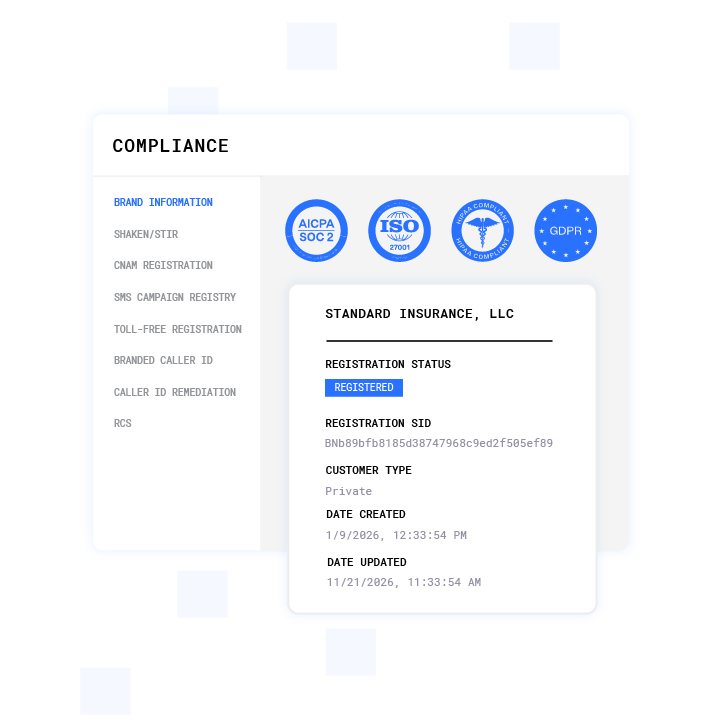
- Carrier-level scrubbing. Every outbound contact is checked against federal and state DNC registries before the dial attempt. Numbers that do not meet configured rules are stopped at origination, not flagged after the fact.
- TCPA-litigator list filtering. After DNC checks, Plura integrates with The Blacklist Alliance’s TCPA Litigation Firewall for real-time litigation-risk screening4 on every outbound contact. TCPA violations can carry statutory damages of $500 to $1,500 per unsolicited call or text, with class action settlements averaging $6.6M in 2023.
- Consent ledger. Express written consent records are timestamped, immutable, and audit-ready. The consent record travels with the contact token across every channel.
- Quiet-hours enforcement. Time-zone detection applies federal and state calling-window restrictions automatically on every campaign. Operators do not configure this manually per state.
- Audit-ready exports. The compliance dashboard surfaces one-click exports for legal review, carrier requirements, or regulatory inquiries. Plura supports compliance infrastructure, while operators remain responsible for their own regulatory obligations and should consult qualified counsel on their specific posture.
- Plura’s compliance framework includes SOC 2, HIPAA, ISO certification, GDPR, SHAKEN/STIR caller ID verification, TCPA-related controls, and DNC-related controls.1 Full compliance detail is available in Plura’s compliance documentation.
Stateful Cross-Channel Memory in Daily Use
- 9:00 a.m. SMS. An AI agent texts a lead about a home-services quote. The lead replies with a budget range and a preferred appointment window. Both are written to the Stateful Conversation Database, keyed to the lead’s phone number.
- 9:47 a.m. No response to follow-up SMS. The workflow triggers an outbound voice call. The AI agent opens with the lead’s name, references the budget range from the earlier text, and proposes the appointment window the lead already specified. No re-introduction. No repeated questions.
- 9:49 a.m. Objection raised. The lead asks about a competitor’s pricing. The AI agent references the negotiation guardrails in the workflow node (BATNA floor and ceiling) and responds within those bounds. The objection is logged to the database.
- 9:51 a.m. Warm transfer. The lead asks to speak with a human. The AI agent warm-transfers to a U.S. agent with a full context summary: channel history, budget, objection, and qualification status. The human agent does not ask the lead to start over.
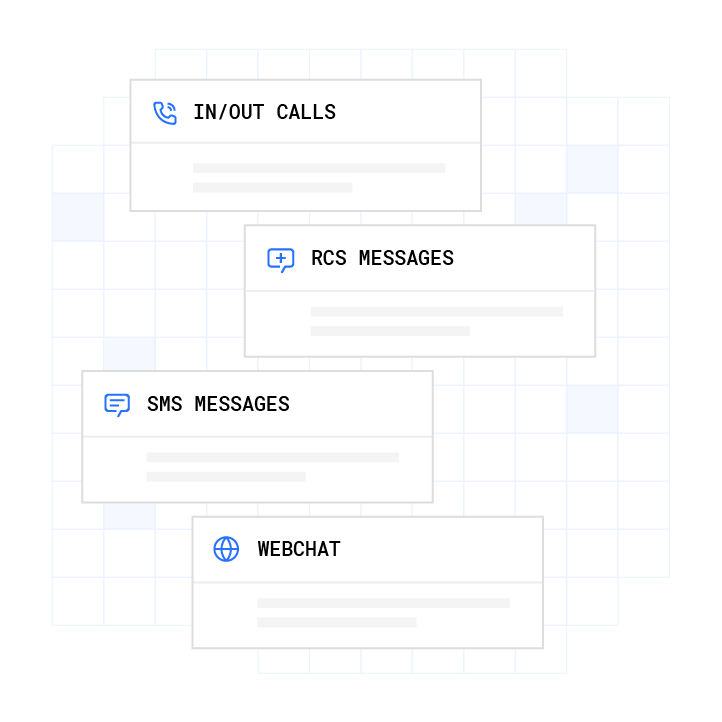
- This unified stateful inbox maintains full conversation history across every channel, so every touchpoint builds on the last.
That memory layer is what makes the following lead-to-meeting sequence work without forcing the customer to repeat themselves at each step.
5-Step Lead-to-Meeting Sequence with No-Code Triggers
This five-step sequence shows how a typical lead moves from first touch to booked meeting using Plura workflows.
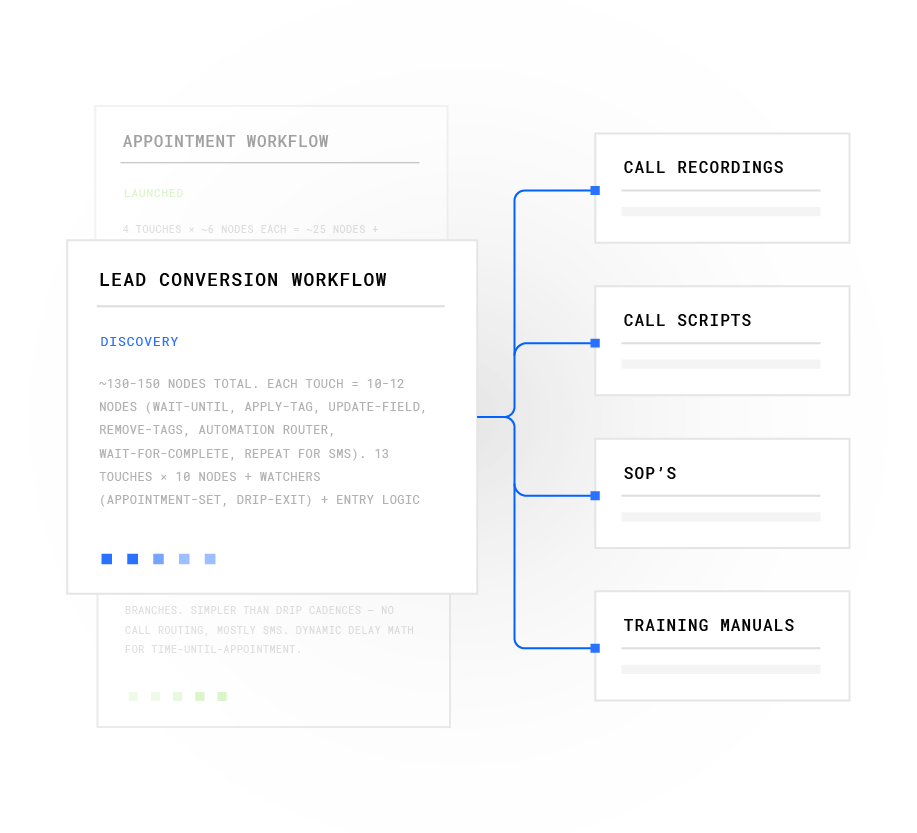
- Trigger node. A form fill, CRM event, or inbound call fires the workflow in Plura’s no-code Workflows canvas. The AI agent pulls 30+ enrichment data points on the lead in real time before the first word is spoken or sent.
- Immediate SMS. Within 5 seconds of the trigger, an AI SMS agent sends a personalized opening message. The message references the lead’s inquiry context, not a generic template. Plura enables lead response times under 60 seconds across voice, SMS, RCS, and webchat.
- Voice follow-up. If the lead does not reply within a configured window, the AI Predictive Dialer initiates an outbound call with branded caller ID and SHAKEN/STIR authentication. The voice agent reads the SMS thread from the stateful database and continues the conversation.
- Qualification gate. The workflow node evaluates qualification criteria in real time. Leads that meet the threshold are routed to calendar booking via Calendly, Cal.com, or Google Calendar. Leads that do not meet the threshold enter a nurture branch.
- Meeting confirmation. An AI RCS or SMS agent sends a branded confirmation with the meeting details, a document link if needed (DocuSign or PandaDoc), and a reminder sequence. Every step is logged to the stateful database and visible in the Unified Inbox.
Walk through the Workflows canvas with your own use case in a live Plura session.
Spam-Label Remediation Playbook for Higher Pickup Rates
- Branded caller ID issuance. Plura issues branded caller ID directly through its FCC-licensed carrier. Calls present with the company’s name and the reason for the call instead of “Spam Likely” or an unrecognized number. This is not available to platforms that rent from a CPaaS, because they inherit the CPaaS caller-ID reputation.
- SHAKEN/STIR authentication. Every outbound call runs SHAKEN/STIR (Secure Telephone Identity Revisited / Signature-based Handling of Asserted information using toKENs) authentication at the carrier level. The destination carrier uses this to verify legitimate origination and reduce spam-label assignment.
- iOS 26 call-screening integration. In addition to SHAKEN/STIR, Plura’s AI communicates with Apple’s iOS 26 call-screening layer so calls that would otherwise be intercepted before ringing can present a recognizable identity to the recipient.
- Carrier-level remediation. When a number is flagged, remediation happens at the carrier level, not through a third-party dispute process. Plura owns the origination path, so the remediation loop is shorter and does not depend on a CPaaS intermediary.
- Number reputation monitoring. Plura integrates with IP Quality Score and TrestleIQ for ongoing number-reputation monitoring.4 Numbers showing degraded reputation are rotated or remediated before pickup rates drop.
90-Day TCO and ROI Scenario for a 15-Agent Team
- Day 1-30: Deployment and baseline. The first-month savings of $45,600 mentioned earlier come from replacing a 15-agent operation at 40% talk utilization with 6 Plura agents at 100% utilization, dropping monthly costs from $60,000 to $14,400. The calculator shows this math in detail for your volumes.
- Day 31-90: Optimization and pipeline growth. Conversation Intelligence surfaces objection patterns and conversion gaps. Workflows are iterated against real call outcomes. Plura customers report 47% average pipeline growth and 90% faster lead-response time3 within the first 90 days. Pre-conversation lead enrichment can increase conversion rates by 30% or more.
- 12-month economics. Savings stack to $547,200 over 12 months in the illustrative 15-agent scenario. For healthcare operators, AI-driven appointment confirmation and patient intake workflows support up to 40% improvement in no-shows, adding a separate revenue-recovery line to the ROI calculation.
- Total Cost of Ownership. Plura’s TCO of $300,000 to $700,000 per year replaces the traditional $4M to $7M contact-center cost structure on equivalent volume. Every annual contract includes a 90-day opt-out window if the deployment is not delivering.
- 60-month compounding. The 60-month ROI in the default calculator scenario reaches $2,736,000. The stateful database compounds in value over time, because every conversation adds context that makes the next one more precise.
Run your numbers through Plura’s calculator to check your ROI in real time.
Frequently Asked Questions
Is SMS sales automation legal in the United States in 2026?
SMS sales automation operates within a framework that includes the TCPA, the CAN-SPAM Act (15 U.S.C. § 7701 et seq.), federal DNC registry rules, and 50+ state-level statutes.2 The framework governs consent requirements, calling windows, opt-out handling, and record-keeping. Operators should consult qualified legal counsel to evaluate their specific consent practices and campaign structures against current regulations. Plura’s compliance engine supports operators by enforcing real-time DNC scrubbing, maintaining an immutable consent ledger, applying quiet-hours rules automatically through time-zone detection, and generating audit-ready exports on demand. Plura provides the infrastructure, and operators remain responsible for their own compliance posture and regulatory obligations.
What is the difference between a carrier-owned AI platform and a CPaaS-wrapper platform?
A CPaaS-wrapper platform rents telecom infrastructure from a third-party provider like Twilio and builds an AI layer on top of it.4 The platform does not own the carrier, cannot issue branded caller ID at the carrier level, and cannot enforce DNC scrubbing at origination. Compliance is typically bolted on as an add-on or left to the customer. A carrier-owned platform like Plura operates its own FCC-licensed audio bridging carrier. Voice originates on Plura’s domestic infrastructure. Branded caller ID is issued directly. DNC scrubbing runs before the dial attempt. SHAKEN/STIR authentication runs at the carrier level. The practical differences show up in pickup rates, compliance posture, and per-minute economics. Carrier-owned platforms also eliminate the foreign-infrastructure exposure that FCC NPRM CG Docket No. 26-52 creates for platforms with offshore telecom dependencies.
How does stateful conversation memory work across voice and SMS?
Plura’s Stateful Conversation Database keys every interaction to a customer token, which can be a phone number, email address, or account ID. Every channel, including voice, SMS, RCS, and webchat, reads from and writes to the same database. When an AI agent sends an SMS at 9 a.m. and then calls the same lead at noon, the voice agent opens the call with full context from the text thread: what was offered, what was said, what objections were raised, and what qualification status was assigned. No re-introduction. No repeated questions. The same context is available to a human agent in the Unified Inbox if the call escalates to a live transfer. This architecture separates a stateful platform from a collection of channel-specific tools that happen to share a brand name.
How long does it take to deploy sales automation with SMS and voice on Plura?
Deployment timelines depend on conversation complexity. A straightforward inbound qualification flow typically goes live in days. A multi-step intake workflow, such as a 25-question health-history survey with conditional routing, runs closer to one to two months because the workflow logic itself requires design and validation time. Plura’s onboarding sequence covers a discovery audit of the operator’s business and call economics, intake of sample calls and existing scripts, an overnight build of a dynamic conversation mockup, a review meeting to iterate on the mockup, engineering build of the production workflow, a pilot test on a subset of real calls, and full go-live. Every annual contract includes a 90-day opt-out window. If the deployment is not delivering, the operator is not held to the annual term.
What happens when an AI agent encounters a question or situation outside its workflow?
Plura’s workflows include explicit escalation paths for every node. When a customer’s response falls outside the defined conversation paths, the AI agent does not improvise. It escalates by warm-transferring the call to a U.S. agent, flagging the conversation in the Unified Inbox, or routing to a designated escalation queue depending on the workflow configuration. Sensitive data, including protected health information, personally identifiable information, and payment data, is redacted at the field level and routed through HIPAA-aligned channels. Negotiation nodes carry BATNA (Best Alternative to a Negotiated Agreement) guardrails that define the floor and ceiling within which the AI is authorized to negotiate. Anything outside those bounds triggers escalation, not improvisation.
Conclusion: One Stack for Speed, Compliance, and ROI
The 90-day path from deployment to measurable ROI on sales automation with SMS and voice runs through four decisions. Leaders choose whether to own the carrier stack or rent it, enforce compliance at origination or bolt it on afterward, share conversation memory across channels or fragment it by tool, and remediate spam labels at the carrier level or lose calls before the first ring.
Plura is built on the premise that those four decisions are the same decision. The FCC-licensed carrier, the Stateful Conversation Database, the real-time DNC and TCPA compliance engine, and the branded caller ID layer are not separate products. They form one stack, running on 100% U.S. infrastructure, with a 90-day opt-out window in every contract.
The math is on the table: the 3x ROI and $45,600 first-month savings outlined earlier, compounding to $2,736,000 over 60 months in the default scenario. The calculator runs your numbers, not a generic model.
Run your numbers through Plura’s calculator to check your ROI in real time.
Review the 90-day deployment plan for your operation in a live Plura session.
1 Plura AI maintains SOC 2, HIPAA, ISO, and GDPR posture as part of its platform infrastructure. References to compliance frameworks in this article describe Plura’s platform capabilities and do not constitute a guarantee that any customer using Plura will themselves be compliant with applicable laws or standards. Customers remain solely responsible for their own regulatory obligations, certifications, consent management, recordkeeping, and the claims they make to their own end users. Consult qualified legal counsel for guidance specific to your use case.
2 This article describes regulatory frameworks at a general level and does not constitute legal advice. Laws and regulations vary by jurisdiction, change over time, and apply differently depending on facts and circumstances. Readers should consult qualified legal counsel before making compliance decisions.
3 Performance figures, customer outcomes, and industry statistics referenced in this article are drawn from cited third-party sources or Plura customer case studies. Individual results vary based on implementation, use case, industry, audience, and execution. Past or aggregate performance is not a guarantee of future results.
4 References to third-party products, services, companies, or research are made for informational and comparative purposes only. Plura AI is not affiliated with, endorsed by, or sponsored by any third party named in this article unless explicitly stated. Trademarks and product names referenced remain the property of their respective owners.
This article is provided for informational purposes only and reflects Plura AI’s understanding at the time of publication. Product capabilities, integrations, and specifications are subject to change. For the most current information, visit plura.ai.
This article was produced with the assistance of AI tools and reviewed by Plura AI prior to publication.