
Written by: Matt Beucler, CEO, Plura AI
Updated June 2026
Key Takeaways for Contact Center and Revenue Leaders
- Real-time DNC scrubbing at the moment of each dial is essential because batch methods miss numbers added after the last run.
- Immutable, timestamped consent logs must be queryable before every call to defend against TCPA claims with $500 to $1,500 damages per violation.
- Time-zone quiet-hours enforcement and carrier-level STIR/SHAKEN A-level attestation support compliance and improve call completion rates.
- Only platforms that own their FCC-licensed carrier stack can enforce all four compliance controls inside the call path instead of through bolted-on APIs.
- Experience these native compliance controls in a live environment by booking a live demo with Plura.
Defining Fully DNC Compliant AI Lead Qualification in 2026
The phrase “DNC compliant” appears frequently in AI lead qualification marketing, but it has a specific technical meaning in 2026. Four concrete elements define whether an AI qualification workflow supports DNC compliance at scale.
First, real-time registry checks keep every dial aligned with current DNC data. 47 CFR 64.1200 governs automated outbound calling, and the National Do Not Call Registry adds numbers throughout each day.2 Any static compliance check becomes stale within hours. A batch scrub run the night before a campaign cannot account for numbers registered after that run, which means every call the next day carries unknown exposure. Real-time scrubbing checks each number at the moment of dial and treats every call as a fresh compliance decision.
Second, immutable consent logging creates a defensible record for every contact. 47 U.S.C. § 227 establishes a private right of action for TCPA violations, with statutory damages of $500 to $1,500 per call.2 Consent records therefore need to be timestamped, unalterable, and queryable at call initiation. If consent cannot be confirmed in real time, the system should block the call.
Third, time-zone quiet-hours enforcement protects against off-hours outreach. FCC rules prohibit telemarketing calls to home phones before 8 a.m. and after 9 p.m. in the called party’s local time.2 Effective enforcement ties dialing logic to the contact’s time zone, not the agent’s or the dialer’s data center.
Fourth, carrier-level STIR/SHAKEN authentication supports caller ID integrity and call completion. STIR/SHAKEN (Secure Telephone Identity Revisited / Signature-based Handling of Asserted information using toKENs) is the FCC’s caller-ID authentication framework. A-level attestation confirms that the originating carrier owns the number being used, which requires direct control of that number. CPaaS platforms that rely on shared number pools typically deliver B-level attestation, which completes at lower rates.
Real-Time Carrier Scrubbing vs. Batch and API-Wrapper Approaches
These four requirements create a clear dividing line in the market. Most AI lead qualification tools today rely on either batch scrubbing or API-wrapper methods for DNC checks.
The architectural gap has direct financial impact. TCPA class action filings increased 95% year-over-year in 2025, and recent verdicts have reached $925 million against a single company.3 A contact database of 100,000 records with a 25% annual decay rate will contain roughly 25,000 unreliable entries within one year.3 At the same time, the National Do Not Call Registry contains more than 258 million registered phone numbers as of the end of fiscal year 2025. Batch methods cannot keep pace with that level of daily change, so every campaign inherits blind spots.
See real-time carrier-level DNC scrubbing in action during a live demo and review how it behaves in a live call environment.
2026 Regulatory Exposure for AI Lead Qualification Programs
The architectural gap between real-time and batch scrubbing becomes even more critical when viewed against the current regulatory landscape. Three federal developments and a growing set of state statutes are reshaping the risk profile for any AI tool that touches outbound lead qualification.
At the federal level, the FCC’s Notice of Proposed Rulemaking, CG Docket No. 26-52, proposes caps on offshore customer-service calls and restrictions on offshore handling of sensitive consumer data such as passwords, multi-factor authentication codes, Social Security numbers, and banking or card data. The Keep Call Centers in America Act (S.2495) would extend the federal regulatory perimeter for domestic call-handling requirements. Readers should review the Federal Register text and consult qualified counsel for the current status and interpretation of these proposals.
At the state level, five jurisdictions have enacted or are enforcing active restrictions. New York’s Call Center Jobs Act carries penalties of up to $10,000 per day for covered violations. New Jersey’s mirror statute imposes comparable requirements. Connecticut restricts offshore handling on state contracts. Missouri’s executive order mandates disclosure when calls are handled offshore. Florida limits offshore handling of medical information. Secondary coverage from JD Supra/Littler and the Connecticut General Assembly tracks these statutes, but organizations should rely on primary statute text and qualified counsel for applicability.4
Any AI lead qualification tool with foreign infrastructure dependencies, or any platform that routes voice through an offshore CPaaS node, carries exposure under this framework that a domestically owned carrier stack does not.
Architecture Requirements for DNC Compliant AI Voice Agents
The four compliance elements described earlier, real-time scrubbing, immutable consent logging, quiet-hours enforcement, and STIR/SHAKEN authentication, can be enforced reliably only at origination by a carrier that owns both the number pool and the call path. A platform that rents capacity from a third-party CPaaS inherits that CPaaS provider’s number reputation, attestation ceiling, and scrubbing posture.
Plura AI owns its telecom infrastructure and holds an FCC carrier license, while platforms that depend on Twilio operate as a software layer without a carrier license.4 That distinction determines whether compliance controls live inside the call path or sit as bolt-on services after the dial decision.
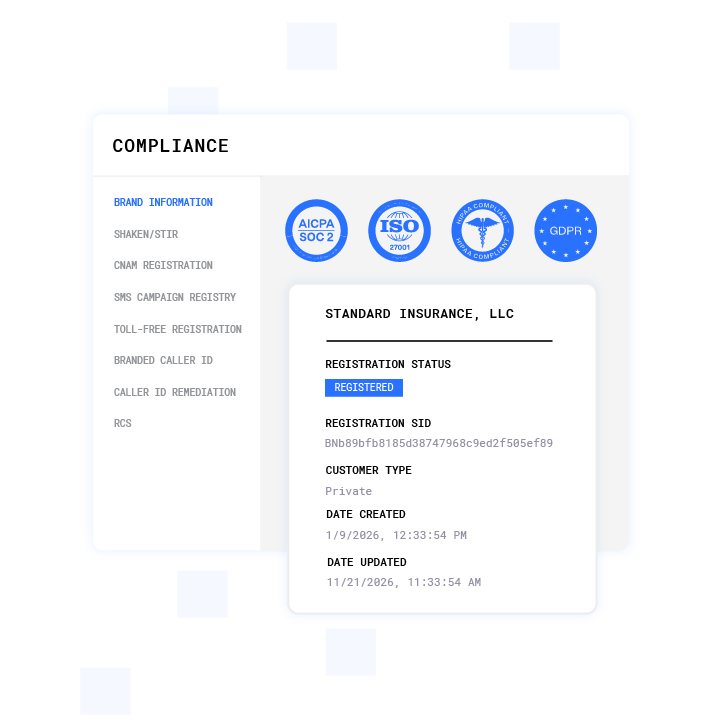
Plura’s compliance framework layers multiple controls to address each dimension of call compliance.1 SOC 2 compliant infrastructure secures the data layer. TCPA and STIR/SHAKEN enforcement manage regulatory requirements at origination. Integration with Blacklist Alliance screens for DNC issues in real time, and Number Verifier maintains caller ID reputation so calls can complete. Every outbound contact passes through this full stack of controls before the call originates, not as a post-dial audit.
TCPA-Focused Lead Qualification: Consent and Audit Trails
Consent management for AI-powered outbound qualification operates under the FCC rules described earlier, which classify AI-generated voice calls as artificial or prerecorded voice calls that require prior express written consent for marketing use cases. That consent needs to be documented, timestamped, and retrievable at the moment of each call attempt.
Businesses must retain all consent documentation, DNC scrub logs, and opt-out records for at least five years to support responses to enforcement actions or litigation. Plura’s compliance engine timestamps consent records and stores them in an immutable ledger, with audit-ready exports available in one click from the compliance dashboard. Customers remain responsible for their own consent collection practices and downstream obligations, while Plura provides the infrastructure to log and surface those records.
Companies must also honor consumer opt-out requests. Plura logs opt-out events in real time and automatically suppresses those numbers from subsequent outbound attempts.
FCC Licensed AI Dialer Infrastructure for Contact Centers
The practical difference between an FCC-licensed AI dialer and a CPaaS-wrapper model appears in three operational areas: caller ID, attestation level, and where compliance enforcement occurs.
On caller ID, Plura AI supports voice, SMS, RCS, and webchat in a unified platform with drag-and-drop workflows and FCC-licensed carrier status. Branded caller ID is issued at the carrier level, not through a third-party reseller. Calls present with the company’s name and the reason for the call, which reduces the chance that a “Spam Likely” label blocks the contact before it rings.
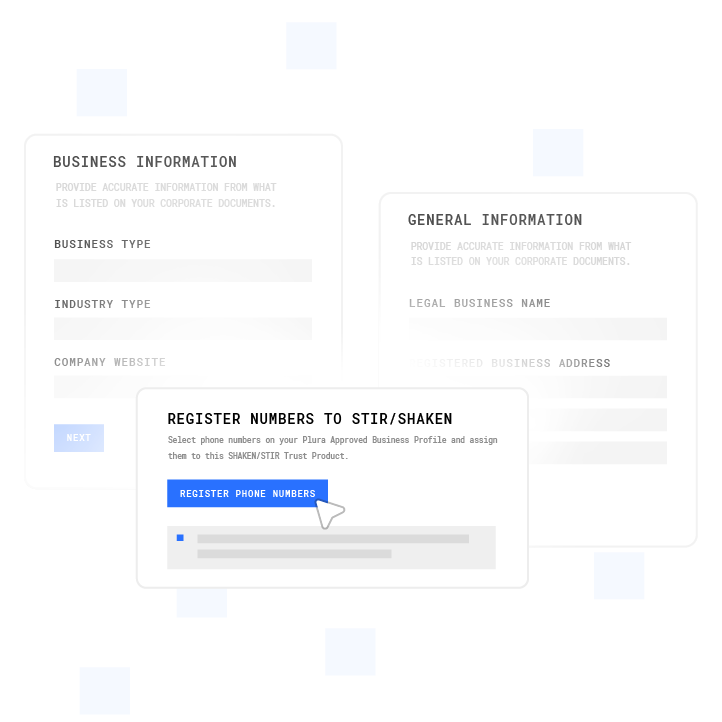
On attestation, Plura owns the number pool, so outbound calls qualify for A-level STIR/SHAKEN attestation. A carrier that manages a customer’s number pool directly can deliver consistent A-level attestation, which completes calls at higher rates than the B-level attestation typically delivered by CPaaS platforms using shared number pools.
On compliance enforcement location, Plura AI provides HIPAA and SOC 2 support, along with integration with The Blacklist Alliance’s TCPA Litigation Firewall for real-time Do Not Call scrubbing and litigation protection.1 These controls execute at origination inside the carrier layer, not as an API call to a third-party service after the dial decision.
Plura’s voice origination, model hosting, data storage, and call recording all run on 100% U.S. infrastructure. This domestic footprint aligns with the FCC NPRM’s proposed restrictions on offshore handling of sensitive consumer data without requiring architectural changes to the platform.
Walk through the carrier stack and compliance architecture with a Plura engineer in a live demo and map it to your current workflows.
Frequently Asked Questions
How do you stay DNC compliant with AI calling?
DNC compliance for AI calling requires real-time scrubbing of every number against the National Do Not Call Registry and applicable state lists at the moment of each dial attempt, not at campaign setup. The platform also needs timestamped, immutable consent records that are queryable before each call, automatic time-zone-based quiet-hours enforcement, and STIR/SHAKEN authentication at the carrier level. Plura’s compliance engine performs all four functions natively before the call originates. Customers remain responsible for their own consent collection practices and overall compliance posture.
What is the difference between real-time DNC scrubbing and batch scrubbing?
Batch scrubbing checks a contact list at a fixed interval, typically the night before a campaign runs, while real-time scrubbing checks each number at the moment of dial. As explained earlier, the registry adds numbers continuously, so batch methods miss any number registered between checks. Real-time scrubbing closes that gap by treating each call as a fresh compliance decision and, when implemented at the carrier layer, keeps the check inside the call path.
What does it mean for an AI dialer to be FCC licensed?
An FCC-licensed AI dialer operates on a carrier that holds its own FCC authorization to originate and terminate voice traffic, rather than routing calls through a third-party CPaaS like Twilio. In practice, the licensed carrier can issue branded caller ID directly, qualify for A-level STIR/SHAKEN attestation on its own number pools, and enforce DNC scrubbing and consent checks inside the call path instead of as an add-on layer. Most AI voice platforms on the market today function as software wrappers on top of a CPaaS and do not hold their own carrier license.
What are the financial risks of non-compliant AI lead qualification?
TCPA statutory damages range from $500 per violation for standard violations to $1,500 per violation for willful or knowing violations, with no cap on the number of violations in a class action. Telemarketing Sales Rule penalties for DNC violations can reach $43,280 per call at the federal level, and state-level penalties range from $500 to $25,000 per violation across states that maintain separate registries. A single campaign touching 1,000 numbers without proper consent documentation creates potential exposure of $500,000 to $1.5 million under TCPA alone, before legal defense costs, operational disruption, and reputational impact. Organizations should consult qualified counsel to assess their specific exposure.
Does Plura make my organization compliant with TCPA and DNC rules?
Plura provides infrastructure that supports compliance, including real-time DNC scrubbing, immutable consent logging, quiet-hours enforcement, STIR/SHAKEN authentication, and audit-ready reporting. Plura supports customer compliance and does not absolve customers of their own obligations. Each organization remains responsible for its own consent collection practices, campaign configurations, regulatory obligations, and the claims it makes to its own end users. For questions about your specific compliance posture, consult qualified legal counsel and review the applicable regulations directly at the FCC and eCFR.
Conclusion and Next Steps for Evaluating AI Lead Qualification Vendors
The compliance architecture gap in AI lead qualification is an infrastructure problem, not a documentation problem. Batch scrubbing cannot account for numbers added to the National Do Not Call Registry after the last run. API-wrapper platforms cannot issue A-level STIR/SHAKEN attestation on number pools they do not own. CPaaS-dependent tools cannot enforce DNC checks inside the call path because the call path belongs to another carrier.
Plura AI addresses this gap by owning the full carrier stack, including FCC-licensed audio bridging, branded caller ID issuance, real-time DNC scrubbing integrated with The Blacklist Alliance’s TCPA Litigation Firewall, immutable consent logging, and STIR/SHAKEN authentication at origination. The domestic infrastructure described earlier positions Plura customers to address the FCC NPRM’s proposed offshore restrictions without retrofitting their vendor stack.
The 2026 regulatory environment, including FCC NPRM CG Docket No. 26-52, the Keep Call Centers in America Act, and active state onshoring statutes in five states, turns vendor selection into a compliance decision as well as a capability decision. Review capability and compliance details at plura.ai/pricing and consult qualified counsel on your organization’s specific obligations.
1 Plura AI maintains SOC 2, HIPAA, ISO, and GDPR posture as part of its platform infrastructure. References to compliance frameworks in this article describe Plura’s platform capabilities and do not constitute a guarantee that any customer using Plura will themselves be compliant with applicable laws or standards. Customers remain solely responsible for their own regulatory obligations, certifications, consent management, recordkeeping, and the claims they make to their own end users. Consult qualified legal counsel for guidance specific to your use case.
2 This article describes regulatory frameworks at a general level and does not constitute legal advice. Laws and regulations vary by jurisdiction, change over time, and apply differently depending on facts and circumstances. Readers should consult qualified legal counsel before making compliance decisions.
3 Performance figures, customer outcomes, and industry statistics referenced in this article are drawn from cited third-party sources or Plura customer case studies. Individual results vary based on implementation, use case, industry, audience, and execution. Past or aggregate performance is not a guarantee of future results.
4 References to third-party products, services, companies, or research are made for informational and comparative purposes only. Plura AI is not affiliated with, endorsed by, or sponsored by any third party named in this article unless explicitly stated. Trademarks and product names referenced remain the property of their respective owners.
This article is provided for informational purposes only and reflects Plura AI’s understanding at the time of publication. Product capabilities, integrations, and specifications are subject to change. For the most current information, visit plura.ai.
This article was produced with the assistance of AI tools and reviewed by Plura AI prior to publication.