

Written by: Matt Beucler, CEO, Plura AI | Last updated: August 26, 2026
Key Takeaways
- AI predictive dialers increase agent talk time from 15 minutes to 45+ minutes per hour, tripling productivity and cutting labor cost per conversation.3
- Manual dialing wastes 40–45 minutes per agent hour on dialing, voicemails, and logging, costing a 50-agent team roughly $937 per hour in idle time.
- AI auto-logging and call summaries reclaim several minutes per call, saving hundreds of hours monthly across a 50-agent team.
- Plura AI runs on an FCC-licensed carrier platform that supports TCPA, DNC, and SHAKEN/STIR compliance at the network layer, reducing per-call violation exposure and third-party add-on fees.1
- Plura delivers up to 10× lower total cost of ownership than traditional contact centers; talk to Plura now to see the savings in action.
The Cost of Manual Dialing and Compliance Overhead
Manual dialing typically produces roughly 15–20 minutes of talk time per agent per hour, with the remaining 40–45 minutes lost to dialing, ringing, voicemails, and post-call logging. For a 50-agent team at $25 per hour fully loaded, that idle time costs approximately $937 per hour in paid-but-unproductive labor.3
Labor is only part of the problem. Contact centers allocate 60–70% of operating costs to agent labor, and because that cost scales linearly with volume, every new campaign requires proportional headcount. That linear scaling makes manual CRM logging, which consumes 5–10 minutes per call, a compounding drain on capacity. Add TCPA (Telephone Consumer Protection Act) and DNC (Do Not Call) compliance managed outside the dialer, and the administrative overhead compounds further at scale.
Per-Agent Savings with an AI Predictive Dialer
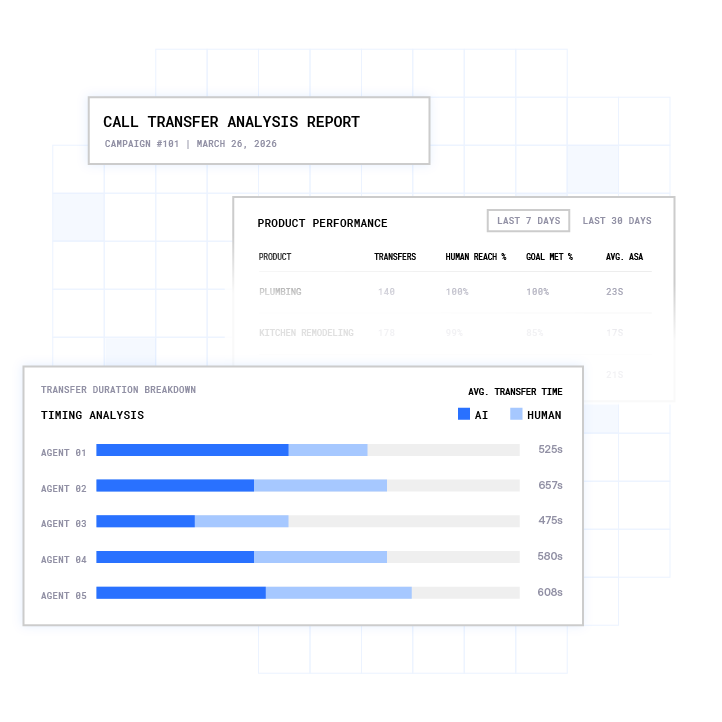
AI predictive dialers convert idle time into live conversations, which effectively triples output per agent at the same hourly rate. The table below quantifies this productivity gap for a 50-agent operation at $25 per hour fully loaded, showing how a 30-minute talk-time delta per hour translates into lower cost per connected call and significant monthly savings.
| Metric | Manual Dialing | AI Predictive Dialer | Monthly Delta (50 Agents) |
|---|---|---|---|
| Talk time per agent hour | 15–20 min | 45–50 min | +30 min per agent hour |
| Effective hourly labor cost per agent | $25.00 | $25.00 | Same rate, 3× output |
| Monthly labor cost (50 agents) | Baseline | Equivalent output at higher productivity | Significant savings |
| Cost per connected call | Higher | Lower | Substantial reduction |
Talk Time and Cost: Dialing Modes Side by Side
The side-by-side below shows how AI predictive dialers compress cost per connected call by maximizing talk time and dial volume. It extends the 45–50 minute talk-time benchmark above to compare the full spectrum from manual dialing through power dialers to AI predictive dialers, so you can see how each step up in automation improves utilization and reduces labor cost per conversation.
| Dialing Mode | Talk Time / Hour | Dials / Hour | Cost per Connected Call |
|---|---|---|---|
| Manual / Click-to-Dial | 15–20 min | 8–15 | Relatively high |
| Power Dialer | 30–38 min | 15–25 | Medium |
| AI Predictive Dialer | 45–57 min | 80–110 | Low |
3× Call Capacity with AI-Paced Outbound
Outbound dialers can increase agent productivity by up to 300% compared with manual dialing by filtering voicemail, busy signals, and unanswered rings before the call ever reaches an agent. That equivalency means one agent on an AI-enhanced predictive dialer handles 3–4 times the conversation volume of a manual dialer.
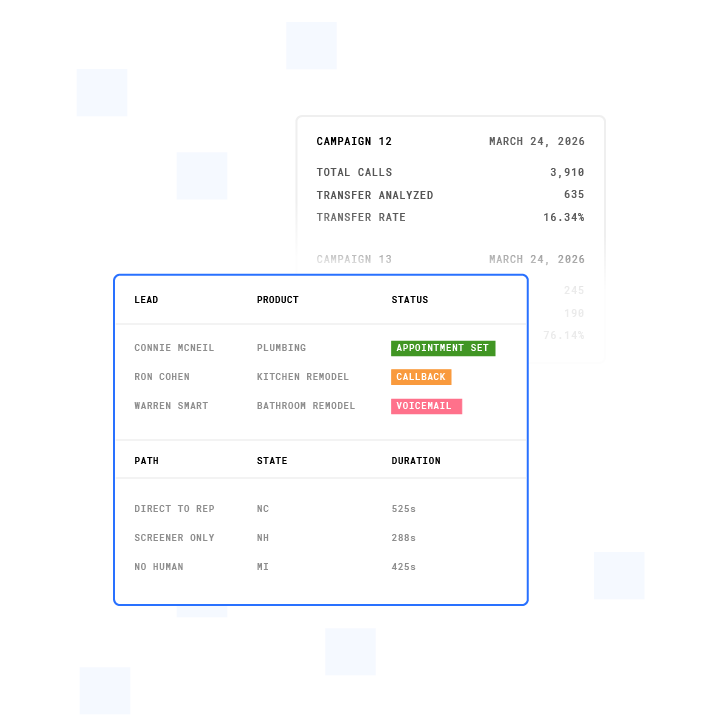
For a 50-agent floor, that 3× capacity equivalency means the same output is achievable with significantly fewer agents, or the existing 50 agents can triple throughput without adding headcount. The next section shows how auto-logging compounds this productivity gain by reclaiming post-call wrap time.
Admin Time Reduction with AI Auto-Logging
AI call summaries and auto-logging eliminate 5–10 minutes of manual wrap-up per call by automating post-call notes and CRM updates. For a 50-agent team handling 30 connected calls per agent per day, that reclaimed time adds up to hundreds of hours monthly that can shift from admin work to revenue-generating conversations. The table below quantifies the monthly savings at $25 per hour fully loaded.
| Metric | Manual Logging | AI Auto-Logging | Monthly Savings (50 Agents) |
|---|---|---|---|
| Post-call wrap time per call | 5–10 min | <1 min | Several minutes reclaimed per call |
| Connected calls per agent per day | 30 | 30 | Same volume baseline |
| Hours reclaimed per agent per month | 0 | Several hours | Hundreds of hours across 50 agents |
| Dollar value at $25/hr fully loaded | $0 | Substantial | Significant monthly savings |
Book a live demo with Plura to see how auto-logging and AI pacing work together on a real outbound floor: talk to Plura now.
Compliance Cost Avoidance with an FCC-Licensed Carrier
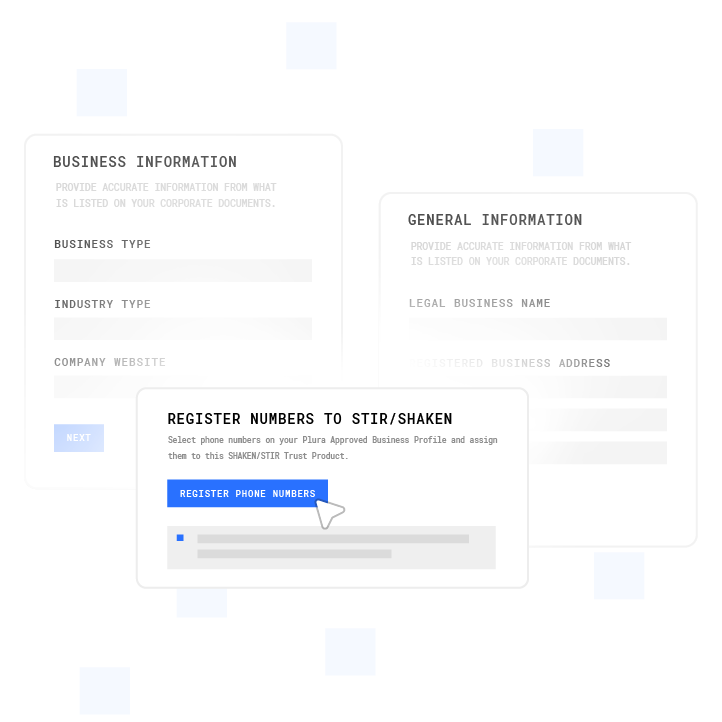
TCPA violations carry $500–$1,500 per call in statutory penalties. The FCC’s abandonment rate rule limits predictive dialer volume per campaign, and managing DNC scrubbing, SHAKEN/STIR authentication, and SOC 2 audit preparation outside the platform adds recurring overhead.2 Plura supports compliance by enforcing these controls at the carrier level before each dial, not as a bolt-on after the fact.1 The table below breaks down the cost avoidance by compliance area, showing where Plura’s carrier-level enforcement can reduce third-party fees and per-call exposure.
| Compliance Area | Manual / Third-Party Cost | Plura Platform Handling | Estimated Annual Avoidance |
|---|---|---|---|
| TCPA violation exposure | $500–$1,500 per call | Real-time DNC scrubbing + 0% abandonment on AI calls | Variable; reduces per-call exposure |
| DNC scrubbing (third-party) | Add-on costs | Built into platform, no add-on fee | Avoided add-on costs |
| SHAKEN/STIR + SOC 2 audit prep | External costs | Carrier-level authentication; SOC 2 certified infrastructure | Avoided external costs |
Predictive Dialer vs Full AI-Voice Cost Structure
A traditional predictive dialer routes calls to human agents once connected. Full AI-voice platforms like Plura’s AI Predictive Dialer can handle the conversation end-to-end, which removes the per-seat cost entirely for qualifying calls.
| Model | Platform Cost | Per-Minute / Per-Conversation Cost | Agent Seat Required |
|---|---|---|---|
| Legacy predictive dialer + human agents | Per-seat monthly fees | Per-minute telephony charges | Yes, plus fully loaded hourly rate |
| Full AI-voice (Plura) | See Plura pricing | Usage-based pricing per completed conversation | No seat required for qualifying calls |
Plura AI TCO Benchmark: 700K vs 7M
For a 100-seat contact center, traditional operations cost $4 million to $7 million annually, while AI-powered communications using platforms like Plura cost $300,000 to $700,000.3 That is a 10× reduction in total cost of ownership (TCO) at equivalent volume.
The same 10× ratio holds at smaller scale: at the 50-seat level, a 50-seat offshore team costs approximately $1.2M annually fully loaded, while Plura handling equivalent volume costs $180K to $300K annually. Domestic onshore operations at $15–$25 per agent hour before benefits and overhead sit higher still.
Plura’s ROI calculator models this directly. Using default inputs of 15 agents at $20 per hour with 25% taxes and benefits and 40% talk utilization, monthly human agent costs reach $60,000 versus $14,400 for Plura at 100% talk utilization with 6 agents, producing a 30-day ROI of $45,600, a 12-month ROI of $547,200, and a 60-month ROI of $2,736,000.
Run your numbers through Plura’s calculator to check your ROI in real time: calculate your savings now.
Frequently Asked Questions
How much is a dialer per month?
Legacy predictive dialer software typically runs with per-seat monthly platform fees, separate telephony charges per outbound minute, and compliance add-ons such as DNC scrubbing and call recording storage that add further costs. For a 50-agent floor, that stack can create substantial software and compliance overhead before you even consider agent labor. Plura’s AI Predictive Dialer is priced differently: the platform fee covers carrier-grade infrastructure, SHAKEN/STIR authentication, real-time DNC scrubbing, and SOC 2 certified infrastructure in a single line item. See current plans on the pricing page.
What is the cheapest dialer?
The cheapest dialer by software fee rarely delivers the lowest total cost. Open-source options like VICIdial carry no license fee but require server infrastructure, IT maintenance, and manual compliance configuration. Per-seat SaaS dialers appear affordable at $50–$100 per seat but multiply quickly across a 50-agent floor and do not include carrier costs or compliance tooling. Full AI-voice platforms that remove the human agent seat for qualifying calls usually produce the lowest cost per connected conversation at scale, because the marginal cost of an additional dial is telephony and AI compute rather than another hourly wage. Plura’s ROI calculator lets you model your specific agent count, hourly rate, and talk utilization to find the actual cost floor for your operation.
How does an AI predictive dialer affect TCPA compliance?
TCPA (Telephone Consumer Protection Act, 47 U.S.C. § 227) governs outbound calling practices including consent requirements, calling windows, and abandonment rate limits.2 Traditional predictive dialers often manage TCPA exposure through third-party DNC scrubbing tools, manual consent record management, and conservative pacing ratios to stay within the FCC’s abandonment rate limits. Plura supports TCPA compliance by enforcing real-time DNC scrubbing before each dial, maintaining timestamped and immutable consent records, and applying automated quiet-hours rules through time-zone detection on every outbound contact. Because Plura is an FCC-licensed carrier, these controls operate at the network layer rather than as software add-ons. Customers are responsible for their own TCPA obligations and should consult qualified legal counsel on their specific programs.
What savings does SHAKEN/STIR deliver?
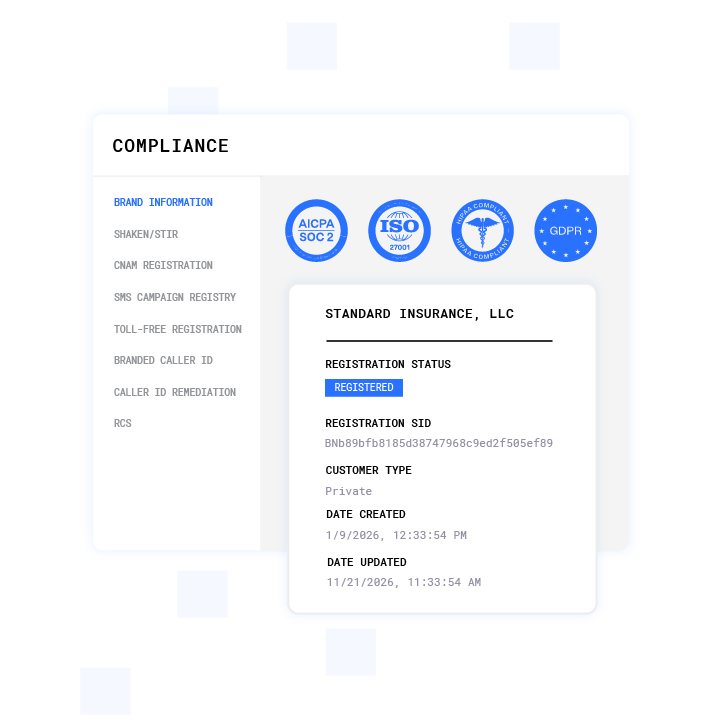
SHAKEN/STIR (Secure Telephone Identity Revisited / Signature-based Handling of Asserted information using toKENs) is the FCC-mandated caller-ID authentication framework that destination carriers use to verify whether an outbound call originated from a legitimate source. U.S. mobile answer rates for unknown numbers have declined substantially in recent years due to carrier spam labeling and STIR/SHAKEN enforcement. Calls that authenticate cleanly through SHAKEN/STIR and present with branded caller ID connect at materially higher rates than unauthenticated calls flagged as “Spam Likely.” Plura runs SHAKEN/STIR authentication on every outbound call through its own FCC-licensed carrier, issuing branded caller ID at the carrier level rather than through a third-party reseller. The savings come from higher connect rates on the same dial volume, which directly reduces cost per connected call without increasing headcount or dialing spend.
Does Plura AI support HIPAA and GDPR?
Plura’s platform is built with HIPAA-aligned encryption, access controls, and audit logging for protected health information across voice, SMS, RCS, and webchat. The infrastructure is SOC 2 Type II certified with continuous monitoring, penetration testing, and third-party audits. Plura also holds ISO certification and supports GDPR for operations with European data obligations.1 Sensitive data including protected health information is redacted at the field level and routed through HIPAA-aligned channels. Customers are responsible for their own HIPAA and GDPR compliance posture and should engage qualified counsel to assess their specific obligations under 45 CFR Parts 160, 162, and 164 (HIPAA) and Regulation (EU) 2016/679 (GDPR). Plura provides the infrastructure; downstream compliance obligations remain with the customer.
How quickly does the 3× capacity appear?
The talk-time improvement from an AI predictive dialer is operational from the first dial session, because the productivity gain comes from removing idle time between calls rather than from a learning curve. Most teams see the 3× capacity equivalency within the first week of deployment as pacing ratios stabilize and voicemail detection filters dead-end calls before they reach agents. Plura’s onboarding sequence moves from discovery audit to production go-live in days to weeks depending on conversation complexity. Annual contracts include a 90-day opt-out window, so the deployment is measured against real output from the start.
Conclusion: Run Your Numbers
The savings from an AI predictive dialer stack across four levers: talk-time recovery, agent equivalency, admin reduction, and compliance cost avoidance. At the 50-agent level, those levers combine to produce significant monthly savings before you factor in TCPA exposure avoided.
The 10× TCO reduction detailed earlier is not a projection. It is the math that runs on Plura’s own FCC-licensed carrier infrastructure, with compliance supported at the network layer and conversation memory shared across voice, SMS, RCS, and webchat on a single stateful database.
Book a live demo with Plura and see the platform running on a real outbound floor: schedule your demo now.
Compare plans and rates side by side on the pricing page, or run your specific agent count and hourly rate through the Plura ROI calculator to get your number in real time.
1 Plura AI maintains SOC 2, HIPAA, ISO, and GDPR posture as part of its platform infrastructure. References to compliance frameworks in this article describe Plura’s platform capabilities and do not constitute a guarantee that any customer using Plura will themselves be compliant with applicable laws or standards. Customers remain solely responsible for their own regulatory obligations, certifications, consent management, recordkeeping, and the claims they make to their own end users. Consult qualified legal counsel for guidance specific to your use case.
2 This article describes regulatory frameworks at a general level and does not constitute legal advice. Laws and regulations vary by jurisdiction, change over time, and apply differently depending on facts and circumstances. Readers should consult qualified legal counsel before making compliance decisions.
3 Performance figures, customer outcomes, and industry statistics referenced in this article are drawn from cited third-party sources or Plura customer case studies. Individual results vary based on implementation, use case, industry, audience, and execution. Past or aggregate performance is not a guarantee of future results.
This article is provided for informational purposes only and reflects Plura AI’s understanding at the time of publication. Product capabilities, integrations, and specifications are subject to change. For the most current information, visit plura.ai.
This article was produced with the assistance of AI tools and reviewed by Plura AI prior to publication.