

Written by: Matt Beucler, CEO, Plura AI
Updated June 2026
Key Takeaways
- Per-minute AI voice agent pricing often hides true costs, with real-world TCO inflated 2x–5x by carrier markups, spam remediation, compliance, and integrations that most providers pass through to customers.
- Plura AI removes carrier overhead by using its own FCC-licensed audio bridging infrastructure, delivering branded caller ID and STIR/SHAKEN authentication that cuts spam-label remediation expenses.
- Shared stateful memory across voice, SMS, RCS, and webchat reduces handle time by eliminating repetitive explanations, which improves conversion rates and operational efficiency.
- 2026 regulatory requirements from the FCC and multiple states add significant compliance costs for offshore or foreign-infrastructure platforms, while Plura’s 100% U.S. architecture supports TCPA, DNC, HIPAA, and SOC 2 as built-in layers.1
- High-volume operators often see about 3x ROI within 90 days using Plura.3 You can calculate your exact savings with the Plura AI ROI calculator.
Per-Minute AI Pricing vs Total Cost of Ownership
Total cost of ownership gives a more accurate picture of AI voice agent economics than headline per-minute rates. The table below contrasts headline per-minute rates against fully loaded TCO for a representative high-volume deployment, showing how API-reseller platforms carry 2x–4x hidden cost multipliers that Plura’s carrier-owned stack avoids. All figures are drawn from cited sources and reflect 2026 market conditions.
| Cost Layer | Human Agent (U.S. Onshore) | API-Reseller AI Voice (Twilio-based CPaaS) | Plura AI (Carrier-Owned Stack) |
|---|---|---|---|
| Base per-minute rate | $0.13–$0.33/min fully burdened | $0.05 advertised; $0.18–$0.33 all-in after STT, LLM, TTS, and telephony | Fixed pricing available at Plura’s calculator |
| Carrier/infrastructure overhead | Included in labor burden | Twilio telephony adds $0.0085–$0.014/min on top of AI stack | Eliminated: Plura uses its own FCC-licensed audio bridging carrier |
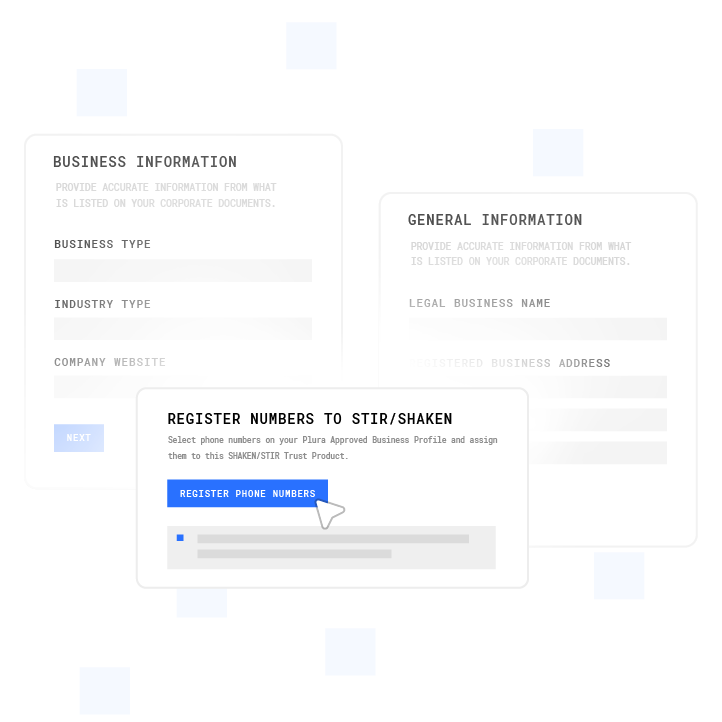
| Spam-label remediation | Not applicable | Not included; requires third-party remediation vendor | Included: branded caller ID issued at carrier level, STIR/SHAKEN authenticated on every call |
| 2026 FCC/state regulatory exposure | Offshore contracts: potential penalties up to $10,000/day (NY); FCC NPRM offshore cap risk | Foreign infrastructure dependencies create FCC NPRM exposure; compliance bolted on post-facto | 100% U.S. infrastructure by architecture; Plura supports compliance with TCPA, DNC, HIPAA, SOC 2 as a first-class layer |
For a 50-seat equivalent operation, traditional offshore operations cost $35,000–$50,000 monthly versus $8,000–$15,000 monthly for an AI contact center.3 At the 100-seat level, traditional operations run $4M–$7M annually versus Plura.
AI Voice Agent Savings in a Typical Deployment
The default scenario on Plura’s ROI calculator uses 15 human agents at $20/hour with 25% taxes, benefits, and commissions at 40% talk utilization, producing a monthly cost of $60,000. Replacing that team with 6 Plura agents at $15/hour and 100% talk utilization drops the monthly cost to $14,400, a 30-day saving of $45,600.
Third-party data supports the directional magnitude. McKinsey’s 2026 AI in Customer Service analysis found voice AI resolutions averaging $1.18 versus $7.40 overall for human agents, based on a $52/hour fully burdened human-agent cost and a 22% escalation rate.3
Labor is the primary driver. Contact centers allocate 60%–70% of operating costs to agent labor, and AI agents remove the turnover cycle that compounds that cost.
Hidden Cost Layers That Cut Into AI Savings
Labor savings are only half the equation. Per-minute rates are the entry point of the conversation, not the conclusion. AI voice agent providers commonly distribute costs across five independent charge layers: telephony, LLM (large language model) inference, speech synthesis, transcription, and orchestration, each priced differently and varying with usage. The published per-minute rate does not reflect the true loaded cost per completed call.
Specific hidden cost categories include:
- Carrier markup: Off-the-shelf platforms such as VAPI advertise $0.05/min but carry true all-in costs of $0.18–$0.33/min once transcription, LLMs, voice synthesis, and telephony are added separately.4 Platforms that do not own their carrier pay a CPaaS (Communications Platform as a Service) wrapper tax that passes directly to the customer.
- Spam-label remediation: Calls flagged as “Spam Likely” never reach the prospect. Platforms that rent from third-party carriers inherit that carrier’s caller ID reputation and cannot issue branded caller ID at the origination level. Remediation through a separate vendor adds cost and latency that most per-minute quotes exclude entirely.
- Integration overhead: Connecting AI voice agents to existing CRM or business systems may require custom development. System integrations often represent a substantial portion of total project cost for custom builds.
- Compliance drag: Building and maintaining TCPA-focused AI voice systems can involve dedicated consent databases, real-time API scrubbing, and automated revocation workflows that add material infrastructure costs.
- Overage penalties: Overage penalties for exceeding included AI voice agent minutes can result in higher per-minute rates than base pricing.
- Annual maintenance: Annual maintenance for model tuning, bug fixes, and conversation flow improvements can add significantly to the total cost of ownership each year.
Cross-Channel Memory and Handle-Time Reduction
Cross-channel memory turns every prior interaction into context that shortens the next one. Most AI voice platforms and AI SMS platforms are separate products from separate vendors with separate memories. A customer who texted at 9 a.m. has to re-explain their situation when the call comes at noon. That repetition costs time, degrades conversion, and signals operational fragility to the customer.
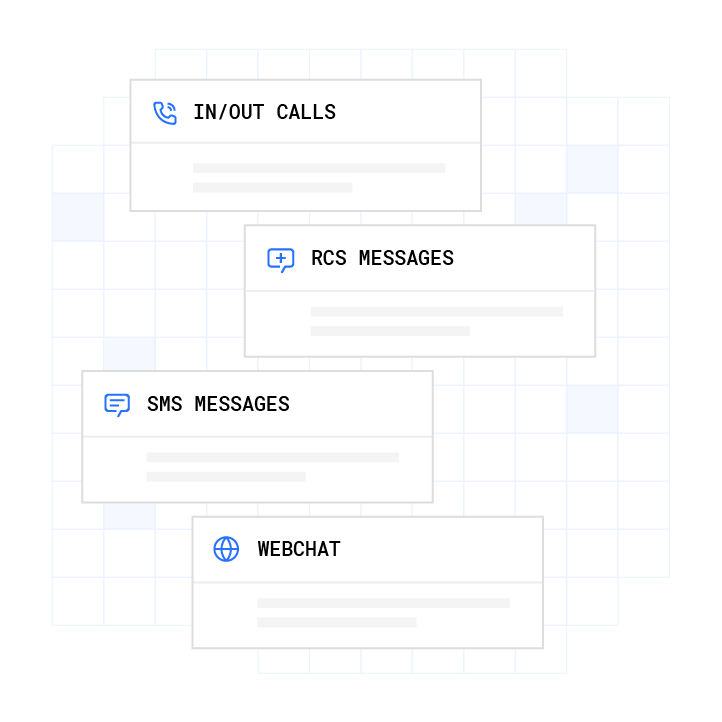
Plura’s AI Voice, AI SMS, AI RCS (Rich Communication Services), and AI Webchat all share a Stateful Conversation Database. Every interaction is keyed to a customer token by phone number, email, or ID. Every channel inherits the full memory of every prior touchpoint: pricing offers made, objections raised, qualification status, and sensitive-data redactions. The AI agent that texted a lead at 9 a.m. picks up the call at noon already knowing what was said.
30-Day and 90-Day ROI Examples
Using the default inputs on Plura’s ROI calculator:
- 30-day savings: $45,600 (using the default calculator scenario described earlier)
- 12-month savings: $547,200
- 60-month savings: $2,736,000
For higher-volume operations, TCO of $300,000–$700,000 per year replaces traditional contact-center economics of $4M–$7M. A 50-seat offshore team costs approximately $1.2M annually fully loaded in the insurance industry, while Plura handling equivalent volume costs $180,000–$300,000 annually.
2026 Regulatory Pressures on AI Voice Economics
The 2026 regulatory environment directly affects AI voice agent cost structures. The FCC’s Notice of Proposed Rulemaking (NPRM, CG Docket No. 26-52) proposes capping offshore customer-service calls at 30% and prohibiting offshore handling of sensitive consumer data including passwords, multi-factor authentication credentials, Social Security numbers, banking data, and card data.2 Companion federal legislation includes the Keep Call Centers in America Act (S.2495) and the Foreign Robocall Elimination Act (S.2666).
State-level exposure is already active. New York’s Call Center Jobs Act carries penalties up to $10,000 per day. New Jersey, Connecticut, Missouri, and Florida have enacted or proposed companion restrictions on offshore handling of medical, financial, and consumer data. Colorado’s SB 24-205 requires developers and deployers of high-risk AI systems to provide certain consumer disclosures and implement risk management measures to avoid algorithmic discrimination, with civil penalties up to $20,000 per violation, effective June 30, 2026.
On the federal AI-voice front, the FCC’s February 2024 Declaratory Ruling (FCC-24-17) confirmed that AI-generated voices are treated as “artificial or prerecorded voice” under the TCPA (Telephone Consumer Protection Act, 47 U.S.C. § 227), subjecting AI voice calls to consent requirements and statutory damages of $500–$1,500 per illegal call.2 This ruling remains the operative federal baseline in 2026. Operators should consult qualified counsel regarding their specific obligations under these frameworks.
Plura runs on 100% U.S. infrastructure by architecture. Voice origination, model hosting, data storage, and call recording all sit on domestic infrastructure. Plura supports compliance with TCPA, DNC, HIPAA, SOC 2, and 50+ state rule sets through pre-loaded enforcement built into the platform as a first-class layer, not a bolt-on.1 Customers remain responsible for their own regulatory obligations and certifications.
Compare plans and rates side by side at Plura’s pricing page.
Frequently Asked Questions
What is the real total cost of ownership for an AI voice agent deployment in 2026?
The advertised per-minute rate is one line item in a longer cost structure. A complete TCO calculation for an AI voice agent deployment includes the base per-minute or per-hour platform rate, telephony carrier fees, LLM inference costs, speech-to-text and text-to-speech charges, integration development for CRM and other business systems, ongoing maintenance and model tuning, compliance infrastructure for TCPA consent logging and DNC scrubbing, and spam-label remediation if the platform does not own its carrier. Platforms built on third-party CPaaS providers pass all of those layers to the customer as separate line items. Plura’s carrier ownership removes that external markup and consolidates these layers into a single stack.
What hidden costs most commonly erode AI voice agent savings?
Five cost categories consistently inflate real-world spend beyond advertised rates. First, carrier markup: platforms that rent telephony from Twilio or another CPaaS pay a per-minute wrapper tax that gets passed to the customer, turning a $0.05 advertised rate into $0.18–$0.33 all-in once transcription, LLM, voice synthesis, and telephony are added. Second, spam-label remediation: calls flagged as “Spam Likely” never reach the prospect, and platforms without carrier ownership cannot fix this at the origination level. Third, integration overhead: connecting to CRM, EHR, or ERP systems can require custom development and often represents a substantial portion of total project cost for custom builds. Fourth, compliance infrastructure: TCPA consent databases, real-time DNC scrubbing APIs, and audit-ready logging are not included in most per-minute quotes and add material ongoing cost. Fifth, overage penalties: exceeding included minutes on usage-based plans can trigger per-minute rates higher than the base rate.
How does cross-channel memory affect AI voice agent ROI?
Cross-channel memory reduces repeat work and improves conversion. When AI voice and AI SMS run on separate platforms with separate memories, every channel restart costs handle time and degrades the customer experience. A customer who texted at 9 a.m. re-explains their situation when the call comes at noon, adding minutes to average handle time and reducing conversion probability. Shared stateful memory across voice, SMS, RCS, and webchat eliminates that repetition. The AI agent inherits the full context of every prior touchpoint: what was offered, what was declined, what qualification status was established. This shortens handle time and allows the AI to continue a negotiation rather than restart it. The compounding effect grows with every interaction stored in the database, increasing context per contact over time without adding headcount.
What does the 2026 regulatory environment mean for AI voice agent costs?
The regulatory environment in 2026 adds cost exposure in two directions. For operators using offshore BPO vendors or AI tools with foreign infrastructure dependencies, the FCC NPRM (CG Docket No. 26-52) proposes a 30% cap on offshore customer-service calls and a prohibition on offshore handling of sensitive consumer data. State laws in New York, New Jersey, Connecticut, Missouri, and Florida already impose penalties and restrictions on offshore data handling. Every offshore contract a covered entity holds is now a compliance liability to be priced into TCO. For AI voice deployments specifically, the FCC’s February 2024 Declaratory Ruling (FCC-24-17) treats AI-generated voices as “artificial or prerecorded voice” under the TCPA, which drives the need for consent infrastructure, real-time DNC scrubbing, and audit-ready logging on outbound contact strategies. Colorado’s SB 24-205 requires developers and deployers of high-risk AI systems to provide certain consumer disclosures and implement risk management measures to avoid algorithmic discrimination, with civil penalties up to $20,000 per violation, effective June 30, 2026. Operators should consult qualified legal counsel to assess their specific exposure under these frameworks. Plura’s 100% U.S. infrastructure by architecture and built-in compliance engine are designed to support operators navigating this environment.
Conclusion: Why TCO Beats Per-Minute Quotes
Per-minute pricing is a starting point, not a TCO figure. The real cost of an AI voice agent deployment includes carrier infrastructure, spam remediation, compliance overhead, integration development, and the ongoing maintenance that most advertised rates exclude. Platforms that do not own their carrier stack pass every one of those layers to the customer as separate costs. The carrier-owned architecture described earlier, combined with 100% U.S. infrastructure and stateful conversation memory across voice, SMS, RCS, and webchat, supports a TCO of $300,000–$700,000 annually replacing $4M–$7M in traditional contact-center economics, with about 3x average ROI in 90 days for high-volume operators.
Run your numbers through Plura’s calculator to model your 30-day and 90-day savings in real time.
Compare plans and rates side by side at Plura’s pricing page.
1 Plura AI maintains SOC 2, HIPAA, ISO, and GDPR posture as part of its platform infrastructure. References to compliance frameworks in this article describe Plura’s platform capabilities and do not constitute a guarantee that any customer using Plura will themselves be compliant with applicable laws or standards. Customers remain solely responsible for their own regulatory obligations, certifications, consent management, recordkeeping, and the claims they make to their own end users. Consult qualified legal counsel for guidance specific to your use case.
2 This article describes regulatory frameworks at a general level and does not constitute legal advice. Laws and regulations vary by jurisdiction, change over time, and apply differently depending on facts and circumstances. Readers should consult qualified legal counsel before making compliance decisions.
3 Performance figures, customer outcomes, and industry statistics referenced in this article are drawn from cited third-party sources or Plura customer case studies. Individual results vary based on implementation, use case, industry, audience, and execution. Past or aggregate performance is not a guarantee of future results.
4 References to third-party products, services, companies, or research are made for informational and comparative purposes only. Plura AI is not affiliated with, endorsed by, or sponsored by any third party named in this article unless explicitly stated. Trademarks and product names referenced remain the property of their respective owners.
This article is provided for informational purposes only and reflects Plura AI’s understanding at the time of publication. Product capabilities, integrations, and specifications are subject to change. For the most current information, visit plura.ai.
This article was produced with the assistance of AI tools and reviewed by Plura AI prior to publication.