

Written by: Matt Beucler, CEO, Plura AI | Last updated: August 27, 2026
Updated August 27, 2026
Key ROI Takeaways for Automated Lead Qualification
- Automated lead qualification ROI equals incremental gross profit from conversion lift plus SDR capacity recovered, minus platform cost.
- High-volume teams often move from 13% to 39–40% MQL-to-SQL conversion when AI enrichment and behavioral modeling replace manual qualification.3
- Conversational AI typically recovers 40–60% of SDR hours, turning a 15-person team’s qualification workload into more than $30,000 per month in redeployable capacity.3
- At 10K–100K monthly leads, a 0.5 percentage-point lift in lead-to-SQL conversion produces 50–500 additional SQLs and scales directly with deal value.3
- Plura AI delivers 3× average ROI in 90 days across voice, SMS, RCS, and webchat; use the calculator to model your specific volume and deal value.3
Lead-to-SQL Ratios That Signal Healthy Performance
A sales-qualified lead (SQL) is a lead that has passed defined criteria and is ready for a direct sales conversation. For high-volume B2B teams, the median MQL-to-SQL conversion rate across B2B SaaS sits at 13 to 15%, with top performers in B2B SaaS reaching 25–40% MQL-to-SQL conversion. Manual qualification processes typically land teams at the lower end of that range. Automated qualification, by contrast, can lift MQL-to-SQL conversion from 13% to 39 to 40% when behavioral modeling and AI enrichment are applied. The gap between a 13% and a 25% SQL rate on 50,000 monthly leads is 6,000 additional qualified opportunities per month with no change in ad spend.
Daily Lead Capacity at 10K Monthly Volume
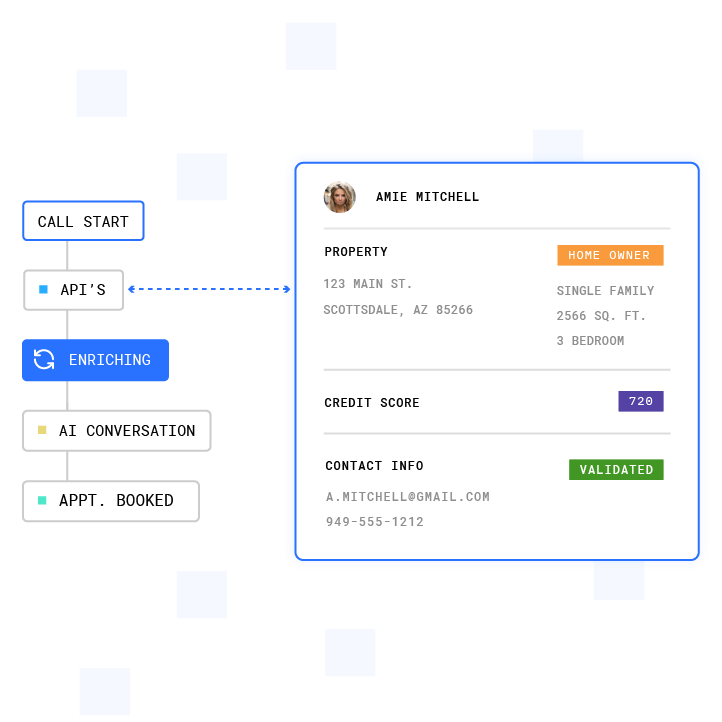
At 10,000 leads per month, a team processes roughly 333 leads per day across 22 working days. Manual qualification has substantial labor costs for U.S.-based sales teams, so labor becomes a major investment before any conversion is counted. Conversational AI can reduce those costs by automating a substantial portion of qualification tasks. At 50K or 100K monthly volume, the labor math becomes the primary constraint on pipeline growth, not demand generation. To model that constraint accurately, you need five baseline numbers from your current operation.
Step 1: Capture Five Baseline Inputs From Your Funnel
Before modeling ROI, establish five numbers from your current operation:
- Monthly lead volume (total inbound and outbound leads entering qualification)
- Current lead-to-SQL conversion rate (percentage of leads that pass qualification criteria)
- Average deal value (closed-won revenue per opportunity)
- SDR fully loaded hourly cost (salary, benefits, taxes, tech stack, management overhead)
- Average hours per SDR per month spent on qualification tasks
These five inputs drive every downstream calculation because each one feeds a specific component of the ROI formula. Lead volume and conversion rate determine SQL output. Deal value translates SQLs into revenue. SDR cost and hours quantify the labor displacement opportunity. Qualification accuracy, defined as the percentage of qualified leads that ultimately convert, is the most commonly overlooked baseline metric and connects qualification process quality directly to revenue.
Step 2: Calculate Labor Cost per Qualified Opportunity
A fully loaded US B2B SDR costs roughly $85,000 to $165,000 annually once base pay, OTE, benefits, taxes, tooling, ramp, and overhead are included. At a 40% talk utilization rate typical of human contact-center work, 15 human agents working 2,400 total hours at $20 per hour with 25% taxes, benefits, and commissions cost $60,000 per month. Divide that figure by the number of SQLs produced to get cost per qualified opportunity. At a 2.0% conversion rate on 10,000 leads, that is 200 SQLs per month, which produces a labor cost of $300 per SQL before any pipeline value is counted.
Step 3: Model Conversion Lift From 2.0% to 2.5%
A 0.5 percentage point lift in lead-to-SQL conversion rate looks modest on paper. At volume, it becomes a major revenue lever. The conversion lift formula is:
Incremental SQLs = Monthly Lead Volume x (New Rate – Baseline Rate)
At 10,000 leads per month, moving from 2.0% to 2.5% produces 50 additional SQLs. At 50,000 leads, that same lift produces 250 additional SQLs. At 100,000 leads, the lift produces 500 additional SQLs per month. Multiply each figure by average deal value to get incremental pipeline. A 1.6 percentage point lift on 10,000 annual opportunities at $50,000 average deal value yields $8,000,000 in incremental revenue. The conversion lift component of ROI scales directly with lead volume, which is why the model changes materially between 10K and 100K monthly leads.
Leads contacted within 60 seconds are 391% more likely to convert. Companies responding within five minutes are up to 100× more likely to connect than those waiting 30 minutes. Speed-to-first-contact is the single largest driver of conversion lift in automated qualification deployments. Conversion lift captures the revenue impact of better qualification. Automation also frees SDR capacity that can be redeployed to higher-value activities, which creates a second, independent source of ROI.
Step 4: Quantify SDR Hours Recovered
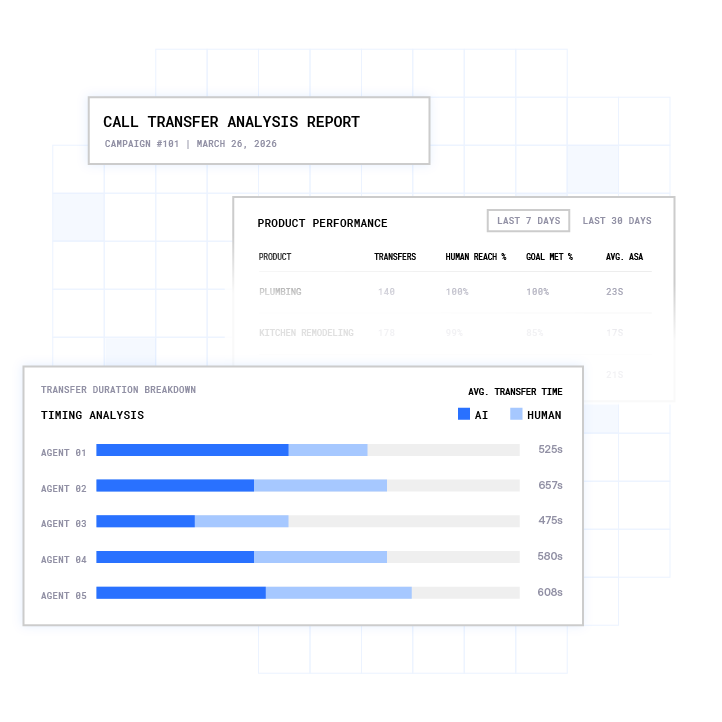
Sales representatives spend approximately 70% of their time on administrative and non-selling tasks including lead research and qualification, and automation typically reclaims 8 to 15 hours per sales representative per week according to 2026 benchmarks from multiple vendors. This shift effectively doubles capacity for revenue-generating conversations without added headcount. Conversational AI for lead qualification delivers a 40 to 60% reduction in SDR hours spent on qualification tasks. The capacity recovered formula is:
Capacity Value = (Hours Recovered per SDR x Number of SDRs) x Fully Loaded Hourly Cost
For a 15-person SDR team at $20 per hour, recovering 10 hours per rep per week produces $30,000 per month in redeployable capacity. Because that capacity remains on payroll, it can be redirected to pipeline acceleration, account expansion, or higher-complexity qualification that automation cannot handle, which turns a cost line into a productivity multiplier.
Step 5: Net Incremental Gross Profit Against Platform Cost
The complete ROI equation is:
ROI = (Incremental Gross Profit from Conversion Lift + Capacity Recovered) – Platform Cost
Replacing 15 human agents with Plura at $15 per hour, 100% talk utilization, and 6 Plura agents doing the work of 15 humans drops the monthly cost to $14,400, against a $60,000 human baseline. That shift produces $45,600 in direct labor savings in the first 30 days before any conversion lift is counted. Add the incremental gross profit from the 0.5 percentage point conversion lift and the redeployable SDR capacity, and the net ROI figure at 10K monthly volume becomes material inside the first quarter. For a 100-seat contact center, traditional operations cost $4 million to $7 million annually, while AI-powered communications using platforms like Plura cost $300,000 to $700,000, which reflects a TCO reduction of 90% at scale. These savings compound differently depending on your lead volume tier, so the ROI math at 10K monthly leads looks materially different from 100K.
Step 6: Run Sensitivity at 10K, 50K, and 100K Leads
The following table shows how labor savings and SQL lift scale across three volume tiers. The pattern highlights that ROI grows non-linearly as lead volume increases.
50 additional SQLs250 additional SQLs500 additional SQLs
| Monthly Lead Volume | Incremental SQLs at +0.5% Lift | Monthly Labor Savings (15-agent baseline) | Estimated 90-Day Net ROI |
|---|---|---|---|
| 10,000 leads | $45,600/month | $136,800 (labor only) | |
| 50,000 leads | $27,000-$42,000/month vs. offshore baseline | Scales with deal value; model your scenario in the calculator | |
| 100,000 leads | $300K-$700K/year TCO vs. $4M-$7M traditional | 3x average ROI in 90 days at Plura benchmarks |
Sensitivity analysis at three volume tiers makes the CFO conversation concrete. The labor savings line is fixed and verifiable from payroll data. The conversion lift line requires an assumed deal value, which is why the ROI calculator accepts your own average deal value as an input rather than applying a generic benchmark.
Check your ROI in real time using Plura’s calculator.
Step 7: Track Five Metrics Before and After Deployment
Five metrics connect the model to operational reality:
- Lead-to-SQL conversion rate. This is the primary output metric. Healthy B2B benchmarks sit at 16 to 20% for teams with defined qualification criteria; track this weekly for the first 90 days.
- Speed-to-first-contact. B2B teams have a median first-response time of 47 hours; the target post-deployment is under 5 minutes. Harvard Business Review research found that companies responding within five minutes are 100 times more likely to connect with a prospect than those waiting 30 minutes.
- Cost per qualified lead (CPQL). Total platform cost divided by qualified leads generated.
- SDR hours on qualification vs. pipeline activity. Sales reps spend only 35.2% of their time on revenue-generating activities in manual environments. The post-deployment target is 60% or higher.
- Qualified-to-booked meeting rate. The median qualified-to-booked rate across 1 million-plus form submissions is 62%. Top-decile teams reach 78% or higher, with best performers at 88%.
How Plura AI Deploys This Model in 90 Days
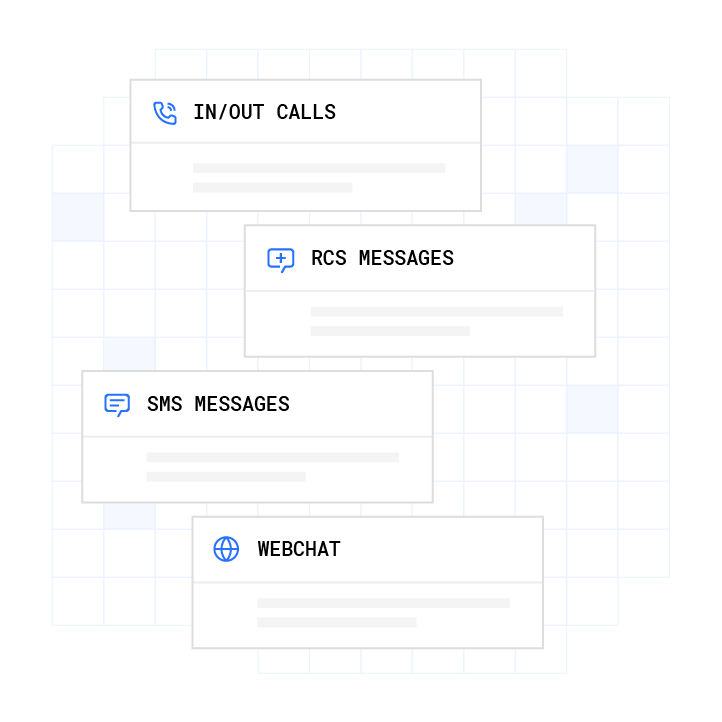
Plura AI is an FCC-licensed platform running AI voice agents, AI SMS, AI RCS, and AI webchat on 100% U.S. infrastructure. Every channel shares a Stateful Conversation Database, so a lead that texted at 9 a.m. is recognized when the call comes at noon, with full context from every prior touchpoint. This stateful memory separates qualification at scale from simple volume handling because the AI continues the conversation instead of restarting it on each channel.
The deployment sequence follows a consistent pattern. The team runs a discovery audit of current call economics, ingests existing scripts and SOPs, and builds a dynamic conversation workflow overnight. A pilot test runs on a live lead subset, followed by full go-live. Plura enables lead responses in under 60 seconds across all four channels from day one of deployment. The AI Predictive Dialer handles outbound qualification flows. Inbound qualification runs through AI voice agents and AI SMS simultaneously. Conversation intelligence surfaces objection patterns and conversion gaps weekly, and the workflow is tuned against actual outcomes rather than assumed benchmarks.
Plura’s compliance engine supports TCPA compliance, DNC compliance, HIPAA, SOC 2, ISO certification, GDPR, and SHAKEN/STIR caller ID verification.1,2 Real-time DNC scrubbing runs before every outbound contact. TCPA consent records are timestamped and immutable. Quiet-hours rules enforce automatically through time-zone detection. Customers are responsible for their own regulatory obligations. Plura provides the infrastructure and supports compliance posture at the platform level. Full details are at plura.ai/products/compliance.
Every annual contract includes a 90-day opt-out window. If the deployment is not delivering, customers are not held to the annual term. Pricing and plan details are at plura.ai/pricing.
Model your specific volume and deal value in the calculator.
Frequently Asked Questions
How long does it take to see ROI from automated lead qualification?
Most teams see positive ROI within the 90-day measurement window described earlier, with the labor savings component visible in the first billing cycle. That component reflects direct cost reduction from replacing or augmenting human qualification capacity. The conversion lift component takes longer to measure because it requires enough lead volume to produce statistically meaningful SQL counts before and after deployment. Teams processing 10,000 or more leads per month typically have enough volume to see conversion lift within 30 to 60 days. Teams at lower volumes may need 60 to 90 days to isolate signal from noise.
What prerequisites does a high-volume sales team need before deploying automated lead qualification?
Three prerequisites matter most. First, defined qualification criteria, because the AI enforces whatever criteria the team specifies, and vague or inconsistent criteria produce vague or inconsistent qualification. Second, a CRM or data system that can receive qualified lead records and trigger downstream workflows. Plura integrates with HubSpot, Salesforce, Zoho, and 50-plus other tools at plura.ai/integrations. Third, a baseline measurement of current lead-to-SQL conversion rate and SDR hours spent on qualification. Without a baseline, there is no way to calculate incremental ROI post-deployment. Teams that have these three elements in place can go live in days for straightforward qualification flows.
How does Plura’s compliance posture support high-volume outbound qualification?
Plura’s compliance engine is a first-class layer of the platform, not a bolt-on. Every outbound contact is checked against federal and state DNC registries in real time before dial. TCPA consent records are timestamped, immutable, and exportable for audit. Quiet-hours rules enforce automatically through time-zone detection on the contact record, applying state and federal calling-window restrictions to every campaign. SHAKEN/STIR caller ID verification runs on every outbound voice call.1,2 The compliance engine described earlier covers federal and state requirements, with real-time enforcement at the carrier level. Customers are responsible for their own compliance obligations and certifications. Plura provides the infrastructure that supports those obligations at the carrier and platform level. Details are at plura.ai/products/compliance. Teams with specific regulatory questions should consult qualified legal counsel.
Which five metrics should a VP of Sales Ops track to prove ROI to the CFO?
The five metrics that translate directly into a CFO-ready ROI report are lead-to-SQL conversion rate (pre- and post-deployment, tracked weekly), speed-to-first-contact (median minutes from lead submission to first AI contact), cost per qualified lead (total platform cost divided by SQLs produced), SDR hours reallocated from qualification to pipeline activity (tracked via CRM activity logs), and qualified-to-booked meeting rate (SQLs that convert to a scheduled sales conversation). These five metrics cover labor efficiency, pipeline quality, and conversion velocity. Together they produce the three-line ROI summary a CFO needs: cost displaced, pipeline added, net return. Plura’s conversation intelligence layer surfaces all five automatically and generates exportable reports for leadership review.
What is the 700K TCO benchmark and how does it apply to my team?
The 700K TCO benchmark refers to Plura’s total cost of ownership for a high-volume AI-powered communications deployment, compared to a traditional contact-center cost structure of $7 million annually on equivalent volume. The benchmark applies to operations running at 100-seat-equivalent scale or above. For smaller teams, the same cost ratio holds at lower absolute numbers. The Plura ROI calculator’s default scenario shows a 15-agent operation costing $60,000 per month in human labor replaced by Plura at $14,400 per month. That shift reflects the same 76% cost reduction shown in the 15-agent scenario earlier, scaled to enterprise volume. The calculator at plura.ai/calculator accepts your own agent count, hourly rate, and utilization figures to produce a number specific to your operation rather than a generic benchmark.
Conclusion: Turning Lead Volume Into a CFO-Ready ROI Story
Automated lead qualification ROI for high-volume sales teams is not a directional estimate. It is a calculable number built from five baseline inputs, a conversion lift model, a labor cost displacement figure, and a platform cost. At 10,000 monthly leads, the math produces a material return inside 90 days. At 50,000 or 100,000 leads, the same model produces numbers that justify a CFO presentation in a single slide.
Plura AI is an FCC-licensed, 100% U.S.-infrastructure platform that executes this model across voice, SMS, RCS, and webchat with stateful conversation memory, carrier-level SHAKEN/STIR caller ID verification, real-time DNC compliance support, and a 90-day opt-out window that aligns with the ROI measurement period.
See your ROI calculation with your actual numbers in the calculator.
1 Plura AI maintains SOC 2, HIPAA, ISO, and GDPR posture as part of its platform infrastructure. References to compliance frameworks in this article describe Plura’s platform capabilities and do not constitute a guarantee that any customer using Plura will themselves be compliant with applicable laws or standards. Customers remain solely responsible for their own regulatory obligations, certifications, consent management, recordkeeping, and the claims they make to their own end users. Consult qualified legal counsel for guidance specific to your use case.
2 This article describes regulatory frameworks at a general level and does not constitute legal advice. Laws and regulations vary by jurisdiction, change over time, and apply differently depending on facts and circumstances. Readers should consult qualified legal counsel before making compliance decisions.
3 Performance figures, customer outcomes, and industry statistics referenced in this article are drawn from cited third-party sources or Plura customer case studies. Individual results vary based on implementation, use case, industry, audience, and execution. Past or aggregate performance is not a guarantee of future results.
This article is provided for informational purposes only and reflects Plura AI’s understanding at the time of publication. Product capabilities, integrations, and specifications are subject to change. For the most current information, visit plura.ai.
This article was produced with the assistance of AI tools and reviewed by Plura AI prior to publication.