

Written by: Matt Beucler, CEO, Plura AI
Key Takeaways
- Automated lead qualification at scale relies on real-time carrier-level DNC scrubbing, immutable consent logging, quiet-hours automation, and cross-channel memory to support TCPA and DNC compliance.
- Real-time scrubbing at the carrier layer blocks contacts to numbers added to registries after the last batch run, closing gaps that batch processes leave open.
- Timestamped, immutable consent records, including exact disclosure language, E-SIGN signatures, and capture metadata, should be maintained for at least five years and surfaced for audit on demand.
- State-specific quiet hours and one-to-one consent rules require time-zone detection at the contact level and brand-specific consent validation to reduce exposure to statutory damages up to $1,500 per violation.
- Plura AI embeds these compliance controls as infrastructure layers, and you can see them in a live demo tailored to your current outbound programs.
2026 Compliance Checklist for Automated Lead Qualification
- Scrub every number against federal and state DNC registries in real time before any outbound attempt.
- Capture and store timestamped, immutable prior-express-written-consent records that include exact disclosure language and E-SIGN-compliant signature.
- Enforce state-specific quiet hours automatically through time-zone detection on every contact record.
- Apply one-to-one consent rules so consent collected for one sender cannot be shared or sold.
- Export audit-ready reports that link every contact to its consent record and scrubbing result.
TCPA violations carry statutory damages of $500 to $1,500 per unsolicited call or text, with class action settlements averaging $6.6 million in 2023.2 Manual or bolted-on compliance processes leave high-volume operators exposed at every step of the qualification funnel. The workflows below address each control point directly.
Real-Time vs. Batch DNC Scrubbing
Real-time DNC scrubbing gives outbound teams a moving safety net that updates on every attempt. Batch scrubbing, run nightly or weekly against a static list, leaves a window where a number added to the National DNC Registry or a state registry after the last batch run can still receive an outbound contact. Real-time scrubbing checks every number at the moment of dial or send and closes that window.
Decision tree:
- Check a carrier-level real-time API before every dial or text.
- Use daily batch scrubbing only for non-outbound hygiene and list maintenance, not as the primary compliance gate.
- Flag any number appearing on a state DNC list or a TCPA litigator list for manual review before any outbound attempt.
Implementation steps:
- Integrate a Blacklist Alliance feed at the carrier layer so scrubbing occurs before the call or message originates, not after.
- Log every scrub result with a timestamp and the list version queried, creating an auditable record of the check.
- Block non-compliant numbers before the first attempt and avoid relying on post-dial suppression.
Plura’s compliance engine runs real-time DNC scrubbing and TCPA Litigation Firewall integration at the carrier layer on every outbound contact. Plura owns its FCC-licensed audio bridging carrier rather than routing through a third-party CPaaS (Communications Platform as a Service), so scrubbing is enforced at origination instead of bolted on downstream.
Automating TCPA Consent Logging for AI Agents
Real-time DNC scrubbing prevents contact with numbers on suppression lists, but that control assumes you had valid consent to contact the number in the first place. Consent logging becomes the second critical control point in a defensible qualification workflow.
The FCC’s consent framework describes recordkeeping expectations for consent events.2 Businesses maintain a copy of the exact consent language shown at opt-in, the timestamp of submission, the URL or platform where consent was collected, evidence that a real human submitted the form, and for prior express written consent specifically, a copy of the signed consent including date, signature, and telephone number.
The Fifth Circuit’s February 25, 2026 ruling in Bradford v. Sovereign Pest Control of TX, Inc. held that the TCPA’s statutory text permits prior express consent to be given orally or in writing for automated telemarketing calls to cellphones within that circuit, rejecting the FCC’s 2012 written-consent rule there. That ruling applies only within the Fifth Circuit, and other circuits and state statutes may still apply stricter standards. For nationwide programs, many operators treat prior express written consent that satisfies both FCC regulations and state-law requirements as the more defensible posture and consult qualified counsel on specific obligations.
The FCC’s February 2024 declaratory ruling confirmed that AI-generated voices constitute “artificial voices” under federal law, which subjects AI-generated or AI-assisted messages to the same consent and disclosure framework as conventional automated messages.2
Decision tree:
- Require prior express written consent for marketing contacts and store the exact disclosure text, timestamp with timezone, capture URL or channel, IP address, and brand identity.
- Retain records for at least five years per the Telemarketing Sales Rule, or longer where state law requires.
- Surface revocation requests received via any reasonable method within ten business days, consistent with FCC rules effective April 11, 2025.
Implementation steps:
- Tokenize every lead with consent metadata at ingestion, including disclosure text, timestamp, channel, IP, and brand identity.
- Write an immutable ledger entry on every AI agent interaction that links the contact record to its originating consent event.
- Process revocation requests across all channels and reflect them in internal suppression lists promptly.
Plura’s compliance framework includes timestamped, immutable consent records and integration with the Reassigned Numbers Database (RND) to flag numbers where the original consent holder may have changed.
State Quiet-Hours Enforcement Across Campaigns
Quiet-hours enforcement protects outbound teams from state-level calling window violations that go beyond the federal baseline. Federal TCPA calling-window restrictions set a floor, while state statutes frequently impose stricter limits.
Oregon House Bill 3865, effective January 1, 2026, restricts contact hours to 8 a.m. to 8 p.m. local time, limits daily calls to three per consumer, and expressly applies those restrictions to text messages.2 Texas Senate Bill 140, effective September 1, 2025, broadened “telephone solicitation” to include texts and images and created a private right of action with statutory damages up to $5,000 per violation.
Decision tree:
- Detect the contact’s time zone from area code or address data on every record.
- Apply the strictest applicable state window for that contact’s location.
- Suppress any outbound attempt outside the applicable window and log the suppression reason for audit.
Implementation steps:
- Store a time-zone field on every contact record and update it when address or area-code data changes.
- Run a pre-dial check against current local time before every outbound attempt.
- Log the suppression reason, the applicable state rule, and the timestamp for each blocked contact.
Plura’s platform automatically enforces calling window restrictions on every interaction. Time-zone detection runs at the contact level rather than at the campaign level, so a single campaign can serve contacts across multiple states without manual window management.
One-to-One Consent Rule Application by Brand
One-to-one consent rules prevent a single opt-in from powering outreach for dozens of unrelated brands. The FCC’s one-to-one consent framework, as described in FCC proceedings and subsequent guidance, addresses the lead-generator loophole where a comparison-shopping site opt-in historically authorized contacts from many senders.
Under the FCC’s January 2026 one-to-one consent rule, consent cannot be shared across brands or sold to third parties.2 Each sender entity must obtain its own consent directly from the consumer.
Decision tree:
- Confirm consent was obtained directly by the sending entity, not through a shared lead-generation form or third-party comparison site.
- Reject shared or purchased lead lists without independent verification of direct-sender consent.
- Require new consent when the original consent was collected on a form that bundled multiple brands.
Implementation steps:
- Validate consent source at lead intake and block any record lacking direct-sender proof before it enters the qualification workflow.
- Maintain a separate consent ledger per brand, with each entry tied to the specific disclosure language and capture event for that brand.
- When purchasing third-party leads, require vendors to provide independent proof of consent for every lead and verify the domain where the lead originated.
Walk through Plura’s consent ledger and one-to-one enforcement in a live campaign review.
Audit-Ready Reporting Across Channels
Audit-ready reporting turns daily operations into a defensible record that can be produced quickly on request. TCPA consent records should be retained for at least four years, which matches the TCPA statute of limitations period, and exported monthly to independent storage rather than relying solely on the originating platform. State statutes may require longer retention periods.
Decision tree:
- Export a record containing contact ID, consent record, DNC scrub result, quiet-hours check, and outcome for every outbound contact.
- Retain records for the longer of four years or the applicable state statute.
- Tag every record with campaign ID and agent ID to support retrieval on legal or carrier inquiry.
Implementation steps:
- Link every exported record to its originating consent event and scrubbing log entry so the full audit trail stays intact.
- Schedule monthly exports to independent storage such as a CRM or data warehouse so records survive platform migrations or vendor changes.
- Enable one-click retrieval for legal review, carrier requirements, or regulatory inquiries by tagging each record with campaign ID and agent ID at export time.
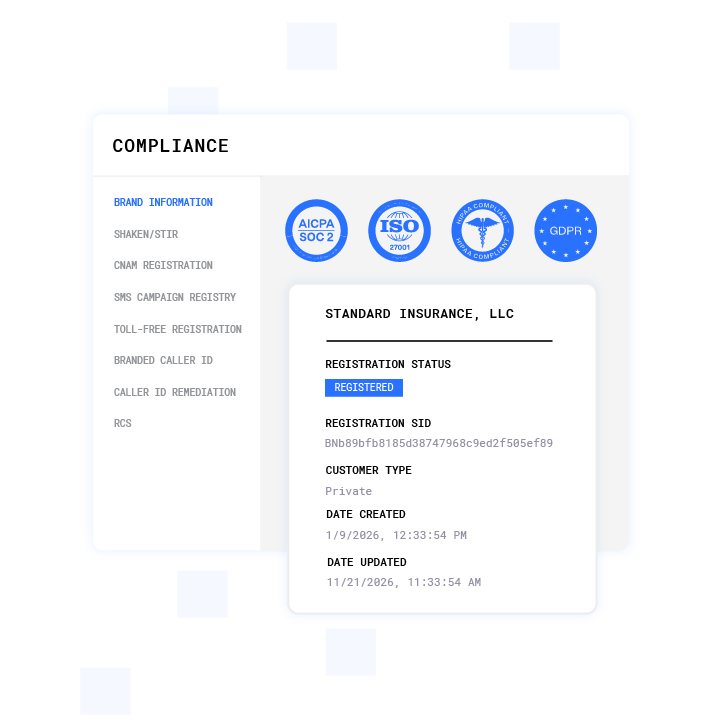
Plura’s compliance dashboard surfaces audit-ready exports in one click, with every contact linked to its consent record, DNC scrub result, and quiet-hours check. The platform’s SOC 2 certification covers the underlying infrastructure with continuous monitoring and third-party audits.1
Frequently Asked Questions
What changed in FCC consent rules in 2025 and 2026?
Several significant developments reshaped consent handling in this period. On April 11, 2025, FCC rules took effect that describe how businesses should honor consumer revocation of consent for marketing texts and calls at any time via any reasonable means, with processing within ten business days.
In January 2026, the FCC delayed the “revocation-all” requirement, which would have treated any opt-out request as revocation across all automated marketing and informational messages, until January 31, 2027. The one-to-one consent framework, which prohibits sharing or selling consumer consent across brands, also took effect in January 2026.
On February 25, 2026, the Fifth Circuit ruled in Bradford v. Sovereign Pest Control of TX, Inc. that the TCPA’s statutory text permits prior express consent to be given orally or in writing for automated telemarketing calls to cellphones within that circuit, departing from the FCC’s 2012 written-consent rule. Operators should consult qualified counsel to assess how these developments apply to their specific programs and geographies.
How long must TCPA consent records be retained?
The TCPA’s statute of limitations period is four years, which many operators treat as the baseline retention floor for consent records. The Telemarketing Sales Rule describes a five-year retention period for certain seller and telemarketer records, including consent records, starting from the date the record is produced. State statutes may impose longer retention periods.
Many organizations retain the full consent record, including the exact disclosure text, timestamp with timezone, capture channel or URL, IP address, and brand identity, for the longer of five years or the applicable state statute, with monthly exports to independent storage outside the originating platform.
Does the one-to-one consent rule apply to informational messages?
The one-to-one consent framework primarily targets marketing and promotional contacts. Informational or transactional messages may rely on prior express consent if tied directly to the consumer’s provision of the number in that context.
The line between informational and marketing content is a legal determination that depends on message content, context, and applicable circuit precedent. Operators should consult qualified counsel to classify their specific message types and confirm the appropriate consent standard for each.
Can consent collected on a lead-generation form be shared across brands?
The FCC’s January 2026 one-to-one consent framework treats consent obtained via lead-generation forms or third-party comparison sites as brand-specific. Consent cannot be shared across brands or sold to third parties.
Each sender entity maintains its own separate consent records directly from the consumer. Consent collected on a form that bundled multiple brands does not provide downstream coverage for those brands without independent verification of direct-sender consent.
When purchasing third-party leads, the calling brand, not the lead seller, faces TCPA exposure if consent is invalid. Vendor-supplied proof of consent and domain verification at lead intake therefore play a central role in risk management.
What are the statutory damages for a TCPA violation?
Under 47 U.S.C. § 227, statutory damages for TCPA violations range from $500 to $1,500 per unsolicited call or text, with the higher amount available for willful or knowing violations. Texas Senate Bill 140, effective September 1, 2025, created a separate state private right of action with statutory damages up to $5,000 per violation for telephone solicitations that include texts and images.
Class action exposure compounds the per-contact damages mentioned earlier across large contact lists. Numerous TCPA lawsuits were filed in 2025, and projections indicate state-level enforcement actions will increase through 2026 as more states introduce TCPA-style legislation.
Conclusion
Automated lead qualification at scale depends on compliance controls that operate at the infrastructure layer, not as post-dial add-ons. Carrier-level real-time DNC scrubbing, immutable consent logging with timestamped metadata, time-zone-aware quiet-hours enforcement, one-to-one consent validation at lead intake, and audit-ready reporting form five operational controls that support a defensible TCPA and DNC posture in 2026.
Plura AI’s FCC-licensed carrier stack embeds each of these controls as a platform layer. Real-time scrubbing runs before origination. Consent records are immutable and linked to every contact event. Quiet-hours enforcement applies at the contact level across all 50 states. The compliance dashboard exports audit-ready reports in one click. Customers remain responsible for their own obligations under 47 U.S.C. § 227 and applicable state law, and Plura provides the infrastructure that supports those efforts.
Run your numbers through Plura’s calculator to check your ROI in real time: calculate your ROI now.3
Compare plans and rates side by side: view pricing and plans.
See Plura’s full compliance stack in action with a live demo for your team.
1 Plura AI maintains SOC 2, HIPAA, ISO, and GDPR posture as part of its platform infrastructure. References to compliance frameworks in this article describe Plura’s platform capabilities and do not constitute a guarantee that any customer using Plura will themselves be compliant with applicable laws or standards. Customers remain solely responsible for their own regulatory obligations, certifications, consent management, recordkeeping, and the claims they make to their own end users. Consult qualified legal counsel for guidance specific to your use case.
2 This article describes regulatory frameworks at a general level and does not constitute legal advice. Laws and regulations vary by jurisdiction, change over time, and apply differently depending on facts and circumstances. Readers should consult qualified legal counsel before making compliance decisions.
3 Performance figures, customer outcomes, and industry statistics referenced in this article are drawn from cited third-party sources or Plura customer case studies. Individual results vary based on implementation, use case, industry, audience, and execution. Past or aggregate performance is not a guarantee of future results.
This article is provided for informational purposes only and reflects Plura AI’s understanding at the time of publication. Product capabilities, integrations, and specifications are subject to change. For the most current information, visit plura.ai.
This article was produced with the assistance of AI tools and reviewed by Plura AI prior to publication.