

Written by: Matt Beucler, CEO, Plura AI | Last updated: August 26, 2026
Key Takeaways
- A cloud based AI predictive dialer uses real-time pacing, AMD filtering, and compliance controls to raise agent talk time from about 12 minutes to 45–50 minutes per hour.3
- Lawful use depends on documented consent, DNC scrubbing, abandonment-rate caps, time-zone enforcement, and STIR/SHAKEN authentication under TCPA and FTC frameworks.2
- Carrier-grade platforms that own FCC-licensed infrastructure typically deliver higher connect rates, lower per-minute costs, and A-level STIR/SHAKEN attestation than CPaaS-wrapper tools.
- Plura AI integrates with Salesforce, HubSpot, and 50+ CRM and data tools while maintaining stateful conversation history across voice, SMS, RCS, and webchat.
- Teams evaluating cloud based AI predictive dialers can book a live demo with Plura AI to see carrier-grade pacing and compliance controls in action.
Predictive Dialers and U.S. Telemarketing Rules
Predictive dialers are not inherently illegal in the United States. Lawful use depends on documented consent, list hygiene, pacing controls, and time-zone enforcement. The primary federal frameworks are the Telephone Consumer Protection Act (TCPA, 47 U.S.C. § 227), the FTC Telemarketing Sales Rule (16 CFR Part 310), and FCC implementing regulations.2 State laws, including Florida’s Telephone Solicitation Act (FTSA), may impose additional or broader requirements. Operators should consult qualified legal counsel to evaluate their specific obligations.
The checklist below describes the compliance controls that a cloud based predictive dialer platform should support. It does not constitute legal advice, and using any platform does not replace an operator’s own compliance program.
| Compliance Area | Regulatory Reference | What the Platform Should Support | Plura AI Capability |
|---|---|---|---|
| Prior express written consent | 47 U.S.C. § 227 | Timestamped, immutable consent records per contact | Immutable consent ledger, audit-ready exports |
| National DNC Registry scrubbing | 16 CFR 310.4 | Scrub no more than 31 days before dial | Real-time DNC scrubbing before every dial |
| Abandoned-call rate cap | FTC rules, 3% per campaign/30-day window | Live abandonment monitoring and pacing throttle | Dynamic pacing with abandon-rate controls |
| Calling-hour restrictions | 8 a.m.-9 p.m. local time at called party’s location | Time-zone detection and automatic quiet-hours enforcement | Automated quiet-hours by contact time zone |
| TCPA-litigator screening | 47 U.S.C. § 227(b)(3): $500-$1,500 per violation | Pre-dial filtering against known litigant lists | Real-time TCPA-litigator screening before dial |
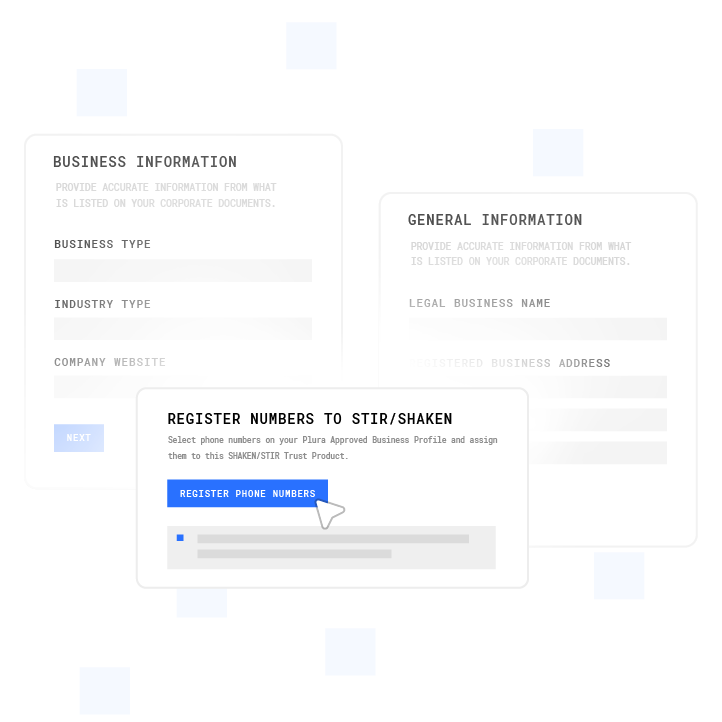
| STIR/SHAKEN caller authentication | FCC TRACED Act implementation | A-level STIR/SHAKEN attestation | STIR/SHAKEN on Plura’s own FCC-licensed carrier |
| FCC Know Your Customer (2026) | FCC Know Your Customer rules | Verified caller identity and origination documentation | FCC-licensed carrier with operating company number registration |
Plura AI supports customer compliance through platform-level controls. Customers remain responsible for their own regulatory obligations, consent programs, and legal interpretations.
AI Predictive Dialers vs. Auto Dialers
Once you understand the compliance framework, the next step is choosing the dialing technology that fits your operation. An auto dialer places calls from a list without predicting agent availability. An AI predictive dialer adds a statistical pacing engine that calculates how many numbers to dial simultaneously based on live metrics such as average handle time, current answer rate, and the number of agents in ready or wrap-up state.
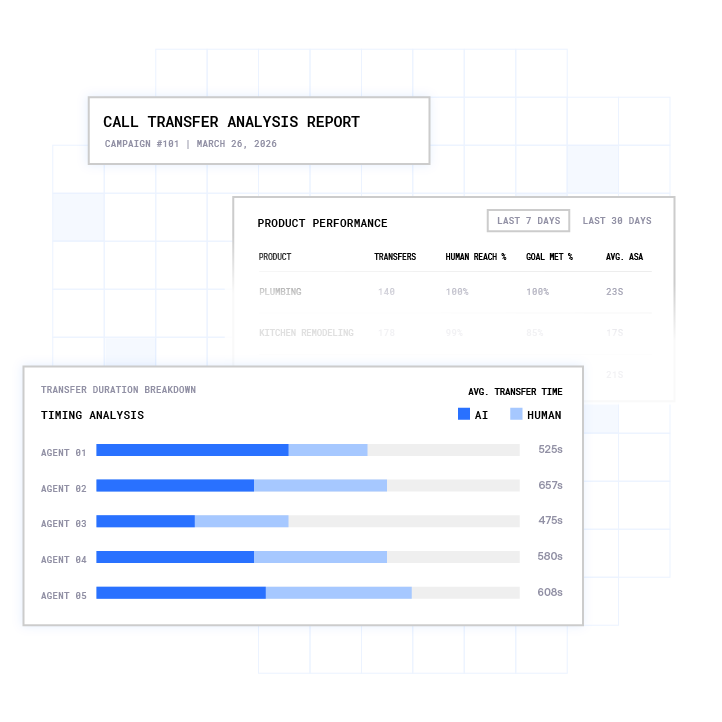
The pacing algorithm updates continuously throughout a calling session. It analyzes average agent handle time, call abandonment rate, and live answer rate to set a dial ratio and recalculates in real time. When answer rates drop, the ratio rises. When abandonment approaches the regulatory cap, the ratio falls.
AMD classifies each call outcome as a live human answer, voicemail, busy signal, disconnected number, or fax tone. Only live human answers route to an available agent. AMD in cloud outbound systems can increase agent talk time by filtering voicemail and connecting agents only to live answers.
Time-zone enforcement operates as a separate control layer. Federal rules prohibit calls outside the permitted calling window at the called party’s location, not the caller’s time zone. A carrier-grade platform applies this rule automatically using the contact’s area code and state, not the dialer operator’s location.
A power dialer dials one number per agent at a time and waits for the agent to finish before placing the next call. This one-to-one approach removes abandonment risk but slows overall throughput. A progressive dialer improves on this by dialing slightly ahead of confirmed agent availability, which reduces idle time while keeping tight control. AI predictive dialing extends this progression by using statistical models to maximize throughput, and it suits teams with enough active agents to keep the pacing model stable. AI predictive dialers require a sufficient number of active agents for the statistical model to keep abandonment rates stable under the 3% cap, while smaller teams typically use progressive or power dialing instead.
Cost Structure of Cloud Based AI Predictive Dialers
Pricing for cloud based AI predictive dialer software typically falls into two models: CPaaS (Communications Platform as a Service) wrappers and carrier-grade platforms. The difference in unit economics is material, and the gap widens at volume.
CPaaS-based dialers route calls through a third-party carrier such as Twilio. The dialer vendor pays a per-minute wholesale rate to the CPaaS provider and passes that cost to the customer with a markup. Sixty-second billing increments common among resellers create substantial monthly waste compared to 6-second billing from a network-owning provider.
Spam labeling further widens the cost gap. Cloud dialers with strong carrier relationships achieve connect rates up to 12–18%, compared to 5–8% averages for platforms with poor carrier trust.3 A CPaaS-based dialer inherits the caller-ID reputation of the upstream carrier, not its own. STIR/SHAKEN signing occurs at the originating carrier level, never in the dialer software itself, and hosted dialer vendors that resell upstream telephony typically receive B or C attestation because resellers rarely meet the verification bar for A-level attestation.
Plura AI operates its own FCC-licensed audio bridging carrier. Voice originates on Plura’s domestic infrastructure, not a third-party CPaaS. Branded caller ID is issued at the carrier level, and STIR/SHAKEN authentication runs on every outbound call under Plura’s own operating company number. This structure produces lower per-minute economics and a spam-label posture that a wrapper tool cannot easily match.
On the ROI side, the default scenario on Plura’s ROI calculator models a 15-agent operation at $20 per hour with standard taxes, benefits, and commissions at 40% talk utilization, which totals $60,000 per month. Replacing that team with Plura at $15 per hour, 100% talk utilization, and 6 Plura agents doing the equivalent work drops the monthly cost to $14,400. That shift produces $45,600 in savings in the first 30 days and $547,200 over 12 months.3
Run your numbers through Plura’s calculator to check your ROI in real time.
Choosing a Cloud Based AI Predictive Dialer for Sales Teams
Platform selection usually comes down to three operational requirements: integration depth with the CRM stack, channel continuity across voice and messaging, and dialing modes that match team size and campaign type.
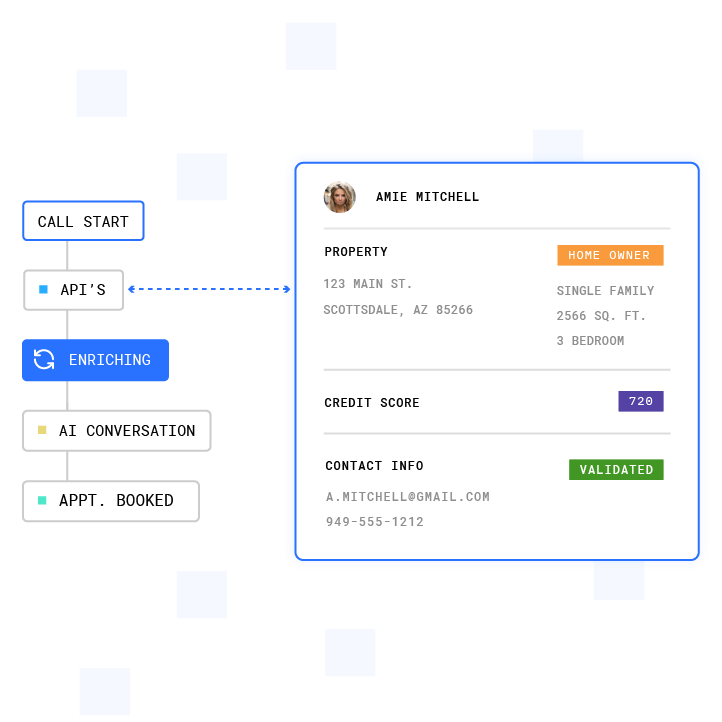
Plura’s AI Predictive Dialer integrates natively with Salesforce, HubSpot, and Zoho through Plura’s integrations directory, which covers 50+ tools across CRM, calendar, attribution, and data enrichment. Contact records update in real time during and after each call. Enrichment from more than 30 data sources runs during the conversation itself, not in a downstream batch job.
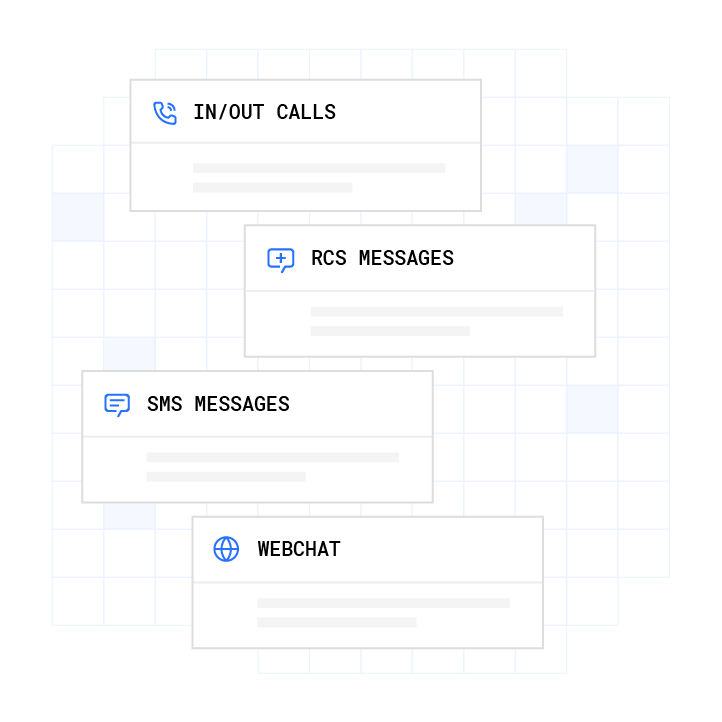
Channel continuity separates carrier-grade platforms from single-channel dialers. Plura’s AI Voice, AI SMS, AI RCS, and AI Webchat all share a Stateful Conversation Database. Every interaction is keyed to the same customer token. An agent that texted a lead at 9 a.m. can pick up the call at noon already knowing what was said, what was offered, and what objections were raised. Plura AI provides omnichannel support for voice, SMS, webchat, and RCS within a unified stateful inbox that maintains full conversation history.4 CPaaS-based wrappers typically do not provide this by default because cross-channel state management lives above the API layer and must be built at the carrier and database level.
Dialing mode selection follows team size and campaign structure.
- AI predictive dialing suits teams with 8 or more active agents running high-volume outbound campaigns where maximizing talk time per hour is the primary objective.
- Power dialing suits smaller teams or regulated campaigns where one-to-one dial control reduces abandonment risk.
- Progressive dialing sits between the two, placing each call only after agent availability is confirmed, which fits mid-size teams or compliance-sensitive verticals.
Plura’s AI Predictive Dialer includes list management, dynamic pacing, time-zone logic, answer rate tuning, and compliance controls in a single platform. Plura AI owns its telecom infrastructure and holds an FCC carrier license, while platforms that depend on Twilio operate as a software layer without a carrier license.4 Because Plura owns its carrier infrastructure, branded caller ID, A-level STIR/SHAKEN attestation, and real-time DNC scrubbing are enforced at origination rather than bolted on later.
Plura’s compliance engine supports customer programs related to TCPA, DNC, HIPAA, SOC 2, ISO certification, and 50+ state rule sets.1 Every outbound contact is checked against federal and state DNC registries in real time before dial. Quiet-hours rules enforce automatically through time-zone detection. The dashboard exports audit-ready reports in one click. Plura supports customer compliance, and customers remain responsible for their own regulatory obligations.
Frequently Asked Questions
What is the minimum team size for AI predictive dialing to work effectively?
AI predictive dialing relies on a statistical model that predicts when an agent will next be free. That model requires enough active agents to produce stable averages. With too few consistently active agents, availability statistics become volatile and the pacing algorithm oscillates between over-dialing and idling, which can push abandonment rates toward the regulatory cap. Teams below that threshold typically see better results with power or progressive dialing, which place one call per agent at a time and do not depend on statistical prediction. As team size grows past roughly 15 to 20 active agents, AI predictive dialing usually produces the largest productivity gains because the pacing model has enough data to run accurately throughout the session.
How does Plura handle spam labeling on outbound calls?
Spam labels are applied at the carrier level, not by the dialer software. Plura issues branded caller ID directly through its own FCC-licensed audio bridging carrier, so calls can present with the company’s name rather than an unfamiliar number or a “Spam Likely” label. STIR/SHAKEN authentication runs on every outbound call under Plura’s own operating company number, which supports A-level attestation because Plura both knows the caller’s identity and has confirmed the displayed numbers belong to that caller. Platforms that route through a third-party CPaaS inherit the upstream carrier’s attestation level, typically B or C, and carrier analytics engines weigh that signal when deciding how calls are displayed and filtered. Plura also communicates with Apple’s iOS 26 call-screening layer so calls can present a recognizable identity to the recipient rather than being intercepted before they ring through.
What is the difference between a cloud based AI predictive dialer and a Twilio-wrapper tool?
A Twilio-wrapper tool is a dialer application built on top of Twilio’s CPaaS APIs. The vendor does not own the underlying carrier infrastructure and instead rents it. That structure means caller ID is not issued under the vendor’s own carrier identity, STIR/SHAKEN attestation is controlled by Twilio rather than the vendor, and compliance enforcement happens at the application layer rather than at origination. A carrier-grade cloud based AI predictive dialer, by contrast, originates calls on infrastructure the vendor owns and operates under its own FCC license. Plura AI is its own FCC-licensed audio bridging carrier, and voice does not route through Twilio. Branded caller ID, real-time DNC scrubbing, TCPA-litigator screening, and STIR/SHAKEN authentication are all enforced before the call leaves Plura’s network. The practical impact appears in connect rates, spam-label frequency, per-minute billing, and the ability to maintain cross-channel conversation state across voice, SMS, RCS, and webchat.
How long does it take to see ROI from a cloud based predictive dialer?
Most deployments reach financial break-even in 1 to 3 months. The first 30 days typically cover configuration, list preparation, script tuning, and initial call volume. Months 2 and 3 are where pacing settings, AMD thresholds, and lead segmentation stabilize, and where the productivity gap between the old workflow and the new one becomes measurable. The 90-day window is also the standard Plura uses for its opt-out clause, so if the deployment is not delivering, customers are not held to the annual contract term. The variables that most affect the timeline include list quality, consent documentation completeness, CRM integration depth, and whether the team has defined clear handoff criteria between the AI dialer and human agents for complex conversations.
Conclusion: Carrier-Grade Dialing as a Different Category
A cloud based predictive dialer that runs on owned carrier infrastructure, issues branded caller ID at the carrier level, enforces real-time DNC and TCPA-litigator screening before every dial, and shares stateful conversation memory across voice, SMS, RCS, and webchat operates in a different category from a CPaaS-wrapper tool. The performance gap appears in connect rates, talk-time density, compliance posture, and 90-day ROI.
Plura AI delivers these capabilities on 100% U.S. infrastructure, with no third-party CPaaS in the call path, no offshore exposure, and a 90-day opt-out window in every annual contract. The economics and operational impact are transparent and measurable.
Run your numbers through Plura’s calculator to check your ROI in real time.
1 Plura AI maintains SOC 2, HIPAA, ISO, and GDPR posture as part of its platform infrastructure. References to compliance frameworks in this article describe Plura’s platform capabilities and do not constitute a guarantee that any customer using Plura will themselves be compliant with applicable laws or standards. Customers remain solely responsible for their own regulatory obligations, certifications, consent management, recordkeeping, and the claims they make to their own end users. Consult qualified legal counsel for guidance specific to your use case.
2 This article describes regulatory frameworks at a general level and does not constitute legal advice. Laws and regulations vary by jurisdiction, change over time, and apply differently depending on facts and circumstances. Readers should consult qualified legal counsel before making compliance decisions.
3 Performance figures, customer outcomes, and industry statistics referenced in this article are drawn from cited third-party sources or Plura customer case studies. Individual results vary based on implementation, use case, industry, audience, and execution. Past or aggregate performance is not a guarantee of future results.
4 References to third-party products, services, companies, or research are made for informational and comparative purposes only. Plura AI is not affiliated with, endorsed by, or sponsored by any third party named in this article unless explicitly stated. Trademarks and product names referenced remain the property of their respective owners.
This article is provided for informational purposes only and reflects Plura AI’s understanding at the time of publication. Product capabilities, integrations, and specifications are subject to change. For the most current information, visit plura.ai.
This article was produced with the assistance of AI tools and reviewed by Plura AI prior to publication.