

Written by: Matt Beucler, CEO, Plura AI | Last updated: August 27, 2026
Key Takeaways for Contact Center and Revenue Leaders
- Conversational AI qualifies leads in real time through instant contact, live enrichment, structured BANT/MEDDIC dialogue, dynamic scoring, and stateful warm transfers.
- Plura AI is the only FCC-licensed carrier platform with stateful cross-channel memory across voice, SMS, RCS, and AI webchat on 100% U.S. infrastructure.
- Most API-reseller tools struggle with 2026 spam-label and compliance expectations because they rent from third-party CPaaS providers and cannot deliver consistent A-level STIR/SHAKEN attestation or branded caller ID.
- Plura’s compliance engine supports real-time DNC scrubbing, TCPA consent tracking, quiet-hours rules, and 50-plus state rule sets at the carrier level before every outbound contact.1
- Plura AI delivers 3x average ROI in 90 days and replaces $60,000 per month in human-agent costs with $14,400 per month while supporting compliance.3 Book a live demo with Plura to see the qualification workflow in action.
Five-Step Real-Time Lead Qualification Workflow
Real-time lead qualification runs through five steps inside a single conversation, often before a human agent joins.
- Instant contact. The AI voice agent answers or dials within seconds of a lead signal. Responding to a lead within 60 seconds can lift conversions by 391%, and contacting a lead within five minutes makes them up to 100 times more likely to connect.3 Plura’s AI voice agents reach leads in under five seconds with 24/7 call answering.
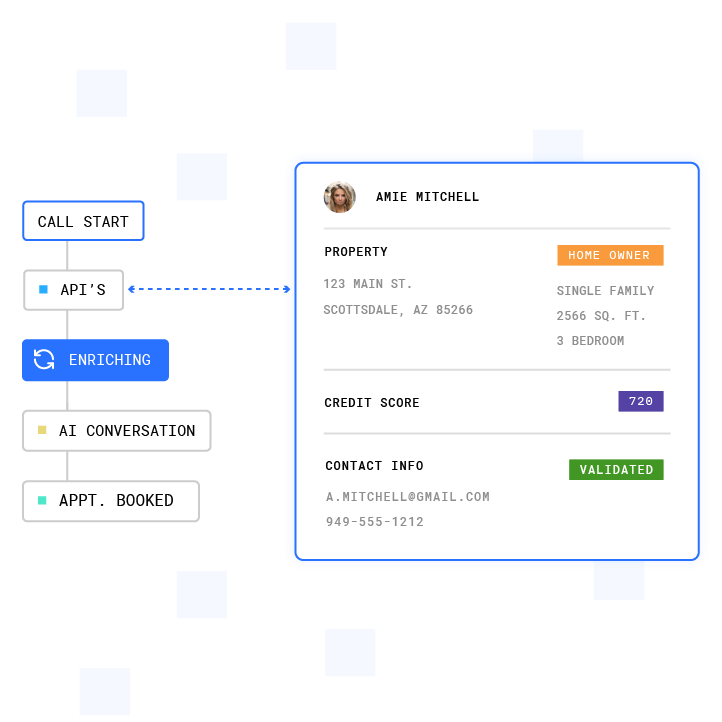
- Real-time enrichment. While the conversation opens, Plura’s AI Lead Intelligence layer pings 30-plus data sources such as IP data, property records, email validation, and business firmographics. The agent enters the qualifying dialogue already knowing who it is speaking with.
- Structured qualification dialogue. The agent asks four to six questions mapped to BANT (Budget, Authority, Need, Timeline) or MEDDIC (Metrics, Economic Buyer, Decision Criteria, Decision Process, Identify Pain, Champion) frameworks. Conversational qualification using natural dialogue achieves three times higher conversion rates than static form submissions.
- Live scoring and routing. Intent signals update a lead score in real time. High-scoring leads trigger an immediate warm transfer to a U.S. agent. Mid-range leads enter a nurture sequence. Low-scoring leads receive automated follow-up without consuming agent time.
- Stateful handoff. The receiving agent gets the full conversation transcript, lead score, enrichment data, objections raised, and qualification status before the call connects. The agent avoids re-verification and repeated questions.
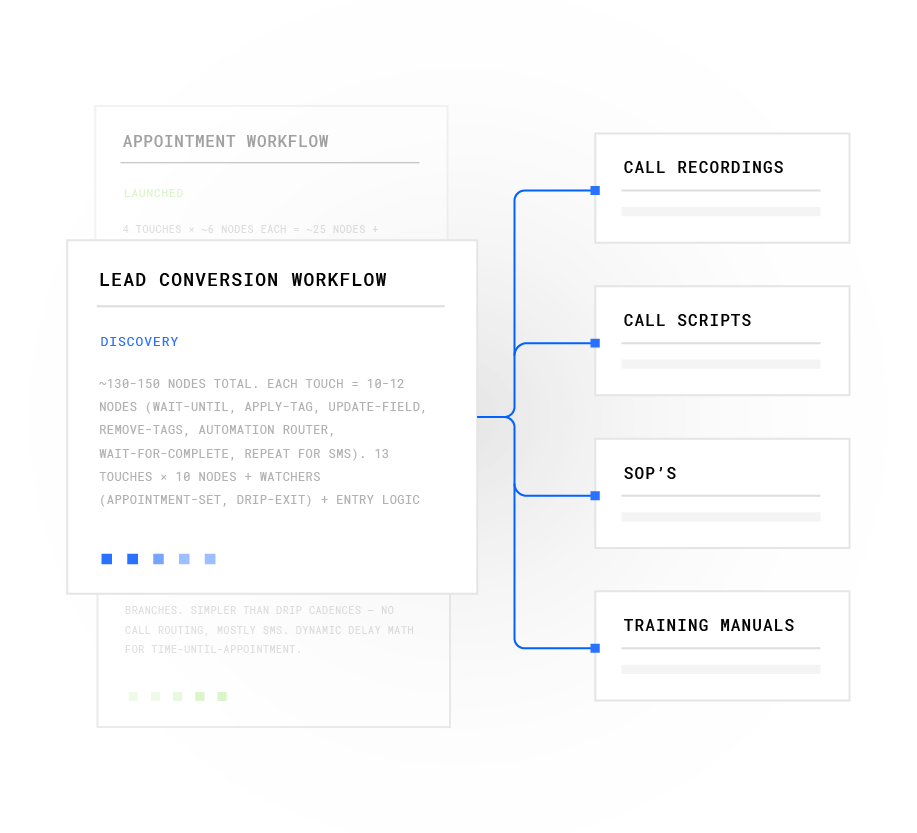
Every step runs on Plura’s Stateful Conversation Database (SCD), which keys each interaction to a customer token across voice, AI SMS, RCS, and webchat. A lead who texted at 9 a.m. is recognized when the call arrives at noon. Plura’s no-code workflow builder lets operators configure this entire sequence without engineering resources.
Relevant compliance frameworks for outbound AI voice and SMS include the Telephone Consumer Protection Act (TCPA, 47 U.S.C. § 227), the National Do Not Call (DNC) Registry, and STIR/SHAKEN caller-ID authentication standards.2 The FCC’s February 2024 declaratory ruling (FCC 24-17) classified AI-generated voice calls as artificial or prerecorded voice under the TCPA, applying the same consent standards as traditional robocalls.2 Operators should consult qualified counsel on their specific obligations. See also: Plura’s AI Communications Strategy guide.
AI Lead Scoring That Updates During the Conversation
The five-step qualification process depends on a scoring model that updates in real time during the conversation itself. Static lead scoring assigns points after the fact based on form fields and page visits, while AI lead scoring reacts as new signals appear.
Plura’s AI Lead Intelligence layer draws on 30-plus data sources to build a lead picture during the live interaction. The scoring model maps to BANT or MEDDIC sub-scores and updates dynamically as new signals arrive. A solar company using AI Lead Intelligence increased conversion rates from 6% to 18% with the same leads and offer. In the same guide, solar and home services companies using AI agents with property data, energy usage estimates, and home valuations achieved two to three times improvements in appointment set rates, building on that same data-driven approach.
The stateful memory layer is what separates Plura from API-reseller tools.4 Plura’s stateful AI architecture remembers previous interactions, preferences, and outcomes across channels, so a lead score reflects the entire relationship history, not just the current session. That complete history also powers the conversation intelligence layer, which surfaces which scripts close, which objections recur, and which routing paths convert. A legal marketing firm using this intelligence found 23% of engaged leads lacked sufficient case value, adjusted qualification criteria, and reduced wasted attorney time by 31%.
Plura’s conversation intelligence layer feeds these findings back into the workflow tuning loop. Revenue leaders see which campaigns and scripts drive qualified pipeline instead of guessing from raw call volume.
Warm Transfer AI Voice Agents With Full Context
Warm transfer AI voice agents improve live-agent performance by handing off complete context before the call connects. A warm transfer is a call handoff in which the AI agent briefs the receiving human agent on the lead’s qualification status, conversation history, and intent signals in advance.
The receiving agent enters the call already knowing the lead’s budget range, stated timeline, objections raised, and enrichment data. SQM Group research across 500-plus North American call centers found that transferred calls carry a 12% lower CSAT score and a 14% lower first-call resolution rate compared to calls resolved by the original agent when context is not passed. Plura’s warm-transfer handoff payload addresses that gap by passing the full transcript, lead score breakdown, enrichment summary, and consent status to the receiving agent before connection.
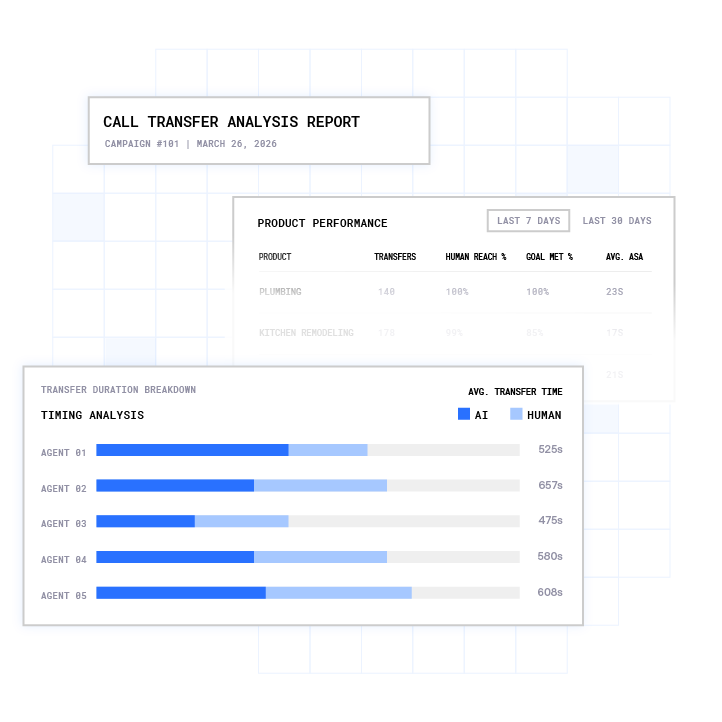
In production deployments, receiving agents on warm-transferred AI-intake calls often run shorter average handle times than on cold-transferred equivalents. Warm transfers can improve customer satisfaction and are often preferred by customers over cold transfers.
Twilio-based API resellers struggle to deliver stateful warm transfers because their voice and SMS agents run on separate systems with separate memories. A lead who texted yesterday appears as a stranger when the call comes today. Plura’s SCD removes that blind spot by design. Every channel reads from and writes to the same database, so the handoff payload is complete regardless of which channel the lead used first.
Plura’s AI Predictive Dialer then prioritizes outbound contacts using stateful conversion signals such as historical answer rates, prior negotiation outcomes, and prior offer-acceptance bands. Operations leaders gain higher talk time per dial and route the highest-intent leads first.
Why Many Tools Miss 2026 Compliance and Spam-Label Expectations
Compliance and spam-label control now sit at the center of AI voice strategy for U.S. call centers. The compliance landscape for AI voice and SMS shifted materially between 2024 and 2026, and three developments define the current risk surface.
First, the FCC’s February 2024 declaratory ruling (FCC 24-17) classified AI-generated voices as artificial or prerecorded voice under the TCPA (47 U.S.C. § 227), with prior express written consent expectations for outbound AI voice telemarketing calls to consumer wireless numbers. STIR/SHAKEN attestation requirements were phased in starting in late 2020 with extensions for many small providers, so attestation did not apply to all outbound calls immediately.
Second, the FCC’s Notice of Proposed Rulemaking (NPRM, CG Docket No. 26-52) proposes caps on offshore customer-service calls and limits on offshore handling of sensitive consumer data. Companion federal legislation including the Keep Call Centers in America Act (S.2495) and the Foreign Robocall Elimination Act (S.2666) extends the regulatory perimeter. State laws in New York, New Jersey, Connecticut, Missouri, and Florida already address offshore handling of medical, financial, and consumer data. Operators should consult qualified counsel on their exposure under these frameworks.
Third, CPaaS platforms provisioning numbers from shared pools typically deliver only B-level STIR/SHAKEN attestation by default, while direct carrier-managed number pools enable consistent A-level attestation. API resellers rent from a third-party CPaaS and inherit that carrier’s attestation reputation, not their own, which limits their ability to correct spam-label issues at the source.
Spam-label remediation operates at the carrier level. Plura issues branded caller ID directly through its FCC-licensed carrier and runs STIR/SHAKEN authentication on every outbound call. Calls present with the company’s name instead of an unfamiliar number. API resellers cannot replicate this pattern because they do not hold the carrier license.
Plura owns its telecom infrastructure and holds an FCC carrier license, whereas Synthflow depends on Twilio and operates as a software layer without a carrier license.4 The same structural gap appears across the broader API-reseller category.
Platform Comparison: Carrier-Owned AI vs Resellers and Human Teams
The table below isolates four operational categories that determine whether a platform can deliver compliant, stateful lead qualification at scale. These categories are carrier ownership, cross-channel memory, U.S. infrastructure, and total cost of ownership, along with related compliance controls. Every cell reflects publicly available information or Plura’s documented platform capabilities.
| Metric | Plura AI | Twilio-Based API Resellers | Offshore BPO | Onshore Human Teams |
|---|---|---|---|---|
| Carrier ownership | FCC-licensed carrier; owns infrastructure | Rents from Twilio or equivalent CPaaS; no carrier license | Varies by country; no U.S. FCC license | Not applicable; uses third-party telecom |
| Stateful cross-channel memory | Full stateful memory across voice, SMS, RCS, webchat | Typically stateless; separate systems per channel | Depends on CRM integration; no native cross-channel memory | Depends on CRM; manual context transfer between agents |
| STIR/SHAKEN attestation level | A-level; issued at carrier level | Typically B-level from shared CPaaS pools | Foreign-origin numbers; attestation varies | Depends on carrier contract |
| Branded caller ID | Carrier-provisioned; issued directly | Reseller-dependent; not issued at carrier level | Not available for U.S. branded presentation | Available via carrier contract; not platform-native |
| U.S. infrastructure | 100% U.S. by architecture; voice origination, model hosting, data storage all domestic | Varies; model and data hosting may be offshore | Offshore by definition; exposed to FCC NPRM CG Docket No. 26-52 | Onshore; no offshore exposure |
| Monthly TCO (15-agent equivalent) | $14,400/month at 100% talk utilization | Variable; per-minute CPaaS costs plus platform margin | Wage arbitrage; rising under regulatory pressure | $60,000/month at 40% talk utilization |
| Real-time DNC scrubbing | Pre-dial; supported at platform level before every outbound contact | Bolted on; customer’s responsibility to configure | Manual or third-party; not platform-native | Manual or third-party; not platform-native |
Plura Compliance Engine: Eight Controls for Outbound AI
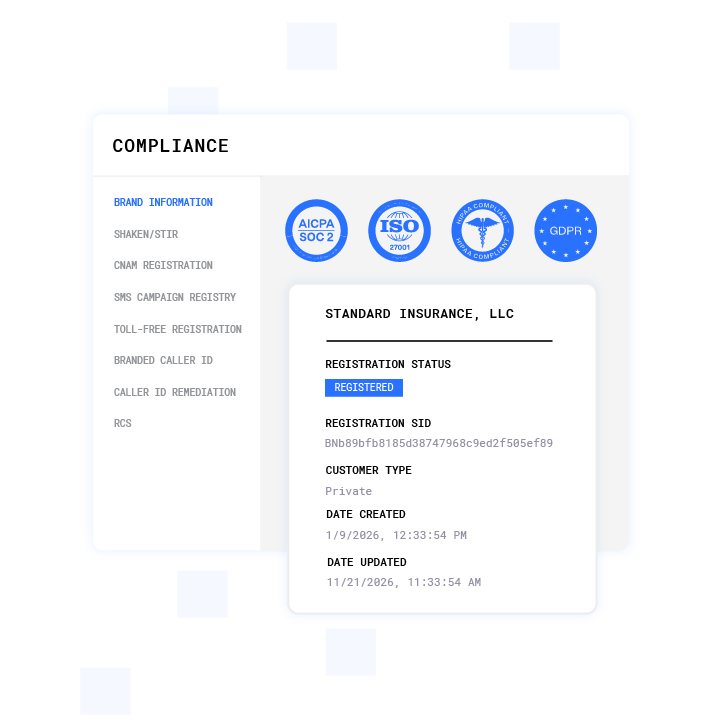
Plura’s compliance engine operates as a core layer of the platform and supports enforcement on every outbound contact. This engine extends the earlier compliance discussion into concrete controls that operations leaders can review with counsel. Operators remain responsible for their own regulatory obligations and should consult qualified counsel on their specific compliance posture. See plura.ai/products/compliance for full documentation.
- Real-time DNC scrubbing. Every outbound contact is checked against federal and state DNC registries before dial. Non-compliant numbers are blocked before the first attempt.
- TCPA consent ledger. Consent records are timestamped, immutable, and audit-ready. Express written consent is tracked per contact with full provenance.
- Quiet-hours enforcement. Automated time-zone detection applies federal and state calling-window restrictions to every campaign without manual configuration.
- STIR/SHAKEN authentication. Every outbound voice call carries A-level attestation issued through Plura’s FCC-licensed carrier, not a shared CPaaS pool.
- HIPAA-aligned infrastructure. End-to-end encryption, access controls, and audit logging cover protected health information across all four channels.1
- SOC 2 certification. Continuous monitoring, penetration testing, and third-party audits cover the underlying infrastructure.1
- 50-plus state rule sets. State-specific quiet-hours, disclosure, and consent rules are pre-loaded and applied automatically by jurisdiction.
- One-click audit export. The compliance dashboard exports audit-ready reports for legal review, carrier requirements, or regulatory inquiries without manual data assembly.
Book a live demo with Plura to see the compliance engine in action across voice, SMS, RCS, and webchat.
Plura TCO Math and 90-Day ROI
Contact center leaders can benchmark Plura’s economics using a 15-agent operation as the baseline scenario.
- Human agent cost: $60,000/month (15 agents at $20/hour, 25% taxes/benefits/commission, 40% talk utilization)
- Plura agent cost: $14,400/month ($15/hour, 100% talk utilization, 6 Plura agents replacing 15 humans)
- 30-day savings: $45,600
- 12-month savings: $547,200
- 60-month savings: $2,736,000
For higher-volume operations, Plura’s total cost of ownership of $700,000 per year replaces the traditional $7 million contact-center cost structure on equivalent volume, per Plura’s AI Communications Strategy guide. The platform delivers the 3x average ROI in 90 days cited earlier, along with 47% average pipeline growth and 90% faster lead-response time.
The economics hold because Plura agents run at 100% talk utilization with no taxes, benefits, commissions, rehiring cycles, or training ramp. The platform scales into peak seasons without advance hiring budgets.
Compare plans and rates side by side at Plura pricing.
Frequently Asked Questions
How does conversational AI qualify leads in real time without losing compliance?
Conversational AI qualifies leads in real time by combining instant contact, live data enrichment, structured dialogue, and dynamic scoring inside a single conversation. The compliance layer runs in parallel: every outbound contact is checked against federal and state DNC registries before dial, consent records are timestamped and immutable, and calling-window restrictions apply automatically by time zone. As noted earlier, the FCC’s February 2024 ruling extended TCPA consent requirements to AI-generated voices, applying the same standards as traditional robocalls. Platforms that own their carrier stack can support these requirements at the network level before a call leaves the system. API resellers that rent from a third-party CPaaS often rely on post-origin configuration, which can create gaps in the audit trail. Operators should consult qualified counsel on their specific TCPA and state-law obligations.
What is AI lead scoring for call centers and how accurate is it?
AI lead scoring for call centers evaluates natural language responses, behavioral signals, and enrichment data in real time to compute a prospect’s purchasing intent during the live conversation. The score updates dynamically as new signals arrive, such as a stated budget range or a specific product question, and drives routing decisions before the buying moment passes. Well-implemented predictive AI lead scoring models for U.S. SaaS achieve 85-95% AUC accuracy after training, compared to lower rates for traditional static scoring.
The accuracy advantage comes from combining explicit answers mapped to BANT or MEDDIC frameworks with behavioral signals and third-party enrichment data, rather than relying on form fields alone. Plura’s AI Lead Intelligence layer draws on 30-plus data sources during the live interaction, so the score reflects a complete lead picture rather than a partial one. Scored leads and full conversation transcripts push directly into CRM systems including HubSpot, Salesforce, and Zoho via Plura’s integrations layer, so sales teams act on AI-captured insights without manual data entry.
How do warm transfer AI voice agents improve contact center performance?
Warm transfer AI voice agents improve contact center performance by passing a complete handoff payload to the receiving human agent before the call connects. That payload includes the lead’s qualification status, full conversation transcript, enrichment data, objections raised, sentiment indicator, and consent status. The receiving agent enters the call already briefed, which removes the re-verification and repeated questions that reduce CSAT and first-call resolution rates on cold transfers.
Research across North American call centers found that transferred calls carry a 12% lower CSAT score and a 14% lower first-call resolution rate when context is not passed. Warm transfers can improve customer satisfaction and are often preferred by customers over cold transfers. In production deployments, receiving agents on warm-transferred AI-intake calls often run shorter average handle times than on cold-transferred equivalents. The stateful memory layer makes this possible at scale because voice, SMS, RCS, and webchat all share the same conversation database, so the handoff payload is complete regardless of which channel the lead used first.
What makes a carrier-owned AI platform different from an API reseller for lead qualification?
A carrier-owned AI platform originates voice traffic on its own FCC-licensed infrastructure rather than routing through a third-party CPaaS. That distinction has three operational consequences. First, branded caller ID is issued at the carrier level, so calls present with the company’s name instead of an unfamiliar number or a Spam Likely label. API resellers inherit the CPaaS’s caller-ID reputation and cannot issue branded identity under their own carrier license.
Second, STIR/SHAKEN attestation runs at A-level from a direct carrier-managed number pool. Shared CPaaS pools typically deliver B-level attestation, which increases the probability of spam labeling and reduces call completion rates. Third, compliance enforcement starts at origination, before the call leaves the network, rather than as a configuration layer the customer must manage separately. For regulated industries handling sensitive consumer data, the infrastructure question also shapes FCC NPRM exposure, since platforms with foreign infrastructure dependencies face potential liability under CG Docket No. 26-52 and companion state onshoring laws. Operators should consult qualified counsel on their specific exposure.
How long does it take to deploy conversational AI for lead qualification at call-center scale?
Deployment timelines depend on conversation complexity and integration requirements. A standard inbound qualification flow with an approved call script and CRM access typically reaches live calls in days. Complex multi-step intake workflows, such as a 25-question health-history survey with HIPAA-aligned field-level redaction, run closer to one to two months because the workflow logic requires design and validation before production launch.
Healthcare and financial services deployments may add time for compliance documentation review. Plura’s onboarding sequence follows a consistent path: discovery audit, intake of sample calls and existing scripts, overnight build of a conversation mockup, iteration meeting, engineering build of the production workflow, pilot test on a subset of real calls, and full go-live. Every annual contract includes a 90-day opt-out window if the deployment is not delivering, so the iteration commitment remains active from day one.
Conclusion: Carrier-Owned Conversational AI as an Operational Lever
The regulatory and economic case for carrier-owned conversational AI in call centers now rests on concrete rules and measurable savings. The FCC’s February 2024 ruling extended TCPA consent requirements to AI-generated voice. The FCC NPRM (CG Docket No. 26-52) proposes caps on offshore call handling and limits on offshore handling of sensitive consumer data. Several states have active onshoring or sensitive-data restriction laws. API-reseller platforms struggle to pass spam-label tests, deliver consistent A-level STIR/SHAKEN attestation, or support compliance at origination because they do not own the carrier.
Plura’s FCC-licensed carrier stack, stateful cross-channel memory, and 100% U.S. infrastructure address these failure modes in a single platform. The TCO math is transparent: $14,400 per month replaces $60,000 per month on a 15-agent equivalent, with $547,200 in 12-month savings and the 3x ROI described above.
Run your numbers through Plura’s calculator to check your ROI in real time. Compare plans and rates side by side at Plura pricing, or book a live demo with Plura to see the qualification workflow, compliance engine, and warm-transfer handoff running on live calls.
1 Plura AI maintains SOC 2, HIPAA, ISO, and GDPR posture as part of its platform infrastructure. References to compliance frameworks in this article describe Plura’s platform capabilities and do not constitute a guarantee that any customer using Plura will themselves be compliant with applicable laws or standards. Customers remain solely responsible for their own regulatory obligations, certifications, consent management, recordkeeping, and the claims they make to their own end users. Consult qualified legal counsel for guidance specific to your use case.
2 This article describes regulatory frameworks at a general level and does not constitute legal advice. Laws and regulations vary by jurisdiction, change over time, and apply differently depending on facts and circumstances. Readers should consult qualified legal counsel before making compliance decisions.
3 Performance figures, customer outcomes, and industry statistics referenced in this article are drawn from cited third-party sources or Plura customer case studies. Individual results vary based on implementation, use case, industry, audience, and execution. Past or aggregate performance is not a guarantee of future results.
4 References to third-party products, services, companies, or research are made for informational and comparative purposes only. Plura AI is not affiliated with, endorsed by, or sponsored by any third party named in this article unless explicitly stated. Trademarks and product names referenced remain the property of their respective owners.
This article is provided for informational purposes only and reflects Plura AI’s understanding at the time of publication. Product capabilities, integrations, and specifications are subject to change. For the most current information, visit plura.ai.
This article was produced with the assistance of AI tools and reviewed by Plura AI prior to publication.