
Written by: Matt Beucler, CEO, Plura AI
Key Takeaways
- HIPAA-compliant lead response relies on signed BAAs with every vendor touching PHI, encryption in transit and at rest, role-based access controls, minimum-necessary handling, audit logging, and breach notification procedures.
- First-touch messages stay high level. Scripts acknowledge the inquiry, offer next steps, and move any clinical detail into secure portals.
- Each channel follows specific rules. SMS and email carry administrative content, voicemail stays generic, webchat verifies identity before PHI, and live calls allow PHI only after verification.
- Any vendor that creates, receives, maintains, or transmits PHI on your behalf, including CRMs, form builders, texting platforms, AI vendors, email providers, and cloud hosts, typically requires a signed BAA before PHI flows.
- Plura AI delivers sub-5-second HIPAA-aligned lead responses across voice, SMS, RCS, and AI webchat, with compliance controls built into the platform.
Core Requirements For HIPAA-Compliant Lead Response
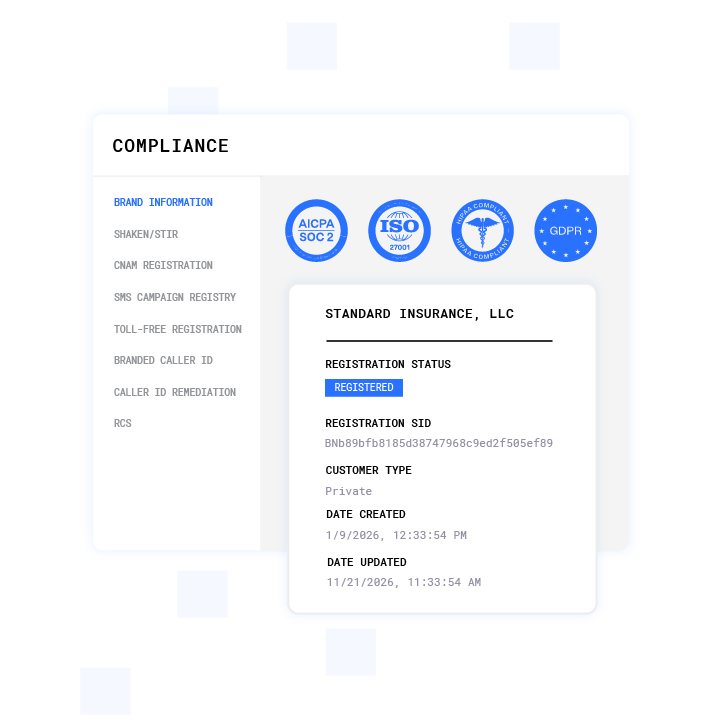
A HIPAA-compliant lead response requires, at minimum, a signed Business Associate Agreement (BAA) with every vendor touching PHI, encryption in transit and at rest, role-based access controls, and minimum-necessary handling of PHI, alongside audit logging and breach notification procedures, per HIPAA-compliant data handling guidance.2 Those requirements describe what a compliant workflow must contain. They do not dictate how fast it can run. Plura AI contacts leads in under 5 seconds across AI voice, AI SMS, RCS, and AI webchat, with compliance features enforced inside the platform.
 1
1The full requirements list, drawn from 45 CFR Parts 160, 162, and 164 and HHS OCR guidance:
- Signed BAA with every vendor that creates, receives, maintains, or transmits PHI
- Encryption in transit (TLS 1.2+) and at rest (AES-256)
- Role-based access control limiting PHI visibility to authorized staff
- Minimum necessary standard under 45 CFR 164.502(b) applies to most uses and disclosures of PHI. Exceptions include disclosures to or requests by a health care provider for treatment, disclosures to the individual, and uses or disclosures required by law.
- Audit logging capturing who accessed what PHI, when, and why, per 45 CFR 164.312(b)
- Breach notification procedures meeting the 60-day requirement under 45 CFR 164.404
- Documented risk analysis covering all systems touching electronic PHI (ePHI), per 45 CFR 164.308(a)(1)
Scripts For HIPAA-Safe First-Touch Lead Responses
The sentence that often creates risk is: “We received your request for [treatment/condition].” Naming a condition or treatment in an outbound message can disclose PHI over a channel that may not be encrypted end-to-end. A compliant rewrite is: “We received your inquiry and want to connect you with our team.”
The minimum necessary standard under 45 CFR 164.502(b) requires limiting PHI to what is necessary for the purpose. For a first-touch lead response, the purpose is scheduling contact, not clinical exchange. That distinction drives every script below.
SMS Auto-Response Template (First Touch, No Treatment or Condition Named)
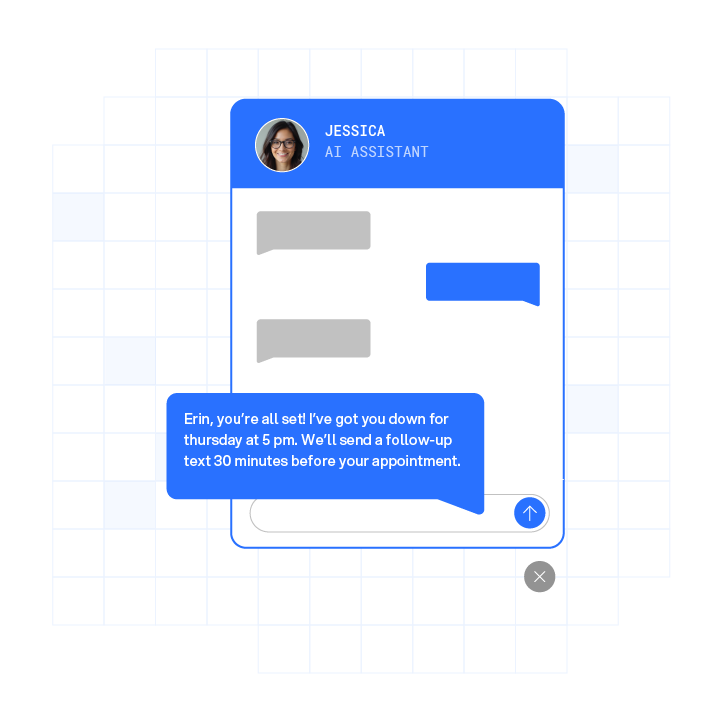
“Hi [First Name], this is [Practice Name]. We received your inquiry and want to make sure you get connected quickly. Reply here or call us at [number]. We’re available [hours].”
Email First-Response Template
- Subject line: “Your inquiry with [Practice Name]”
- Body: Acknowledge receipt, provide scheduling link, offer phone number
- What stays out: Any reference to condition, treatment, or service type
- What routes to secure portal: Clinical questions, care-plan details, documents containing PHI
Voicemail Script
- What stays out: Condition, treatment, or appointment type that reveals a diagnosis
- Compliant version: “Hi [Name], this is [Practice Name] returning your call. Please call us back at [number] so we can help you.”
Live-Call Opening Script
- Identity verification before any PHI is discussed
- “Before we continue, can you verify your date of birth and the phone number on file?”
Speed still drives conversion. Research cited by Intellivizz finds that an automated first response firing within 60 seconds can recover 40% of web leads that would otherwise be lost to slow follow-up, and that practices responding within 5 minutes are 400% more likely to qualify a lead than those responding at 10 minutes.3 HIPAA supports fast response with the right content on the right channel.
See compliant sub-minute lead response in action across voice, SMS, RCS, and webchat.
Channel Rules For HIPAA-Safe Lead Response
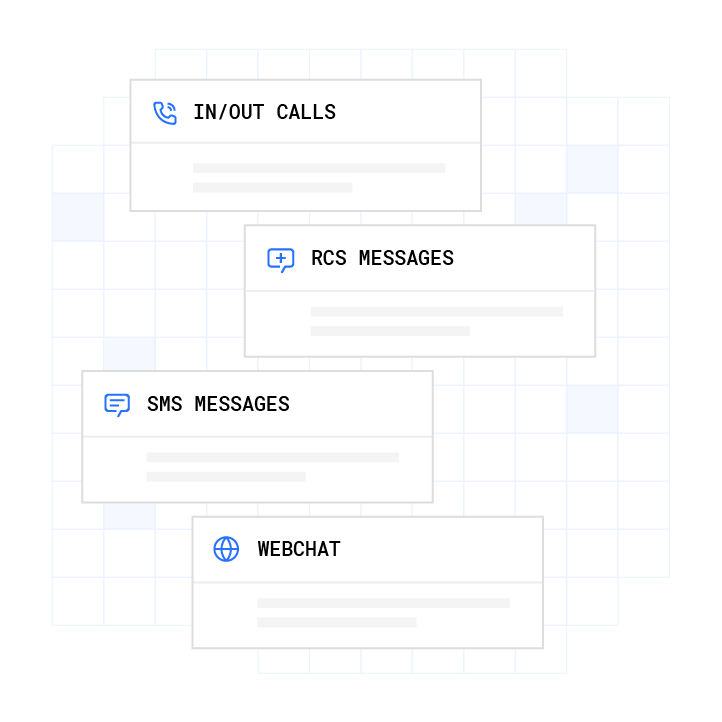
The pattern across channels is consistent. The less control you have over who can see a message, the less clinical detail that channel should carry. The table below maps each channel to what it can and cannot carry, with the compliance rationale drawn from 45 CFR 164.312 and HHS OCR guidance. Consult qualified counsel for your specific deployment.
| Channel | Permitted Content | Prohibited Content | Why |
|---|---|---|---|
| SMS | Appointment reminders, portal links, neutral callbacks | Diagnoses, treatment details, condition-specific content | Standard SMS lacks end-to-end encryption |
| Administrative items, forms, general instructions | Clinical questions, care plans, PHI in subject lines | Standard email is not secure for PHI without encryption. Encryption is an addressable implementation specification under 45 CFR 164.312(a)(2)(iv) and (e)(2)(ii), meaning it must be implemented where reasonable and appropriate or the entity must document why not and apply an equivalent safeguard. | |
| Voicemail | Generic callback requests | Condition, treatment, appointment type revealing diagnosis | Message may be heard by others. HHS permits limited voicemail with reasonable safeguards. |
| Webchat | Scheduling, general inquiries, portal routing | Clinical discussions before identity verification | Webchat requires a HIPAA-aligned platform: a signed BAA, Security Rule safeguards such as access controls and audit logs, and encryption in transit and at rest. Encryption alone is not sufficient. |
| Live Call | Full PHI after identity verification | PHI before two-factor verification | Public telephone network is not encrypted. Identity verification functions as the gate. |
| Secure Portal | All PHI, clinical content, documents | N/A – designed for PHI | Secure patient portals can serve as the primary secure channel because they combine encryption, authentication, auditing, and chart integration, consistent with the technical safeguard standards in 45 CFR 164.312. |
BAA Checklist For Lead Management Vendors
Under 45 CFR 164.502(e) and 164.308(b), a covered entity may disclose PHI to a business associate only after obtaining satisfactory assurances in a written BAA. A business associate is any person or entity that creates, receives, maintains, or transmits PHI on behalf of a covered entity. That definition is broad. The following vendor categories typically require a BAA before any PHI flows to their systems. Confirm your specific situation with qualified counsel.
The same test applies to every category. Does the vendor create, receive, maintain, or transmit PHI on your behalf?
- CRM: Qualifies if it stores or processes PHI
- Form builder: Qualifies if form submissions include PHI
- Texting platform: Qualifies if messages contain PHI or route to PHI
- AI vendor: Qualifies if AI processes PHI in prompts, training, or outputs
- Email provider: Qualifies if email contains PHI
- Cloud hosting: Qualifies if infrastructure stores ePHI
Morgan Lewis’s May 2026 healthcare AI compliance analysis notes that a BAA must explicitly permit the contemplated data flows in the operating environment. A BAA covering general cloud services does not automatically cover AI/ML services running on that infrastructure.
What the BAA must cover, per 45 CFR 164.504(e):
- Permitted uses and disclosures
- Prohibition on further use or disclosure
- Safeguards commitment
- Breach reporting timeline (contracts may set a shorter window than 60 days)
- Subcontractor flow-down
- Return or destruction of PHI at termination
Confirm a signed BAA exists before any PHI touches a vendor’s system. This checklist describes the framework and does not replace legal advice.
AI vendors are the category where that rule is most often missed, because PHI can enter a system through a prompt rather than a database.
How AI Interacts With HIPAA Rules
HHS OCR has stated that ePHI contained in AI training data, prediction models, and algorithm data maintained by regulated entities is protected by the HIPAA Rules. An AI system acting on behalf of a workforce member is held to the same access control and minimum necessary requirements as that employee. Without a signed BAA, sending PHI to an AI vendor is itself a HIPAA issue regardless of downstream use, per the BAA requirements at 45 CFR 164.502(e) and 164.308(b).
Analysis of healthcare AI deployments identifies broad API scopes and persistent conversation context as two common ways AI systems can miss the minimum necessary standard. An agent that retrieves an entire patient record and then discards irrelevant fields has already missed the standard at the point of query, before any output is produced.
The most common compliance gap in healthcare AI is teams using general-purpose AI APIs without BAAs for tasks that inadvertently include PHI in prompts. A BAA alone is also insufficient. Engineering controls should enforce PHI boundaries, including scanning prompts for PHI before sending to external models and blocking PHI from reaching non-BAA APIs entirely.
See how Plura handles PHI boundaries at the platform level before any outbound contact is made.
AI Platforms And HIPAA-Aligned Deployments
No LLM is HIPAA compliant in isolation. Compliance is a property of the deployment. Major AI providers offering BAAs for enterprise services include AWS Bedrock, Google Cloud Vertex AI, Azure OpenAI Service, Anthropic (enterprise/API), and OpenAI (enterprise/API).4 Consumer tiers of ChatGPT and Claude.ai do not offer BAAs, which creates exposure if used with PHI.
Plura runs on 100% U.S. infrastructure by architecture. HIPAA-aligned encryption, access controls, and audit logging are enforced at the platform level, and the Stateful Conversation Database maintains context across AI voice, AI SMS, RCS, and AI webchat. Before any outbound contact, the platform runs real-time DNC scrubbing, TCPA-litigator screening, automated quiet hours, and immutable consent logging.
Upcoming HIPAA Security Rule Changes
As of September 2026, the HIPAA Security Rule modernization proposed January 6, 2025 (90 FR 898) remains proposed, not final. HHS pushed the target date for final amendments from May 2026 to July 2027, and the rulemaking’s status changed from “final rule stage” to “long term actions” on reginfo.gov (RIN 0945-AA22).5 Current Security Rule requirements still govern until a final rule is issued.
The proposed rule would eliminate the addressable category, mandate encryption at rest and in transit, require multi-factor authentication (MFA), and require annual compliance audits. Industry analysis notes that the proposed requirements represent what an honest risk analysis under the current rule at 45 CFR 164.306 would already conclude is reasonable and appropriate for many environments.
Separately, HHS OCR’s Risk Analysis Initiative, launched in late 2024, has produced a steady run of settlements targeting entities that never conducted a compliant risk analysis. On April 23, 2026, HHS OCR announced four simultaneous ransomware settlements totaling $1,165,000, all citing the same deficiency: no accurate and thorough risk analysis before the breach.
Those settlements show that enforcement is active under the current rule. The same rule still allows fast lead response, and the benchmarks below show how much speed is available inside a compliant workflow.
Measuring HIPAA-Aligned Response Speed
HIPAA-compliant lead response can still move quickly. Plura delivers the sub-5-second response described earlier, across the same channels, with compliance enforced inside the platform before dial. Healthcare Call Center’s patient lead response research finds that 78% of patients go with the first practice that responds, and that practices responding within 5 minutes are 400% more likely to book than those taking an hour or more. Healthcare has the slowest average lead response time of any industry at approximately 2 hours and 5 minutes.
Plura also supports up to a 40% improvement in no-shows through automated follow-up across compliant channels. For speed-to-lead benchmarks and ROI modeling, run your numbers through Plura’s ROI calculator.
Frequently Asked Questions
Can AI Violate HIPAA?
Yes. See the section “How AI Interacts With HIPAA Rules” above for the BAA and minimum necessary analysis. The short version: without a signed BAA, sending PHI to an AI vendor can itself trigger HIPAA obligations.
Which AI Platforms Are HIPAA Compliant?
No LLM is compliant in isolation. See “AI Platforms And HIPAA-Aligned Deployments” above for details on enterprise BAAs and deployment controls.
What Are the New HIPAA Compliance Requirements for 2026?
The Security Rule modernization remains proposed as of September 2026. See “Upcoming HIPAA Security Rule Changes” above for the timeline and the list of proposed changes.
What Can You Say in a Lead Response Without Breaking HIPAA?
A first-touch response can acknowledge the inquiry, offer scheduling options, and route clinical content to a secure portal. See “Scripts For HIPAA-Safe First-Touch Lead Responses” above for templates built around the minimum necessary standard at 45 CFR 164.502(b).
Which Vendors Require a BAA Before Handling PHI?
Any vendor that creates, receives, maintains, or transmits PHI on behalf of a covered entity typically qualifies as a business associate. See “BAA Checklist For Lead Management Vendors” above for common categories and flow-down obligations.
Conclusion: Compliant Response Is an Engineering Problem
HIPAA defines what can travel over each channel and where PHI belongs. It still allows fast response. The scripts, channel rules, and vendor requirements in this playbook translate that framework into day-to-day operations.
Plura AI makes HIPAA-compliant lead response an engineering and scripting problem operators can solve. The platform runs on 100% U.S. infrastructure by architecture and uses its own FCC-licensed audio bridging carrier. SOC 2 Type II certification, HIPAA-aligned encryption, and audit logging are in place, and compliance is enforced inside the platform before dial.
To see what that changes for your cost per booked appointment, run your numbers through Plura’s ROI calculator, then book a live demo with Plura to see the workflow end to end.
1 Plura AI maintains SOC 2, HIPAA, ISO, and GDPR posture as part of its platform infrastructure. References to compliance frameworks in this article describe Plura’s platform capabilities and do not constitute a guarantee that any customer using Plura will themselves be compliant with applicable laws or standards. Customers remain solely responsible for their own regulatory obligations, certifications, consent management, recordkeeping, and the claims they make to their own end users. Consult qualified legal counsel for guidance specific to your use case.
2 This article describes regulatory frameworks at a general level and does not constitute legal advice. Laws and regulations vary by jurisdiction, change over time, and apply differently depending on facts and circumstances. Readers should consult qualified legal counsel before making compliance decisions.
3 Performance figures, customer outcomes, and industry statistics referenced in this article are drawn from cited third-party sources or Plura customer case studies. Individual results vary based on implementation, use case, industry, audience, and execution. Past or aggregate performance is not a guarantee of future results.
4 References to third-party products, services, companies, or research are made for informational and comparative purposes only. Plura AI is not affiliated with, endorsed by, or sponsored by any third party named in this article unless explicitly stated. Trademarks and product names referenced remain the property of their respective owners.
5 This article contains forward-looking statements regarding industry trends, technology adoption, and future capabilities. These statements reflect current expectations and are subject to change. Plura AI undertakes no obligation to update forward-looking statements except as required.
This article is provided for informational purposes only and reflects Plura AI’s understanding at the time of publication. Product capabilities, integrations, and specifications are subject to change. For the most current information, visit plura.ai.
This article was produced with the assistance of AI tools and reviewed by Plura AI prior to publication.