
Written by: Matt Beucler, CEO, Plura AI | Last updated: August 28, 2026
Key Takeaways for Contact Center Leaders
- Lead response time is the gap between lead receipt and first successful contact. Plura AI targets a 2-minute median and 90% of leads contacted within 5 minutes.
- Industry benchmarks show that responding within five minutes can increase contact odds 100× and conversion odds 21× compared to a 30-minute delay, with a 3,593% revenue gap on identical leads.3
- High-volume call centers should track three CRM timestamps for every lead: lead_received, first_attempt, and first_successful_contact, then monitor both median and P90 to expose tail failures that averages hide.
- Replacing 15 human agents ($60,000 per month at 40% utilization) with 6 Plura AI agents ($14,400 per month at 100% utilization) delivers $547,200 in annual savings and removes attrition and ramp-time costs from the staffing model.3
- Plura AI’s carrier-level compliance engine supports real-time DNC scrubbing, one-to-one consent, quiet-hours controls, and STIR/SHAKEN authentication, so teams can pursue aggressive SLAs while supporting compliance.1 Book a live demo to see the playbook in action.
Clear Definition of Lead Response Time
Lead response time equals first successful contact timestamp minus lead-received timestamp. An automated acknowledgment starts the clock but does not stop it. The clock stops when a live conversation, qualification exchange, or warm transfer is completed.
Industry Benchmarks for 2026 Lead Response
The 2026 Speed-to-Lead Benchmark from ArtemisGTM reports a median B2B inbound lead response time of 42 hours, with 12% of companies responding to B2B inbound leads within five minutes and 14% of companies responding after 24 or more hours per the 2026 ArtemisGTM benchmark.4 Industry variation is wide. Roughly 5% of FinTech teams respond within five minutes compared with about 15% in RevOps tools.
The foundational data behind the five-minute rule comes from the Lead Response Management Study led by Dr. James B. Oldroyd at MIT Sloan with InsideSales.com, which analyzed more than 15,000 web leads and 100,000 call attempts.4 Contact odds at five minutes were 100 times higher than at 30 minutes, and qualification odds were 21 times higher. A Velocify analysis of millions of leads found that calling within the first minute lifts conversion by approximately 391%, decaying to 160% at two minutes and 62% at 30 minutes.4
Based on B2B software data with a $4,970 average deal size, leads responded to in under one minute achieve an 87% contact rate and 18% close rate, generating $89,400 revenue per 100 leads. Leads responded to after 24 hours achieve an 8% contact rate and 0.5% close rate, generating $2,488 per 100 leads. That is a 3,593% revenue gap on identical leads.
Call-Center-Specific SLAs for Speed-to-Lead
Given the impact of response speed on contact and conversion rates, high-volume operations need precise SLA targets by lead type and channel. The table below translates the research findings into operational thresholds that contact center and marketing leaders can configure directly in their CRM.
| Lead Type | Channel | Target (Median) | P90 Ceiling |
|---|---|---|---|
| Inbound web form / high-intent | AI SMS auto-reply | <5 seconds | <30 seconds |
| Inbound web form / high-intent | AI Voice outbound | <2 minutes | <5 minutes |
| Missed inbound call | AI Voice callback | <5 minutes | <10 minutes |
| Standard MQL (Marketing Qualified Lead) | AI SMS or AI Voice | <15 minutes | <60 minutes |
The overall operational target is a median first contact at or below 2 minutes, with 90% of all leads contacted within 5 minutes. Teams responding within five minutes convert leads at 11.4% versus 0.6% for teams responding after 24 hours, a 19x performance gap on identical leads.
How to Track Median and P90 Response Time
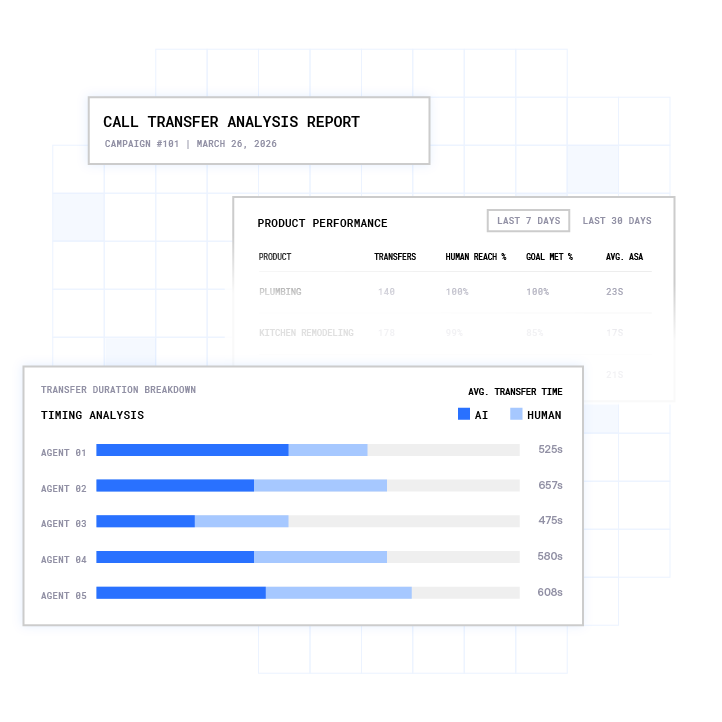
Averages hide tail failures. CRM analyses show that teams with acceptable average response times may still leave many leads untouched for hours. The average looks acceptable, and the P90 (90th percentile) exposes the problem.
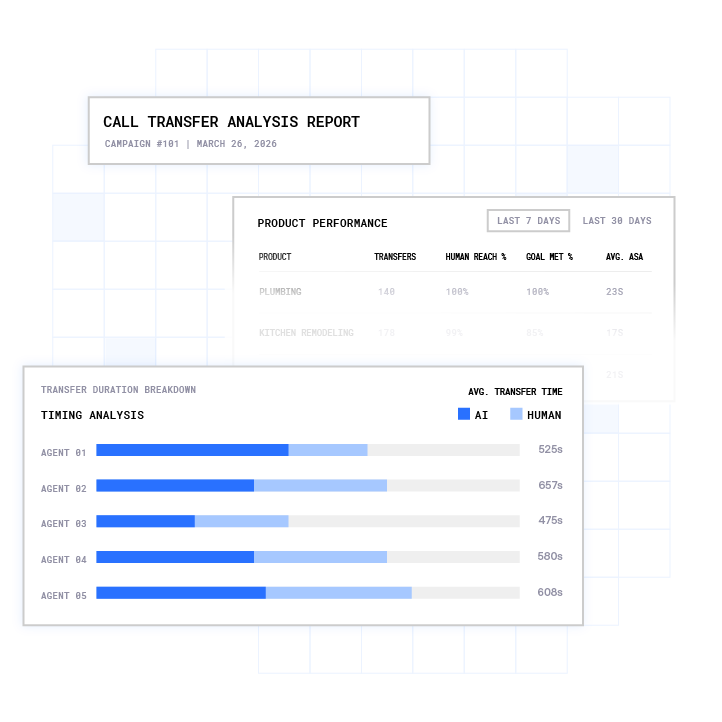
Instrument three timestamps in your CRM on every lead record:
- lead_received_timestamp: when the form, call, or SMS arrived in the system.
- first_contact_attempt_timestamp: when the first outbound dial or SMS fired.
- first_successful_contact_timestamp: when a live conversation or qualification exchange was completed.
Calculate median and P90 across both attempt and successful contact. Set an sla_breach_flag automatically when the attempt timestamp exceeds the SLA ceiling for that lead type. Review P90 weekly, not monthly. A P90 above 10 minutes on high-intent leads signals a revenue leak, not a reporting footnote.
Human vs. AI Agent Economics for Speed-to-Lead
The cost comparison below uses the default inputs from Plura’s ROI calculator. Fully loaded cost for human agents includes salary, taxes, benefits, commissions, and real estate. Talk utilization is the percentage of paid hours an agent spends in active conversation. Measured averages for agent utilization are about 48% in IT service desks and typically 60 to 80% in customer-facing contact centers.
| Model | Agents | Monthly Cost | Talk Utilization |
|---|---|---|---|
| 15 human agents at $20/hr + 25% overhead | 15 | $60,000 | 40% |
| 6 Plura AI agents at $15/hr equivalent | 6 | $14,400 | 100% |
The 30-day saving is $45,600. Over 12 months that is $547,200. Over 60 months, $2,736,000.3 Six Plura agents replace 15 human agents because AI runs at 100% talk utilization with no breaks, no PTO, no ramp time, and no attrition. Agent turnover in contact centers runs 30 to 45% annually, with each replacement costing $10,000 to $20,000 in recruiting and ramp-up expenses. That cost does not appear in the hourly rate but it appears in the P&L.
Run your numbers through Plura’s calculator to check your ROI in real time.
Real-Time Compliance Routing for Fast Outreach
Speed without compliance creates material risk. TCPA (Telephone Consumer Protection Act, 47 U.S.C. § 227) statutory damages run $500 per violation and $1,500 per willful violation, with each call or text counted separately.2 A single high-volume campaign without proper consent can generate eight-figure exposure before class certification.
Plura’s compliance engine runs a coordinated set of checks before every outbound contact, at the carrier level, without third-party CPaaS wrappers:
- Real-time DNC scrubbing: every number is checked against federal and state DNC (Do Not Call) registries before dial. Non-compliant numbers are blocked before the first attempt.
- One-to-one consent enforcement: the FCC’s consent rule, effective January 27, 2025, describes that consumer opt-ins authorize calls from one named seller.2 Plura’s consent records are timestamped, immutable, and audit-ready.
- Quiet-hours enforcement: federal TCPA rules describe limits on telemarketing calls before 8:00 AM or after 9:00 PM in the called party’s local time zone, with stricter state limits in Florida, Connecticut, and others. Plura applies these automatically through time-zone detection on every contact.
- TCPA-litigator screening: high-risk numbers are flagged before dial so operations teams can manage exposure.
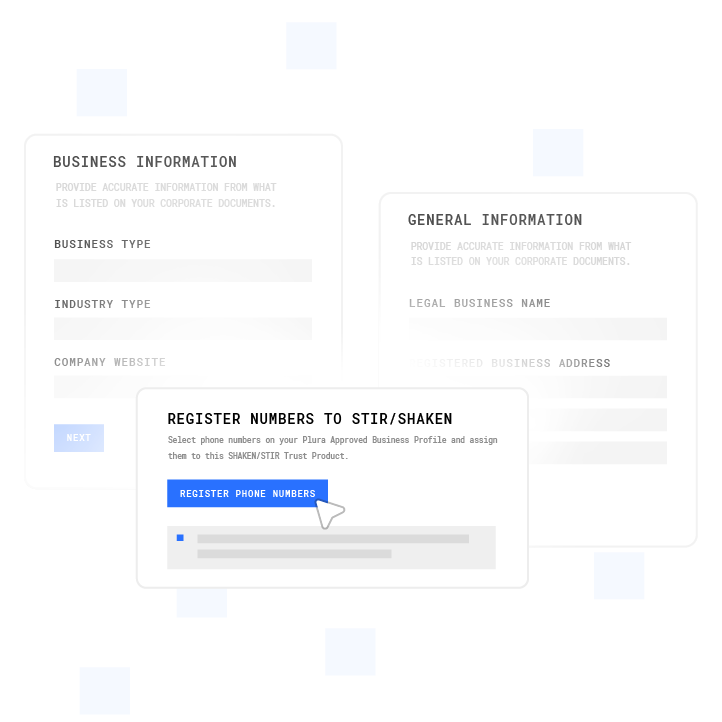
- STIR/SHAKEN authentication: caller ID is authenticated on every outbound call through Plura’s own FCC-licensed carrier, not a reseller’s identity.
Plura supports customer compliance with TCPA, DNC, HIPAA, SOC 2, and 50+ state rule sets.1 Customers remain responsible for their own regulatory obligations and consent programs. Leaders should consult qualified counsel on their specific compliance posture.
Plura’s AI voice agent, AI SMS, and AI predictive dialer all inherit this compliance layer by default.
Workflow Examples for High-Intent Leads
Flow 1: Inbound web lead to warm transfer
- Lead submits a high-intent form.
- Plura’s AI SMS sends an automated acknowledgment in under 5 seconds.
- At the same time, the AI voice agent dials the lead within 90 seconds.
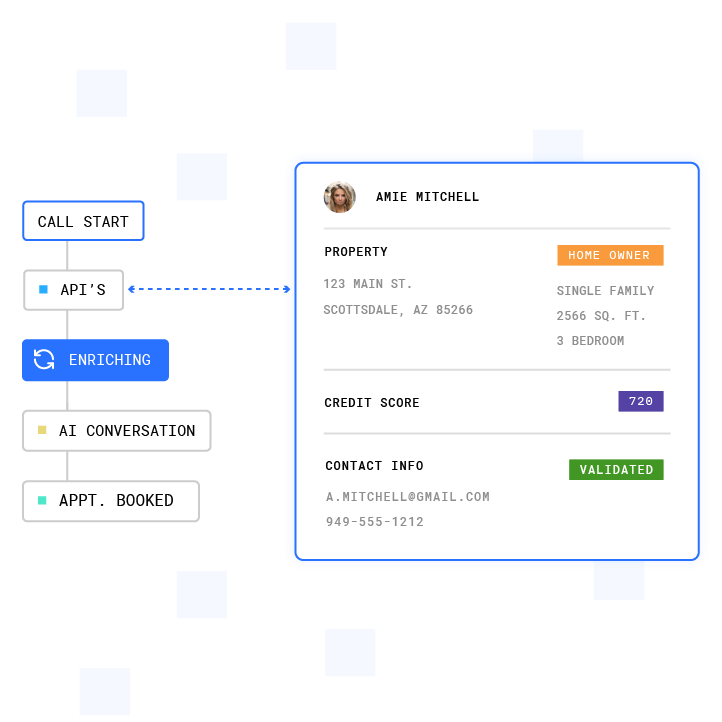
- The AI qualifies the lead using 30+ enrichment data sources in real time during the call.
- A qualified buyer is warm-transferred to a U.S. agent with full conversation context from the Stateful Conversation Database.
Flow 2: Missed inbound call recovery
- An inbound call goes unanswered.
- A webhook triggers an AI voice callback within 5 minutes.
- If there is no answer, AI SMS sends a personalized follow-up immediately.
- All attempts are logged to the CRM with timestamps for SLA tracking.
Flow 3: High-intent form with stateful cross-channel memory
- A lead fills a pricing or demo request form.
- AI SMS acknowledges in under 5 seconds with a personalized message referencing the form content.
- The lead replies via SMS, and the AI holds a qualification conversation.
- When the AI voice agent calls, it already knows the SMS exchange, the lead’s enrichment profile, and any objections raised, because all channels share the same Stateful Conversation Database.
Implementation Checklist for Contact Center Teams
- Define SLAs by lead type: set median and P90 targets for each tier using the table above as a baseline. These targets establish the performance thresholds you will measure.
- Instrument your CRM: add lead_received_timestamp, first_contact_attempt_timestamp, first_successful_contact_timestamp, and sla_breach_flag to every lead record. Without these fields, you cannot see whether you are meeting the SLAs you just defined.
- Audit consent capture: verify that every lead source provides one-to-one consent documentation including IP address, timestamp, form URL, and the named seller. Perform this review before routing any leads through the new workflow, and consult counsel on your consent program.
- Configure carrier routing: route all outbound voice through Plura’s FCC-licensed carrier to enable branded caller ID, STIR/SHAKEN authentication, and pre-dial DNC scrubbing.
- Build compliance rule sets: configure federal and state quiet-hours, per-state attempt limits, and TCPA-litigator screening inside Plura’s compliance engine before go-live.
- Run a pilot: test on a subset of real leads for two weeks. Measure median and P90 response time, contact rate, and qualification rate against your baseline.
- Measure and iterate: review P90 weekly. Use conversation intelligence to identify objection patterns and tune workflows.
- Quarterly compliance audit: re-verify consent documentation, DNC scrub recency, and state rule-set updates. Export audit-ready reports from Plura’s compliance dashboard.
Book a live demo with Plura to walk through this checklist against your current operation.
Frequently Asked Questions
How quickly should you respond to a lead?
The research-supported target for high-intent inbound leads is under five minutes, with a sub-two-minute median response as the operational goal for call centers running at volume. Contact odds fall 100 times between the five-minute mark and the 30-minute mark. Conversion lift from a sub-one-minute response is approximately 391% compared to longer delays. For automated acknowledgment via AI SMS, the target is under five seconds. For a live qualification conversation via AI voice, the target is under two minutes. These thresholds mark the points at which contact and conversion rates materially change.
What is an acceptable hold time in a call center?
For inbound calls, the industry standard service level is 80% of calls answered within 20 seconds, often written as 80/20. For lead response specifically, hold time matters less than speed to first outbound contact. A lead who submitted a form and is waiting for a call back experiences response latency, not hold time. The SLA that matters is the time between form submission and first outbound dial, not the time a caller waits in queue. AI voice agents answer inbound calls on the first ring with zero hold time and initiate outbound dials within seconds of lead receipt, which is structurally different from a human-staffed queue.
How do you calculate how many agents you need to meet a 5-minute response SLA?
Human agent headcount for a five-minute SLA is typically calculated using the Erlang C queueing formula. This model takes call volume per interval, average handle time (AHT), and target answer time as inputs, then adjusts for shrinkage such as breaks, training, PTO, and absenteeism, which often runs 25 to 35% in contact centers. At 40% talk utilization, a human agent is in live conversation for roughly 19 of every 47 paid minutes. To staff a five-minute SLA at peak volume with humans, leaders need significant headcount buffer for the busiest intervals. Plura agents run at 100% talk utilization with no shrinkage, which is why six AI agents replace 15 human agents on equivalent volume. The Plura ROI calculator lets you input your own volume and AHT to see the staffing math for your operation.
What is the difference between median and P90 response time, and why does it matter?
Median response time is the midpoint, where half of leads are contacted faster and half slower. P90 (90th percentile) is the response time at which 90% of leads have been contacted. Averages mask tail failures. A team with a 3-minute average response time may still have 10 to 15% of leads sitting untouched for 30 minutes or more, because a few very fast responses pull the average down. P90 exposes those tail failures. For SLA management, track both. Median shows how the typical lead is handled, and P90 shows how the worst-served 10% are handled. Both should be instrumented in the CRM with automatic breach flags, not calculated manually in a spreadsheet after the fact.
How does TCPA compliance work when using AI voice agents for rapid lead response?
The FCC’s February 2024 Declaratory Ruling classifies AI-generated voices as artificial voices under the TCPA, applying the same consent framework as prerecorded calls. Prior express written consent is the standard described for many marketing calls and texts to wireless numbers. The FCC’s one-to-one consent rule, effective January 27, 2025, describes that consent should name one specific seller, and blanket consent covering multiple buyers does not meet that description. Quiet-hours restrictions apply at the called party’s local time zone, with state-level variations that are stricter than federal minimums in several states. Plura’s compliance engine checks DNC registries, applies quiet-hours rules, and maintains immutable consent records before every outbound contact. Operators are responsible for their own consent programs and regulatory obligations, and should consult qualified legal counsel on their specific TCPA posture before deploying any outbound AI voice or SMS campaign.
What does “stateful cross-channel memory” mean in a call center context?
Stateful cross-channel memory means that every interaction a lead has with your operation, whether via AI SMS, AI voice, AI webchat, or a human agent, is stored in a single database keyed to that lead’s phone number, email, or ID. When the AI voice agent calls a lead who already replied to an SMS, it knows what was said in that SMS thread, what objections were raised, what offers were made, and what the lead’s qualification status is. The lead does not repeat themselves. The agent does not start from zero. In a traditional call center with separate SMS and voice platforms, this context is lost at every channel handoff. Plura’s Stateful Conversation Database closes that gap across all four channels.
Conclusion: Turning Speed-to-Lead into a Repeatable System
Lead response time call center performance comes down to one number: how many minutes pass between lead received and first successful contact. The research is consistent across 15 years of studies. The five-minute window is where contact rates and conversion rates are won or lost. A median target of 2 minutes or less, with 90% of leads contacted within 5 minutes, forms the operational SLA that separates top-quartile performers from the 93% of teams still responding in hours.
The staffing math to hit that SLA with human agents is expensive and fragile. The staffing model shown above, with human agents running at 40% talk utilization and 30 to 45% annual attrition, cannot deliver sub-2-minute median response at scale without constant rehiring and retraining. Plura agents run at 100% talk utilization, with sub-5-second automated acknowledgment and real-time compliance routing on Plura’s own FCC-licensed carrier, which supports consistent performance at volume.
The compliance layer is not optional for high-volume outreach. TCPA violations carry statutory penalties that can reach eight figures in class actions. One-to-one consent, real-time DNC scrubbing, quiet-hours controls, and immutable consent records function as operational requirements for outbound programs in 2026. Plura’s compliance engine applies these controls at the carrier level before every dial, supporting operators as they build their own compliant programs. Operators remain responsible for their own consent programs and regulatory obligations.
Run your numbers through Plura’s calculator to check your ROI in real time.
Book a live demo with Plura to see the SLA playbook applied to your operation.
1 Plura AI maintains SOC 2, HIPAA, ISO, and GDPR posture as part of its platform infrastructure. References to compliance frameworks in this article describe Plura’s platform capabilities and do not constitute a guarantee that any customer using Plura will themselves be compliant with applicable laws or standards. Customers remain solely responsible for their own regulatory obligations, certifications, consent management, recordkeeping, and the claims they make to their own end users. Consult qualified legal counsel for guidance specific to your use case.
2 This article describes regulatory frameworks at a general level and does not constitute legal advice. Laws and regulations vary by jurisdiction, change over time, and apply differently depending on facts and circumstances. Readers should consult qualified legal counsel before making compliance decisions.
3 Performance figures, customer outcomes, and industry statistics referenced in this article are drawn from cited third-party sources or Plura customer case studies. Individual results vary based on implementation, use case, industry, audience, and execution. Past or aggregate performance is not a guarantee of future results.
4 References to third-party products, services, companies, or research are made for informational and comparative purposes only. Plura AI is not affiliated with, endorsed by, or sponsored by any third party named in this article unless explicitly stated. Trademarks and product names referenced remain the property of their respective owners.
This article is provided for informational purposes only and reflects Plura AI’s understanding at the time of publication. Product capabilities, integrations, and specifications are subject to change. For the most current information, visit plura.ai.
This article was produced with the assistance of AI tools and reviewed by Plura AI prior to publication.