
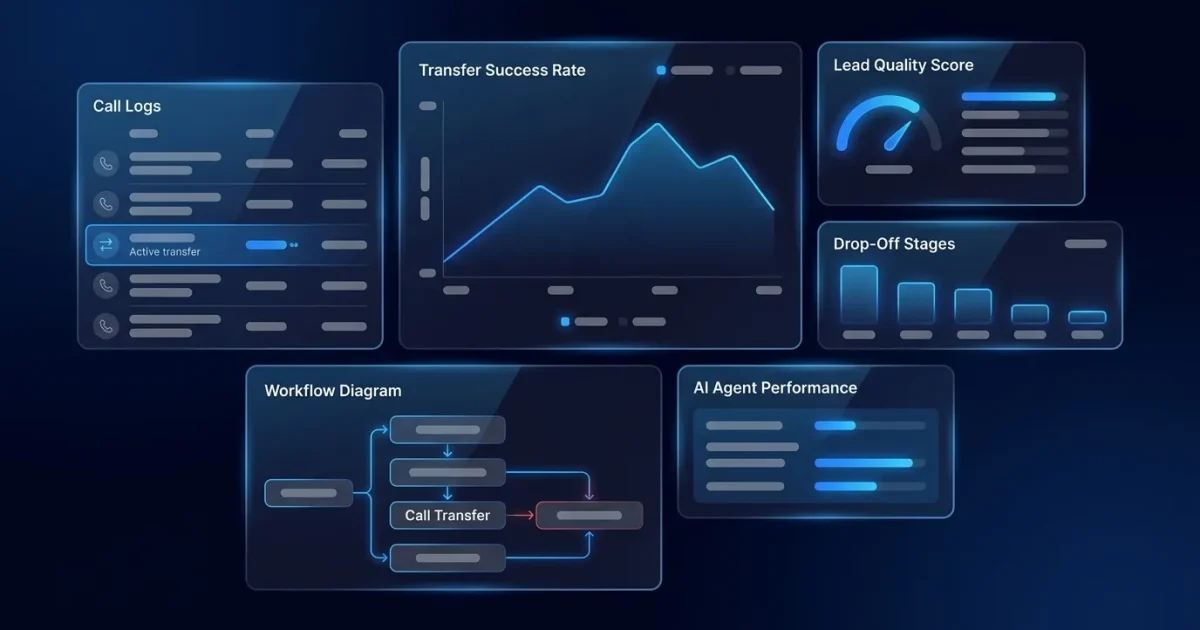
Written by: Matt Beucler, CEO, Plura AI
Key Takeaways
- Live transfer programs fail at predictable points: excessive hold times, high per-transfer costs, inconsistent screening, refund friction, and downstream TCPA/DNC liability. These failures erode margins when close rates slip.
- Volume-first vendor incentives push fronters to loosen qualification criteria and rush intake, which delivers lower-quality transfers that buyers still pay full price for.
- Hold time above 30 seconds, silence during handoff, availability mismatch, and context loss drive significant drop rates and close-rate erosion, detailed in the cost section below.
- Operators can reduce losses by documenting every transfer, enforcing written qualification rubrics, auditing calls, and renegotiating terms when accuracy falls below 85 percent or dispute rates exceed 10 percent.
- Plura AI eliminates these pain points through AI-mediated handoffs: the AI qualifies prospects, passes full context, scrubs DNC in real time, and warm-transfers buyers to agents. See how it works.
Why Live Transfer Leads Skew Lower Quality
Vendor incentives sit at the root of most live transfer quality problems. Most live transfer vendors receive compensation per transfer delivered, not per transfer that closes. That model pushes fronters toward the loosest defensible reading of what counts as qualified. Under volume-first incentive structures, qualification criteria agreed at onboarding get interpreted generously when monthly targets are at risk. Prospects expressing general curiosity get booked, and disqualification conversations get avoided because they reduce transfer count.
Rushed intake scripts compound the problem. A fronter working a predictive dialer at volume has 60 to 90 seconds to screen a prospect before the licensed-agent queue goes cold. That window rarely covers intent, budget, and authority. Some call centers use minimal screening, confirming the prospect is alive and breathing, then transfer. The buyer pays the same per-transfer price regardless of screening depth.
Misaligned vendor compensation creates a third structural drag on quality. Per-transfer pricing from a BPO (business process outsourcer) incentivizes volume over quality, while per-hour pricing with performance bonuses better aligns the provider’s incentives with transfer quality rather than quantity. Operators buying on a per-transfer basis fund a model structurally motivated to over-transfer. The result appears as a qualification accuracy problem that shows up as a close-rate problem, and the buyer absorbs the cost of both.
What Live Transfer Pain Points Actually Cost You
Live transfer economics work when close rates hold and collapse when close rates slip. Marketplace live transfer pricing by vertical runs from $35 to $55 per transfer for auto insurance, $40 to $80 for Medicare and ACA, $45 to $90 for life insurance, $50 to $100 for solar, and $60 to $150 for debt consolidation. At 50 transfers per day and $50 per transfer, that is $2,500 per day in lead acquisition alone, or roughly $55,000 per month before agent labor, dialer costs, or compliance overhead.3
Agent labor adds a significant fixed cost. Domestic contact center agents cost $15 to $25 per hour before benefits and overhead4, and industry average annual agent turnover in contact centers runs 30 to 45 percent4. That turnover drives constant recruiting and retraining on top of base labor. Contact center agent training takes 6 to 8 weeks before handling live calls, so staffing for a live transfer program behaves like a semi-fixed cost, not a clean variable tied to volume.
Missed transfers convert directly into 100 percent losses. A missed live transfer does not go to voicemail; it goes to dial tone. The transfer cost still hits the budget. The prospect moves to the next agent in the queue or drops. Estimates put 15 to 25 percent of live transfers resulting in a hang-up before a real conversation begins, raising the effective cost per real conversation from $50 to $62.50 when 20 percent of transfers are no-shows.
The compounding effect creates the largest losses. A program running at a 25 percent close rate on $50 transfers produces a $200 cost per sale. At a 15 percent close rate on $50 leads, the cost per acquisition is $833. At $150 per live transfer, a 20 percent close rate produces a cost per funded deal of about $750, while a 35 percent close rate lowers that to about $429. The transfer price stays constant while the close rate moves. That gap turns a working channel into a losing one.
What Causes Live Transfer Drop-Off During Handoff
Drop-off during handoff traces to four operational failure modes: hold time, silence, availability mismatch, and dropped calls. Each has a diagnosable root cause and a specific fix.
Hold time. SQM Group research across 500-plus North American contact centers found that calls with hold time scored 15 percent lower CSAT (customer satisfaction score) and 19 percent lower FCR (first-call resolution) than calls without hold time4. Operational targets for transfer health in regulated outbound voice set hold time on transfer at under 30 seconds, with hold times above 60 seconds showing up as drop-rate spikes and re-quote requests. Licensed-agent staffing misalignment drives this: the fronter desk has no real-time view of the licensed-agent queue, so transfers fire into a queue that cannot absorb them at pace.
Silence and cold handoffs. Transferred calls scored 12 percent lower CSAT than non-transferred calls, and 19 percent of customers were transferred during their call. The silence problem is structural because most warm transfers operate as cold transfers in practice. A warm transfer requires the fronter to stay on the line through the handoff, introduce the prospect to the licensed agent verbally, convey context, and only drop once the licensed agent acknowledges acceptance. When that sequence collapses into a blind transfer, the prospect arrives with no introduction and no context, and the receiving agent starts from zero.
Availability mismatch. A transfer acceptance rate below 60 percent means the fronter is over-transferring, while above 90 percent means the fronter is qualifying too tightly and burning leads. When licensed-agent staffing falls behind dialer pace, hold time rises, drop rate rises, and post-transfer close rate falls within the same week. These SLAs interact, so fixing one without the others simply shifts the failure to a different mode.
Context loss after transfer. Research from SQM Group found that customers who receive a warm transfer report higher satisfaction and first-call resolution than those who are cold-transferred, largely because they do not have to repeat their information. When context does not travel with the call, the receiving agent asks the prospect to start over. That repetition turns a recoverable conversation into a dropped deal.
Watch a live transfer in action to see how AI-mediated handoffs remove hold time, silence, and context loss inside a single transfer flow.
The Live Transfer Lifecycle Failure-Stage Table
The four failure modes above map to specific stages of the transfer lifecycle. The table below shows where each failure occurs, what causes it, and the countermeasure that addresses it.
| Transfer Stage | Failure Mode | Operational Root Cause | Countermeasure |
|---|---|---|---|
| Before Transfer | Wrong qualification or routing; prospect does not meet buyer’s criteria | Volume-first vendor incentives push fronters to interpret qualification criteria loosely under deadline pressure | Require a written qualification rubric in the vendor contract; track qualification accuracy (target 85 percent or higher, per CallForce Global’s 2026 guide); audit 10 to 15 percent of calls |
| During Transfer | Hold time above 30 seconds, silence, or dropped call | Fronter desk has no real-time view of the licensed-agent queue; dialer pace exceeds agent availability | Enforce hold-time SLA under 30 seconds and drop rate under 5 percent in writing; staff two licensed agents per active campaign hour; use a warm bridge that keeps the fronter on the line through introduction |
| After Transfer | No context passed; agent asks prospect to repeat information | Cold or blind transfer architecture passes only the audio, not the conversation state | Require a structured context package (intent, qualification answers, captured disclosures) delivered to the receiving agent before or at bridge; measure caller-repeats rate (target under 10 percent, per Twig’s handoff research) |
| Resolution | Customer must transfer again; re-escalation to a different agent or supervisor | QA only listens to the fronter side of the call; disposition data does not close the loop back to routing | Record both halves of the call; flow post-call dispositions back to the routing layer; track re-escalation rate (target under 8 percent); audit every disputed or escalated call plus a fixed quota per fronter per week |
How to Dispute Bad Live Transfer Leads with a Vendor
Most operators absorb bad live transfer costs because they lack the documentation to dispute them. That problem becomes solvable once you build the dispute infrastructure before the bad leads arrive.
What to document on every transfer. Record the timestamp of the transfer, the fronter’s name or ID, the prospect’s phone number, the qualification answers the fronter captured, and the outcome of the receiving agent’s conversation. If the vendor records calls, request access to the recording for every disputed transfer. A provider unable to produce a specific call recording within 24 hours has an inadequate archiving system.
What constitutes a legitimate dispute. A transfer is disputable when the prospect does not meet the written qualification rubric in the vendor contract, when the prospect was not live on the call at the moment of transfer, when the transfer was not exclusive and the prospect had already spoken with a competing buyer, or when the vendor cannot produce a valid consent record for the underlying outbound contact. Many live transfer vendors sell the same prospect to two or three agents within minutes, meaning non-exclusive transfers can result in multiple buyers paying full price for the same consumer.
TCPA and DNC liability exposure. Buyers of live transfer leads carry downstream compliance exposure. Buyers receiving live transfers may face TCPA and DNC liability if the transfer vendor’s outbound calling practices intersect with regulations, since the receiving agent can be held liable for the vendor’s compliance failures2. TCPA violations can cost $500 to $1,500 per call under 47 U.S.C. § 227 and 47 CFR Part 64 Subpart L, and buyers may remain liable for violations committed by their outsourced agents.2 Operators should consult qualified counsel on their specific consent chain and review vendor documentation. Require vendors to describe one-to-one consent evidence, DNC scrub logs, and call recording disclosure practices in writing.
How to renegotiate terms. A chargeback rate above 10 percent signals leads are overpriced relative to quality, while a rate under 5 percent suggests the buyer may be disputing to manage budget. Track your dispute rate by vendor and by lead source. If qualification accuracy falls below 85 percent over a 30-day window, that data gives you leverage to renegotiate the per-transfer price or require a pre-delivery replacement policy. Contracts should also include a rejection threshold: if a batch fails spec by more than 15 percent, it triggers full batch review and rate renegotiation, plus a clawback window that credits back bounced, duplicate, or out-of-spec leads delivered in the last 30 days.
The In-House Version: SDR-to-AE Live Transfer Pain Points
The same lifecycle failures that plague vendor-supplied live transfers appear in internal SDR (sales development representative) to AE (account executive) handoffs. The failure modes stay the same while the accountability structure changes.
Before transfer, SDRs face the same volume-incentive problem as external fronters. BDRs (business development representatives) incentivized purely on meeting volume book low-quality conversations that drain sales capacity. When SDRs receive measurement on meetings booked rather than meetings that convert, qualification loosens under quota pressure.
During handoff, internal transfers suffer from the same context-loss problem as vendor transfers. In the classic cold transfer failure mode, an AI handles intake, collects the problem description, verifies account data, attempts resolution paths, fails, and then transfers to a human agent passing nothing but the customer’s phone number, forcing the customer to repeat the problem and the human to re-ask for the account number already retrieved. The same pattern plays out in SDR-to-AE handoffs when the CRM (customer relationship management system) note is thin or missing.
After transfer, according to Prospectory’s review of 200 handoff notes, AEs who receive a cold handoff spend the first three minutes of a discovery call reconstructing context the SDR already captured, with 73% of handoff notes containing nothing beyond company name and job title. Misaligned incentives between marketing and sales are a structural driver of poor lead quality: marketing teams measured primarily on lead volume optimize for broader targeting and lower-friction forms, while sales teams measured on closed revenue care about lead quality. That misalignment produces the same qualification gap internally that vendor volume incentives produce externally.
Resolution failures in internal transfers show up as re-escalation. The AE cannot close the deal because the SDR transferred a prospect who was not actually qualified, and the deal stalls or requires a second qualification conversation. If an SDR costs a company $75,000 annually and spends half their time on unqualified leads, the company burns $37,500 per year on an avoidable lead-quality problem.
What Changes When the Handoff Is AI-Mediated
Whether the handoff is vendor-supplied or internal, the same failure modes appear. The core failure modes in live transfer programs, hold time, context loss, qualification inconsistency, and compliance exposure, are infrastructure problems. AI-mediated handoffs address them at the infrastructure layer.
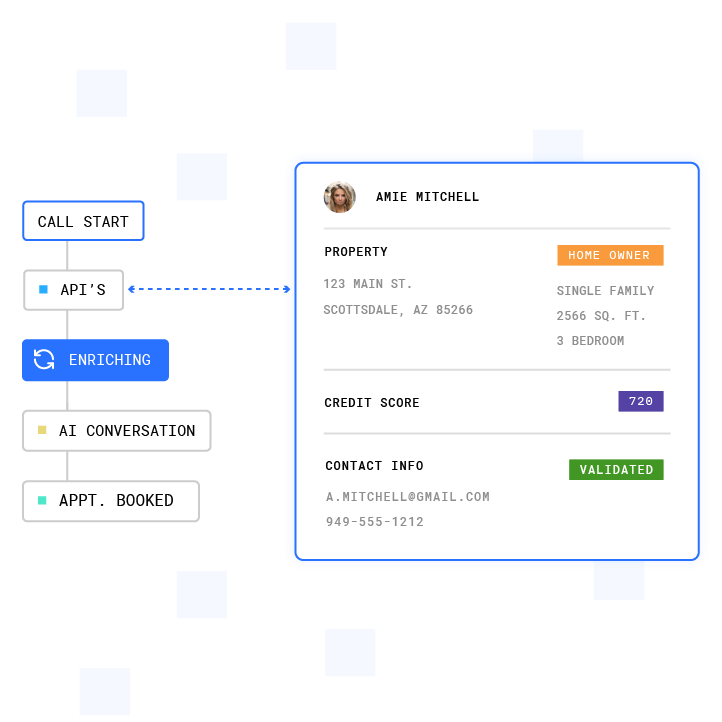
Plura AI’s AI voice agent answers and transfers with full context. Every inbound call is handled from greeting to handoff by an AI agent running on Plura’s own FCC-licensed audio bridging carrier, not a third-party CPaaS (Communications Platform as a Service). The AI qualifies the prospect, captures structured conversation state, and warm-transfers a live buyer to a U.S. agent with the full context package delivered before the bridge connects. The receiving agent does not start from zero.
Plura’s AI SMS qualifies and live-transfers warm buyers. The AI texts every new lead in seconds, holds a real qualification conversation, and calls and live-transfers a warm buyer straight to the agent. A 60-second response to a lead lifts conversions by 391%, per industry research published on plura.ai/calculator3. The AI closes that gap without requiring an agent to be available at the moment of inquiry.
Stateful conversation memory across voice, SMS, RCS (Rich Communication Services), and AI webchat keeps every interaction connected. A prospect who texted at 9 a.m. is the same prospect when the call comes at noon. The AI reads from and writes to the same Stateful Conversation Database on every channel, so the receiving agent inherits the full history of every prior touchpoint, including pricing offers made, objections raised, and qualification status.
Real-time DNC scrubbing and TCPA-litigator screening run before every dial. Every outbound contact is checked against federal and state DNC registries before the first attempt. Non-compliant numbers are blocked before dial. Consent records are timestamped, immutable, and audit-ready. Quiet-hours rules enforce automatically through time-zone detection. Operators should consult qualified counsel on their specific compliance obligations; Plura supports compliance infrastructure but does not absorb the customer’s regulatory responsibilities.
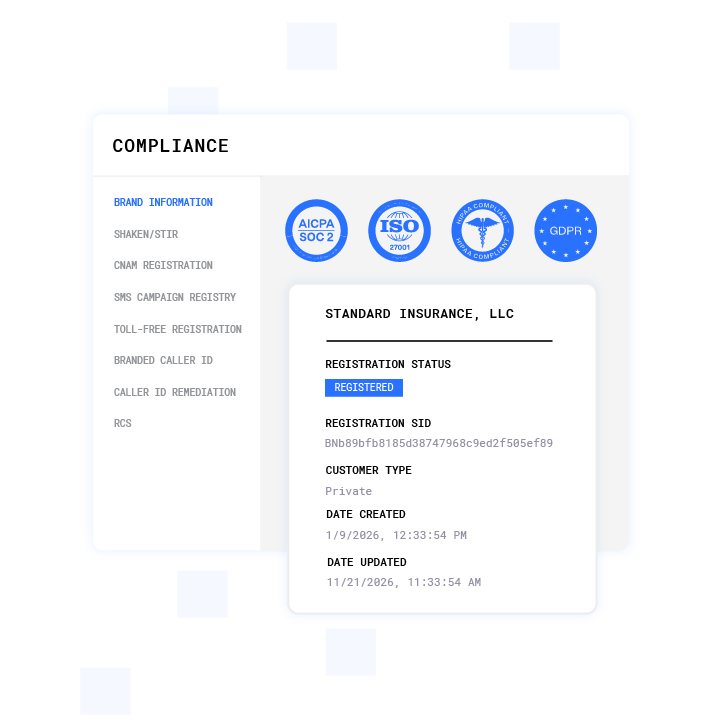
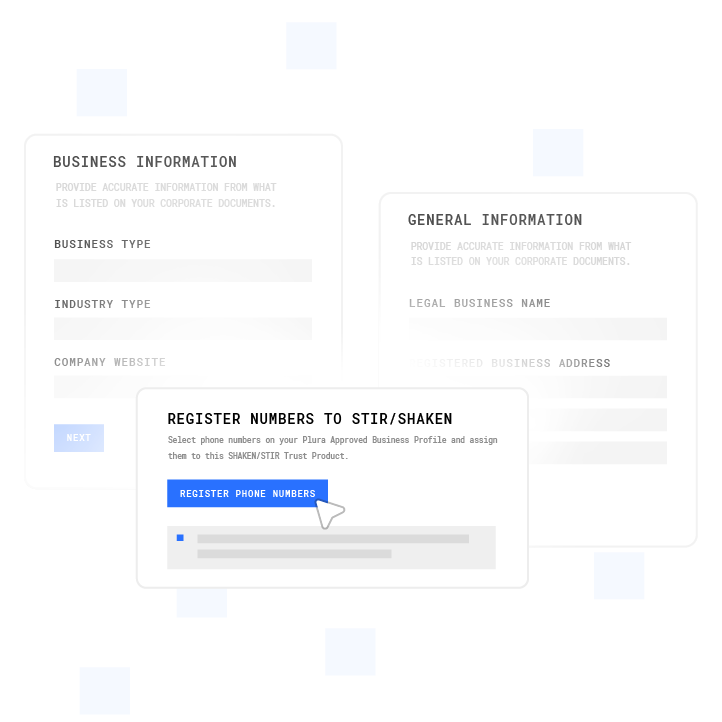
Plura’s FCC-licensed carrier stack issues branded caller ID directly, not through a reseller. Calls present with the company’s name and the reason for the call rather than “Spam Likely” or an unfamiliar number. STIR/SHAKEN (Secure Telephone Identity Revisited/Signature-based Handling of Asserted information using toKENs) authentication runs on every outbound call. Many Twilio-based API resellers cannot provide this because they do not own the carrier.
Plura’s AI Predictive Dialer decides who to call next using stateful conversion signals, historical answer rates, prior negotiation outcomes, and prior offer-acceptance bands. This maximizes talk time per dial and prioritizes contacts most likely to convert. Conversation intelligence analyzes every interaction to surface what scripts close, what objections recur, and what conversion paths win, then feeds findings back into the workflow tuning loop. CRM integration across HubSpot, Salesforce, and Zoho, part of 50+ integrations across 10+ categories, ensures the AI reads the right customer record and fires the right post-conversation event without manual entry.
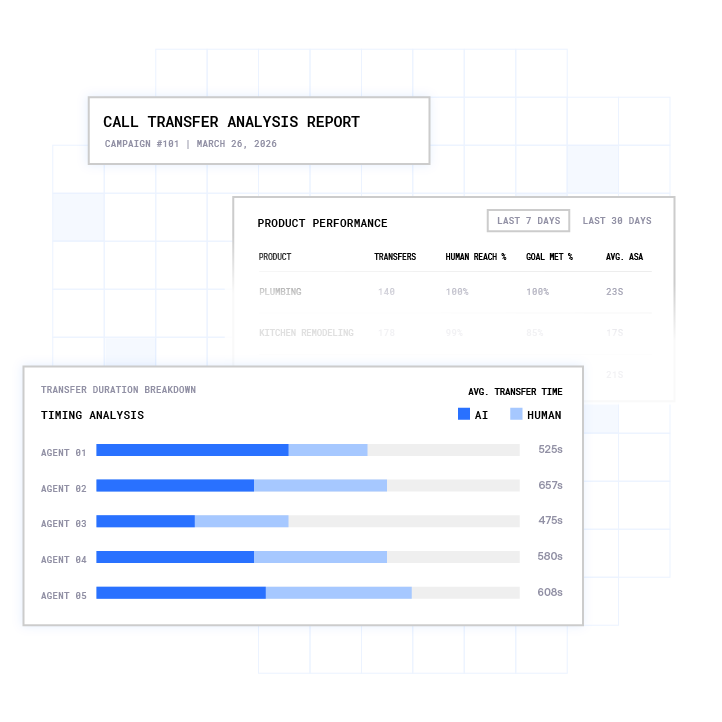
See how AI-mediated handoffs work across the full transfer lifecycle.
Frequently Asked Questions
Why Are Live Transfer Leads Inherently Lower Quality?
Live transfer vendors are typically compensated per transfer delivered, not per transfer that closes. That structure pushes fronters to interpret qualification criteria loosely under volume pressure, use rushed intake scripts that cannot verify intent or budget in 60 to 90 seconds, and avoid disqualification conversations that reduce transfer count. The result is a qualification accuracy problem that shows up as a close-rate problem on the buyer’s side. Operators buying on a per-transfer basis fund a model structurally motivated to over-transfer, and the buyer absorbs the cost of both the transfer and the failed close.
What Causes Live Transfer Drop-Off During Handoff?
Drop-off during handoff traces to four failure modes: hold time above 30 seconds caused by licensed-agent staffing misalignment, silence from blind or cold transfer architecture that passes no context to the receiving agent, availability mismatch when dialer pace exceeds agent capacity, and context loss when the receiving agent asks the prospect to repeat information already captured by the fronter. SQM Group research across 500-plus North American contact centers found that calls with hold time scored 15 percent lower CSAT and 19 percent lower FCR than calls without hold time. Each failure mode has a distinct root cause and a distinct countermeasure, so fixing hold time without fixing context loss produces a different failure mode at the same stage.
How Do You Dispute Bad Live Transfer Leads with a Vendor?
Build the dispute infrastructure before the bad leads arrive. Document the timestamp, fronter ID, prospect phone number, qualification answers captured, and outcome of every transfer. A transfer is disputable when the prospect does not meet the written qualification rubric in the vendor contract, when the prospect was not live on the call at the moment of transfer, when the transfer was not exclusive and the prospect had already spoken with a competing buyer, or when the vendor cannot produce a valid consent record for the underlying outbound contact. Track your dispute rate by vendor over a 30-day window. If qualification accuracy falls below 85 percent, use that data to renegotiate the per-transfer price or require a pre-delivery replacement policy with a clawback window for out-of-spec leads. Consult qualified counsel on TCPA and DNC topics before signing any vendor agreement.
How Does AI Change Live Transfer Quality?
AI-mediated handoffs address the core live transfer failure modes at the infrastructure layer. An AI voice agent qualifies every prospect against a consistent rubric without volume-incentive drift, passes a structured context package to the receiving human agent before the bridge connects, and responds to leads via voice, SMS, RCS, and webchat in under five seconds and warm-transfers a qualified buyer to a rep with the phone ringing seconds after the prospect agrees, eliminating hold time almost entirely. Stateful conversation memory across voice, SMS, RCS, and webchat means the receiving agent inherits the full history of every prior touchpoint. Real-time DNC scrubbing and TCPA-litigator screening run before every dial, and branded caller ID issued at the carrier level improves pickup rates. The result is a transfer that arrives with context, connects without silence, and routes to an agent who already knows the prospect’s intent and qualification status.
Conclusion: Fix the Transfer or Stop Paying for It
Live transfer pain points follow a pattern. They occur at predictable stages, each with a diagnosable root cause: volume incentives degrade quality before the transfer fires, hold time and silence kill it during handoff, context loss wastes it after the bridge, and dispute friction leaves the buyer absorbing the cost of all three. Operators who close the gap treat the transfer lifecycle as an infrastructure problem, not only a vendor-management problem.
Plura AI is built for operators who need live transfers that connect, qualify, and close. The platform provides:
- AI voice agents that answer and transfer with full context
- AI SMS that qualifies and live-transfers warm buyers
- Stateful conversation memory across every channel
- Real-time DNC scrubbing and TCPA-litigator screening before dial
- An FCC-licensed carrier stack that issues branded caller ID directly
The math is on the table: run your numbers through Plura’s ROI calculator to check your ROI in real time.
Compare live transfer plans and rates side by side.
Schedule a walkthrough of the transfer lifecycle and see what a live transfer program looks like when the handoff infrastructure actually works.
1 Plura AI maintains SOC 2, HIPAA, ISO, and GDPR posture as part of its platform infrastructure. References to compliance frameworks in this article describe Plura’s platform capabilities and do not constitute a guarantee that any customer using Plura will themselves be compliant with applicable laws or standards. Customers remain solely responsible for their own regulatory obligations, certifications, consent management, recordkeeping, and the claims they make to their own end users. Consult qualified legal counsel for guidance specific to your use case.
2 This article describes regulatory frameworks at a general level and does not constitute legal advice. Laws and regulations vary by jurisdiction, change over time, and apply differently depending on facts and circumstances. Readers should consult qualified legal counsel before making compliance decisions.
3 Performance figures, customer outcomes, and industry statistics referenced in this article are drawn from cited third-party sources or Plura customer case studies. Individual results vary based on implementation, use case, industry, audience, and execution. Past or aggregate performance is not a guarantee of future results.
4 References to third-party products, services, companies, or research are made for informational and comparative purposes only. Plura AI is not affiliated with, endorsed by, or sponsored by any third party named in this article unless explicitly stated. Trademarks and product names referenced remain the property of their respective owners.
This article is provided for informational purposes only and reflects Plura AI’s understanding at the time of publication. Product capabilities, integrations, and specifications are subject to change. For the most current information, visit plura.ai.
This article was produced with the assistance of AI tools and reviewed by Plura AI prior to publication.