

Written by: Matt Beucler, CEO, Plura AI
Key Takeaways for Multi-Location Leaders
- Legacy multi-location call centers create linear cost growth, uneven SLAs, spam-label issues, offshore exposure, and fragmented channel memory that AI platforms can address.
- Plura AI replaces site-by-site infrastructure with a unified, FCC-licensed platform that runs AI voice, SMS, RCS, and webchat agents on a single Stateful Conversation Database.
- Operators report an average 3x ROI within 90 days, with annual TCO dropping by roughly 90% compared with traditional 100-seat operations.3
- Plura enforces centralized scripts, real-time compliance checks (TCPA, DNC, SHAKEN/STIR), and per-location dashboards while scaling instantly for peak seasons without extra headcount.1,2
- Book a live demo with Plura to see how multi-location call center replacement runs on a single 100% U.S. platform.
Why Multi-Location Call Centers Strain Operations
Multi-location customer communications create four compounding problems that additional hiring cannot solve.
Linear cost scaling. Every new location, shift, and peak season requires proportional headcount. Personnel costs consume 60-70% of a typical call center budget, and terminating a single call center agent costs $10,000 to $20,000 in lost productivity and recruiting. For a 100-seat contact center, that math produces a total cost of ownership of $4 million to $7 million annually, per Plura’s executive communications guide.
Inconsistent SLAs across sites. Best and worst franchise locations show a 3-5x performance gap, driven by staffing quality, turnover, and script drift. A customer calling Location A experiences one standard, while Location B delivers another, and operators lack a centralized mechanism to close that gap.
Spam labels and pickup rate collapse. Outbound calls from multi-location operations often appear as “Spam Likely” because originating numbers lack carrier-level branded caller ID. Apple’s iOS 26 call-screening layer intercepts unfamiliar numbers before they ring, which compresses connect rates even further.
Offshore regulatory exposure. The FCC released NPRM FCC-26-16 (CG Docket No. 26-52) on March 27, 2026, proposing a cap on offshore customer-service call volume and a flat prohibition on offshore handling of sensitive consumer data such as passwords, Social Security numbers, bank accounts, and card information. That federal proposal builds on existing state restrictions: New York, New Jersey, Connecticut, Missouri, and Florida already restrict offshore handling of medical, financial, and consumer data. Together, these frameworks mean every offshore call center contract a covered entity holds is now a compliance liability that qualified counsel should evaluate.
Fragmented channel memory. When voice, SMS, and webchat run on separate vendors, a customer who texted at 9 a.m. must re-explain the issue when a call comes at noon. Teams lose shared memory, unified context, and continuity of experience.
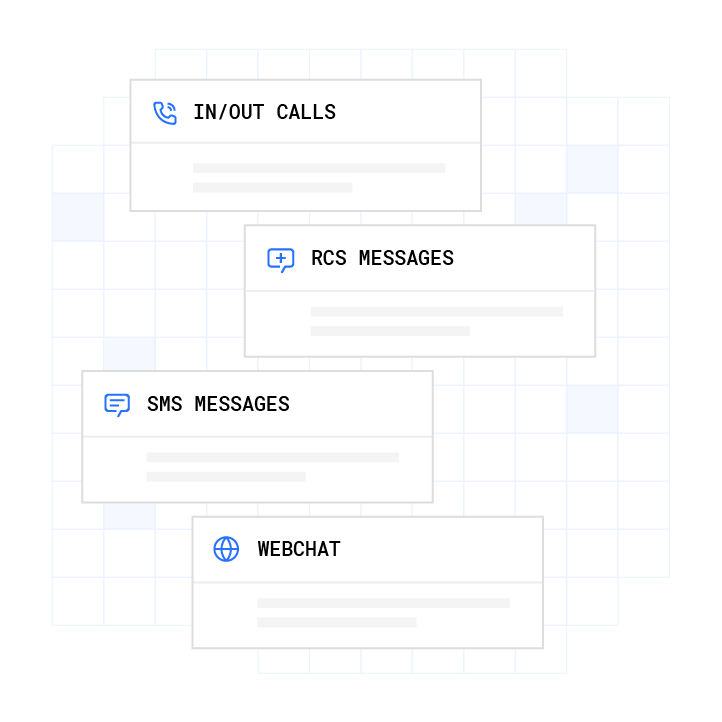
AI contact center platforms form the emerging category built to address these problems in one architecture. Unlike traditional CCaaS, AI contact center platforms replace human agent queues with autonomous AI agents that handle full conversations across channels, share a single memory layer, and run compliance checks before each contact.
Book a live demo with Plura to see how multi-location replacement works on a single platform.
How Plura Rebuilds Multi-Location Call Center Infrastructure
The five problems above require a platform designed differently from the ground up. Plura’s architecture addresses each structurally by operating as a four-channel AI communications OS that shares one Stateful Conversation Database.
Plura runs AI voice agents, AI SMS, AI RCS, and AI webchat on Plura’s own FCC-licensed audio bridging carrier. Every channel reads from and writes to the same conversation memory, which removes the fragmentation that frustrates customers and staff.
Inbound flow that standardizes SLAs. A customer calls any location, and the AI voice agent answers within two rings. It runs the approved qualification script, checks the Stateful Conversation Database for prior interactions, and either resolves the inquiry or warm-transfers to a U.S. agent with full context. Every location delivers the same script, greeting, and SLA, which removes the 3-5x performance spread created by site-by-site execution.
Outbound flow that restores pickup rates. The AI predictive dialer prioritizes contacts using stateful conversion signals. It dials with branded caller ID issued at the carrier level and authenticates every call through SHAKEN/STIR. Calls that would otherwise be flagged as spam now present with the company’s name and the reason for the call, which directly addresses connect-rate collapse.
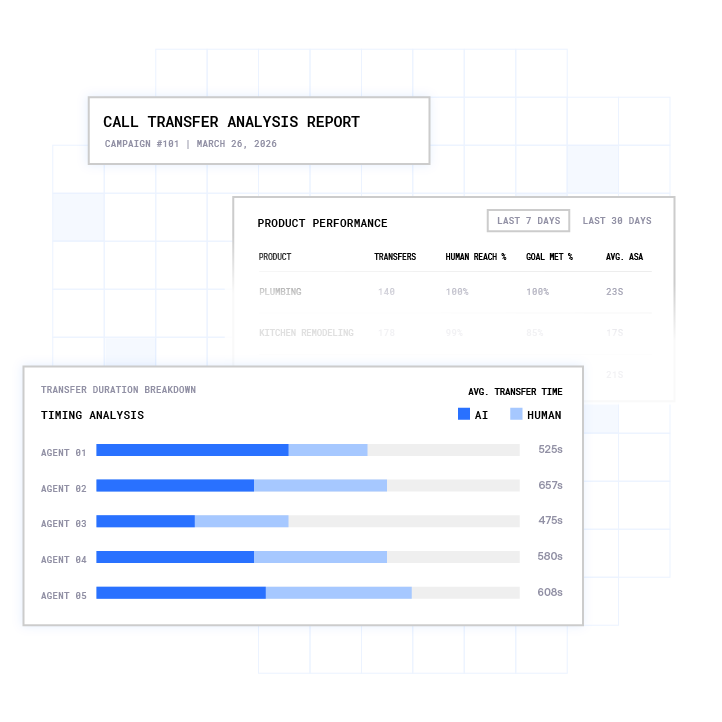
Channel orchestration that unifies memory. A lead who fills out a web form receives an AI SMS response in under 60 seconds. If they reply, the AI continues the conversation. If they call in, the AI voice agent already knows what was said in the text thread. Voice, SMS, RCS, and webchat all share the same Stateful Conversation Database, so customers never repeat themselves across channels.
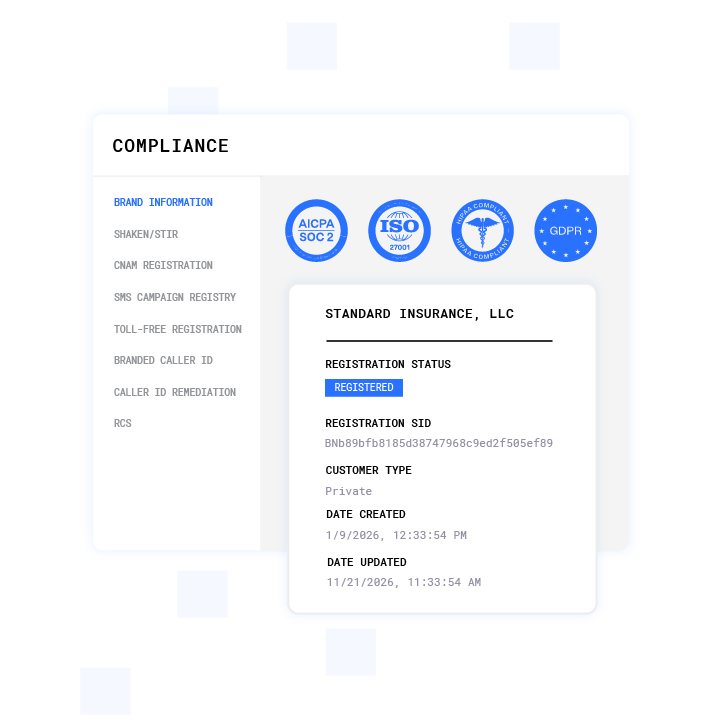
Compliance controls that reduce regulatory risk. Every outbound contact is checked against federal and state DNC registries in real time before dial. TCPA consent records are timestamped and immutable. Quiet-hours rules apply automatically through time-zone detection. The compliance dashboard exports audit-ready reports in one click, per Plura’s compliance framework documentation. This structure supports compliance programs without replacing the need for legal guidance.
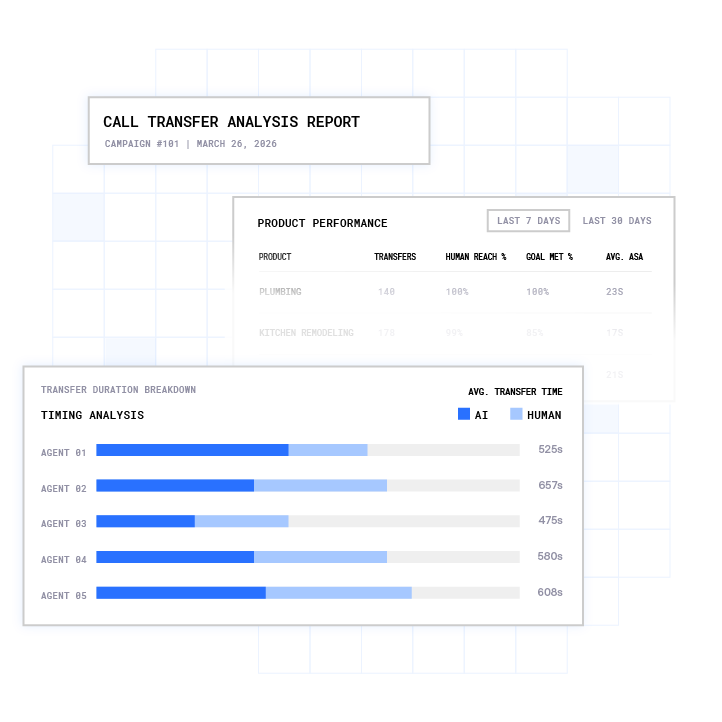
Centralized reporting that aligns locations. A single dashboard surfaces per-location metrics across the entire network. Operations teams no longer reconcile data from multiple point tools and can see performance, SLA adherence, and compliance trends in one view.
The Economics of Replacing Multi-Location Call Centers
The TCO comparison between legacy infrastructure and an AI contact center platform provides a clear economic case for replacement.
| Cost Category | Traditional 100-Seat Contact Center | Plura AI Platform |
|---|---|---|
| Annual TCO | $4M-$7M | $300K-$700K |
| Monthly cost (50-seat equivalent) | $35,000-$50,000 (offshore) | $8,000-$15,000 |
| Agent turnover rate | 30-45% annually | 0% |
| Talk utilization | ~40% (human agents) | 100% (AI agents) |
| Uptime SLA | Variable by site | 99.9% with automatic failover |
| Deployment timeline | 2-4 weeks per new hire | 2-4 weeks from contract to live |
| Offshore regulatory exposure | High (FCC NPRM CG Docket No. 26-52) | None (100% U.S. infrastructure) |
An illustrative 15-agent scenario from Plura’s ROI calculator shows the impact. A team paying $20 per hour with standard taxes, benefits, and commissions at 40% talk utilization costs $60,000 per month.3 Replacing that team with Plura at $15 per hour, 100% talk utilization, and 6 AI agents doing the work of 15 humans drops the monthly cost to $14,400. That shift produces $45,600 in savings in the first 30 days and $547,200 over 12 months.
Run your numbers through Plura’s ROI calculator to see projected savings in real time.
How AI Is Replacing Call Center Categories
Category replacement, not job elimination, describes the shift underway. Four categories currently compete for high-volume customer conversations, and each has a structural ceiling.
- Traditional CCaaS platforms route human agents more efficiently but do not reduce the headcount required to handle volume.4 They sit as software layers on top of the same labor cost structure.
- AI voice agent platforms built on third-party CPaaS wrap the same telecom and model infrastructure as one another. They typically cannot issue branded caller ID at the carrier level, cannot enforce real-time DNC scrubbing natively, and may be exposed if foreign-infrastructure prohibitions advance.
- Offshore BPOs used wage arbitrage to solve cost for two decades. That model now faces pressure from FCC NPRM CG Docket No. 26-52, the bipartisan Keep Call Centers in America Act (S.2495), and state-level onshoring laws. Operators with offshore contracts should consult qualified counsel on their current exposure.
- Onshore human call centers carry the cost structure that made the math difficult: payroll, taxes, benefits, commissions, real estate, and high agent turnover. They struggle to scale into peak season without heavy advance hiring.
AI voice agents autonomously handle 70-85% of customer interactions only in deeply integrated deployments, with the most complex cases escalated to human agents. Human teams shift from handling volume to handling judgment-intensive cases that AI is not designed to resolve. That shift reflects category replacement rather than workforce elimination.
AI Voice Agents Purpose-Built for Franchise Networks
Franchise networks face a specific multi-location challenge. Corporate sets the brand standard, but individual locations execute it with different staff, turnover rates, and compliance levels. The result is the performance gap documented earlier, with best units outperforming worst by 3-5x across many systems, per Plura’s franchise communications guide.
Plura closes that gap through three coordinated mechanisms that work as one system.
- Centralized script enforcement. The AI voice agent runs the approved greeting, qualification script, and disclosure language on every call at every location. Script drift disappears between Monday morning and Friday afternoon, and performance no longer depends on which unit picked up.
- Follow-the-sun routing. Calls route to available AI capacity regardless of which physical location the customer dialed. Plura enables franchises to handle 3x to 5x call volume during peak seasons without temporary staff, because AI capacity scales instantly instead of requiring weeks of recruiting and training.
- Per-location dashboard visibility. Corporate operators see call answer rates, lead response times, conversion rates, and compliance metrics for every location in a single view. Underperforming units stand out in real time, which allows targeted coaching and staffing decisions.
Franchise front desk roles experience 30-50% annual staff turnover. Plura deploys in days versus the 2-4 weeks of training required per new front-desk hire, so the network is not waiting on a hiring cycle to restore coverage.
Book a live demo with Plura to see the franchise network dashboard in action.
CCaaS vs. Plura: Category-Level Comparison
Traditional CCaaS platforms provide centralized dashboards focused on human-agent metrics and follow-the-sun routing for agent queues, but they do not change the underlying labor model. Twilio-based AI wrappers vary widely in their multi-location capabilities and typically depend on third-party compliance tools and foreign infrastructure. Plura provides per-location AI metrics, instant capacity scaling, a first-class compliance layer, and FCC-licensed carrier ownership as part of a single architecture.
Stateful cross-channel memory, 100% U.S. infrastructure, and 2-4 week deployment timelines differentiate Plura from both CCaaS and CPaaS-based AI wrappers for operators who manage high-volume, multi-location conversations.
Risks, Constraints, and Due Diligence for Replacement
Multi-location call center replacement functions as an infrastructure decision, not a simple software purchase. Operators should weigh several factors before committing to a platform.
Deployment timeline. A simple inbound qualification flow deploys in days. A complex multi-step intake, such as a 25-question health-history survey, runs closer to one to two months because the workflow logic requires design and validation. Plura’s onboarding sequence includes a discovery audit, sample call intake, overnight mockup build, iteration session, engineering build, pilot test, and full go-live.
90-day opt-out window. Every Plura annual contract includes a 90-day opt-out window. If the deployment is not delivering, operators are not held to the annual term. That structure places the iteration obligation on the platform rather than the customer.
Compliance language. Plura supports compliance with SOC 2, HIPAA, ISO certification, GDPR, SHAKEN/STIR caller ID verification, TCPA compliance, and DNC compliance.1,2 Plura provides the infrastructure, while downstream compliance posture, certifications, and regulatory obligations remain the customer’s responsibility. Operators in regulated industries should consult qualified counsel on their specific obligations under applicable law before deployment.
FCC NPRM status. As of July 2026, FCC-26-16 (CG Docket No. 26-52) remains a Notice of Proposed Rulemaking. The comment period closed in late May 2026, and final rules have not been adopted. Operators with offshore exposure should monitor the docket and consult counsel on the proposed sensitive-data restrictions, which would apply across calls, emails, texts, and online chats if adopted as proposed.
Integration requirements. Plura connects to 50+ tools across CRM, calendar, attribution, payment, and data enrichment categories, per Plura’s integrations directory. Complex CRM integrations and live-system data mapping add to the deployment timeline. Operators should inventory their existing stack before scoping the build.
Compare plans and rates side by side to scope the right tier for your operation.
Frequently Asked Questions
What is multi location call center replacement and when does it make sense?
Multi location call center replacement retires separate, site-by-site call center infrastructure and consolidates customer communications onto a single AI-driven platform. It makes operational sense when an organization manages inconsistent SLAs across locations, faces linear cost scaling as volume grows, deals with high front-desk or agent turnover, or carries offshore regulatory exposure under the FCC NPRM or state onshoring laws. The practical floor for ROI is roughly 500 daily customer interactions or $5,000 per month in paid-media spend, below which the depth of an AI agent platform may not generate enough return to justify the build.
How does Plura handle compliance across multiple locations and states?
Plura’s compliance engine operates as a first-class layer of the platform, not a bolt-on. Every outbound contact is checked against federal and state DNC registries in real time before dial. TCPA consent records are timestamped and immutable. Quiet-hours rules apply automatically through time-zone detection on the contact, using state and federal calling-window restrictions for every campaign. The platform supports SOC 2, HIPAA, ISO certification, GDPR, SHAKEN/STIR caller ID verification, TCPA compliance, and DNC compliance. Customers remain responsible for their own regulatory obligations and certifications, and Plura provides the infrastructure that supports those obligations. Operators in regulated industries should consult qualified counsel on their specific requirements.
What is the difference between Plura and a traditional CCaaS platform for multi-location operations?
Traditional CCaaS platforms route human agents more efficiently but do not reduce the headcount required to handle volume. They sit on top of the same labor cost structure and typically rent telecom infrastructure from a third-party CPaaS provider like Twilio. Plura is its own FCC-licensed audio bridging carrier. Branded caller ID is issued at the carrier level, SHAKEN/STIR authentication runs on every outbound call, and real-time DNC scrubbing occurs before each contact rather than through a separate tool. Plura also shares a Stateful Conversation Database across voice, SMS, RCS, and webchat, so every channel inherits the full memory of prior touchpoints. CCaaS platforms typically silo channel history by system.
How long does it take to replace a multi-location call center with Plura?
Deployment typically runs 2-4 weeks from contract to live AI conversations for standard inbound and outbound flows. Complex multi-step workflows, such as a 25-question health-history intake or a multi-state negotiation flow, run closer to one to two months because the workflow logic requires design, validation, and pilot testing on real calls before full go-live. Every annual contract includes a 90-day opt-out window, so operators are not locked into a year-long term if the deployment is not delivering against agreed benchmarks.
Does Plura work for franchise networks with dozens or hundreds of locations?
Plura is purpose-built for multi-unit operators. AI voice agents answer 100% of inbound calls across all franchise locations within two rings, running identical greeting and qualification scripts regardless of which unit the customer dialed. A centralized dashboard surfaces per-location metrics including call answer rates, lead response times, and conversion rates in a single view. AI capacity scales instantly into peak seasons without recruiting or training cycles, enabling franchise networks to handle 3x to 5x call volume during high-demand periods without temporary staff. System-level enforcement of scripts, disclosures, DNC lists, and state regulations closes the performance gap between best and worst units referenced earlier.
Conclusion: A Single Platform for Multi-Location Conversations
Legacy multi-location call center infrastructure creates four problems that compound over time: linear cost scaling that ties revenue growth to headcount growth, inconsistent SLAs that produce wide performance gaps across locations, spam-label barriers that collapse outbound connect rates, and offshore regulatory exposure that legal teams now evaluate under FCC NPRM CG Docket No. 26-52 and applicable state law.
Plura AI addresses each of these structurally. The FCC-licensed carrier stack issues branded caller ID and runs SHAKEN/STIR authentication on every call. The Stateful Conversation Database unifies voice, SMS, RCS, and webchat memory so every channel inherits full context from prior touchpoints. The compliance engine checks TCPA, DNC, and quiet-hours rules before each contact. The centralized dashboard closes the per-location visibility gap. A 100% U.S. infrastructure by architecture removes offshore exposure from the platform design.
The 90% cost reduction outlined earlier, with Plura’s annual TCO compared with traditional 100-seat operations, provides a clear economic argument for replacement.
Book a live demo with Plura to see multi location call center replacement on a single FCC-licensed, 100% U.S. platform.
1 Plura AI maintains SOC 2, HIPAA, ISO, and GDPR posture as part of its platform infrastructure. References to compliance frameworks in this article describe Plura’s platform capabilities and do not constitute a guarantee that any customer using Plura will themselves be compliant with applicable laws or standards. Customers remain solely responsible for their own regulatory obligations, certifications, consent management, recordkeeping, and the claims they make to their own end users. Consult qualified legal counsel for guidance specific to your use case.
2 This article describes regulatory frameworks at a general level and does not constitute legal advice. Laws and regulations vary by jurisdiction, change over time, and apply differently depending on facts and circumstances. Readers should consult qualified legal counsel before making compliance decisions.
3 Performance figures, customer outcomes, and industry statistics referenced in this article are drawn from cited third-party sources or Plura customer case studies. Individual results vary based on implementation, use case, industry, audience, and execution. Past or aggregate performance is not a guarantee of future results.
4 References to third-party products, services, companies, or research are made for informational and comparative purposes only. Plura AI is not affiliated with, endorsed by, or sponsored by any third party named in this article unless explicitly stated. Trademarks and product names referenced remain the property of their respective owners.
This article is provided for informational purposes only and reflects Plura AI’s understanding at the time of publication. Product capabilities, integrations, and specifications are subject to change. For the most current information, visit plura.ai.
This article was produced with the assistance of AI tools and reviewed by Plura AI prior to publication.