

Written by: Matt Beucler, CEO, Plura AI | Last updated: August 28, 2026
Updated August 28, 2026
Key Takeaways for Multi-Tenant AI Lead Follow-Up
- Multi-tenant AI lead follow-up runs on a purpose-built 10-layer architecture that enforces data isolation, per-tenant prompts, usage metering, and billing at every layer to protect compliance and margins.
- Plura AI owns its FCC-licensed carrier stack, which enables branded caller ID, STIR/SHAKEN authentication, and real-time DNC/TCPA scrubbing without third-party CPaaS dependencies.
- Row-level security, per-tenant vector namespaces, and tenant-scoped cache keys enforce data isolation at the infrastructure layer and reduce the risk of cross-tenant leaks that could trigger SOC 2, HIPAA, or GDPR issues.1
- Usage metering across tokens, messages, tool calls, and storage flows directly into Stripe for hybrid per-client billing, helping agencies protect profit margins compared to manual operations.
- Agencies and franchise networks can deploy this architecture in days to weeks and scale to 15–20 clients per account manager. Book a live demo with Plura AI to see the 10-layer system in a live multi-tenant environment.
The 10-Layer Architecture for Multi-Tenant AI Lead Follow-Up
Each layer below acts as a separate enforcement boundary. Skipping or reordering any layer risks mixing tenant contexts, opening compliance gaps, or breaking per-client billing accuracy. Tenant isolation must be enforced at every layer of the request pipeline including authentication, tenant resolution, context compilation, inference, and caching.
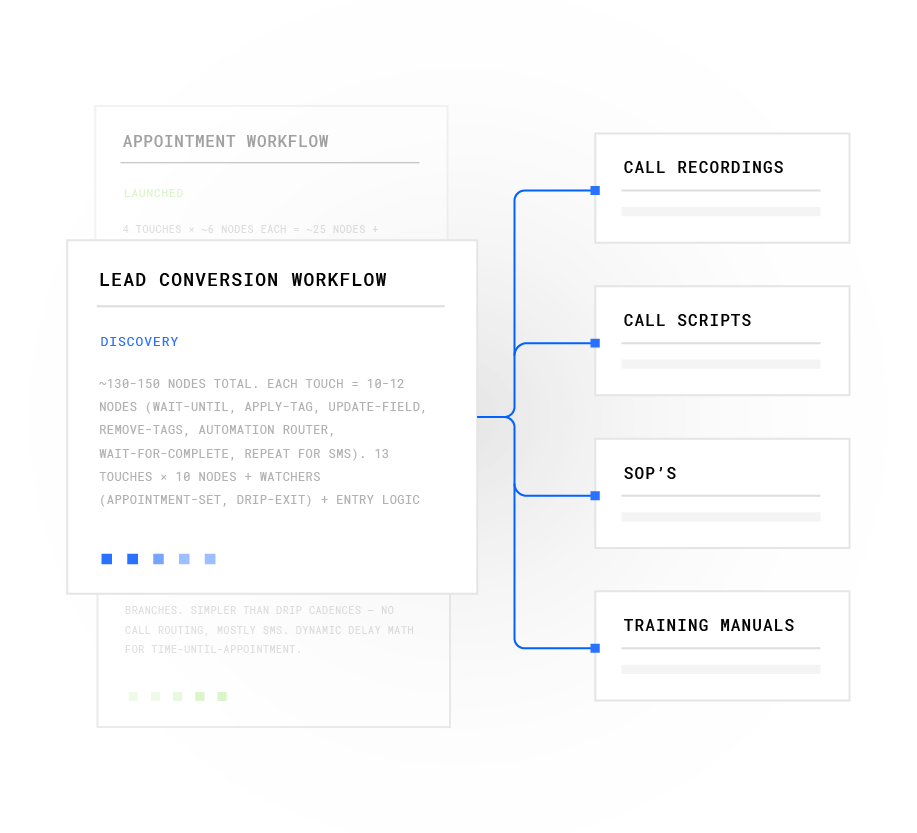
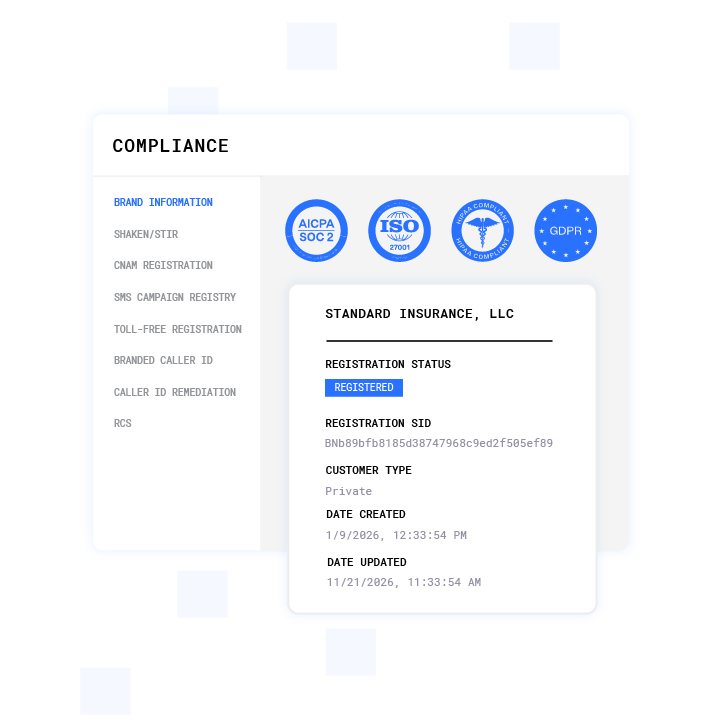
- FCC-Licensed Carrier Foundation. Voice originates on Plura’s own FCC-licensed audio bridging carrier, not a third-party CPaaS (Communications Platform as a Service). Branded caller ID is issued at the carrier level. STIR/SHAKEN (Secure Telephone Identity Revisited / Signature-based Handling of Asserted information using toKENs) authentication runs on every outbound call. Real-time DNC (Do Not Call) scrubbing and TCPA (Telephone Consumer Protection Act) litigator screening are enforced before dial, not added afterward.2
- Identity and Tenant Resolution. Every inbound request carries a verified tenant claim via a signed JWT (JSON Web Token) or session token. No tenant ID is accepted from path parameters without cross-validation against the authenticated claim. Tenant context is injected into a thread-safe context variable that follows the entire request lifecycle.
- Data Isolation Layer. Row-level security (RLS) attaches access policies directly to tables so the database evaluates the tenant isolation policy on every query before returning rows. This removes reliance on application code to apply a WHERE tenant_id filter. High-value or regulated tenants such as healthcare or financial services can use dedicated database schemas or instances for stronger separation.
- Per-Tenant Vector Namespaces. Each tenant’s knowledge base, conversation history, and enrichment data live in a dedicated vector namespace or collection. The strongest pattern is a dedicated per-tenant index where cross-tenant queries require a separate API call and IAM (Identity and Access Management) grant. Queries that lack the tenant filter are rejected at the query layer, not filtered after retrieval.
- Per-Tenant AI Prompt Customization. Tenant-specific system prompts are generated dynamically per request from a tenant configuration store and are never cached across tenants. Each prompt declares the tenant context explicitly and rejects any attempt to reference other tenants’ data. Plura’s no-code workflow builder lets agency operators configure greeting nodes, qualification gates, negotiation guardrails, and transfer rules per client without engineering support.
- Prompt Sanitization and Output Guardrails. Input guardrails inspect live transcripts before model context is built, covering PII (Personally Identifiable Information), PHI (Protected Health Information), prompt injection, and workflow-specific policy violations. Output guardrails check what the agent is about to say before it is spoken or sent, with the ability to block, replace, or escalate unsafe content in real time. The gateway records the resolved tenant identity and classifier verdicts on prompts and responses to create a queryable, tenant-scoped audit trail.
- Calendar and Workflow Routing. Each tenant’s calendar integrations such as Google Calendar, Calendly, or Cal.com are scoped to that tenant’s credentials and stored in a per-tenant vault entry. The agent runtime injects credentials at call time so no agent code accesses credentials outside its own tenant. Workflow orchestration verifies that agents exchanging messages or state belong to the same tenant before passing context.
- Usage Metering. Token counts for input and output, tool execution compute, embedding generation, similarity search, and storage for conversation history are tracked per tenant as an append-only ledger. The enforcement layer evaluates tenant access, usage limits, and credit balance synchronously in the request path before resources are consumed. Post-request checks support reporting only and do not control live usage.
- Stripe Billing Integration. Metered usage events feed directly into Stripe Billing for per-client invoicing. The dominant model for AI communications platforms in 2026 is hybrid: a base subscription tier that includes a message or token allowance, with overage charges billed at a per-unit rate. OpenView benchmarks found SaaS companies with usage-based pricing grow revenue ~38% faster (≈1.38x) than those with traditional seat-based or pure subscription models.3 Plura’s pricing tiers support this structure across agency and franchise deployments.
- White-Label Reporting and Audit Trail. Plura’s conversation intelligence layer generates client-ready ROI exports, per-tenant performance dashboards, and one-click audit reports. Every span, metric, and log entry carries a structured tenant_id attribute so compliance exports can be sliced cleanly per client without post-hoc parsing.
Run your numbers through Plura’s ROI calculator to check your multi-tenant AI lead follow-up ROI in real time.
Data Isolation in Multi-Tenant AI Lead Follow-Up
Data isolation is the layer most agencies underestimate, and it carries the highest compliance and reputational risk when it fails. The risk extends beyond a misconfigured database. The riskiest failure mode is a correctly scoped database where an agent prompt or retrieval query silently omits the tenant filter under some code path such as a background job or newly added tool.
Three rules govern isolation in Plura’s architecture, and each one addresses a different failure mode.
- Filter before retrieval, not after. Tenant_id filters are applied at the vector database query level. Applying tenant_id filters at the vector database query level rather than filtering results in application code after retrieval prevents cross-tenant data from entering memory, caches, or logs.
- Tenant-scoped cache keys. Every cache key follows the format {tenant_id}:{cache_type}:{content_hash}. A cache keyed only on prompt text can serve one customer’s cached response to another. Conversation history, session summaries, and response caches are all treated as tenant data.
- Prompt sanitization as a second control. Bugs in prompt construction that pull in the wrong session’s history can leak information the model then repeats. Plura’s gateway scans for cross-tenant markers and denies requests that fail the check before any text reaches the LLM (Large Language Model).
Real-world AI agent incidents such as the Salesloft/Drift incident affecting over 700 organizations demonstrate how the absence of database-level boundaries can amplify damage when agents act on data they should not access. For agencies managing 15–20 client accounts, a single cross-tenant leak can create a reportable event with contractual and regulatory consequences under SOC 2, HIPAA, or GDPR (General Data Protection Regulation) obligations.
Plura supports HIPAA, SOC 2, and GDPR compliance postures at the infrastructure layer.1 Customers remain responsible for their own certifications and regulatory obligations downstream of the platform.
Per-Client Billing Metering
Usage metering often breaks down in agency platforms. Without per-tenant attribution at the individual LLM-call level, agencies struggle to price client accounts accurately, protect margins, or pass through model costs from providers.
Plura’s metering layer tracks four billable dimensions per tenant.
- Tokens processed, including input and output, with model-specific multipliers where applicable
- Messages sent across AI SMS, voice, RCS (Rich Communication Services), and AI webchat
- Tool execution compute and data transfer for enrichment calls across 30+ data sources
- Storage for conversation history and learned patterns per tenant
These events feed an append-only ledger that records grants, deductions, expirations, and reversals as immutable events. Current balance is derived from transaction history rather than a mutable counter, which prevents race conditions when two agent sessions hit the same tenant credit balance at the same time.
The Stripe integration maps metered usage to per-client invoices on a hybrid model. A base subscription covers an included allowance, and overage charges bill at the per-unit rate above that allowance. This hybrid flat-plus-metered structure aligns price with customer value, captures expansion revenue from heavy users, lowers barriers for lighter users, and enables agencies to offer flexible per-client recurring service lines. Agency operators running Plura report profit margins that significantly exceed manual operations. Case studies detail typical ranges for AI-driven agency margins.
Compare plans and rates side by side at plura.ai/pricing to model your per-client recurring service line.
White-Label Reporting for Agencies and Franchises
Client retention in agency and franchise models depends on clear, defensible ROI. Plura’s conversation intelligence layer turns every interaction across voice, AI SMS, RCS, and AI webchat into client-ready reporting.
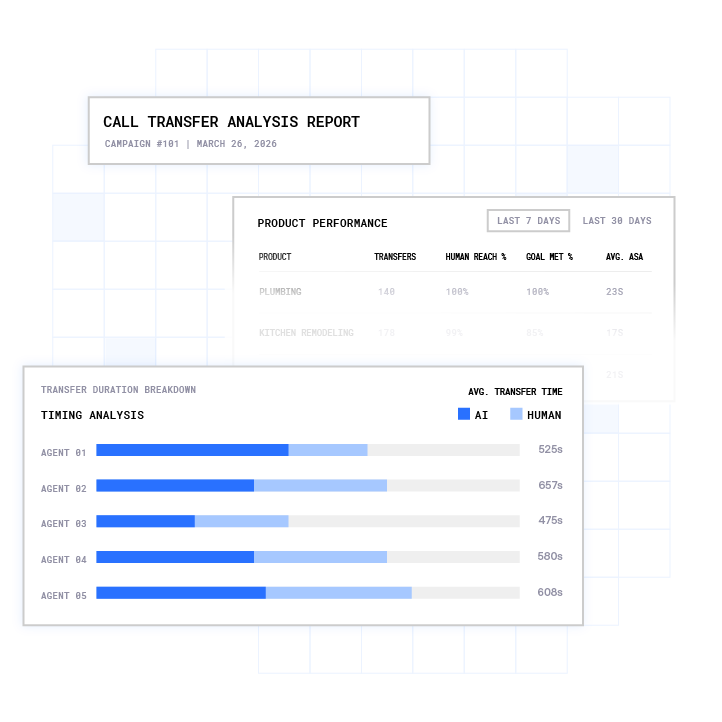
White-label dashboard requirements for multi-tenant deployments include the following capabilities.
- Per-tenant performance metrics such as contact rate, qualification rate, conversion rate, and cost per completed action
- Client-ready ROI exports that map AI agent activity to pipeline outcomes
- Audit trails with immutable consent records, timestamped per contact, exportable in one click for TCPA, DNC, or carrier compliance reviews
- Per-location dashboards for franchise networks, with system-level aggregation across all units
Every log entry carries a structured tenant_id attribute, so compliance exports slice cleanly per client. Agencies using Plura handle 15–20 clients per account manager, versus 5–8 in manual operations.3, in part because reporting that previously required manual assembly is generated automatically.
Platform Comparison: Build vs. Buy for Multi-Tenant AI Lead Follow-Up
The build-versus-buy decision for multi-tenant AI lead follow-up centers on carrier ownership, data isolation architecture, and time to first conversation. The following describes verifiable, published positions of each platform.
Twilio is a CPaaS (Communications Platform as a Service) that provides APIs requiring custom development.4 Building a production-ready AI voice agent on Twilio APIs typically takes 6 to 12 months and costs $300,000 to $500,000 or more in first-year engineering and infrastructure. Data isolation, prompt customization, and per-tenant billing must be engineered from scratch by the buyer’s team. Twilio does not hold an FCC carrier license in the same operational capacity as Plura.
Synthflow depends on Twilio and operates as a software layer without a carrier license.4, which means branded caller ID and carrier-level compliance enforcement are not available natively. Bland AI is voice-only, API-based, and requires developers, and it lacks carrier status.4 It also has no native SMS, RCS, or webchat channel and no multi-tenant billing metering built into the platform.
Plura owns its FCC-licensed audio bridging carrier. Plura’s complete AI agent platform enables time to first conversation in days, with data isolation, per-tenant prompt customization, usage metering, Stripe billing integration, and white-label reporting included in the platform rather than requiring custom engineering. The full comparison is available at plura.ai/compare.
Book a live demo with Plura at plura.ai/plura-webchat to walk through how each layer enforces isolation in a production environment.
Frequently Asked Questions
What is multi-tenant AI lead follow-up and why does it require a separate architecture from single-tenant deployments?
Multi-tenant AI lead follow-up is a software architecture where a single platform instance serves multiple clients, or tenants, at the same time, with each tenant’s data, prompts, calendars, and billing kept completely isolated from every other tenant. Single-tenant deployments run one client per instance, which is operationally simple but does not scale for agencies or franchise networks that manage dozens of client accounts. A purpose-built multi-tenant architecture enforces isolation at the database layer, the vector retrieval layer, the prompt construction layer, the cache layer, and the billing layer at the same time. Skipping any of these layers creates cross-tenant data exposure risk, which under SOC 2, HIPAA, or GDPR obligations can trigger a reportable event. Plura’s 10-layer architecture treats each of these boundaries as a discrete enforcement point rather than relying on application-level filtering alone.
How does Plura enforce data isolation across multiple client accounts without requiring separate infrastructure per client?
Plura uses a hybrid isolation model that combines shared and dedicated resources. Row-level security (RLS) on shared database tables covers most tenants, and dedicated database schemas or instances are available for regulated tenants in healthcare or financial services. Every query is evaluated against the tenant isolation policy at the database layer before rows are returned, which removes reliance on application code to apply tenant filters. Vector namespaces are scoped per tenant so retrieval queries cannot surface another tenant’s knowledge base. Cache keys include the tenant_id as a mandatory component, which prevents one client’s cached response from being served to another. Prompt construction pulls only tenant-owned context, and the gateway applies a second check that scans for cross-tenant markers before any text reaches the LLM. This layered approach helps isolation hold even when individual components fail or new tools are added to the agent pipeline.
What does per-client billing metering look like in practice, and how does Plura integrate with Stripe?
Per-client billing metering in Plura tracks four dimensions per tenant. These include tokens processed for input and output, messages sent across voice, AI SMS, RCS, and AI webchat, tool execution compute for enrichment calls, and storage for conversation history. These usage events are recorded to an append-only ledger as immutable events, with current balance derived from transaction history rather than a mutable counter. This design prevents race conditions when multiple agent sessions run against the same tenant account at the same time. The metered usage feeds directly into Stripe Billing, which generates per-client invoices on a hybrid model. A base subscription covers an included allowance, and overage charges bill at the per-unit rate above that allowance. Agency operators can set per-client pricing tiers independently, which supports a recurring service line that reflects actual consumption rather than flat estimates.
What compliance guardrails does Plura support for multi-tenant AI lead follow-up across SMS and voice channels?
Plura supports compliance postures for TCPA, DNC, HIPAA, SOC 2, GDPR, STIR/SHAKEN caller ID verification, and 10DLC (10-Digit Long Code) A2P (Application-to-Person) messaging registration.2 Real-time DNC scrubbing checks every number against federal and state registries before dial. Consent records are timestamped, immutable, and exportable in one click for audit review. Quiet-hours rules enforce automatically through time-zone detection on the contact. HIPAA-aligned encryption, access controls, and audit logging cover PHI across all channels. For multi-tenant deployments, these controls are enforced per tenant, so each client account operates within its own compliance configuration rather than sharing a single campaign-level rule set. Customers remain responsible for their own regulatory obligations and certifications. Plura provides the infrastructure and supports the compliance posture, and it does not replace qualified legal or compliance advice. Operators should consult qualified counsel on their specific regulatory requirements.
How long does it take to deploy a multi-tenant AI lead follow-up system with Plura, and what are the prerequisites?
A standard multi-tenant deployment with Plura moves from discovery to go-live in days to weeks, depending on conversation complexity and the number of client accounts onboarded at once. The onboarding sequence includes a discovery audit of the agency’s client roster and call economics, intake of sample calls and existing scripts per client, an overnight build of a dynamic conversation mockup using Plura’s internal tooling, a review and iteration session, engineering build of the production workflow, pilot testing on a subset of real calls, and full go-live. Prerequisites include a defined list of client accounts to onboard, existing call scripts or SOPs (Standard Operating Procedures) per client, CRM or calendar integrations to connect via Plura’s 50+ integration directory, and a decision on per-client pricing tiers for Stripe billing configuration. Annual contracts include a 90-day opt-out window if the deployment is not delivering against agreed metrics.
Conclusion
Multi-tenant AI lead follow-up at agency or franchise scale is an architecture problem, not a simple configuration choice. A platform that enforces data isolation only at the application layer, lacks per-tenant prompt customization, cannot meter usage per client, or routes voice through a third-party CPaaS will struggle under the compliance, margin, and operational scrutiny of a CFO or technical review.
The 10-layer architecture documented here covers every boundary that matters: FCC-licensed carrier foundation, identity and tenant resolution, row-level data isolation, per-tenant vector namespaces, per-tenant AI prompt customization, prompt sanitization and output guardrails, calendar and workflow routing, usage metering, Stripe billing integration, and white-label reporting. Plura AI is the only platform that delivers all ten layers on its own carrier stack, with no third-party CPaaS in the voice path and no custom engineering required to reach a production-ready multi-tenant deployment.
Franchise networks using Plura handle 3x to 5x call volume during peak seasons without temporary staff.3, and agencies contact every lead within 60 seconds across all client accounts, compared to 1–4 hours in manual operations.
Compare plans and rates at plura.ai/pricing, or book a live demo with Plura at plura.ai/plura-webchat to walk through the architecture on a live deployment.
1 Plura AI maintains SOC 2, HIPAA, ISO, and GDPR posture as part of its platform infrastructure. References to compliance frameworks in this article describe Plura’s platform capabilities and do not constitute a guarantee that any customer using Plura will themselves be compliant with applicable laws or standards. Customers remain solely responsible for their own regulatory obligations, certifications, consent management, recordkeeping, and the claims they make to their own end users. Consult qualified legal counsel for guidance specific to your use case.
2 This article describes regulatory frameworks at a general level and does not constitute legal advice. Laws and regulations vary by jurisdiction, change over time, and apply differently depending on facts and circumstances. Readers should consult qualified legal counsel before making compliance decisions.
3 Performance figures, customer outcomes, and industry statistics referenced in this article are drawn from cited third-party sources or Plura customer case studies. Individual results vary based on implementation, use case, industry, audience, and execution. Past or aggregate performance is not a guarantee of future results.
4 References to third-party products, services, companies, or research are made for informational and comparative purposes only. Plura AI is not affiliated with, endorsed by, or sponsored by any third party named in this article unless explicitly stated. Trademarks and product names referenced remain the property of their respective owners.
This article is provided for informational purposes only and reflects Plura AI’s understanding at the time of publication. Product capabilities, integrations, and specifications are subject to change. For the most current information, visit plura.ai.
This article was produced with the assistance of AI tools and reviewed by Plura AI prior to publication.