

Written by: Matt Beucler, CEO, Plura AI | Last updated: August 28, 2026
Key takeaways for RCS business messaging performance
- RCS Business Messaging replaces plain SMS with verified, rich-media conversations that deliver 15-30% click-through rates and 3-8% conversion rates versus 1-3% for SMS.3
- Financial services, retail, healthcare, and insurance lead adoption, using RCS for authentication, transactional alerts, promotional offers, and customer care.
- Interactive features such as branded sender IDs, carousels, read receipts, and in-message action buttons drive higher engagement and measurable ROI across every traffic category.
- Operators see the strongest results when RCS sits inside stateful, cross-channel workflows that share context with AI voice agents, AI SMS, and AI webchat.
- Plura AI unifies RCS with AI voice agents, AI SMS, AI webchat, and a Stateful Conversation Database on 100% U.S. infrastructure; start a free demo today.
How contact centers and brands use RCS business messaging
RCS Business Messaging (RBM) replaces one-way, plain-text SMS with verified, interactive conversations. Operators deploy it across five traffic categories defined by Google’s RCS for Business documentation: authentication, transactional, promotional, customer care, and multi-use. Each category carries distinct consent, content, and carrier-approval requirements.
The channel delivers a clear performance lift over SMS. Infobip reports the click-through advantage mentioned above, along with significantly higher performance than SMS across other engagement metrics.4 The State of RCS Messaging: 2026 Industry Report documents retail conversion rates of 3 to 8 percent for RCS versus 1 to 3 percent for SMS, and revenue per message of $0.15 to $0.50 versus $0.05 to $0.15.3 U.S. adoption accelerated sharply after Apple added RCS support in iOS 18, and Infobip recorded 1,298.8% year-over-year growth in U.S. RCS interactions, with more than 1.5 billion RCS messages delivered in the U.S. in 2026 alone.
Industries leading RCS adoption and use cases
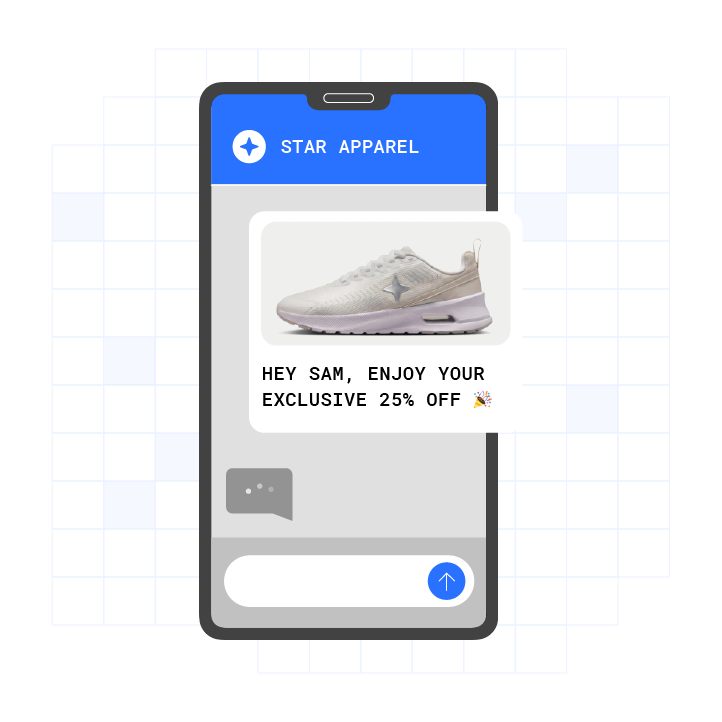
Financial services leads adoption at 49% current usage with another 45% planning deployment within 12 months, primarily for fraud alerts, OTP delivery, and product offers. Retail and e-commerce generate approximately 30% of all RCS business messaging revenue. Healthcare, insurance, automotive, and franchise networks are active deployers, using RBM for appointment management, policy renewals, lead follow-up, and location-level customer communications.
Infobip’s analysis of 628 billion mobile interactions in 2025 found that RCS traffic grew 3x globally and 70x in North America, with 98% of interactions spanning multiple channels. Single-channel communication fell to 2.3% of platform traffic, down from 73% a decade earlier.
Run your numbers through Plura’s ROI calculator to check your ROI in real time.
The following sections walk through each of the five RCS traffic categories in detail, so you can see how operators deploy RCS across authentication, transactional, promotional, customer care, and multi-use workflows.
OTP and authentication use cases for RCS
Google’s RCS for Business documentation defines the AUTHENTICATION traffic type specifically for one-time password (OTP) use cases. RCS adds a verified sender badge, a “Copy Code” button, and branded instructions to what would otherwise be a plain numeric SMS. These elements reduce phishing confusion and support tickets.
| Use Case | Workflow and Metrics |
|---|---|
| Login and payment verification (financial services, fintech) | Users initiate a login or transaction, and the RBM agent delivers a branded OTP with verified sender badge, “Copy Code” button, and security instructions. On Android, the SMS Retriever API enables auto-fill. On iOS 18+, the system suggests the OTP for auto-fill. Verified sender identity reduces phishing risk and lowers inbound support volume. Plura’s Stateful Conversation Database logs the authentication event, so a follow-up AI voice agent call at noon already knows the session was verified at 9 a.m. |
| Account registration and password reset (insurance, healthcare portals) | Registration triggers an RBM OTP with brand logo, clear OTP display, and action buttons. AWS recommends OTP as a dedicated agent type to maintain predictable recipient experience and avoid carrier scrutiny applied to multi-use agents. Plura supports TCPA compliance and DNC compliance on every outbound contact before send. |
Transactional RCS for confirmations and updates
The TRANSACTION traffic type covers messages about a user’s existing services or products, such as confirmations, payment receipts, booking details, and shipping updates. AWS recommends starting RCS migration with high-volume transactional messages because they provide immediate ROI through verified brand identity and reduced customer hesitation.
| Use Case | Workflow and Metrics |
|---|---|
| Appointment reminders (healthcare, home services, legal) | RBM sends a branded reminder 24 to 48 hours before the visit with Confirm, Reschedule, and Call Office buttons. Responses update the downstream scheduling system. Healthcare networks implementing RCS for appointment management have reported reductions in missed appointments along with fewer scheduling phone calls. Plura’s healthcare deployments achieve up to 40% improvement in no-shows.3 Stateful memory means a patient who rescheduled via RCS is flagged in the Unified Inbox before the AI voice agent calls to confirm. |
| Order confirmations and delivery tracking (e-commerce, retail) | A branded card with product image, order summary, live tracking button, and map sends at shipment. RCS order tracking reduces support calls for logistics and retail teams by surfacing status inside the message thread. Read receipts allow Plura’s conversation intelligence layer to time follow-up contacts precisely. |
Promotional RCS for offers and campaigns
The PROMOTION traffic type covers offers, discounts, and announcements. Promotional agents require explicit opt-in consent and face stricter carrier scrutiny than single-purpose agents. Sinch campaign data shows RCS click-through rates 3 to 7 times higher than rich SMS and conversion rates up to 80% in some business use cases.
| Use Case | Workflow and Metrics |
|---|---|
| Abandoned cart recovery (e-commerce, retail) | RBM sends a branded card with the abandoned product image, price, and a one-tap “Complete Purchase” button. Read receipts sharpen follow-up timing. E-commerce brands using RCS for abandoned cart recovery have generated higher recovery rates and better ROI per message compared to SMS. Plura’s AI SMS layer handles fallback for non-RCS devices within the same workflow. |
| Product carousels and personalized offers (fashion, franchise retail) | Personalized carousels based on browsing history deliver product options with Shop Now buttons. Retailers using personalized RCS carousels report 45 to 65% higher click-through rates compared to generic promotions. Plura’s no-code workflow builder branches the next message based on which carousel item the recipient tapped, feeding that signal into the Stateful Conversation Database for cross-channel continuity. |
Customer care and support with RCS
Customer care RCS flows handle service requests, troubleshooting, and support escalations inside the native messaging app. Telecommunications companies using RCS for interactive communications achieved faster issue resolution along with metrics such as 50% cost savings or 40% higher interaction rates in some deployments.
| Use Case | Workflow and Metrics |
|---|---|
| Fraud alerts and account notifications (financial services, insurance) | A verified RBM agent sends “Was this you?” with Yes and No buttons. The verified badge distinguishes the message from phishing attempts. A Datos Insights Study on Financial Services Trust found that 88% of consumers trust a message more when displayed with a verified company badge. Plura’s Stateful Conversation Database records the customer’s response, so the next AI voice agent call opens with full context on the alert status. |
| Interactive onboarding and self-service support (SaaS, telecom, healthcare) | A step-by-step setup guide with Next buttons allows customers to activate accounts or resolve common issues in seconds. Mailchimp’s RCS use-case guide documents a fitness app onboarding flow completed in 30 seconds using three-step quick-reply navigation. Plura’s AI customer service texting layer escalates unresolved threads to a live human via warm transfer when the workflow gate triggers. |
Multi-use RCS agents for blended journeys
Multi-use agents combine transactional and promotional messaging under a single verified sender. AWS notes that multi-use agents face stricter carrier scrutiny during vetting and require clear use-case documentation at registration.
| Use Case | Workflow and Metrics |
|---|---|
| Loyalty programs with transactional and promotional messages (retail, franchise networks) | A single verified agent sends a digital loyalty card, which is transactional, and a personalized discount offer, which is promotional, within the same thread. Mailchimp documents a coffee shop loyalty flow where a Stamp Now button unlocks a Claim Free Coffee button after five stamps. Plura’s Stateful Conversation Database tracks stamp count and offer acceptance across every channel, so the AI voice agent can reference loyalty status on an outbound retention call. |
| Lead generation and qualification (insurance, real estate, home services) | An inbound inquiry triggers a branded RBM card with quick-reply qualification questions. AI reads intent, qualifies the lead, and routes a warm transfer to a licensed agent. Solar and home services operators using AI agents with property data and energy usage estimates achieved 2x to 3x improvements in appointment set rates. Plura contacts new leads in under 5 seconds. Leads contacted within 1 minute are 391% more likely to convert than those contacted after 24 hours. |
RCS vs SMS: conversion and compliance differences
The following table compares the technical capabilities, performance metrics, and compliance considerations that distinguish RCS from standard SMS. It shows why operators see higher engagement and conversion when they deploy RCS for interactive use cases.
| Feature | RCS Business Messaging | Standard SMS |
|---|---|---|
| Branded sender ID | Verified brand name, logo, and color displayed in native messaging app, with a carrier-verified check mark shown to the recipient | Phone number or short code only, with no visual brand identity |
| Rich media | Images, carousels, video, documents, maps, and action buttons delivered in-thread | Plain text, with MMS adding a single image with size limits |
| Read receipts | Delivery and read receipts available in real time, which enables precise follow-up timing | Delivery receipts only, with no read confirmation |
| In-message actions | Quick-reply chips, suggested actions, in-thread payments (Stripe), document signing (DocuSign, PandaDoc), and one-tap CTAs | No interactive elements, so all actions require leaving the message thread |
| Click-through rate | 15 to 30% (Infobip, 2026) | ~3% (Infobip, 2026) |
| Open rate | ~98% (Infobip, 2026) | ~90% (Infobip, 2026) |
| Sender registration | Brand verification through Google and the carrier ecosystem required before sending, and carrier approval currently takes 8 to 16 weeks in the U.S. | A2P 10DLC, short code, or toll-free registration required, in a separate process from RCS |
| TCPA applicability | Consent, opt-out, and quiet-hour obligations may apply. A prudent operational approach treats RCS campaigns as TCPA-covered. Texas SB 140 expressly covers RCS as of September 1, 2025.2 | TCPA applies, and A2P 10DLC registration is enforced by carriers |
| Fallback | Automatic SMS fallback is required for non-RCS devices, and every approved RCS campaign must include an SMS backup sender | Native delivery, with no fallback needed |
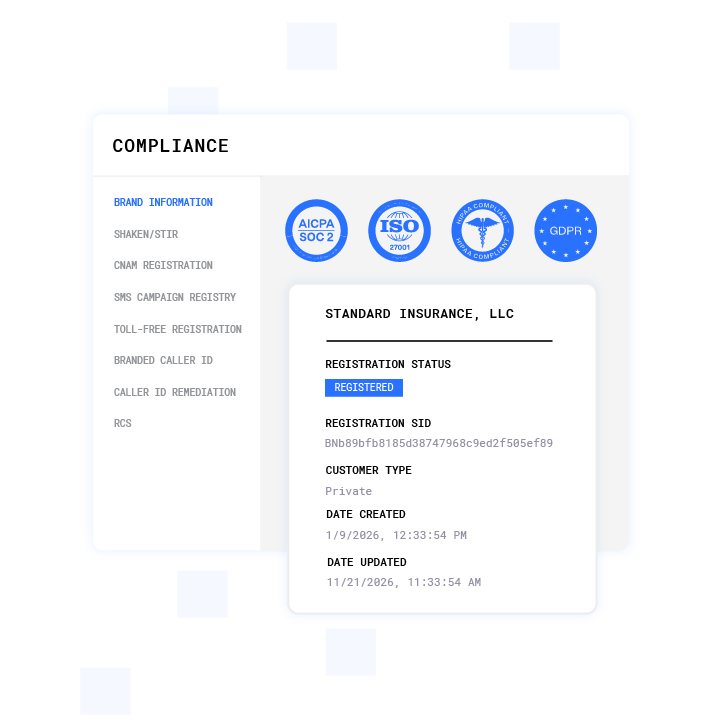
Operators planning high-volume RCS programs should consult qualified legal counsel on TCPA, state mini-TCPA statutes, and applicable industry regulations before launch.2 Plura supports compliance through built-in TCPA compliance infrastructure, DNC compliance scrubbing, STIR/SHAKEN caller ID verification, HIPAA-aligned encryption, and SOC 2 certification on its platform.1 Compliance posture downstream of the platform remains the operator’s responsibility.
Cross-channel stateful workflows with RCS and AI
Most RCS programs fall short on what happens after the message, not on the message itself. A customer who taps “Confirm” on an RCS appointment card at 9 a.m. should not have to re-explain that confirmation when an AI voice agent calls at noon to review pre-visit instructions. Without a shared memory layer, those two interactions stay disconnected. With Plura’s Stateful Conversation Database, they become the same conversation.
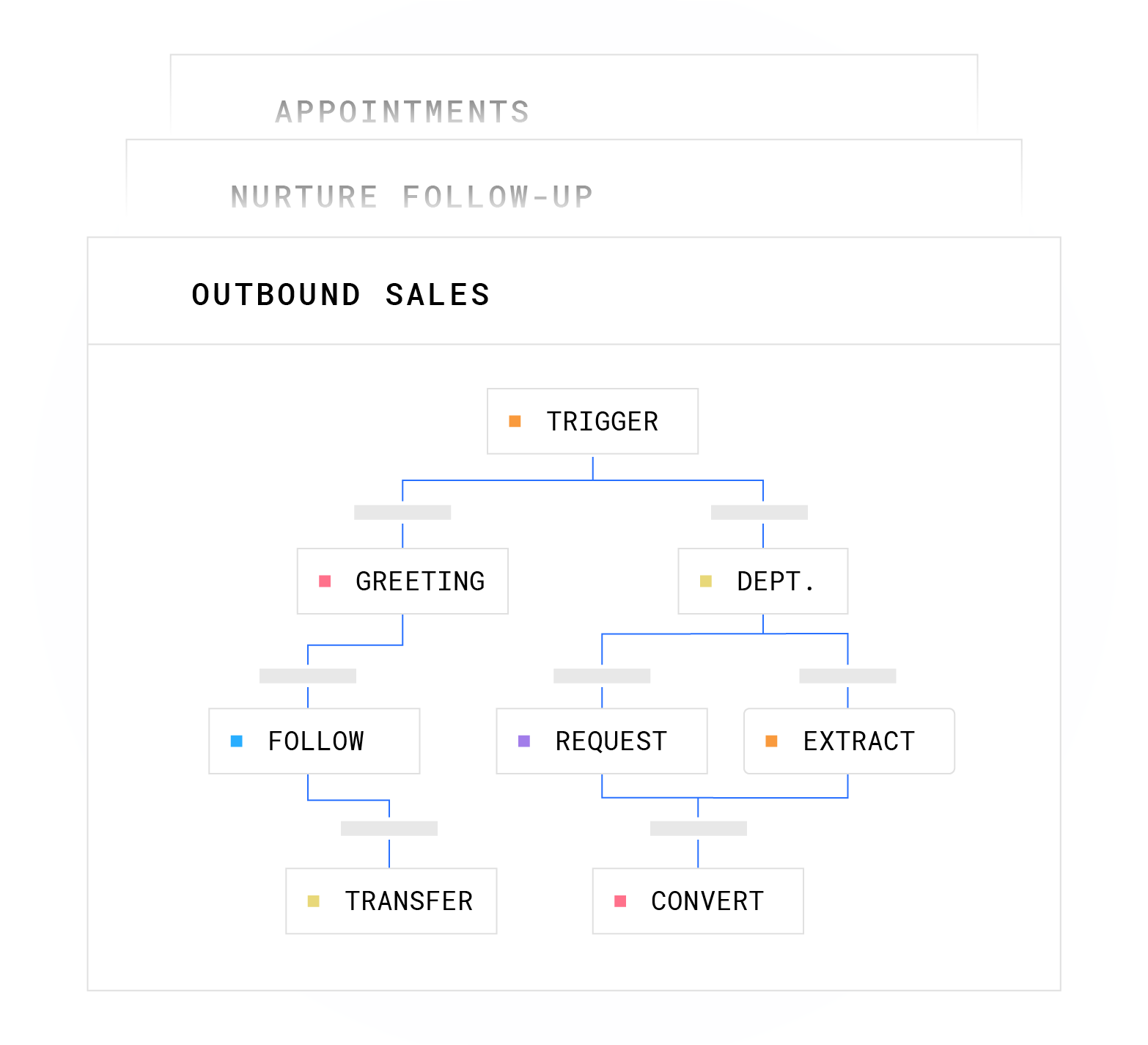
Every RCS interaction on Plura is tokenized to the customer by phone number, email, or ID. The token persists across AI SMS, AI voice agent calls, and AI webchat sessions. A promotional RCS carousel tap at 9 a.m. feeds the product interest into the stateful database. The AI voice agent call at noon opens with that context already loaded. The no-code workflow builder connects these nodes on a visual canvas without engineering involvement.
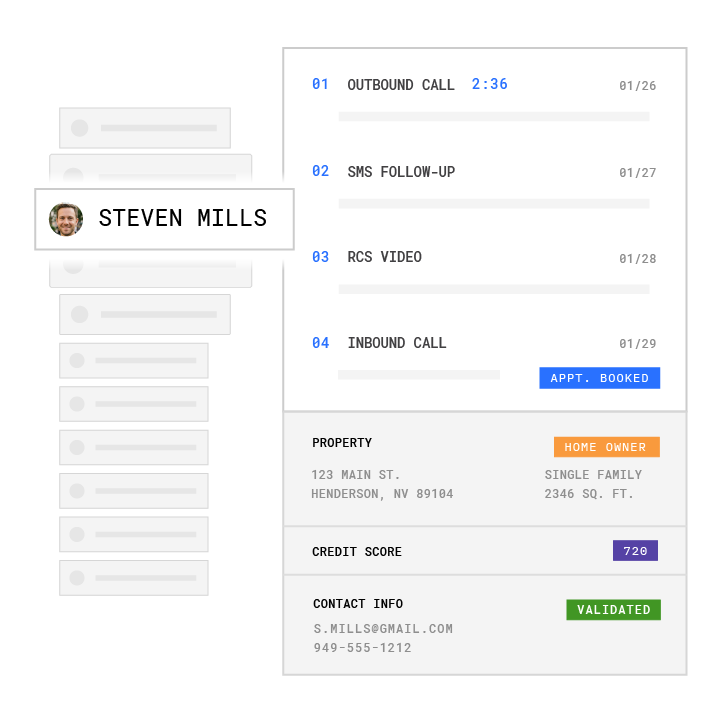
Companies using strong omnichannel engagement retain 89% of customers compared to 33% for those with weak omnichannel strategies (Aberdeen Group, 2023).4 Customers engaging across three or more channels spend 250% more than single-channel customers (Harvard Business Review, 2024).4 The stateful layer is what makes those numbers achievable at operator scale.
Plura’s AI predictive dialer uses stateful conversion signals from prior RCS interactions to prioritize which contacts to call next, based on historical answer rates and prior offer-acceptance data. This creates a cross-channel workflow where RCS handles the rich, interactive touchpoint and voice handles the high-stakes conversation, with shared memory removing the repetition that drives customer attrition.
Run your numbers through Plura’s ROI calculator to check your ROI in real time.
Frequently asked questions about RCS business messaging
What is the difference between RCS Business Messaging and standard SMS?
RCS Business Messaging delivers verified brand identity, rich media such as carousels and images, in-message action buttons, read receipts, and two-way conversational sessions inside the recipient’s native messaging app. Standard SMS delivers plain text from a phone number or short code with no visual branding, no interactivity, and no read confirmation. RCS requires carrier-verified sender registration before any messages can be sent, while SMS uses A2P 10DLC, short code, or toll-free registration. Both channels require explicit consent and opt-out handling under applicable regulations. Operators planning to deploy both should maintain separate registration infrastructure for each, because RCS does not replace the SMS fallback requirement.
Does TCPA apply to RCS Business Messaging?
The regulatory picture for RCS and TCPA is not fully settled at the federal level.2 A prudent operational approach for high-volume commercial RCS is to treat campaigns as subject to TCPA consent, opt-out, and quiet-hour requirements. Texas Senate Bill 140, effective September 1, 2025, expressly covers SMS, MMS, and RCS messages sent to Texas residents for promotional purposes.2 Several state mini-TCPA statutes use broad language that may reach RCS depending on the jurisdiction. Operators should consult qualified legal counsel before launching high-volume RCS programs and maintain consent records, opt-out documentation, and quiet-hour enforcement regardless of channel. Plura’s platform supports TCPA compliance infrastructure including real-time DNC scrubbing and immutable consent logging. Compliance obligations downstream remain the operator’s responsibility.
How long does RCS Business Messaging registration take in the United States?
Carrier approval for a new RCS Business Messaging agent in the United States currently takes 8 to 16 weeks for most brands, depending on use case complexity and whether the submission requires revisions. The process includes brand eligibility review, agent configuration and asset preparation, carrier submission and technical review, and verification badge activation. Each carrier approves independently, so partial production sending is possible once at least one carrier approves. Operators should plan registration timelines well in advance of campaign launch dates, particularly for promotional or high-volume programs that face stricter carrier scrutiny. An underlying A2P 10DLC, short code, or toll-free SMS registration is required in parallel for fallback messaging.
What RCS Business Messaging use cases deliver the highest ROI for contact centers?
Appointment reminders with interactive confirm and reschedule buttons, abandoned cart recovery with one-tap purchase actions, and OTP authentication with verified sender badges consistently deliver measurable ROI in contact center environments. Appointment reminders reduce no-show rates and inbound scheduling calls. Abandoned cart recovery generates higher recovery rates than SMS at comparable send costs when the message includes product imagery and a direct purchase button. OTP flows reduce support tickets from customers questioning code legitimacy. The highest ROI deployments combine RCS with a stateful cross-channel workflow, so the RCS interaction feeds context to a follow-up AI voice agent call or AI SMS thread rather than operating as a standalone send.
How does Plura AI connect RCS Business Messaging to voice and SMS workflows?
Plura’s Stateful Conversation Database stores every RCS interaction against a customer token keyed to phone number, email, or ID. That token is shared across AI voice agent calls, AI SMS threads, and AI webchat sessions. When a customer taps a button in an RCS message, the action is logged to the database in real time. The next outbound contact on any channel opens with that context already loaded, so the AI does not ask the customer to repeat information they already provided. Plura’s no-code workflow builder connects RCS nodes to voice and SMS nodes on a visual canvas, with branching logic driven by the customer’s prior responses. This architecture enables sub-5-second response and persistent memory across every channel without engineering involvement from the operator.
Conclusion: RCS as a core channel in stateful engagement
RCS Business Messaging now operates as a mainstream channel rather than an experiment. U.S. RCS interactions grew 1,298.8% year over year in 2026. All three major U.S. carriers support it. iOS 18 brought it to the majority of U.S. smartphones. The operators capturing that growth do not treat RCS as a standalone campaign tool. They embed it inside stateful, cross-channel workflows where a 9 a.m. RCS interaction feeds context to a noon AI voice agent call, and every touchpoint builds on the last.
Plura AI unifies RCS with AI voice agents, AI SMS, AI webchat, and a Stateful Conversation Database on 100% U.S. infrastructure, with TCPA compliance support, DNC compliance scrubbing, STIR/SHAKEN caller ID verification, HIPAA-aligned encryption, and SOC 2 certification built into the platform.1 The math behind the model is on the table: 3x average ROI in 90 days, 47% average pipeline growth, and 90% faster lead-response time.3
Run your numbers through Plura’s ROI calculator to check your ROI in real time.
Compare plans and rates side by side at plura.ai/pricing.
1 Plura AI maintains SOC 2, HIPAA, ISO, and GDPR posture as part of its platform infrastructure. References to compliance frameworks in this article describe Plura’s platform capabilities and do not constitute a guarantee that any customer using Plura will themselves be compliant with applicable laws or standards. Customers remain solely responsible for their own regulatory obligations, certifications, consent management, recordkeeping, and the claims they make to their own end users. Consult qualified legal counsel for guidance specific to your use case.
2 This article describes regulatory frameworks at a general level and does not constitute legal advice. Laws and regulations vary by jurisdiction, change over time, and apply differently depending on facts and circumstances. Readers should consult qualified legal counsel before making compliance decisions.
3 Performance figures, customer outcomes, and industry statistics referenced in this article are drawn from cited third-party sources or Plura customer case studies. Individual results vary based on implementation, use case, industry, audience, and execution. Past or aggregate performance is not a guarantee of future results.
4 References to third-party products, services, companies, or research are made for informational and comparative purposes only. Plura AI is not affiliated with, endorsed by, or sponsored by any third party named in this article unless explicitly stated. Trademarks and product names referenced remain the property of their respective owners.
This article is provided for informational purposes only and reflects Plura AI’s understanding at the time of publication. Product capabilities, integrations, and specifications are subject to change. For the most current information, visit plura.ai.
This article was produced with the assistance of AI tools and reviewed by Plura AI prior to publication.