

Written by: Matt Beucler, CEO, Plura AI
Updated June 2026
Key Takeaways
- RCS replaces plain SMS with branded, interactive messaging that supports rich media, quick replies, carousels, verified sender profiles, and in-message payments inside native apps.
- In 2026, Apple’s iOS 18 support and carrier adoption have driven RCS penetration, with Google reporting over 1 billion RCS messages sent daily in the U.S.
- RCS delivers 3x higher engagement, 35% click-through rates, and 80% read rates compared to SMS, which suits support, appointment reminders, and order confirmations.3
- Plura AI is the only platform embedding RCS inside a memory-driven, FCC-licensed contact-center stack with compliance support for TCPA, DNC, HIPAA, SOC 2, and ISO on 100% U.S. infrastructure.1
- Experience stateful RCS conversations across voice, SMS, and webchat by seeing Plura’s cross-channel memory in action.
Why RCS now matters for U.S. contact centers
RCS is an IP-based messaging protocol that runs over Wi-Fi or mobile data and delivers capabilities that SMS, which transmits over cellular signaling with a 160-character limit, cannot match. Where SMS sends plain text, RCS sends high-resolution images, video, carousels, suggested replies, and verified sender profiles, all inside the device’s native messaging app.
The market timing in 2026 is favorable for large-scale deployments. Apple added RCS support in iOS 18, and Google reported more than 1 billion RCS messages sent daily in the United States alone as of May 2025. RCS penetration in the U.S. has grown significantly since the iOS 18 update, and the three major U.S. carriers (AT&T, T-Mobile, and Verizon) support RCS. Juniper Research forecasts global RCS for Business mobile operator revenue at $1.2 billion in 2025, rising to $3.1 billion by 2027.5 For contact centers that built their messaging stack on SMS, the infrastructure to reach customers with richer interactions now exists across the U.S. market.
RCS vs SMS for contact centers
The table below compares RCS and SMS on the metrics that matter most to contact-center operations. Every figure is cited to a primary source.
| Capability | SMS | RCS |
|---|---|---|
| Rich media support | SMS: text only, up to 160 characters (GSM-7); MMS supports media up to 2 MB for images (gif/jpeg/png) or 600 KB for audio/video, with text body up to 1600 characters | RCS supports high-resolution images, video, audio, carousels/rich cards, and files up to 100 MiB (with a 100 MiB total per message) |
| Interactive elements | None natively, links redirect to external pages | Quick replies, suggested actions, tappable buttons |
| Branded sender ID | SMS supports verified branded sender IDs via features such as Verified SMS, which displays business names, logos, and trust badges instead of only phone numbers | Verified sender profile with logo, brand name, and colors |
| Engagement vs. SMS baseline | Baseline | 3x higher engagement, 35% click-through rate, 80% read rate |
| Fallback behavior | Universal delivery, no fallback needed | Automatic fallback to SMS when RCS is unavailable on device or carrier |
| Read receipts and typing indicators | Not available | Delivery and read receipts, typing indicators supported |
| Pricing model (2026) | Per-message billing | RCS pricing is typically per-message (or per segment) based on content type and region, plus possible carrier fees |
A Twilio State of Customer Engagement report found that 81% of consumers prefer RCS over traditional SMS, and many business leaders plan to invest in RCS messaging.4 SMS remains the right choice for universal reach and urgent transactional alerts. RCS is the right choice when the goal is engagement, resolution, and conversion inside the message thread.
High-impact RCS features for contact-center teams
RCS gives contact centers a messaging surface that behaves closer to an app than a text thread. The capabilities with the most direct operational impact include:
- Carousels: Scrollable cards that display multiple products, service options, or appointment slots inside a single message, which reduces the need for customers to visit a separate webpage.
- In-message documents: Native integration with document-signing tools such as DocuSign and PandaDoc, which enables contracts and consent forms to be completed inside the conversation thread.
- In-message payments: Payment processors such as Stripe can be embedded directly in the message, which allows customers to pay without leaving the thread.
- 30-second AI-rendered video: Personalized video delivered inside the message for product walkthroughs, onboarding, or post-interaction recaps.
- Verified sender profiles: Brand name, logo, and verification badge displayed in the recipient’s messaging app, which reduces the phishing concerns that suppress engagement on unverified channels.
- Read receipts and typing indicators: Delivery and read receipts plus typing indicators give contact-center agents and AI workflows real-time signal on customer engagement status.
Plura’s AI RCS supports all of these capabilities across more than 2 billion devices, and every RCS interaction is logged to the same Stateful Conversation Database that powers Plura’s voice, SMS, and webchat channels.
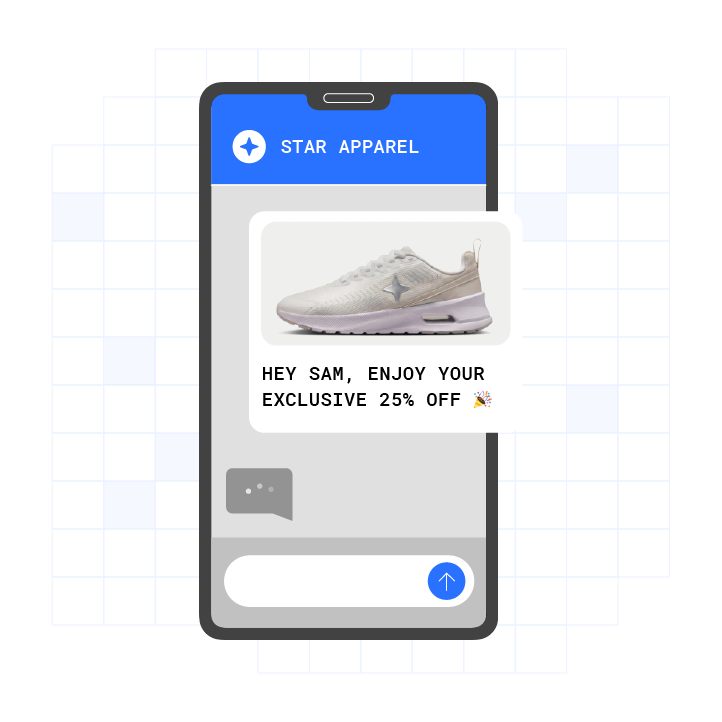
RCS for customer support conversations
Customer support is one of the highest-ROI deployment patterns for RCS in contact centers. RCS enables visual troubleshooting flows where a customer sends an image of a product issue, receives a video tutorial in response, and uses quick-reply options to schedule a service appointment, all inside one thread. That sequence, which would require three separate interactions over SMS, collapses into a single conversation.
Twilio reports that RCS boosts engagement and conversion rates compared to traditional SMS due to rich media and interactive elements. Support triage flows using structured quick-reply options such as “Billing,” “Tech support,” “Cancel,” or “Talk to a person” reduce inbound call volume by deflecting routine inquiries before they reach a live agent.
Because Plura’s AI RCS shares a Stateful Conversation Database with AI Voice and AI SMS, a customer who tapped a quick-reply button in an RCS thread at 9 a.m. does not need to re-explain their issue when the call comes at noon. The agent, human or AI, picks up with full context from every prior touchpoint.
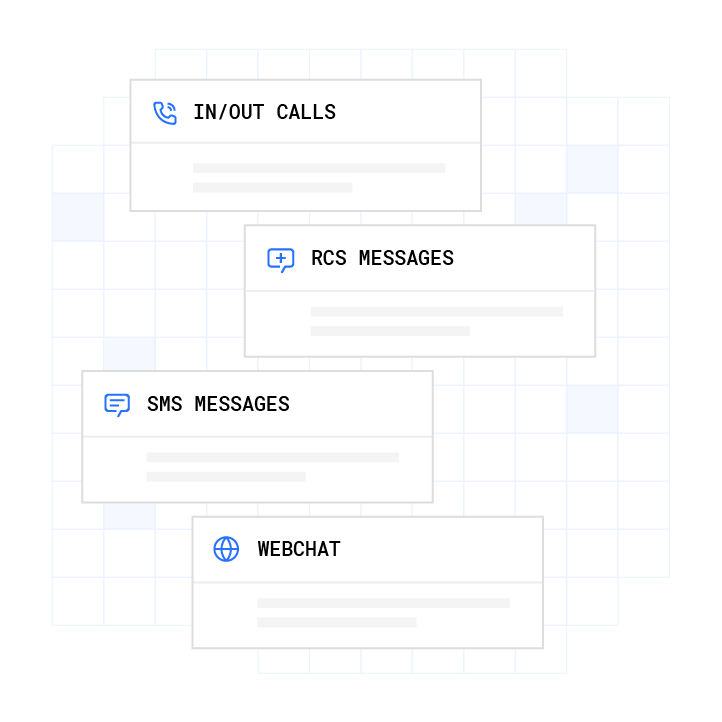
See stateful RCS support in action, and watch how context carries from an RCS thread to a live call without the customer repeating themselves.
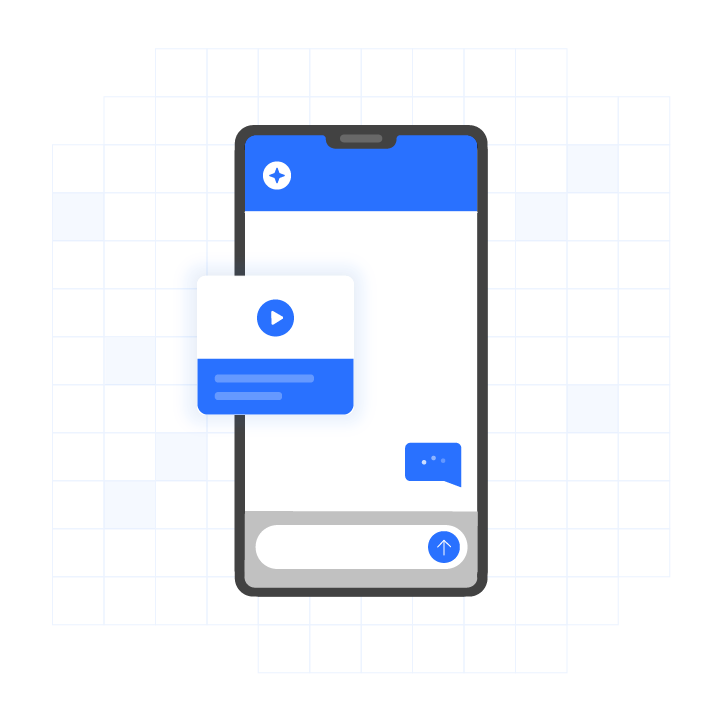
RCS appointment reminders for high-volume scheduling
Appointment management is a proven RCS use case for contact centers in healthcare, legal, financial services, and service networks. RCS appointment reminders include tappable “Confirm” and “Reschedule” buttons directly inside the message, which removes the friction of replying with a keyword or clicking through to a separate scheduling page.
Appointment reminders sent via messaging channels in healthcare settings can reduce missed appointments. Plura’s healthcare deployments support up to a 40% improvement in no-show rates through AI-driven appointment confirmation and rescheduling flows.3 Details on healthcare-specific deployment patterns are available at plura.ai/industries/healthcare.
For contact centers managing high appointment volumes, the operational math is direct. Fewer no-shows mean lower cost per completed interaction and higher revenue per scheduled slot, without adding headcount to the follow-up queue.
RCS order confirmations and contract signing
Beyond appointment management, RCS also transforms transactional workflows. RCS closes a gap that SMS cannot address: the need to complete a transaction or sign a document without redirecting the customer to a separate application or webpage. In-message document integration with DocuSign and PandaDoc allows contracts, consent forms, and service agreements to be presented, reviewed, and signed inside the RCS thread. In-message payment integration with Stripe allows customers to complete purchases in the same conversation.
For contact centers handling high-value transactions in insurance, financial services, legal, or e-commerce, this capability reduces the drop-off that occurs when customers are asked to leave the messaging thread to complete an action. Businesses using RCS for Business have reported improvements such as 11% higher conversions than SMS, 1.6x more conversions than other channels, or 110% higher conversion from clicks, along with reduced cart abandonment in some cases.3
CCaaS integration paths for RCS
Most CCaaS (Contact Center as a Service) platforms are in early stages of native RCS support. RingCentral has announced native RCS support with its initial rollout focused on verified branded messaging, with richer media and interactive carousels planned for subsequent phases.4 Vonage delivers RCS capabilities through its CPaaS Messages API rather than as a native CCaaS feature, which requires integration work and SMS fallback configuration.4
The integration gap that most CCaaS providers have not addressed is stateful cross-channel memory. An RCS thread handled by one system and a voice call handled by another system produce two separate records with no shared context. When a customer moves from an RCS appointment confirmation to a live call, the agent starts from zero. Plura’s architecture resolves this by design. AI Voice, AI SMS, AI RCS, and AI Webchat all read from and write to the same Stateful Conversation Database, so context is preserved across every channel transition without manual data transfer or CRM middleware.
Fallback planning is also a non-negotiable integration requirement. Every RCS campaign must include an approved SMS sender as a fallback when the recipient’s device does not support RCS. Plura handles fallback routing automatically, so operators do not need to manage two separate message delivery pipelines.
Compliance and infrastructure requirements for U.S. operators
RCS deployments in regulated U.S. industries carry compliance considerations that generic CCaaS providers do not address natively. The following frameworks are relevant to contact centers evaluating RCS. Operators should consult qualified legal counsel regarding their specific obligations under each.
TCPA (Telephone Consumer Protection Act, 47 U.S.C. § 227): RCS onboarding requires documented opt-in consent, and consent must be channel-specific, so a single checkbox cannot enroll users in both SMS and RCS.2 Pre-checked boxes are prohibited. Plura’s Compliance Engine timestamps and stores consent records in an immutable ledger, with audit-ready exports available on demand.
DNC (Do Not Call) compliance: Plura checks every outbound contact against federal and state DNC registries in real time before any message is sent.2 Non-compliant numbers are blocked before the first attempt.
HIPAA (45 CFR Parts 160, 162, 164): Google’s RCS terms state that the platform should not be used to share protected health information such as test results, diagnoses, or medical records.2 Healthcare operators should review their specific use cases with counsel. Plura’s infrastructure supports HIPAA-aligned encryption, access controls, and audit logging across all channels.
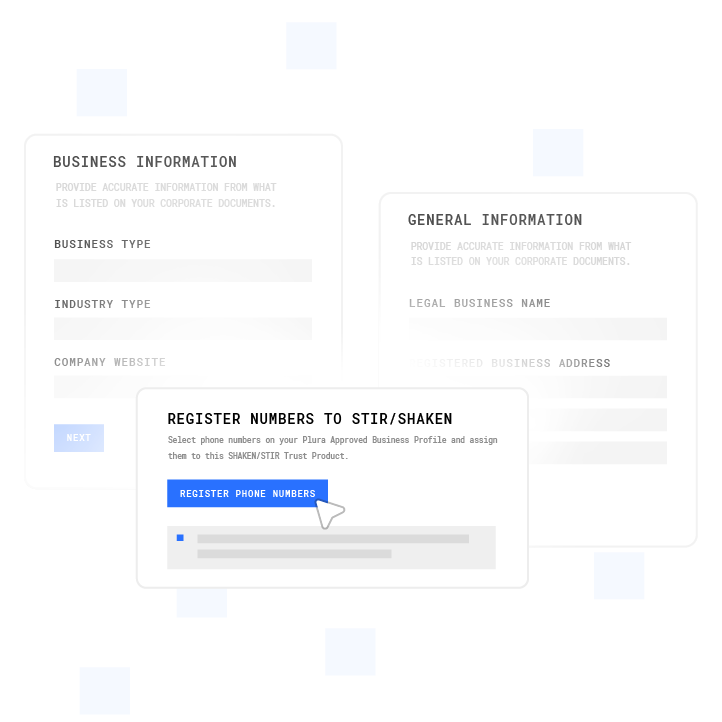
10DLC (A2P registration): A2P 10DLC registration is mandatory for SMS messaging, with carriers blocking unregistered traffic. Plura manages 10DLC registration as part of its platform onboarding.
STIR/SHAKEN: Plura authenticates every outbound voice call through STIR/SHAKEN at the carrier level, not as a bolt-on. Because Plura is its own FCC-licensed carrier, this authentication runs at origination rather than through a third-party CPaaS (Communications Platform as a Service) layer.
100% U.S. infrastructure: Voice origination, model hosting, data storage, and call recording all sit on domestic infrastructure. This architecture is relevant to operators evaluating exposure under the FCC NPRM (CG Docket No. 26-52) and state onshoring laws in New York, New Jersey, Connecticut, Missouri, and Florida.
Plura supports compliance with SOC 2, HIPAA, ISO certification, GDPR, STIR/SHAKEN caller ID verification, TCPA, and DNC frameworks.1 Customers are responsible for their own regulatory obligations and certifications.
2026 RCS implementation checklist
The following steps reflect the standard RCS onboarding process for U.S. contact-center operators. Timelines vary by carrier and use case complexity.
- Carrier verification and brand approval: Submit business information, opt-in documentation, a website link, and message samples for review. Brand approval typically occurs within 24 hours, and Google-managed launches take 1-3 business days when prerequisites are met.
- Google brand verification: Complete Google brand verification via email from the Google RCS Business Messaging Team after submitting through a messaging provider or aggregator.
- Consent documentation: Prepare channel-specific opt-in flows, Terms of Service with carrier liability disclaimer, Privacy Policy with explicit statement that opt-in data will not be shared with third parties, and opt-out instructions displayed in bold.
- 10DLC registration: Register an approved SMS sender for fallback delivery on devices that do not support RCS.
- Fallback planning: Configure automatic SMS fallback for all RCS campaigns. Test fallback behavior across device types before go-live.
- Stateful memory integration: Confirm that RCS interactions are logged to the same customer record as voice, SMS, and webchat interactions. Without shared memory, cross-channel context is lost at every channel transition.
- Audit-ready reporting: Configure consent ledger exports, DNC scrubbing logs, and campaign-level compliance reports before the first message is sent.
Walk through your implementation checklist with Plura’s team, and map the onboarding steps to your specific use case and vertical.
Frequently Asked Questions
What is the difference between RCS and SMS for contact centers, and when should each be used?
SMS transmits plain text over cellular signaling, works on every mobile device without an internet connection, and delivers near-universal reach. It is the right choice for urgent transactional alerts, two-factor authentication codes, and any message that must reach a recipient regardless of device type or data connectivity.
RCS runs over Wi-Fi or mobile data and adds branded sender profiles, rich media, quick-reply buttons, carousels, read receipts, and in-message actions. It is the right choice when the goal is engagement, resolution, or conversion inside the message thread, such as appointment confirmations with reschedule buttons, support triage flows, order confirmations with embedded payment, or contract signing. RCS automatically falls back to SMS when the recipient’s device or carrier does not support it, so operators do not need to choose one channel exclusively. Most contact centers run both, using SMS for reach and RCS for depth.
Does RCS work on iPhones, and how does that affect U.S. contact-center deployments?
Following the iOS 18 rollout mentioned earlier, RCS penetration in the U.S. rose significantly, reaching approximately 70-80% of smartphone users across major markets. All three major U.S. carriers now support RCS, which makes the channel viable for broad-reach contact-center deployments in 2026 in a way it was not in prior years.
RCS for Business support on iOS remains carrier-dependent. Not every U.S. carrier supports the full set of RCS Business Messaging features on iPhone, so operators should run region-specific pilots and confirm carrier coverage before full deployment. SMS fallback handles delivery to devices or carriers where RCS is not supported. Plura manages fallback routing automatically as part of its AI RCS platform.
How does Plura AI differ from other RCS or CCaaS providers for regulated U.S. operators?
Most CCaaS providers and AI messaging platforms deliver RCS through a third-party CPaaS layer, which means they do not own the carrier stack, cannot issue branded caller ID at the carrier level, and cannot enforce compliance at origination. Their RCS and voice channels typically run on separate systems with separate data records, so cross-channel context is not preserved without custom integration work.
Plura AI is its own FCC-licensed carrier. Voice, SMS, RCS, and webchat all share a single Stateful Conversation Database, so a customer who interacts via RCS at 9 a.m. is recognized by name, history, and prior offers when the call comes at noon. Compliance support for TCPA, DNC, HIPAA, SOC 2, and ISO certification is built into the platform, not bolted on after the fact. Real-time DNC scrubbing, immutable consent logging, quiet-hours enforcement, and audit-ready reporting run on every outbound contact. All infrastructure, including voice origination, model hosting, data storage, and call recording, sits on domestic U.S. servers, which is relevant to operators evaluating exposure under the FCC NPRM and state onshoring laws. Plura’s AI RCS delivers the engagement improvements detailed earlier across more than 2 billion supported devices.
Conclusion
SMS built the foundation for business messaging in contact centers. RCS extends that foundation with branded sender profiles, rich media, interactive quick replies, in-message documents, and payments, all inside the recipient’s native messaging app. With U.S. RCS adoption having grown significantly following the iOS 18 rollout, and major U.S. carrier support in place, the infrastructure for broad-reach RCS deployment is ready for 2026.
The gap that most RCS and CCaaS providers leave open is the one that matters most to regulated U.S. operators: stateful cross-channel memory, compliance support built into the carrier stack, and 100% U.S. infrastructure. Plura AI addresses all three inside a single platform, with AI RCS, AI Voice, AI SMS, and AI Webchat sharing one Stateful Conversation Database and running on Plura’s own FCC-licensed carrier infrastructure.
Compare plans and rates side by side at plura.ai/pricing, or see how RCS integrates with your existing stack in a live walkthrough.
1 Plura AI maintains SOC 2, HIPAA, ISO, and GDPR posture as part of its platform infrastructure. References to compliance frameworks in this article describe Plura’s platform capabilities and do not constitute a guarantee that any customer using Plura will themselves be compliant with applicable laws or standards. Customers remain solely responsible for their own regulatory obligations, certifications, consent management, recordkeeping, and the claims they make to their own end users. Consult qualified legal counsel for guidance specific to your use case.
2 This article describes regulatory frameworks at a general level and does not constitute legal advice. Laws and regulations vary by jurisdiction, change over time, and apply differently depending on facts and circumstances. Readers should consult qualified legal counsel before making compliance decisions.
3 Performance figures, customer outcomes, and industry statistics referenced in this article are drawn from cited third-party sources or Plura customer case studies. Individual results vary based on implementation, use case, industry, audience, and execution. Past or aggregate performance is not a guarantee of future results.
4 References to third-party products, services, companies, or research are made for informational and comparative purposes only. Plura AI is not affiliated with, endorsed by, or sponsored by any third party named in this article unless explicitly stated. Trademarks and product names referenced remain the property of their respective owners.
5 This article contains forward-looking statements regarding industry trends, technology adoption, and future capabilities. These statements reflect current expectations and are subject to change. Plura AI undertakes no obligation to update forward-looking statements except as required.
This article is provided for informational purposes only and reflects Plura AI’s understanding at the time of publication. Product capabilities, integrations, and specifications are subject to change. For the most current information, visit plura.ai.
This article was produced with the assistance of AI tools and reviewed by Plura AI prior to publication.