
Written by: Matt Beucler, CEO, Plura AI
Key Takeaways for U.S.-Based AI Call Centers
- U.S.-based AI call center infrastructure requires FCC-licensed voice origination plus 100% domestic data residency across carrier, speech, LLM, and orchestration layers.
- Offshore BPOs face mounting regulatory pressure from the FCC NPRM and state laws, while traditional onshore centers struggle with high costs and turnover.
- Twilio-based AI resellers lack carrier licenses and cannot guarantee U.S. data residency or branded caller ID at origination.
- Plura AI is the only platform that owns an FCC-licensed carrier, supports compliance at the carrier level, and maintains stateful cross-channel context on 100% U.S. infrastructure.
- Experience the full stack with Plura AI’s AI webchat to see how unified, compliant AI voice, SMS, RCS, and webchat work together.
How U.S. Contact Centers Are Shifting in 2026
Three categories of vendors currently compete for high-volume contact center contracts, and each carries a distinct failure mode under the regulatory environment taking shape in 2026.
Offshore BPOs (business process outsourcers) built their cost advantage on wage arbitrage. That advantage is now a liability. The FCC’s March 2026 NPRM (Notice of Proposed Rulemaking), CG Docket No. 26-52, addresses onshoring, English proficiency, robocall deterrence, and general disclosure and data-handling obligations.2 Companion federal legislation includes the Keep Call Centers in America Act (S.2495) and the Foreign Robocall Elimination Act (S.2666), both tracked on Congress.gov.2 State-level exposure already exists: New York’s Call Center Jobs Act carries penalties up to $10,000 per day, New Jersey mirrors that statute, Connecticut bans offshore vendors from state contracts, Missouri issued an executive order on offshore disclosure, and Florida restricts offshore handling of medical information.
The regulatory pressure on offshore operations has driven some operators to consider domestic alternatives, but onshore human call centers introduce a different set of constraints. Domestic contact center agents cost $15 to $25 per hour before benefits and overhead,3 with 35 to 45% annual agent turnover forcing perpetual retraining. Volume growth requires proportional headcount.
Twilio-based AI resellers represent the third category. Most AI voice platforms on the market today are software layers wrapped around a third-party CPaaS. They do not hold FCC carrier licenses, cannot issue branded caller ID at the origination level, and cannot guarantee that voice traffic, model inference, or call recordings remain on U.S. soil. Building a production-ready AI voice agent on Twilio APIs typically takes 6 to 12 months and costs $300,000 to $500,000 or more in first-year engineering and infrastructure,3 with ongoing maintenance requiring 2 to 3 full-time engineers.
Evaluating AI Call Center Platforms by Stack Ownership
Platform quality depends on which layers of the stack a vendor actually owns. A May 2026 Valoir report found that AI agents lead contact center adoption categories at 61%,3 but adoption rate does not equal infrastructure quality. The platforms that survive the current regulatory cycle share four characteristics:
- FCC-licensed carrier origination, not a CPaaS reseller arrangement
- 100% U.S. data residency across inference, storage, logging, and backups
- Stateful cross-channel memory that persists context across voice, SMS, RCS (Rich Communication Services), and webchat
- Compliance enforcement at the carrier level, not as a software add-on
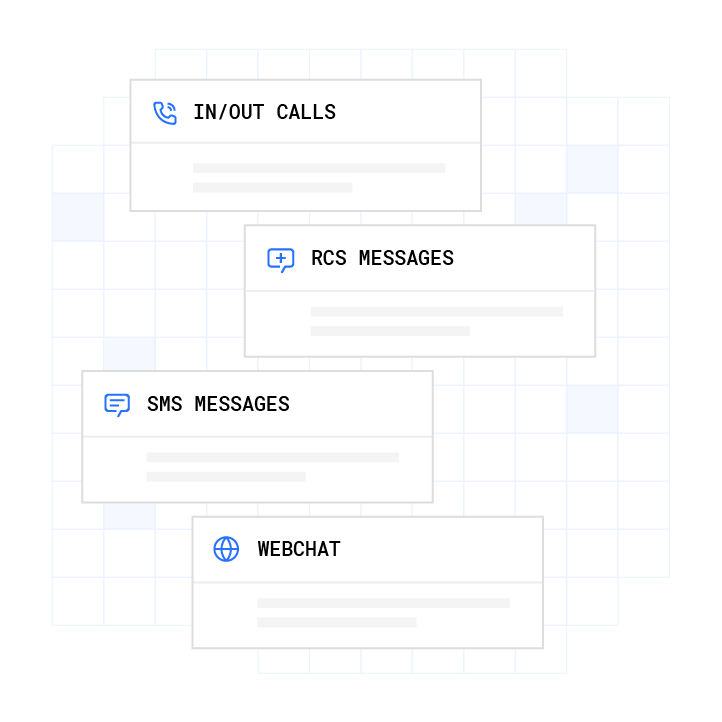
Plura AI meets all four. Plura owns its telecom infrastructure and holds an FCC carrier license, whereas platforms like Vapi depend on Twilio and operate as software layers without a carrier license.4 The same distinction applies to Synthflow and Bland AI. Bland AI is voice-only, API-based, and lacks carrier status, while Plura supports voice, AI SMS, RCS, and AI webchat natively in a unified platform with a no-code workflow builder.
Run your numbers through Plura’s calculator to check your ROI in real time: see your savings estimate.
Build vs. Buy: Strategic Trade-offs for Leaders
Contact center leaders evaluating build-vs-buy decisions face a specific set of trade-offs that generic cloud telephony comparisons do not capture. The most common underestimation is the scope of infrastructure work required.
Building on foundation model APIs covers roughly 10% of the required work. The remaining 90% is infrastructure: FCC-licensed carrier origination, STIR/SHAKEN authentication, branded caller ID issuance, real-time DNC scrubbing, immutable TCPA consent logging, HIPAA-aligned encryption, SOC 2 Type II controls, 50-plus state rule-set enforcement, and a stateful database that holds context across channels. Plura’s FCC carrier license took approximately two years to obtain, a timeline any internal build team would need to replicate before reaching equivalent regulatory standing.
Buying from a Twilio-based reseller transfers the CPaaS dependency and its associated risks: no direct carrier control, no branded caller ID at origination, and no guarantee of U.S. data residency for inference or storage. U.S. soil data residency for AI workloads requires maintaining residency across training datasets, model weights, inference data, storage systems, backups, and network paths, a requirement that most CPaaS-dependent platforms cannot contractually satisfy.
How AI Changes Call Center Staffing
Gartner predicts agentic AI will autonomously resolve 80% of common customer service issues without human intervention by 2029, leading to a 30% reduction in operational costs.3 That projection describes task displacement, not workforce elimination. McKinsey research finds that human agents deliver the most value in selling new products, resolving complex customer issues, and upselling during service interactions, while AI agents handle policy inquiries and consistent product information at scale.
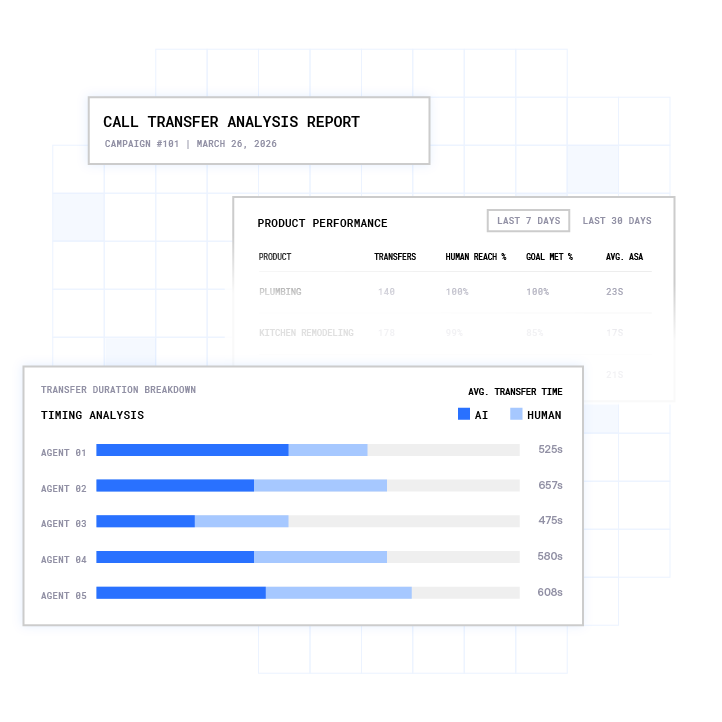
The operational reality for high-volume operators is that AI handles the volume that human agents cannot economically cover. That includes after-hours calls, simultaneous inbound peaks, sub-5-second lead response, and the first-touch qualification that determines whether a lead reaches a human at all. Plura’s AI voice agent and AI Predictive Dialer handle inbound and outbound volume at 100% talk utilization, routing qualified interactions to U.S. agents for the conversations that require human judgment.
Technical and Compliance Benchmarks to Hit
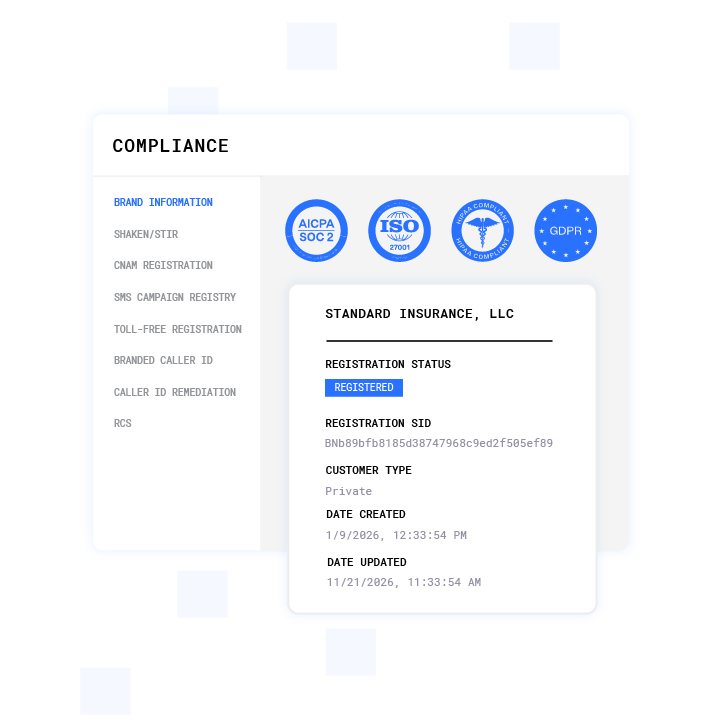
Production-grade AI call center deployments in 2026 follow a consistent set of engineering and compliance standards. Regulated contact-center deployments require SOC 2 Type II certification, HIPAA Business Associate Agreements, AES-256 encryption at rest, and TLS 1.2-plus encryption in transit, with support for cloud, VPC, and on-premises deployment to satisfy data-residency mandates.1
On latency, enterprise voice AI targets include P50 latency of 100 to 150 ms, P95 latency of 200 to 250 ms, call setup under 2 seconds, and packet loss under 0.5%. Industry benchmarks place current median voice AI response time at 1,400 to 1,700 ms, making carrier-layer optimization a direct competitive variable. Platforms that colocate AI inference with telephony points of presence on private U.S. networks reduce the latency accumulation that multi-hop architectures introduce.
On compliance, outbound AI calls must comply with National DNC and state DNC scrubbing every 31 days, honor verbal opt-outs within 10 business days, and observe the 8 a.m. to 9 p.m. local time curfew. Consent records for AI voice calls should be retained for at least four years to cover the federal TCPA statute of limitations.
Five Proven AI Use Cases in Call Centers
Aggregated data from Zendesk, Gartner, and Salesforce indicates voice AI handled 19% of inbound contact center volume in 2026 versus 6% in 2024, with banking and telecom sectors leading adoption.3 Deployment patterns cluster around five use cases, each addressing a specific operational constraint that human-only centers struggle to solve economically:
- Inbound qualification and routing: AI handles the first-touch conversation, qualifies the caller against defined criteria, and warm-transfers to a human agent with full context.
- Outbound lead response: AI contacts new leads in under 5 seconds via voice or AI SMS, qualifying buyers before a human rep engages.
- Appointment confirmation and follow-up: AI sends confirmations, handles rescheduling, and reduces no-shows by up to 40%3 (see healthcare results).
- After-hours coverage: AI answers calls and texts 24/7 without staffing overhead.
- Compliance-sensitive intake: AI conducts structured intake interviews with field-level redaction of PHI (protected health information) and PII (personally identifiable information).
Plura’s Stateful Conversation Database connects all five use cases. An AI voice agent that texted a lead at 9 a.m. picks up the call at noon already knowing what was said, what was offered, and what objections were raised. No other category of platform preserves that context across channels by default.
Assessing Readiness to Deploy Plura
Operators evaluating Plura should assess readiness across four dimensions before committing to a deployment timeline. These dimensions determine both technical fit and economic viability.
First, call volume: the platform generates meaningful ROI at 500 or more daily interactions or $5,000 or more in monthly paid-media spend. Below that threshold, the economics of a carrier-grade AI platform do not fully materialize.
Second, compliance posture: once volume justifies the platform, operators in healthcare, financial services, insurance, and legal should confirm that their existing consent documentation, DNC scrubbing cadence, and quiet-hours enforcement align with the frameworks Plura’s compliance engine supports. Plura supports compliance with TCPA, DNC, HIPAA, SOC 2, and SHAKEN/STIR caller ID verification, and customers remain responsible for their own regulatory obligations and downstream certifications.1
Third, integration readiness: Plura connects to 50-plus tools across CRM, calendar, attribution, and payment categories. Operators running HubSpot, Salesforce, or Zoho can connect existing customer records to the AI conversation layer without rebuilding data infrastructure. See the full integrations directory.
Fourth, conversation complexity: a simple inbound qualification flow deploys in days. A 25-question health-history intake runs closer to one to two months because the workflow logic requires design and validation. Every annual contract includes a 90-day opt-out window.
Common Pitfalls in AI Call Center Rollouts
The most frequent failure modes in AI call center deployments fall into three categories.
Carrier dependency: operators who deploy AI voice on a CPaaS reseller inherit that reseller’s caller ID reputation, STIR/SHAKEN attestation level, and spam-label exposure. Full A attestation gives calls the highest trust level and lowest flagging risk, while B or C attestation leaves calls exposed to reduced-trust treatment by terminating carriers such as Verizon, AT&T, and T-Mobile. Platforms that do not own the originating carrier cannot control attestation level.
Data residency gaps: backup and disaster recovery systems for AI workloads must maintain U.S. soil residency, as offshore backups represent a common oversight that can violate data residency even when primary infrastructure complies. Operators should require vendors to specify residency for inference endpoints, logging systems, and subprocessor chains, not just primary storage.
Build-and-forget deployments: during the first 30 days of an AI agent deployment, human experts must maintain close oversight to validate decisions and ensure alignment with compliance requirements. Vendors that deliver a build and hand off the keys leave operators managing a black box. Plura runs every deployment as a continuous CRO (conversion rate optimization) process, with real-call monitoring and iterative workflow tuning.
Compare plans and rates side by side on Plura’s pricing page.
Comparing Regulatory Exposure by Infrastructure Model
The regulatory perimeter around offshore and CPaaS-dependent AI call center infrastructure has expanded significantly since 2024. The table below maps the primary enforcement instruments and their applicability to each infrastructure category.
| Regulation / Law | Offshore BPO Exposure | CPaaS-Dependent AI Exposure | Plura (FCC-Licensed, 100% U.S.) |
|---|---|---|---|
| FCC NPRM CG Docket No. 26-52 (proposed 30% offshore cap, sensitive-data prohibition) | Direct exposure, proposed cap and data prohibition apply to covered providers routing calls offshore | Exposure if inference or data processing routes through foreign infrastructure | 100% U.S. infrastructure by architecture, voice origination, model hosting, storage, and recording on domestic infrastructure |
| Keep Call Centers in America Act (S.2495) | Direct exposure for covered offshore operations | Indirect exposure if vendor infrastructure is foreign-hosted | No offshore infrastructure dependency |
| Foreign Robocall Elimination Act (S.2666) | Direct exposure for foreign-originated call traffic | Exposure if call origination routes through foreign carriers | FCC-licensed domestic origination, STIR/SHAKEN A-level attestation on every outbound call |
| State laws: NY Call Center Jobs Act, NJ mirror statute, CT state-contract ban, MO executive order, FL medical-data restriction | Active penalties in covered states, NY up to $10,000 per day | Exposure where vendor data processing touches restricted state categories | No offshore data handling, state rule sets pre-loaded in compliance engine |
| FCC February 2024 AI Voice Ruling (TCPA), FCC 24-17 | Applies to any AI-generated voice call regardless of origin | Applies, CPaaS-dependent platforms must bolt on consent logging and DNC scrubbing | Real-time DNC scrubbing, immutable TCPA consent ledger, and quiet-hours enforcement built into the carrier layer |
Operators in healthcare, financial services, insurance, and legal should consult qualified counsel to assess their specific exposure under each instrument. The table above describes the regulatory landscape and does not constitute legal advice.
The Four-Layer Stack Behind U.S.-Based AI Call Centers
U.S. based AI call center infrastructure consists of four interdependent layers. Each layer has compliance enforcement points that influence whether a platform can survive the current regulatory cycle.
| Layer | Function | Compliance Enforcement Points | Plura’s Position |
|---|---|---|---|
| Carrier | PSTN (Public Switched Telephone Network) connectivity, SIP (Session Initiation Protocol) signaling, number management, call origination and termination | STIR/SHAKEN A-level attestation, branded caller ID issuance, DNC scrubbing before dial, TCPA consent verification, spam-label remediation | FCC-licensed audio bridging carrier, carrier-provisioned branded caller ID not available on CPaaS-dependent platforms, STIR/SHAKEN authentication on every outbound call |
| Speech | STT (speech-to-text) transcription, TTS (text-to-speech) synthesis, voice activity detection, echo cancellation | U.S. data residency for audio processing, HIPAA-aligned encryption for PHI in voice streams, BAA (Business Associate Agreement) coverage of the STT and TTS layer | Best-available STT and TTS models continuously upgraded, all processing on U.S. infrastructure, 24/7 availability with 99.9% uptime SLA |
| LLM (Large Language Model) | Intent classification, dialogue management, response generation, negotiation guardrails | U.S. inference endpoint, PHI cannot route to non-BAA-covered model endpoints, immutable audit log of model decisions for regulated interactions | LLM inference on U.S. infrastructure, BATNA (best alternative to a negotiated agreement) guardrails enforce negotiation floors and ceilings, sensitive-data redaction at the field level |
| Orchestration | Cross-channel context management, workflow routing, CRM integration, escalation logic, post-call actions | Stateful memory across channels, audit-ready escalation paths, 50-plus state rule-set enforcement, quiet-hours automation by time-zone detection | Stateful Conversation Database keys every interaction to a customer token across voice, AI SMS, RCS, and AI webchat, no-code workflow builder, one-click audit exports |
Contact centers achieve the lowest-risk infrastructure tier when they control number portability, programmable routing, and real-time SIP visibility, allowing direct inspection and adjustment of AI voice paths without rebuilding the stack for new vendors. Plura’s FCC-licensed carrier provides that control natively.
FAQ
What does “U.S. based AI call center infrastructure” actually mean?
The term describes a four-layer stack where every component operates on domestic infrastructure under U.S. regulatory authority. That means FCC-licensed voice origination, speech processing on U.S. servers, LLM inference at U.S. endpoints, and orchestration data stored and backed up within U.S. jurisdiction. A platform that routes calls through a foreign carrier, processes audio on overseas servers, or stores call recordings in non-U.S. data centers does not meet this definition, regardless of where its headquarters are located. Plura operates all four layers on U.S. infrastructure by architecture, not by contractual promise.
How does the FCC NPRM (CG Docket No. 26-52) affect operators currently using offshore call centers or CPaaS-dependent AI tools?
The FCC’s March 2026 NPRM proposes rules that would apply at minimum to providers of telecommunications services, CMRS (Commercial Mobile Radio Service), interconnected VoIP, cable, and DBS services, and seeks comment on extending those rules to all TCPA-covered calls. The proposed rules include an illustrative 30% cap on offshore customer service call volume, mandatory disclosure when a call routes overseas, and a prohibition on offshore handling of sensitive consumer data including passwords, multi-factor authentication codes, Social Security numbers, and banking and card data. Operators currently using offshore BPOs or AI platforms with foreign infrastructure dependencies should consult qualified counsel to assess their specific exposure. The comment period closed June 22, 2026, and the rule has not been finalized as of August 2026.
Why does FCC carrier licensing matter for spam labels and call deliverability?
Spam and scam labels are applied in the network path by voice service providers and third-party analytics companies, not by apps or software layers. A platform that does not own the originating carrier inherits that carrier’s number reputation and attestation level. STIR/SHAKEN signing occurs at the carrier level: the originating provider signs the call with a digital certificate, and the terminating provider verifies the signature before deciding whether to deliver, label, or block the call. Full A-level attestation, which requires the originating carrier to have authenticated the caller and verified number ownership, gives calls the highest trust level and lowest flagging risk. Platforms built on CPaaS resellers cannot control attestation level or issue branded caller ID at origination. Plura issues branded caller ID directly through its FCC-licensed carrier and remediates spam labels at the carrier level, including communication with Apple’s iOS 26 call-screening layer.
What is the cost difference between a traditional contact center and Plura’s AI platform?
The default scenario on Plura’s ROI calculator uses a 15-agent operation paying $20 per hour with standard taxes, benefits, and commissions at a 40% talk-utilization rate, which costs $60,000 per month. Replacing that team with Plura at $15 per hour, 100% talk utilization, and 6 Plura agents doing the work of 15 humans drops the monthly cost to $14,400,3 generating $45,600 in savings in the first 30 days and $547,200 over 12 months. For higher-volume operations, Plura’s total cost of ownership runs $300,000 to $700,000 per year against a traditional contact center benchmark of $4 million to $7 million. You can run your own numbers in the same calculator.
How does Plura handle compliance across TCPA, DNC, HIPAA, and state-level rules?
Plura’s compliance engine is a first-class layer of the platform, not a software add-on. Every outbound contact is checked against federal and state DNC registries in real time before dial, and non-compliant numbers are blocked before the first attempt. TCPA consent records are timestamped, immutable, and audit-ready. Quiet-hours rules enforce automatically through time-zone detection on the contact. HIPAA-aligned encryption, access controls, and audit logging cover protected health information across all four channels. SOC 2 Type II certification covers the underlying infrastructure with continuous monitoring and third-party audits. More than 50 state-specific rule sets are pre-loaded and applied automatically. The compliance dashboard exports audit-ready reports in one click. As noted in the implementation section, customers remain responsible for their own regulatory obligations and downstream certifications, and Plura provides the infrastructure that supports compliance workflows.
Conclusion and Next Steps for Contact Center Leaders
U.S. based AI call center infrastructure is a four-layer technical requirement, not a marketing category. FCC-licensed carrier origination, domestic speech processing, U.S.-hosted LLM inference, and stateful orchestration with 100% domestic data residency define the standard. Platforms that rent any of those layers from a foreign-infrastructure CPaaS carry regulatory exposure under the FCC NPRM, state onshoring laws, and the federal legislation moving through Congress.
Plura AI owns the full stack. Its FCC-licensed audio bridging carrier originates every call with branded caller ID and STIR/SHAKEN A-level attestation. Its Stateful Conversation Database holds cross-channel context across voice, AI SMS, RCS, and AI webchat. Its compliance engine supports TCPA, DNC, HIPAA, SOC 2, and SHAKEN/STIR caller ID verification controls before every outbound contact. Its 90-day opt-out window on every annual contract puts the performance commitment on the line.
If you want a quick financial view, you can calculate your savings in a few minutes.
When you are ready to compare options, review plans and rates on Plura’s pricing page.
Updated August 2026
1 Plura AI maintains SOC 2, HIPAA, ISO, and GDPR posture as part of its platform infrastructure. References to compliance frameworks in this article describe Plura’s platform capabilities and do not constitute a guarantee that any customer using Plura will themselves be compliant with applicable laws or standards. Customers remain solely responsible for their own regulatory obligations, certifications, consent management, recordkeeping, and the claims they make to their own end users. Consult qualified legal counsel for guidance specific to your use case.
2 This article describes regulatory frameworks at a general level and does not constitute legal advice. Laws and regulations vary by jurisdiction, change over time, and apply differently depending on facts and circumstances. Readers should consult qualified legal counsel before making compliance decisions.
3 Performance figures, customer outcomes, and industry statistics referenced in this article are drawn from cited third-party sources or Plura customer case studies. Individual results vary based on implementation, use case, industry, audience, and execution. Past or aggregate performance is not a guarantee of future results.
4 References to third-party products, services, companies, or research are made for informational and comparative purposes only. Plura AI is not affiliated with, endorsed by, or sponsored by any third party named in this article unless explicitly stated. Trademarks and product names referenced remain the property of their respective owners.
5 This article contains forward-looking statements regarding industry trends, technology adoption, and future capabilities. These statements reflect current expectations and are subject to change. Plura AI undertakes no obligation to update forward-looking statements except as required.
This article is provided for informational purposes only and reflects Plura AI’s understanding at the time of publication. Product capabilities, integrations, and specifications are subject to change. For the most current information, visit plura.ai.
This article was produced with the assistance of AI tools and reviewed by Plura AI prior to publication.