
Written by: Matt Beucler, CEO, Plura AI
Updated September 2026
Key Takeaways
- VICIdial’s MyISAM database engine lacks transaction support and crash recovery, so table corruption recurs and forces manual repairs and downtime.
- Most one-way audio issues come from NAT traversal and SIP ALG settings that break again whenever the network changes.
- Caller reputation and “Spam Likely” labels sit at the carrier layer, so VICIdial cannot control branded caller ID or STIR/SHAKEN attestation.
- The manual patch process, single-server design, and lack of automatic security updates create a maintenance load that grows with every new server.
- When these limits exceed your team’s tolerance, a carrier-owned platform like Plura AI centralizes infrastructure, branded caller ID, and compliance-supporting controls.
VICIdial MyISAM Table Corruption: Why It Keeps Coming Back
MyISAM has no transaction support and no crash recovery. The MySQL 8.0 Reference Manual lists “Transactions” as “No” in its MyISAM feature table, so the engine provides zero rollback capability. When mysqld is killed mid-write, a power supply fails, or a disk fills during a write cycle, the .MYI index file and .MYD data file land in an inconsistent state. The table is marked crashed, and the only path forward is REPAIR TABLE or offline myisamchk against a stopped MySQL instance.
The symptom pattern is familiar at any real outbound volume. Admin screens go blank, agents are locked out mid-shift, and errors appear such as “Table ‘vicidial_log’ is marked as crashed and should be repaired.” ViciStack documents that VICIdial’s lead developer Matt Florell has stated “We do not recommend using InnoDB under any circumstances,” so migrating away from MyISAM is not a supported path. The code assumes MyISAM behaviors throughout.
Run these diagnostic commands when you suspect corruption:
- Run
df -hto confirm the disk is not full before attempting repair. - Run
mysqlcheck --all-databasesto surface crashed tables. - Run
REPAIR TABLE vicidial_log EXTENDED;for the most common failure table. - Tail the MySQL error log at
/var/log/mysql/error.logto confirm the crash event and timestamp.
Verdict: architectural, not misconfiguration. ViciStack reports that a 2-hour VICIdial outage with 50 agents costs $1,500 to $2,500 in idle labor alone, before burned leads and lost sales.3 That cost recurs because REPAIR TABLE is not a one-time fix. The MEMORY tables that hold live agent state, the hopper, and active calls lose all data on every MySQL restart, so agents must log back in and the hopper must refill from scratch. The engine itself is the cause.
VICIdial One-Way Audio and Blank Audio: NAT, SIP ALG, and Asterisk Diagnosis
One-way audio in VICIdial almost always traces back to NAT traversal, not the carrier. ViciStack’s March 2026 remote agent guide ranks the four most common causes in order of frequency: SIP ALG enabled on the agent’s router, missing nat=force_rport,comedia on the Asterisk peer, wrong or missing externip or external_media_address, and the RTP port range blocked by the server firewall.
Typical symptoms include the agent hearing the lead while the lead hears nothing, or a call that goes silent after roughly 30 seconds. The root cause is that the endpoint behind NAT advertises a private IP address in the SDP body’s connection line. The far end sends RTP to an unroutable address, and that direction of audio fails. SIPNEX’s August 2026 troubleshooting guide notes: “Carriers get blamed first and are guilty last. A two-minute capture saves a two-day ticket.”
Use this Asterisk CLI sequence for one-way audio:
- Connect to the Asterisk CLI:
asterisk -rvvv. - Check peer registration and NAT status:
sip show peers. - Verify NAT settings in effect:
sip show settings. - Enable RTP packet logging during an active call:
rtp set debug on. - Inspect the SDP Asterisk sent: run
sip set debug on, place a test call, and look for thec=line.
If the c= line shows a private address like 192.168.x.x or 10.x.x.x, the endpoint is advertising an unroutable address. Set externip and localnet in sip.conf so Asterisk advertises the public address. Then add nat=force_rport,comedia to the peer definition so the far end learns the correct media path. Disable SIP ALG on the router, because it rewrites SIP headers and can undo the fix. Open UDP 10000-20000 on the server firewall to match the RTP range in rtp.conf.
Verdict: usually fixable, but it recurs. Every time network topology changes, a remote agent moves, or a router is replaced, the same diagnosis repeats. Multi-site deployments with 25 or more remote agents carry this support burden continuously.
Why Leads Stop Loading Into the VICIdial Hopper
Hopper failures are the most common mid-shift emergency in VICIdial operations. The root cause is often configuration, yet at scale the single-process hopper becomes a throughput ceiling that tuning cannot fully remove. Work through this diagnostic list in order:
- Check the hopper level and dial method in the campaign settings. Confirm the hopper size fits the current agent count and dial ratio.
- Verify lead statuses are dialable. Leads in DNC, NA, or non-dialable custom statuses will not load. Check the campaign’s “Dial Statuses” field.
- Confirm the list is active and assigned to the campaign. An inactive list or an unassigned list produces an empty hopper with no error.
- Check whether the hopper process is running.
screen -lsshould show an activeAST_VDhoppersession. If it is not running, restart it from the VICIdial admin panel under “Server Stats.” - Verify MySQL connectivity and check for table locks. A locked
vicidial_hopperMEMORY table blocks all hopper inserts. RunSHOW PROCESSLIST;in MySQL to identify blocking queries. - Check timezone and call-time settings. If the campaign’s call time window does not cover the current local time for the leads’ area codes, the hopper filters them out silently.
- Confirm lead recycling rules are not exhausting the list. If all leads have hit the maximum attempts, the hopper has nothing left to load.
ViciStack documents that VICIdial’s MEMORY tables lose all data when MySQL restarts, so the hopper empties completely on any database restart and must refill from scratch. On a large list, that refill delay leaves agents idle.
VICIdial Caller ID and “Spam Likely”: Structural Limits
VICIdial does not own a carrier identity layer. It cannot issue branded caller ID and cannot adjust spam labels at the carrier level. It inherits the reputation of the upstream SIP trunk, and carrier analytics engines control that reputation outside VICIdial.
PanTerra Networks reports that when a business number is labeled “Spam Likely” or “Scam Risk,” answer rates drop 40 to 60 percent, and the label is applied before the phone rings.3 Prospeo’s 2026 outbound sales research found the average dial-to-conversation rate fell to 2.3% in 2026, down from 4.82% the prior year, with carrier filtering identified as a primary driver.3
The STIR/SHAKEN framework, described by the FCC under the TRACED Act, authenticates whether the number displayed on caller ID is legitimately associated with the calling party.2 According to Congressional Research Service report R48941 (May 12, 2026), STIR/SHAKEN authenticates caller ID information but does not determine the purpose of a call or whether it is part of a scam.2 Authentication and reputation operate as separate systems. TNS’s 2026 Robocall Report found that 43% of spam-labeled traffic carries A-level STIR/SHAKEN attestation3, so a fully authenticated number can still receive a spam label based on behavior.
VICIdial does not handle STIR/SHAKEN signing itself. The SIP trunk provider does. Buying DIDs directly from the SIP trunk provider that terminates the calls typically yields automatic Level A attestation. Splitting DIDs and termination across carriers often results in Level B or Level C attestation, lower answer rates, and more spam labeling.
Apple’s iOS 26, released September 15, 2025, added Call Screening. The feature automatically answers calls from unknown numbers and prompts the caller to state their name and reason before the phone rings for the recipient. Predictive dialers that create dead air are most vulnerable because the screening system requires a spoken name and reason; a silent caller never passes the prompt. VICIdial’s predictive dialing model creates exactly this dead-air window.
Verdict: architectural. This problem class often forces migration because it directly suppresses connect rates and VICIdial configuration changes do not control it. The fix requires owning the carrier identity layer.
VICIdial Upgrade and Security Exposure: Manual Patch Reality
VICIdial has no automatic vendor patching path. Operators must monitor SVN revisions, test updates, and apply patches manually, unlike cloud contact-center platforms that patch automatically. The codebase lives in Subversion at svn://svn.eflo.net:3690/agc_2-X/trunk with no Git migration planned.
CVE-2024-8503 is a critical unauthenticated SQL injection vulnerability in VICIdial’s /vicidial/user_stats.php endpoint that allows an attacker to extract the entire vicidial_users table, including plaintext or weakly hashed passwords, and gain full administrative access. CVE-2024-8504 is a critical authenticated remote code execution vulnerability that, chained with CVE-2024-8503, enables root-level server compromise from an unauthenticated starting point. Both are patched in SVN revision 3848 or later.
ViciStack reports that a misconfigured Asterisk server exposed to the internet will be found and attacked within hours because SIP scanners run continuously across the IPv4 space probing port 5060 for open registrations. The default VICIdial AMI credentials are “cron”/“1234” and appear in public install guides.
Run these security checks on any VICIdial installation:
- Check fail2ban status:
fail2ban-client status asterisk. - Review iptables rules:
iptables -L -n -v. - Check for unknown SIP registrations:
asterisk -rx "sip show peers". - Review the Asterisk security log:
tail -f /var/log/asterisk/security. - Check for unexpected listening processes:
ss -tlnp. - Compare PHP files against SVN: run
svn statusin the VICIdial web directory.
Security patches for Asterisk 16 stopped in October 2025, so VICIdial operators still running Asterisk 16 or earlier are on unpatched software. Applying VICIdial’s SVN updates to a production system requires testing, staging, and a maintenance window, with 4 to 8 hours budgeted per major update at the admin’s hourly rate.
Verdict: ongoing maintenance burden that scales with every added server. Every telephony server added to the cluster becomes another surface to patch, another fail2ban instance to tune, and another AMI port to secure.
VICIdial UI Modernization and ACQS Bypass
Patching is not the only layer tied to the original architecture. VICIdial’s agent and admin web interface is still built on the HTML-table-based PHP design that shipped in the 2006 to 2008 era. A new UI skin shipped in early 2025 with better color contrast and larger click targets, but it does not fix the fundamental UX problems. The deeper issue is coupling. Operators who try to modernize the agent interface by decoupling the frontend from the VICIdial core quickly discover that decoupled frontends bypass ACQS (Auto Call Quality System) failsafes.
ACQS enforces abandoned call rate limits and call pacing rules that help outbound operations stay within defined parameters. A decoupled UI that bypasses ACQS creates a compliance exposure.
Verdict: architectural limitation. The UI reflects the underlying single-server design. The database, the Perl daemons, and the agent interface are tightly coupled by design. Pulling one layer out breaks the others.
VICIdial, Asterisk, and FreePBX: How They Actually Differ
These three platforms are related but distinct. VICIdial is a full contact-center application built on top of Asterisk, adding campaign management, predictive dialing, agent interfaces, reporting, and lead management.4 Asterisk is the open-source telephony engine that handles SIP signaling, call routing, and media processing. FreePBX is a web-based GUI for managing Asterisk, aimed at business phone systems rather than outbound contact-center operations.
Running raw Asterisk without VICIdial means building campaign management, agent interfaces, and dialing logic from scratch. Running FreePBX in place of VICIdial gives you a PBX, not a predictive dialer. The three are not interchangeable, and troubleshooting guides written for one do not always apply to the others.
When to Stop Fixing VICIdial: The Decision Threshold
The maintenance burden exceeds migration cost when four conditions converge. First, database corruption recurs on a schedule measured in weeks rather than months, and the repair window consumes agent hours and burns leads on a predictable basis. Second, caller reputation suppression measurably reduces connect rates and no carrier-side remediation is available through the current SIP trunk arrangement. Third, the operation needs to scale beyond a single MySQL instance and the single-server architecture becomes the ceiling. Fourth, compliance or audit requirements cannot be satisfied natively by the open-source stack. TCPA documentation, DNC scrubbing audit trails, and A-level STIR/SHAKEN attestation all require custom tooling built on top of it.2
When those four conditions are present simultaneously, the question becomes which platform eliminates the maintenance burden instead of relocating it to a different set of manual processes.
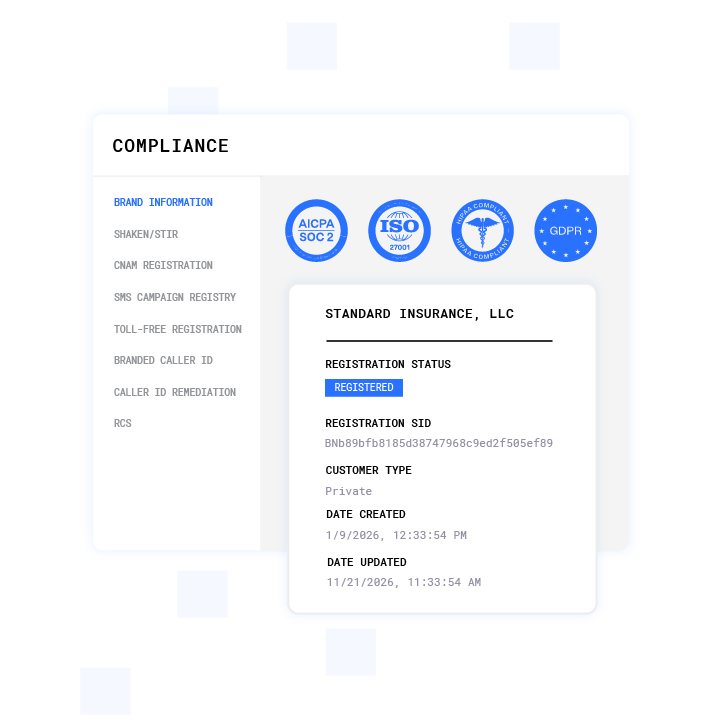
Plura AI is an FCC-licensed platform of AI agents running voice, SMS, RCS, and webchat on 100% U.S. infrastructure. Plura owns its carrier stack. Voice originates on Plura’s FCC-licensed audio bridging carrier, not a third-party CPaaS. Branded caller ID is issued at the carrier level. STIR/SHAKEN authentication runs on every outbound call.1 Real-time DNC scrubbing checks every number before dial.1 TCPA consent records are timestamped and immutable.1 The compliance engine operates as a first-class layer of the platform.
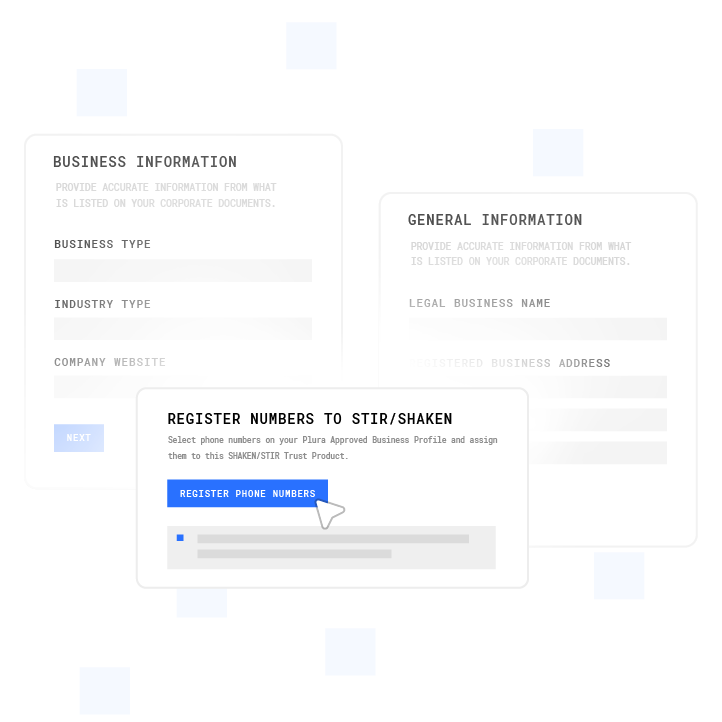
The table below shows where the architectural gaps land. Carrier identity, attestation, DNC enforcement, and patching sit inside the platform in a carrier-owned model, and they remain outsourced or manual in self-hosted VICIdial.
 1
1| Attribute | Self-Hosted VICIdial | Plura AI (Carrier-Owned Platform) |
|---|---|---|
| Carrier ownership | Rents from SIP trunk provider; no carrier identity layer | FCC-licensed audio bridging carrier; owns operating company number |
| Branded caller ID | Unavailable at the carrier level; depends on upstream trunk | Issued directly at the carrier level under Plura’s carrier identity |
| STIR/SHAKEN attestation | Determined by SIP trunk provider; splitting DIDs and termination typically yields Level B or C | A-level authentication on every outbound call via owned carrier |
| Real-time DNC scrubbing | Requires third-party integration and manual configuration | Enforced inside the platform before every dial; immutable consent ledger |
| Security patching | Operator-managed; 4 to 8 operator hours per major update | Vendor-managed; 0 operator hours per update |
| Cross-channel memory | Unavailable; each channel is a separate system | Stateful Conversation Database shared across voice, SMS, RCS, and webchat |
Plura’s AI predictive dialer replaces VICIdial’s dialing engine with a system that uses stateful conversion signals to decide who to call next. Calls route over Plura’s FCC-licensed carrier with branded caller ID and STIR/SHAKEN authentication. The platform is designed to avoid the MyISAM corruption cycle, the manual patch window, and the SIP ALG troubleshooting loop. For a full comparison of VICIdial alternatives and a pros-and-cons breakdown, see Plura’s comparison overview.
See the carrier-owned dialer running against your own call economics in a live walkthrough.
Frequently Asked Questions
Is VICIdial Open Source?
Yes. VICIdial is released under the AGPLv2 license, which permits free use, modification, and distribution when modifications to the source code are also released under the same license. The software license costs nothing. The operational costs, including server infrastructure, SIP trunking, maintenance labor, compliance tooling, and security management, are separate and substantial.
How Much Does VICIdial Cost?
The software license is free, but ViciStack’s 2026 pricing guide estimates the license represents roughly 2% of total cost of ownership. Real-world all-in costs run approximately $250 per agent per month for a 10-agent operation, $82 per agent per month at 50 agents, and $181 per agent per month at 100 agents, where the operation must carry a full-time sysadmin whose salary does not scale down with agent count. The same 2-hour outage cost cited earlier applies here: $1,500 to $2,500 in idle labor before lost sales.
Is VICIdial Still Maintained?
Yes, it is actively maintained. The core team pushes new features and bug fixes into the SVN trunk roughly every week. ViciBox 12.0.2, released September 29, 2025, is the current official installation image, shipping OpenSuSE 15.6 with Asterisk 18, PHP 8.2, and MariaDB 10.11.9. ViciBox 13.0 is in beta.5 The development pace has slowed compared to a decade ago, and the platform has not adopted Asterisk 22 due to legacy dependencies on chan_sip and app_meetme, but the project continues to move.
What Causes VICIdial Database Corruption?
VICIdial uses the MyISAM storage engine for its application tables, while running several critical real-time tables (such as vicidial_live_agents and vicidial_auto_calls) in the MEMORY (HEAP) storage engine. MyISAM has no transaction support and no crash recovery. Any interruption during a write, including a hard reboot, a full disk, a killed MySQL process, or a power failure, can leave the .MYI index file and .MYD data file in an inconsistent state. The table is marked crashed and must be repaired manually using REPAIR TABLE or offline myisamchk. Because VICIdial’s code assumes MyISAM behaviors throughout, migrating to InnoDB is not a supported path. The corruption risk is architectural.
Why Does VICIdial Have One-Way Audio?
One-way audio in VICIdial is almost always a NAT traversal problem. An endpoint behind NAT advertises its private IP address in the SDP connection line. The far end sends RTP to that unroutable address, and one direction of audio fails. The most common causes are SIP ALG enabled on the router rewriting SIP headers, missing nat=force_rport,comedia on the Asterisk peer definition, incorrect or missing externip and localnet configuration in sip.conf, and the RTP port range blocked by the server firewall. The fix is usually achievable, but it recurs every time network topology changes.
What Is the Best VICIdial Alternative for High-Volume Outbound?
For high-volume outbound operations where the maintenance burden of self-hosted VICIdial has exceeded its cost advantage, Plura AI operates as a carrier-owned, compliance-supporting alternative. Plura runs its own FCC-licensed audio bridging carrier, issues branded caller ID at the carrier level, runs STIR/SHAKEN authentication on every outbound call, and enforces real-time DNC scrubbing inside the platform before dial. The AI predictive dialer uses stateful conversion signals to prioritize contacts, and all four channels, voice, SMS, RCS, and webchat, share a single Stateful Conversation Database so context carries across every touchpoint. The platform is designed to avoid the MyISAM corruption cycle, the manual patch window, and the SIP ALG troubleshooting loop.
Conclusion
VICIdial’s open source problems fall into five classes. MyISAM corruption is architectural because the engine has no crash recovery and REPAIR TABLE becomes a recurring tax. One-way audio is usually a fixable configuration issue, yet it returns with each network change. Hopper failures are often configuration-driven at small scale and a throughput bottleneck at large scale. Caller reputation suppression is architectural because VICIdial cannot issue branded caller ID or adjust spam labels at the carrier level, and that gap directly suppresses connect rates. Upgrade and security exposure form an ongoing maintenance burden that grows with every server added to the cluster.
When database corruption recurs weekly, caller reputation suppresses connect rates, the single-server architecture caps scale, and compliance audit requirements demand tooling beyond the open-source stack, continuing to fix VICIdial stops making operational sense. Plura AI functions as a carrier-owned, compliance-supporting alternative, with an FCC-licensed carrier, branded caller ID at the carrier level, STIR/SHAKEN on every call, real-time DNC scrubbing before dial, and stateful cross-channel memory across voice, SMS, RCS, and webchat.
Join a live session and see the carrier-owned dialer running against your current call economics.
Compare Plura’s plans and rates side by side. Run your numbers through Plura’s ROI calculator to check your cost savings in real time.
1 Plura AI maintains SOC 2, HIPAA, ISO, and GDPR posture as part of its platform infrastructure. References to compliance frameworks in this article describe Plura’s platform capabilities and do not constitute a guarantee that any customer using Plura will themselves be compliant with applicable laws or standards. Customers remain solely responsible for their own regulatory obligations, certifications, consent management, recordkeeping, and the claims they make to their own end users. Consult qualified legal counsel for guidance specific to your use case.
2 This article describes regulatory frameworks at a general level and does not constitute legal advice. Laws and regulations vary by jurisdiction, change over time, and apply differently depending on facts and circumstances. Readers should consult qualified legal counsel before making compliance decisions.
3 Performance figures, customer outcomes, and industry statistics referenced in this article are drawn from cited third-party sources or Plura customer case studies. Individual results vary based on implementation, use case, industry, audience, and execution. Past or aggregate performance is not a guarantee of future results.
4 References to third-party products, services, companies, or research are made for informational and comparative purposes only. Plura AI is not affiliated with, endorsed by, or sponsored by any third party named in this article unless explicitly stated. Trademarks and product names referenced remain the property of their respective owners.
5 This article contains forward-looking statements regarding industry trends, technology adoption, and future capabilities. These statements reflect current expectations and are subject to change. Plura AI undertakes no obligation to update forward-looking statements except as required.
This article is provided for informational purposes only and reflects Plura AI’s understanding at the time of publication. Product capabilities, integrations, and specifications are subject to change. For the most current information, visit plura.ai.
This article was produced with the assistance of AI tools and reviewed by Plura AI prior to publication.