

Written by: Matt Beucler, CEO, Plura AI
Updated July 2026
Key Takeaways
- Lead response SMS CRM integration sends compliant AI text replies to new leads in under 5 seconds through native connections to HubSpot, Salesforce, and Zoho.
- Responding within 5 minutes dramatically improves conversion odds, while slower responses cause leads to go cold and can reduce qualification rates by up to 100x.3
- Effective SMS CRM workflows use real-time DNC scrubbing, immutable consent ledgers, quiet-hours enforcement, and 10DLC registration to reduce TCPA risk and carrier filtering.
- Plura AI’s SMS agents and Stateful Conversation Database deliver sub-5-second responses while preserving cross-channel context across SMS, voice, RCS, and webchat for higher engagement.
- Plura AI combines native CRM integration, compliance automation, and omnichannel memory in one platform, and you can see a live demo to understand how it accelerates your lead response.
The Operational Problem: Leads Go Cold Before You Respond
Drift 2017 research on 433 B2B companies found that only 7% responded within 5 minutes and 55% took more than 5 business days.3 That gap represents a major revenue leak. The MIT and InsideSales.com Lead Response Management Study, analyzing over 15,000 leads, found that the odds of contacting a lead drop 100 times when calling at 30 minutes versus 5 minutes.3 Leads contacted within 1 minute are 391% more likely to convert than those contacted after 30 minutes.
Manual SMS follow-up, middleware-heavy workflows, and CRM tools without native AI agents cannot consistently hit these response windows. The infrastructure underneath the response determines whether a lead converts or goes cold.
Run your numbers through Plura’s ROI calculator to quantify what slow lead response costs your operation today. See Plura in a working demo.
Who This Guide Serves in Your Organization
This guide serves sales ops managers, revenue leaders, and agency owners running high-volume lead response across HubSpot, Salesforce, or Zoho. The implementation steps apply to any operator who needs sub-5-second AI SMS replies without building custom middleware or increasing exposure to TCPA (Telephone Consumer Protection Act) risk.
Step 1: Trigger SMS Automatically on Every New CRM Lead
The fastest path from a new CRM lead to an outbound SMS uses a native integration, not a middleware connector. Tools like Zapier or Make introduce latency measured in seconds and add per-task billing that scales poorly at high throughput. Direct webhook-to-API integrations deliver lower latency, clearer pricing, and tighter control over retries and compliance logic.
Plura’s native CRM integration covers HubSpot, Salesforce, and Zoho out of the box. The setup sequence for each platform follows the same pattern:
- Authenticate Plura inside your CRM’s integration settings.
- Define the trigger event: new contact created, form submission, or deal stage change.
- Map CRM fields such as name, phone, lead source, and campaign to the Plura conversation context.
- Configure the outbound SMS workflow to fire on trigger with zero manual steps in the path.
Native integration removes middleware latency that pushes response times past the 5-minute threshold where InsideSales.com research shows lead qualification odds drop 21 times compared to a 5-minute response.
Review every available integration in Plura’s directory, which covers 50+ tools across CRM, calendar, enrichment, and automation categories.
Step 2: Build a TCPA-Focused SMS CRM Workflow
Speed without a compliance framework creates significant risk. A misconfigured automated workflow can generate thousands of potential violations in a few hours before anyone notices. TCPA statutory damages can reach $500 per unsolicited message, increasing to $1,500 per message for willful violations, which can create exposure of $5 to $15 million for a 10,000-message campaign sent without proper consent.2
A TCPA-focused SMS CRM workflow addresses five operational requirements that work together as a protection stack:2
- Prior express written consent capture. Operations need prior express written consent for marketing SMS that references the exact phone number provided by the consumer. Consent should be captured at the point of lead submission and stored with a timestamp, source, and the exact disclosure language shown. This record forms the base layer for every later compliance check.
- Real-time DNC scrubbing. Even with consent, operations benefit from checking that the number does not appear on a Do Not Call registry. Plura’s compliance engine performs real-time DNC scrubbing against federal and state registries before every outbound contact and blocks numbers that fail these checks before the first attempt.
- Immutable consent ledger. Consent can be reviewed in audits or disputes, so every consent record in Plura is timestamped and immutable. Proof of consent records typically include timestamp, source of opt-in, exact language presented to the consumer, and any modifications, and many organizations retain these records for 5 years under the TSR to cover the 4-year TCPA statute of limitations plus buffer.
- Quiet-hours enforcement. Many programs treat marketing texts before 8 AM or after 9 PM in the recipient’s local time zone as outside acceptable windows. Plura enforces quiet hours automatically using time-zone detection on the contact record, not the server’s local time.
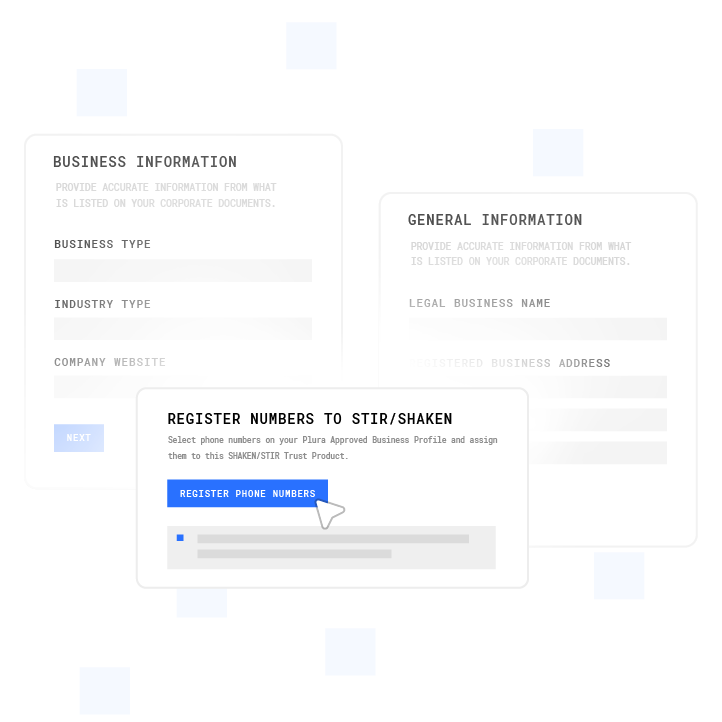
- 10DLC registration. Since 2023, many U.S. businesses sending marketing SMS have used A2P 10DLC (Application-to-Person 10-digit long code) registration with carrier-level brand and campaign verification to reduce filtering or blocking. Plura supports 10DLC registration as part of the onboarding sequence.
Plura supports compliance efforts related to SOC 2, HIPAA, ISO certification, GDPR, SHAKEN/STIR caller ID verification, TCPA, and DNC programs.1 Customers remain responsible for their own regulatory obligations and the claims they make to their end users. Review plans and rates to see which compliance features appear at each tier. Schedule a compliance-focused walkthrough.
Step 3: Deploy Speed to Lead With an AI SMS Agent Layer
With your CRM trigger configured in Step 1 and your compliance framework in place from Step 2, the remaining driver of speed to lead performance is the AI agent layer. Plura’s agents use this infrastructure to achieve the sub-5-second performance outlined earlier. Plura’s compliance framework includes SOC 2 aligned infrastructure, TCPA and STIR/SHAKEN controls, integration with Blacklist Alliance for DNC screening, and Number Verifier for caller ID reputation.
Two platform components drive this performance:
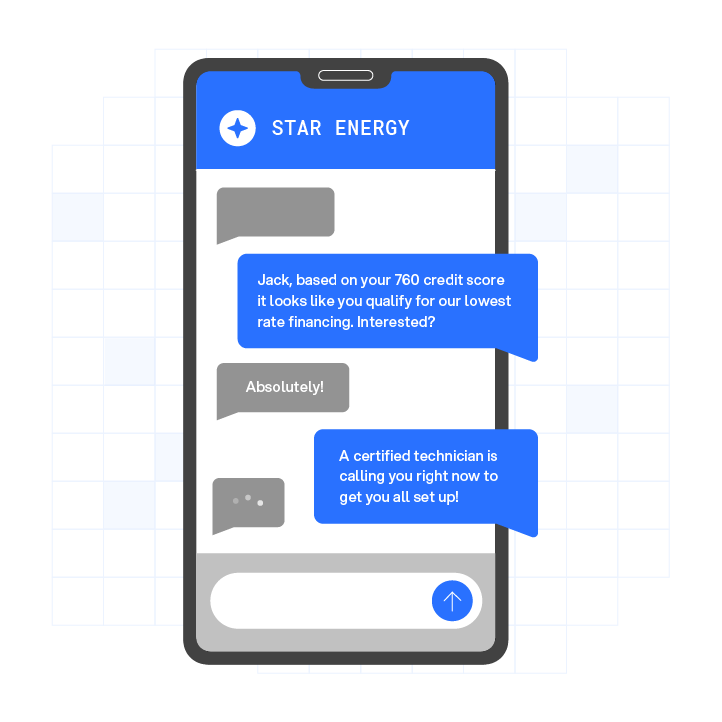
- AI agent deployment. The AI SMS agent sends the outbound message, manages inbound replies, qualifies the lead against defined criteria, and escalates to a live transfer when the workflow gate triggers. The agent runs the same conversation logic on every contact, which removes script drift.
- Stateful conversation database activation. Plura’s Stateful Conversation Database keys every interaction to a customer token such as phone number, email, or ID across voice, SMS, RCS, and webchat. An agent that texted a lead at 9 AM can pick up the call at noon with full context of the earlier exchange. Plura supports voice, SMS, webchat, and RCS within a unified stateful inbox that maintains full conversation history.
Organizations deploying AI for speed to lead often see response times drop from hours to seconds and connection rates increase by 3x to 5x. Teams also see shorter time from lead capture to first sales touch when routing runs automatically.
Step 4: Use a 4-Stage AI Agent Workflow From Trigger to Outcome
The complete lead response SMS CRM integration workflow moves through four clear stages from trigger to outcome:
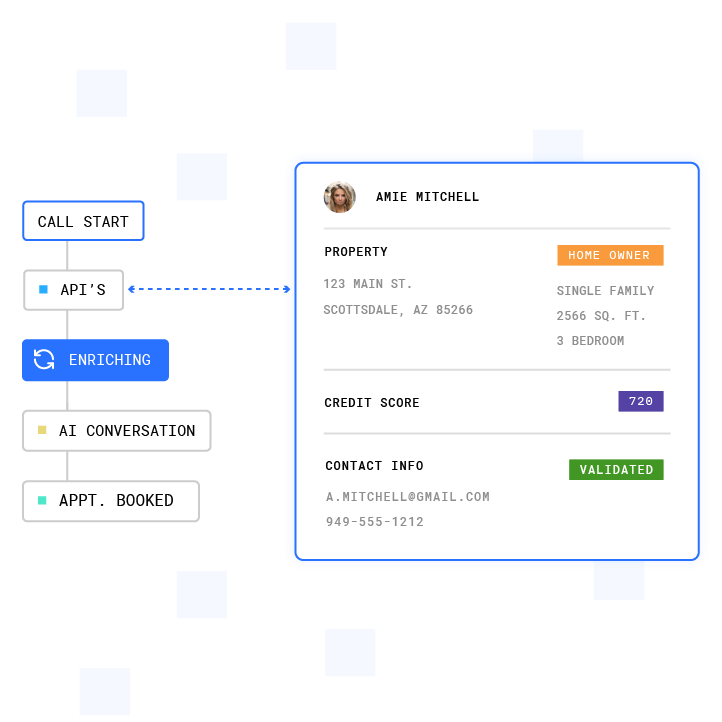
- CRM trigger fires. A new lead record is created or a defined field condition is met in HubSpot, Salesforce, or Zoho. The native integration passes the lead data to Plura with no middleware in the path.
- Real-time enrichment and DNC check. Plura enriches the lead from 30+ data sources in real time during the conversation, while the compliance engine runs real-time DNC scrubbing against federal and state registries. Numbers that fail these checks are blocked before the first message sends.
- Context-aware SMS sent. The AI SMS agent sends a personalized, compliant outbound message in under 5 seconds. The message references enriched lead data and campaign context instead of a static template. Static templates without merge fields underperform CRM-integrated personalization by 40 to 60% on engagement metrics because generic templates often read as spam.
- Stateful memory updated and live transfer option activated. Every reply, qualification signal, and conversation outcome is written back to the Stateful Conversation Database and synced to the CRM record. When a lead qualifies, the live transfer option activates and routes a warm buyer directly to a human rep.
Use Plura’s ROI calculator to model the pipeline impact of moving from a 47-hour average response time to under 5 seconds across your current lead volume.
Compliance Systems and Frameworks for Lead Response SMS
Every lead response SMS CRM integration operating at scale benefits from a compliance framework that runs automatically instead of relying on manual review. The framework described in Step 2 appears in Plura’s compliance engine with the following implementation details:
- SOC 2 Type II with continuous monitoring, penetration testing, and third-party audits1
- HIPAA-aligned encryption, access controls, and audit logging for protected health information1
- ISO certification1
- GDPR support for European operations1
- SHAKEN/STIR caller ID verification on every outbound voice call
- TCPA-focused controls with prior express written consent tracking and an immutable consent ledger
- DNC-focused controls with real-time scrubbing against federal and state registries
- 50+ state-level rule sets enforced using time-zone detection
- 10DLC A2P (Application-to-Person) messaging registry support for SMS
The Stateful Conversation Database underpins every compliance record. Consent timestamps, opt-out events, and conversation outcomes live in one place and export in one click for audit or legal review. Review plans and rates to see compliance-related features by tier.
Common SMS CRM Integration Challenges to Watch
Four operational problems appear consistently in high-volume SMS CRM deployments:
- Latency from middleware. Middleware connectors like Zapier or Make introduce latency measured in seconds rather than milliseconds and often use per-task billing that scales poorly at high throughput. Native integration removes this layer.
- Duplicate sends. CRM workflows that fire twice can send duplicate texts if deduplication logic is not explicitly configured, which causes customer frustration and opt-outs. Plura’s workflow engine includes deduplication controls at the trigger level.
- Opt-out sync delays. When integrating SMS with CRM systems, opt-out status needs to sync automatically so that a STOP reply in the SMS platform suppresses the contact across all CRM workflows and prevents re-enrollment in SMS sequences. Plura processes opt-out requests in real time with no batch delay.
- Timezone-based quiet-hours enforcement. Quiet-hours filtering for SMS should use the recipient’s stored timezone from the CRM record rather than the server’s local time to avoid sending outside permitted windows. Plura enforces this automatically using time-zone detection on every contact.
Measurement: Track Lead Response SMS CRM Performance
Three metrics define the performance of a lead response SMS CRM integration:
- Response time. Measure the elapsed time from CRM trigger to first outbound SMS. Many teams target under 5 seconds. An Optifai benchmark of 939 B2B SaaS companies found a 32% close rate for responses under 5 minutes versus 12% at 24+ hours, a 2.6x difference.3
- Contact rate. Track the percentage of triggered SMS that result in a reply or a connected conversation. Contact rate acts as the leading indicator of pipeline health and often shows the first signs of compliance or deliverability issues.
- Conversion lift. Measure the downstream conversion rate for leads contacted via AI SMS versus leads that received delayed or no response. Core performance metrics in a revenue-attribution model include revenue attributed to SMS via CRM tracking, customer lifetime value lift for SMS-engaged users versus non-engaged users, and cost per conversion.
Use Plura’s ROI calculator to model the 30-day, 12-month, and 60-month impact of sub-5-second lead response on your current operation. Book a demo to see these metrics in a live deployment.
Advanced Tactics: Cross-Channel Memory and Text-to-Call Flows
A lead response SMS CRM integration that stops at the first text message leaves conversion potential unused. The highest-converting deployments use AI SMS as the entry point into a cross-channel qualification flow.
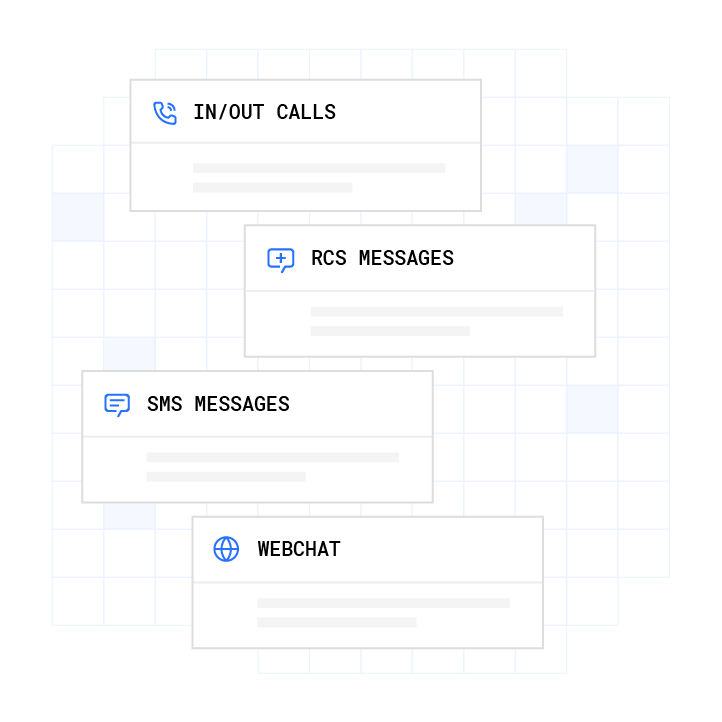
Plura’s Stateful Conversation Database preserves full context across SMS, voice, RCS, and webchat. According to Zendesk’s 2026 CX trends report, 83% of CX leaders say that memory-rich AI agents are central to truly personalized journeys.4
Advanced workflow patterns built on Plura’s platform include:
- Text-to-call escalation. When a lead qualifies via SMS, the AI SMS agent can initiate an outbound call and deliver a warm buyer to a human rep via live transfer. The rep receives full conversation context before the call connects.
- Lead qualification scoring. Plura enriches every lead from 30+ data sources in real time. Lead qualification signals write back to the CRM record and help prioritize human rep time on the highest-intent contacts.
- Cross-channel memory on re-engagement. A lead that went cold after an initial SMS thread can be re-engaged via voice or RCS with full context from the prior conversation. The AI does not restart from zero on the second touch.
- Conversation intelligence for optimization. Plura’s business intelligence layer analyzes every interaction to surface which message sequences convert, which objections recur, and where leads disengage. These insights support continuous workflow improvement.
Frequently Asked Questions
How quickly must a lead receive an SMS reply to improve conversion rates?
Response time has a nonlinear impact on conversion. Leads contacted within 1 minute convert at rates nearly four times higher than those contacted after longer delays, as noted earlier. After 5 minutes, the odds of qualifying a lead drop 21 times compared to a 5-minute response. After 30 minutes, the odds of making contact at all drop 100 times. Many teams target under 5 seconds from the CRM trigger event, which Plura’s native integrations support.
What is the difference between a native CRM integration and a middleware connector for SMS?
A native CRM integration connects directly to the CRM’s API and fires the SMS trigger in real time with no intermediate processing layer. Middleware connectors like Zapier or Make introduce latency measured in seconds, add per-task billing that scales poorly at high volume, and create an additional dependency that can fail silently. For sub-5-second lead response, native integration provides the required architecture. Plura provides native integrations with HubSpot, Salesforce, and Zoho, with a full directory of 50+ integrations available at plura.ai/integrations.
What compliance infrastructure does a TCPA-focused SMS CRM workflow require?
A TCPA-focused SMS CRM workflow typically includes prior express written consent captured before the first message, real-time DNC scrubbing against federal and state registries, an immutable consent ledger with timestamped records, quiet-hours enforcement based on the recipient’s local time zone, and 10DLC brand and campaign registration. Opt-out requests should be processed in real time and synced across all CRM workflows. Plura’s compliance engine supports real-time DNC scrubbing, immutable consent logging, quiet-hours enforcement, and 10DLC support as core platform capabilities. Customers remain responsible for their own regulatory obligations and should consult qualified counsel on their specific compliance posture.
How does cross-channel memory improve lead response outcomes?
Cross-channel memory means the AI agent that texted a lead at 9 AM already knows what was said when the call occurs at noon. Without a stateful conversation database, every channel interaction starts from zero, which forces leads to repeat themselves and lowers the quality of the qualification conversation. Plura’s Stateful Conversation Database keys every interaction to a customer token across SMS, voice, RCS, and webchat. This context is available to both the AI agent and the human rep on every subsequent touchpoint and directly improves contact rate and conversion on multi-touch sequences.
What metrics should sales ops teams track to measure SMS CRM integration performance?
The three primary metrics are response time, contact rate, and conversion lift. Response time measures elapsed seconds from CRM trigger to first outbound SMS. Contact rate measures the percentage of triggered SMS that result in a reply or connected conversation. Conversion lift compares downstream close rate for AI SMS-contacted leads versus delayed or no-response leads. Secondary metrics include opt-out rate by campaign, reply rate, and revenue attributed to SMS via CRM tracking. Plura’s conversation intelligence layer surfaces these metrics automatically and exports them for client reporting or internal review.
Can AI SMS agents handle inbound replies, or do they only send outbound messages?
Plura’s AI SMS agents handle both outbound sends and inbound replies within the same conversation thread. The agent manages the full qualification flow, responds to objections, and escalates to a live transfer when the workflow gate triggers. Ignoring inbound replies is one of the most common failure modes in SMS automation deployments. A system that sends but does not receive can damage lead relationships faster than slow response. Plura’s Unified Inbox consolidates all inbound and outbound SMS threads per customer alongside voice transcripts, RCS exchanges, and webchat sessions in a single screen for human review.
Conclusion
Lead response SMS CRM integration functions as an infrastructure problem before it becomes a messaging problem. The average B2B lead response time still exceeds 47 hours. The conversion data shows that every minute of delay after the first 5 minutes compounds lead loss.
Closing that gap requires a native CRM connection, a compliance layer with real-time DNC scrubbing and an immutable consent ledger, an AI SMS agent that responds in under 5 seconds, and a stateful conversation database that preserves context across every subsequent touchpoint.
Plura delivers all four components in a single platform with native HubSpot, Salesforce, and Zoho integration and the compliance infrastructure outlined above built in from the start.
Run your current lead volume through Plura’s ROI calculator to see the 30-day and 12-month impact of sub-5-second lead response. Review plans and rates to compare tiers. Or request a live workflow demo to see the full process in production.
1 Plura AI maintains SOC 2, HIPAA, ISO, and GDPR posture as part of its platform infrastructure. References to compliance frameworks in this article describe Plura’s platform capabilities and do not constitute a guarantee that any customer using Plura will themselves be compliant with applicable laws or standards. Customers remain solely responsible for their own regulatory obligations, certifications, consent management, recordkeeping, and the claims they make to their own end users. Consult qualified legal counsel for guidance specific to your use case.
2 This article describes regulatory frameworks at a general level and does not constitute legal advice. Laws and regulations vary by jurisdiction, change over time, and apply differently depending on facts and circumstances. Readers should consult qualified legal counsel before making compliance decisions.
3 Performance figures, customer outcomes, and industry statistics referenced in this article are drawn from cited third-party sources or Plura customer case studies. Individual results vary based on implementation, use case, industry, audience, and execution. Past or aggregate performance is not a guarantee of future results.
4 References to third-party products, services, companies, or research are made for informational and comparative purposes only. Plura AI is not affiliated with, endorsed by, or sponsored by any third party named in this article unless explicitly stated. Trademarks and product names referenced remain the property of their respective owners.
This article is provided for informational purposes only and reflects Plura AI’s understanding at the time of publication. Product capabilities, integrations, and specifications are subject to change. For the most current information, visit plura.ai.
This article was produced with the assistance of AI tools and reviewed by Plura AI prior to publication.