
Written by: Matt Beucler, CEO, Plura AI
Updated: September 2026
Key Takeaways
- Live transfer automation uses AI to qualify and route hot leads to human agents in real time.
- Speed of response directly affects connection rates and conversion performance.
- Production-ready platforms deliver instant response, cross-channel memory, real-time qualification, warm transfers, and CRM integration.
- Carrier ownership influences compliance controls, branded caller ID, and pickup rates.
- Plura AI delivers these capabilities on owned carrier infrastructure.
Live Transfer Automation vs. Managed File Transfer for Operators
Sales and contact center operators searching for “live transfer automation tools” often see managed file transfer (MFT) platforms such as Progress MOVEit, GoAnywhere, and Files.com.4 These tools automate secure file and data movement between servers. They do not handle call routing, lead qualification, or agent handoffs. The table below separates the two categories.
| Category | Purpose | Primary Users | Business Outcome |
|---|---|---|---|
| Managed File Transfer (MFT) | Automate secure file and data movement between servers and partners | IT operations, DevOps | Data exchange reliability |
| AI Live Call Transfer | Qualify and transfer live callers and leads to human agents | Sales teams, contact centers | Revenue conversion |
This guide focuses on AI live call transfer for sales and service teams.
Why AI Live Transfer Automation Matters for High-Volume Sales
Lead value decays quickly after first contact. A Harvard Business Review study found that companies responding within five minutes are 100 times more likely to connect with a prospect than those waiting 30 minutes.3 Industry research published on plura.ai/calculator shows that a 60-second response lifts conversions by 391%.3 The industry standard for first contact on an inbound lead still sits at more than 47 hours, and 88% of outbound effort goes unanswered without the right tools.
Manual qualification compounds this gap. Human SDRs spend most of their time attempting contact rather than closing, and the numbers show why. According to Auto Interview AI’s 2026 data, human SDRs dial 15 to 25 times an hour, while AI voice agents can run 100 to 500-plus simultaneous calls.3 That creates a 20 to 50x scale advantage per seat and directly addresses the speed gap. AI live transfer automation answers or dials instantly, qualifies the lead through conversation, and routes only ready buyers to a human agent.
See AI live transfer in action with a Plura demo.
How AI Live Transfer Tools Run From First Touch to Warm Handoff
AI live transfer platforms follow a consistent sequence from first touch to handoff.
- Instant response: The AI answers an inbound call or dials a new lead within seconds of the trigger event such as a form fill, ad click, or CRM record update.
- Conversational qualification: The AI runs a real conversation across voice or SMS and checks intent, fit, and readiness against predefined criteria.
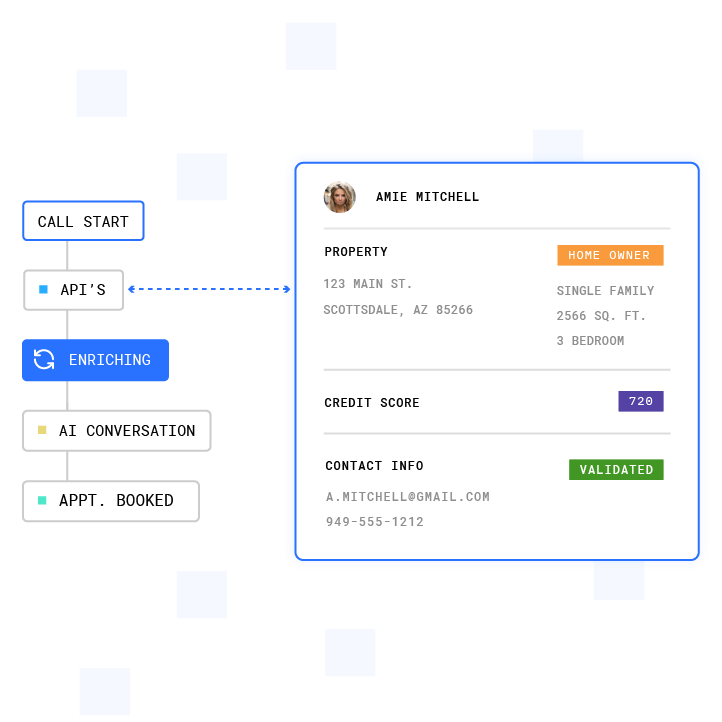
- Context assembly: Before transfer, the AI assembles a context packet that includes qualification status, objections raised, prior interactions, and enrichment data from connected sources.
- Warm handoff: The AI routes the qualified lead to a human agent with full context delivered via whisper audio or a CRM screen pop. The rep starts where the AI left off.
- Cross-channel memory: A stateful platform recognizes the contact if the lead texted earlier, called from a different number, or visited the website, and it continues the prior conversation.
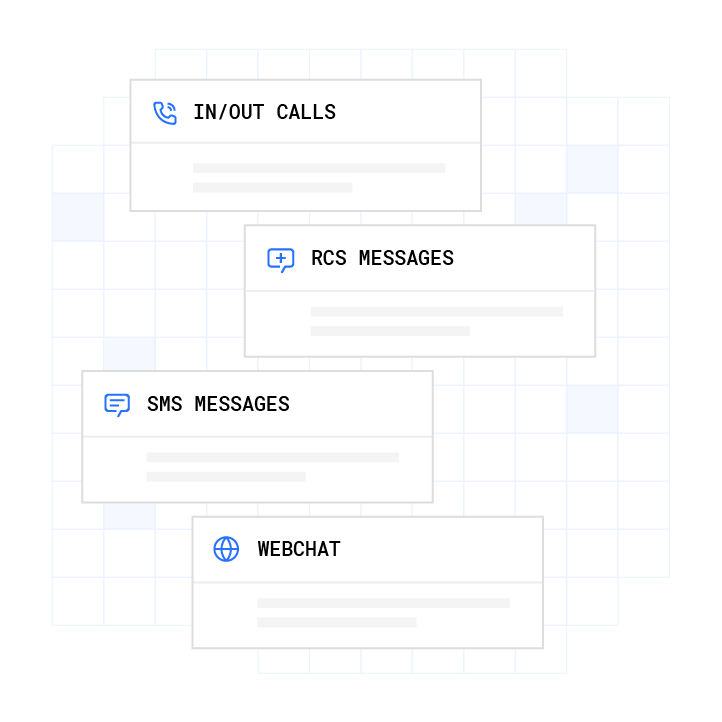
The stateful cross-channel memory step is where many API-reseller platforms fail. A lead who texted at 9 a.m. should not need to re-explain their situation when the call arrives at noon. Plura AI’s Stateful Conversation Database holds context across voice, SMS, RCS, and AI webchat by default. It keys that context to the customer’s phone number, email, or ID.
Core Capabilities to Evaluate in Live Transfer Automation
Several capabilities separate production-grade platforms from demo-only wrappers.
- Instant response (under 5 seconds): Contacting a lead within 5 minutes makes them up to 100 times more likely to connect. Platforms that respond in seconds capture this advantage.
- Omnichannel reach: Voice, SMS, RCS, and webchat should share a single conversation memory. Plura uses one Stateful Conversation Database across all four channels.
- Real-time lead qualification: The AI should enrich and score the lead during the conversation using live data sources. Plura’s AI Lead Intelligence enriches every lead with more than 30 data sources in real time.
- Warm transfer with context: Whisper audio or CRM screen pops should brief the rep before the bridge completes so prospects avoid repeating themselves.
- CRM integration: The platform should write the lead record, qualification scorecard, and full transcript to your CRM before the rep answers. Plura integrates with HubSpot, Salesforce, Zoho, and 50+ additional tools.4
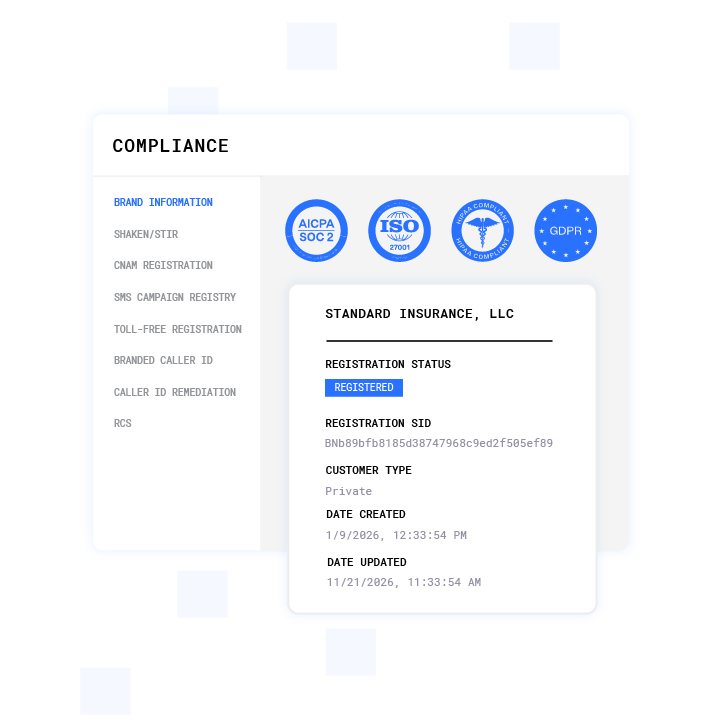
- Compliance infrastructure: The platform should support real-time DNC scrubbing, TCPA consent logging, STIR/SHAKEN authentication, and automated quiet-hours enforcement. Operators should consult qualified counsel regarding their specific obligations under applicable law.2
- Scalability: The platform should handle peak-season volume such as Medicare AEP, tax season, or Black Friday without a hiring cycle.
- Analytics: Conversation intelligence should reveal which scripts close, which objections recur, and which conversion paths win, beyond basic call counts.
Plura delivers these capabilities through its owned FCC-licensed carrier stack. Voice originates on Plura’s domestic infrastructure rather than a third-party CPaaS provider. This structure supports branded caller ID, compliance controls at the carrier layer, and stronger pickup rates.
Plura AI Compared to API-Reseller Tools and Manual Transfer
Most AI voice platforms today resell APIs from third-party telecom carriers and share similar speech, language, and voice-synthesis models. The table below compares Plura to that category and to traditional manual transfer operations on structural attributes.
| Capability | Plura AI | API-Reseller AI Tools | Manual Transfer |
|---|---|---|---|
| Carrier infrastructure | Owns FCC-licensed carrier | Rent third-party (e.g., Twilio) | N/A (human agents) |
| Compliance enforcement | Carrier-level, real-time DNC scrubbing and TCPA consent logging before dial | Added at the application layer | Manual, error-prone |
| Cross-channel memory | Stateful across voice, SMS, RCS, and webchat | Typically single-channel | CRM-dependent |
| Speed to lead | Under 5 seconds | Varies by vendor | Hours to days |
| U.S. infrastructure | 100% domestic by architecture | Varies by vendor | Depends on BPO location |
Plura is the only platform in this category that owns its FCC-licensed audio bridging carrier. Branded caller ID is issued at the carrier level, and compliance enforcement happens before the call leaves the network. According to Invoca’s 2026 B2C Buyer Experience Report, 79% of consumers will switch to a competitor that responds faster.3 Pickup rate and first-contact speed translate directly into revenue.
Experience the carrier-level difference firsthand.
Selecting the Right Live Transfer Tool for Your Operation
The right platform depends on volume, compliance exposure, and integration requirements. The use cases below map common operator profiles to the features that matter most.
- High-volume sales teams: Need sub-5-second response, concurrent outbound scale, and warm transfer with context. Plura’s AI Predictive Dialer and AI SMS handle inbound and outbound at scale on owned carrier infrastructure.
- Agencies: Need multi-client management, per-client compliance isolation, and ROI reporting. Plura enables account managers to expand from 5–8 clients to 15–20, with margins shifting from a 15–25% industry baseline to 35–50%.
- Healthcare operators: Need HIPAA-aligned encryption, sensitive-data redaction, and audit-ready logging. Plura achieves up to 40% improvement in no-shows.
- Home services: Need 24/7 answering and booking. Plura’s AI agents answer calls within two rings and book jobs directly into the CRM for home-services deployments.
- Franchise networks: Need consistent performance across locations. Plura AI voice agents answer 100% of inbound calls across all franchise locations within two rings, with a centralized dashboard for per-location metrics.
Operators handling regulated data in sectors such as healthcare, financial services, or legal should also review the FCC NPRM (CG Docket No. 26-52), which proposes restrictions on offshore handling of sensitive consumer data. Plura runs on 100% U.S. infrastructure by architecture, which addresses that exposure at the network level. Operators should consult qualified counsel for guidance on their specific regulatory obligations.2
Live Transfer Automation Cost and ROI for Leaders
AI live transfer tools use several pricing models, including per-minute usage, per-seat subscriptions, flat monthly tiers, and custom enterprise contracts. Developer-oriented platforms like Vapi advertise a $0.05/minute headline rate, but realistic all-in costs reach $0.07–$0.25/minute once speech-to-text, LLM, text-to-speech, and telephony are included.4 Flat-rate bundled plans create more predictable spend for productized deployments.
Plura’s pricing is transparent, with an annual contract and a 90-day opt-out window. The illustrative scenario on Plura’s ROI calculator shows a 15-agent operation costing $60,000 per month in human labor. That scenario assumes 15 agents at $20/hour with taxes, benefits, and a 40% talk-utilization rate. Replacing that team with 6 Plura agents at $15/hour and 100% talk utilization drops the monthly cost to $14,400. That shift produces a 30-day saving of $45,600 and a 12-month saving of $547,200.3 At higher volume, the same model produces a total cost of ownership of $700,000 per year against a traditional contact-center benchmark of $7 million.
Leaders can run their own numbers through Plura’s ROI calculator to estimate savings in real time. Compare plans and rates on Plura’s pricing page.
Walk through the ROI math for your operation with a Plura demo.
Frequently Asked Questions
What is the best live transfer automation tool for sales and contact center teams?
For sales and contact center operators, the strongest live transfer automation platform owns its carrier infrastructure, enforces controls before the call leaves the network, and preserves conversation context across every channel. Plura AI meets all three criteria. It operates its own FCC-licensed audio bridging carrier, which means branded caller ID is issued at the carrier level, real-time DNC scrubbing runs before dial, and STIR/SHAKEN authentication runs on every outbound call. Its Stateful Conversation Database holds context across voice, SMS, RCS, and webchat, so a lead who texted in the morning is recognized when the call comes in the afternoon. Plura is the only platform in this category that combines full carrier ownership with cross-channel memory by default.
Is live transfer the same as file transfer?
Live transfer and file transfer solve different problems. File transfer, or managed file transfer (MFT), automates the secure movement of data and files between servers and systems. It functions as an IT operations tool with no connection to call routing or lead handling. Live transfer in a sales or contact center context means an AI-qualified caller or lead moves to a human agent in real time with full conversation context. Sales teams searching for “live transfer automation tools” are almost always seeking this second category, even though many search results still return MFT software.
How do AI live transfer tools work?
AI live transfer tools follow a sequence from first contact to warm handoff. The AI answers an inbound call or dials a new lead within seconds, conducts a qualifying conversation through voice or SMS, enriches the lead record using connected data sources, and then routes only qualified buyers to a human agent. The handoff includes a context packet that covers qualification status, objections raised, and prior interaction history. That packet is delivered via whisper audio or a CRM screen pop before the rep is bridged in. On platforms with cross-channel memory, the AI also recognizes leads from prior touchpoints on other channels, so the human agent inherits the full conversation history instead of just the current call.
What is the difference between a predictive dialer and a power dialer?
A predictive dialer uses algorithms to dial multiple numbers simultaneously and predict agent availability. It connects answered calls to available agents and drops or leaves voicemails for the rest. A power dialer dials one number per agent sequentially and waits for a disposition before moving to the next record. Predictive dialers maximize talk time per hour at scale, while power dialers give agents more control over pacing. Plura’s AI Predictive Dialer extends both models by using stateful conversion signals such as historical answer rates, prior negotiation outcomes, and prior offer-acceptance bands to decide who to call next.
How does Plura handle TCPA and DNC compliance?
Plura supports compliance infrastructure across its platform. Every outbound contact is checked against federal and state DNC registries in real time before dial. Consent records are timestamped and immutable. Quiet-hours rules enforce automatically through time-zone detection on the contact. STIR/SHAKEN authentication runs on every outbound voice call. The compliance dashboard exports audit-ready reports in one click. Plura supports TCPA compliance, DNC compliance, SOC 2, HIPAA, ISO certification, and GDPR as part of its platform infrastructure.1 Customers remain responsible for their own regulatory obligations and should consult qualified counsel regarding their specific compliance requirements.
Can AI live transfer tools integrate with my CRM?
AI live transfer platforms should integrate directly with your CRM. A production-grade tool writes the lead record, qualification scorecard, and full conversation transcript to your CRM before the rep answers the transferred call. Plura integrates with HubSpot, Salesforce, Zoho, and 50+ additional tools across CRM, calendar, attribution, payment, and automation categories. The full directory is available on Plura’s integrations page. Two-way sync ensures that updates in the CRM flow back to the AI’s context layer so every subsequent conversation reflects the current record.
1 Plura AI maintains SOC 2, HIPAA, ISO, and GDPR posture as part of its platform infrastructure. References to compliance frameworks in this article describe Plura’s platform capabilities and do not constitute a guarantee that any customer using Plura will themselves be compliant with applicable laws or standards. Customers remain solely responsible for their own regulatory obligations, certifications, consent management, recordkeeping, and the claims they make to their own end users. Consult qualified legal counsel for guidance specific to your use case.
2 This article describes regulatory frameworks at a general level and does not constitute legal advice. Laws and regulations vary by jurisdiction, change over time, and apply differently depending on facts and circumstances. Readers should consult qualified legal counsel before making compliance decisions.
3 Performance figures, customer outcomes, and industry statistics referenced in this article are drawn from cited third-party sources or Plura customer case studies. Individual results vary based on implementation, use case, industry, audience, and execution. Past or aggregate performance is not a guarantee of future results.
4 References to third-party products, services, companies, or research are made for informational and comparative purposes only. Plura AI is not affiliated with, endorsed by, or sponsored by any third party named in this article unless explicitly stated. Trademarks and product names referenced remain the property of their respective owners.
This article is provided for informational purposes only and reflects Plura AI’s understanding at the time of publication. Product capabilities, integrations, and specifications are subject to change. For the most current information, visit plura.ai.
This article was produced with the assistance of AI tools and reviewed by Plura AI prior to publication.