
Written by: Matt Beucler, CEO, Plura AI
Updated September 2026
Key Takeaways
- RCS Business Messaging delivers measurable engagement and conversion lifts versus SMS and rich SMS in verified deployments by Clarins, LA Rams, Casas Bahia, and Subway.3,4
- Published case studies omit critical details: per-message costs, carrier and device coverage, fallback rates, and measurement methodology.
- Reach depends on device and carrier support; RCS requires iOS 18+ or Android 6.0+ and does not match SMS for universal coverage.
- Cost structures are carrier-specific, opaque, and materially higher than SMS when rich media and conversational sessions are included.
- Plura AI integrates AI RCS into a stateful, multi-channel conversation stack that unifies AI Voice, AI SMS, AI RCS, and AI Webchat for consistent customer experiences across every touchpoint.
The Verified RCS Business Messaging Deployment Table
The table below lists named RCS Business Messaging deployments verified against their published sources. Rows for Aetna and Coppel are excluded because their published metrics could not be verified against a live, named primary source.
| Brand | What the Deployment Did | Published Metric | Source | Date |
|---|---|---|---|---|
| Clarins | Interactive carousels for holiday gift sets with rich media and action buttons | 3x higher average engagement rate vs. rich SMS; 79% read rate; 22% CTR; 2.5x higher CTR vs. rich SMS | Google RCS for Business; Sinch RCS use cases | 2024-2026 |
| LA Rams | Game-day ticket offers, seat upgrades, behind-the-scenes video clips replacing text links with visual seating maps and tap-to-buy links | 70% engagement lift vs. previous SMS campaigns (verified). A secondary source reports 60% more ticket sales, but the original brand publication could not be located, so that figure is excluded from this table. | Scalify Labs RCS messaging examples (citing brand campaign outcomes) | Feb 2026 |
| Casas Bahia | Automated abandoned-cart recovery with product images in-thread; personalized promotional campaign with “Complete Purchase” button and limited-time offer timer | 6.2x higher ROI vs. other conversational channels; 1.6x more conversions; 28% response rate; 3.1x higher purchase completion rate | Google RCS for Business case study (cited by Zembula); Scalify Labs | 2024-2026 |
| Subway | Location-based visual meal promotions and quick-reply vouchers; two-sandwich RCS offer | 140% higher conversion on two-sandwich offer vs. SMS; 51% higher conversion on $20 meal deal | Mobivity case study (cited by SimplyRCS) | Jan 2019 |
| Telekom Deutschland | RCS Business Messaging deployment in DACH market; all three German carriers (Telekom, Vodafone, o2) billing RBM productively since early 2026 | ~80% of smartphones in Germany RCS-capable; all three carriers live in production | Chatarmin RCS Business Messaging (citing GSMA and carrier data) | Sep 2026 |
Each published RCS Business Messaging metric reflects what one brand measured in one campaign against one baseline in one market during one time window. It does not disclose deployment cost, the share of the audience that actually received RCS versus SMS fallback, the measurement methodology, or whether the result would replicate at your volume and carrier mix. Treat every published metric as a hypothesis to test against your own baseline, not as a forecast. The gaps that make that testing necessary fall into four categories.
What The Case Studies Leave Out
Cost Structures Behind RCS Business Messaging
RCS Business Messaging pricing is carrier- and country-dependent, negotiable, and opaque. There is no global list price like WhatsApp. The published rates that do exist fall into three tiers: basic text at low single-digit cents, rich media at 20–30% above that, and conversational sessions at roughly double the SMS rate with a 24-hour unlimited-reply window included.
US pricing illustrates the spread. AWS End User Messaging prices Rich Media RCS outbound at $0.02000 per message plus a $0.00949 carrier fee.4 Rich RCS outbound runs $0.00700 per 160-byte segment plus a $0.00494 carrier fee. Twilio publishes $0.0083 per basic RCS message and $0.0220 for rich media, with carrier fees of $0.0025 to $0.02 per message on top. In the US, all RCS Agents are non-conversational, meaning every message is billed individually by type. Vendor pages highlight the win and stop, because the cost structure is complex, carrier-specific, and often under NDA.
Carrier And Device Coverage In 2026
All three major US carriers support RCS Business Messaging: AT&T, Verizon, and T-Mobile, plus 20+ prepaid and MVNO brands. Apple added RCS support in iOS 18 in September 2024. RCS for Business began rolling out with iOS 18.1 in October 2024. However, RCS for Business requires Android Marshmallow 6.0 or higher and iOS 18 or later, and older iPhones that cannot update to iOS 18 and feature phones do not support RCS at all.
Carrier approval for new RCS business senders takes 8 to 16 weeks. Coverage also varies by market. Android RCS carrier adoption is nearly universal except in parts of South Asia and East Africa. iOS RCS carrier support is well established only in the US, Canada, the UK, Japan, Spain, Germany, and France.
Measurement Limits In Real Campaigns
Published RCS metrics are not directly comparable across vendors. RCS read receipts are not always accurate, because recipients can turn read receipts off and read events are only reported within a limited window after the original send. When a device cannot receive RCS, the message falls back to SMS and reports as SMS, so comparisons must separate recipients by device capability first.
A logistics client’s RCS OTP campaign in Germany achieved only 65% delivery, with 93% of failures due to device incompatibility. That outcome would be invisible in a blended delivered count. Cross-vendor numbers do not align because baselines, measurement windows, coverage, and fallback rates differ.
Operator Sentiment From The Field
Operators on RCS deployment forums consistently report the same friction points. Carrier approval queues often stretch beyond the 8-to-16-week estimate. Brand vetting can stall without clear next steps. Vendor dashboards sometimes report engagement rates that operations teams cannot reproduce in their own CRM or data warehouse.
These are sentiment reports, not measured outcomes, yet they recur often enough to treat as a risk factor in any deployment plan.
RCS vs. SMS vs. WhatsApp: How Leaders Allocate Budget
The table below compares RCS Business Messaging, SMS, and WhatsApp Business on the four dimensions that decide budget. All figures are cited inline.
| Dimension | RCS Business Messaging | SMS | WhatsApp Business |
|---|---|---|---|
| Reach | RCS can reach over 80% of US smartphones, based on a SimplyRCS derivation from StatCounter US OS share and Apple iOS adoption data; requires iOS 18+ or Android 6.0+; carrier-dependent | Universal; works on every mobile phone; no data connection required | ~32% US consumer penetration; requires app download and opt-in |
| Cost | Carrier- and country-dependent; basic text comparable to SMS; rich media 20-30% higher; conversational sessions ~2x SMS | $0.00774 base + $0.00421 carrier fee per message (US 10DLC) | Per delivered message template; marketing messages ~€0.1131 in Germany; US marketing templates paused since April 2025 |
| Interactivity | Rich media, carousels, suggested replies, in-message actions, verified sender branding | Text-only, 160 characters, link-out only | Rich media, buttons, conversational commerce, end-to-end encryption |
| Measurement | Read receipts, button taps, carousel views, conversion tracking; read receipts can be disabled; fallback to SMS degrades data | Delivery confirmation only; no read receipts | Read receipts, conversation completion, handover rate; 24-hour session window |
The decision frame is straightforward. Use RCS for reach into the native messaging inbox with verified branding and rich interaction where device and carrier support it. Use SMS for universal reach, OTPs, and any message that must reach every handset. Use WhatsApp for markets where it is the dominant messaging behavior, such as DACH, Brazil, and India, and for conversational commerce where end-to-end encryption is required. Most serious deployments run RCS first with SMS as the automatic safety net.
The Verified-Identity Trust Factor, Operationally
Branded sender identity changes pickup behavior. The message arrives from a verified business profile with logo, brand colors, and a verification badge. That visual identity is the opposite of the anonymized short codes consumers associate with phishing.
A Datos Insights study on financial services trust found 88% of consumers trust a message more if it is displayed with a verified company badge, and 59% of consumers stated they would choose a financial services provider offering RCS over one that does not. A GSMA study found 70% of consumers say RCS makes them more likely to communicate with a brand. Two independent studies point the same direction.
For a high-volume operator, that trust carries across channels. A verified RCS message at 9 a.m. sets up a warmer answer when the AI voice agent calls at noon.
iOS/Apple RCS Adoption And 2026 Reach
Apple shipped RCS support in iOS 18 on September 16, 2024, and RCS for Business went live across Apple devices on October 28, 2024. By early 2025, iOS 18 adoption reached approximately 68% of active iPhones. Apple began rolling out interoperable end-to-end-encrypted RCS in beta on May 11, 2026, alongside iOS 26.5, with encryption enabled by default and a lock icon displayed in encrypted conversations. As of May 11, 2026, Apple’s support page listed 23 U.S. carriers supporting end-to-end encrypted RCS messaging.
For reach in 2026, the vast majority of U.S. iPhones now support RCS. Combined with near-universal Android RCS support, the addressable U.S. market for RCS Business Messaging covers the majority of smartphone users. Carrier enablement still varies by market, and SMS fallback remains essential. Where reach is established, the conversion data is where RCS separates from SMS.
Marketing Conversions vs. Customer-Support Efficiency
Marketing Conversions
RCS marketing campaigns deliver 3 to 7 times higher click-through rates than rich SMS, and interactive campaigns can lift average order value by nearly 10%. Clarins achieved a 79% read rate and 22% CTR on an interactive RCS gift-set launch campaign, which was 2.5 times higher than the same campaign sent via rich SMS.3 Casas Bahia generated 6.2x higher ROI and 1.6x more conversions with RCS versus other conversational channels. Success metrics for marketing include delivered rate, read rate, CTR, conversion rate, and revenue per send.
Customer-Support Efficiency
RCS provides read receipts, typing indicators, and delivery confirmation, which gives CX teams real-time visibility into whether a message was opened and whether the customer is responding. An anonymized global financial services provider reported 42% fewer service calls, a 94% read rate on urgent notifications, and 300% faster resolution using RCS. Success metrics for customer support include resolution rate, self-service completion rate, first-response time, agent handover rate, and customer satisfaction score.
Seven Questions To Ask Before You Believe An RCS Case Study
An operator’s audit frame includes specific questions to ask a vendor before accepting a metric.
- What was the baseline? Clarify whether the comparison was against SMS, rich SMS, email, or no message at all.
- What was the measurement window? Confirm whether it covered one campaign, one holiday season, or a sustained program.
- What was the coverage? Ask what share of the audience actually received RCS versus SMS fallback.
- What did it cost? Request per-message rate, carrier fees, platform fees, onboarding fees, and fallback costs.
- What happened after the pilot? Check whether the lift sustained or decayed after the novelty wore off.
- Who measured it? Identify whether the brand, the vendor, or an independent third party ran the analysis.
- Can I see the raw data? Ask for the underlying data set, not just a summary metric in a slide deck.
Without separating recipients by device capability, RCS results can be understated because the RCS cohort may contain fallback SMS traffic. A metric that looks like an RCS result may be a blended RCS-plus-SMS result with the fallback rate hidden inside the denominator. That is the standard any platform should be held to, including the one this article comes from.
Where Plura AI Fits
Plura AI runs AI RCS as one channel inside a stateful, multi-channel AI conversation stack. AI Voice, AI SMS, AI RCS, and AI Webchat all share one Stateful Conversation Database, so a customer who received an RCS message at 9 a.m. is the same customer when the call comes at noon.
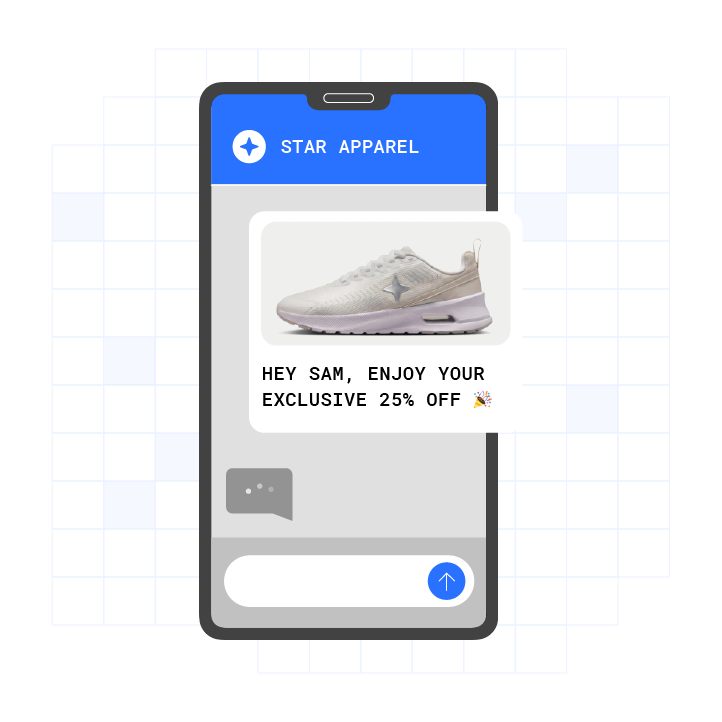
Because Plura operates as its own FCC-licensed audio bridging carrier, it can issue branded caller ID at the carrier level and run STIR/SHAKEN authentication on every outbound call.1,2 That carrier position also lets Plura enforce compliance controls inside the platform on every outbound contact, including real-time DNC scrubbing, TCPA consent logging, automated quiet hours, and audit-ready exports.1,2 Plura supports customer compliance without absolving customers of their own obligations.
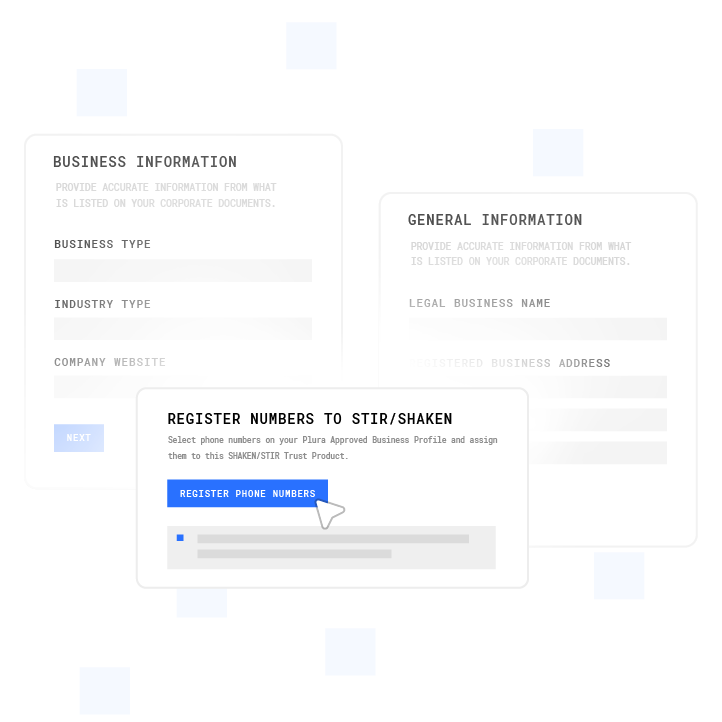
For appointment-driven operators, RCS read receipts and reminders directly attack the no-show problem. Plura achieves up to 40% improvement in no-shows3, and RCS read receipts and reminders are how that happens. A multi-specialty clinic using an RCS appointment confirmation flow with confirm, reschedule, and cancel buttons reduced no-show rates from 31% to 9% and cut manual confirmation calls by 78%. That result illustrates the operational case for RCS as one channel inside a multi-channel stack.
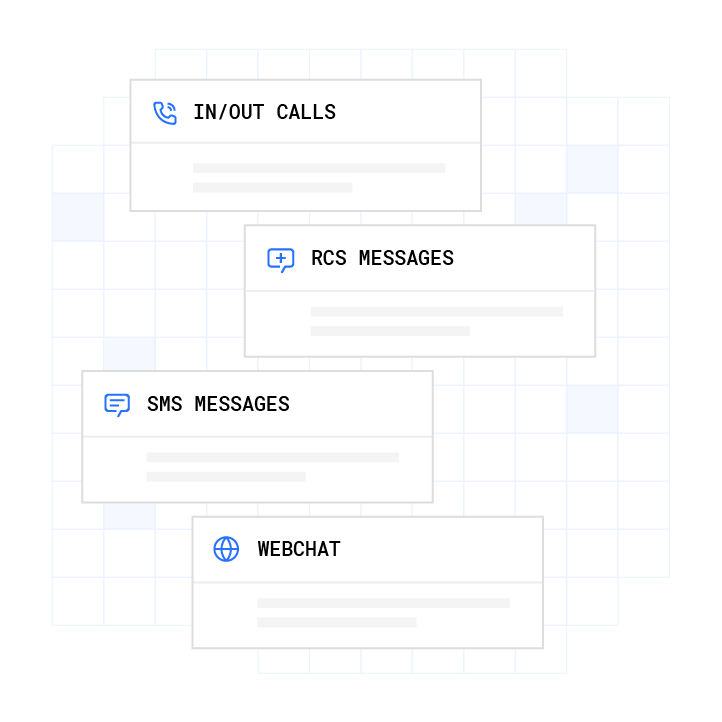
Plura’s integrations connect RCS and every other channel to the CRMs, calendars, and payment processors operators already run, including HubSpot, Salesforce, Zoho, DocuSign, Stripe, and 50+ others. The conversation intelligence layer surfaces what scripts close, what objections recur, and what conversion paths win across every channel. The no-code workflow builder lets operators adjust greeting nodes, qualification gates, and transfer rules without engineering.
Run your numbers through Plura’s ROI calculator, and compare plans and rates side by side.
Frequently Asked Questions
Is RCS Business Messaging Actually Beating SMS In Real Deployments?
In named deployments, RCS outperforms SMS on engagement and conversion metrics. The specific figures appear in the deployment table above. The counterweight is delivery. RCS delivery rates can be lower than SMS in mixed-device markets, as the German OTP campaign discussed earlier shows. SMS remains more reliable for universal reach, particularly for OTPs and time-critical alerts where delivery certainty matters more than rich media.
What Did The Named Brand Deployments Actually Measure?
Each brand measured a different metric against a different baseline. Clarins measured against rich SMS, LA Rams against prior SMS campaigns, Casas Bahia against other conversational channels, and Subway against SMS. The specific figures are in the deployment table above. No two brands measured the same thing, which means the numbers cannot be compared directly to each other.
Where Does RCS Underperform SMS And WhatsApp?
RCS underperforms SMS on universal reach. SMS works on every phone without data, while RCS requires iOS 18 or later or Android 6.0 or later and an active data connection. SMS delivery exceeds 90% of the time. RCS delivery depends on device, carrier, and connectivity. For simple text alerts and OTPs, SMS is usually more cost-effective and more reliable.
RCS underperforms WhatsApp on end-to-end encryption for business messaging. RCS for Business is encrypted in transit but not end-to-end. RCS also trails WhatsApp on conversational commerce maturity. WhatsApp has a deeper tool ecosystem in DACH and other markets where it is the dominant messaging behavior. The practical answer for most operators is to run RCS where device and carrier support it, with SMS as the automatic fallback, and WhatsApp where market behavior demands it.
What Carrier And Device Coverage Does RCS Business Messaging Have In 2026?
All three major US carriers support RCS Business Messaging: AT&T, Verizon, and T-Mobile, along with 20+ prepaid and MVNO brands including Cricket Wireless, Metro by T-Mobile, Visible, Xfinity Mobile, Spectrum Mobile, Boost Mobile, Mint Mobile, and Consumer Cellular. Apple added RCS support in iOS 18 in September 2024, and RCS for Business began rolling out with iOS 18.1 in October 2024. RCS for Business requires Android Marshmallow 6.0 or higher and iOS 18 or later, and older iPhones that cannot update to iOS 18 and feature phones do not support RCS at all. Carrier approval for new RCS business senders takes 8 to 16 weeks. Android RCS carrier adoption is nearly universal except in parts of South Asia and East Africa, while iOS RCS carrier support is well established in the US, Canada, the UK, Japan, Spain, Germany, and France.
How Much Does RCS Business Messaging Cost?
RCS pricing is carrier- and country-dependent, negotiable, and opaque. There is no global list price. Basic text messages cost low single-digit cents. Rich media messages run 20–30% higher. Conversational sessions are roughly double the SMS rate but include a 24-hour window for unlimited replies.
In the US, AWS End User Messaging prices Rich Media RCS outbound at $0.02000 per message plus a $0.00949 carrier fee. Rich RCS outbound runs $0.00700 per 160-byte segment plus a $0.00494 carrier fee. Twilio publishes $0.0083 per basic RCS message and $0.0220 for rich media, with carrier fees of $0.0025 to $0.02 per message on top. In the US, all RCS Agents are non-conversational, meaning every message is billed individually. Beyond per-message rates, budget for one-time carrier onboarding fees, brand vetting fees, and platform or aggregator markups. The total cost of ownership is materially higher than the per-message rate alone.
Conclusion: Turning Case Studies Into A Deployment Plan
The deployments are real, but the published numbers are not a forecast. The gap between a case study and a deployment plan is made of four unknowns: cost, coverage, fallback rate, and measurement method. Closing that gap sits with the operator, not the vendor.
Plura runs AI RCS as one channel inside the same stateful stack as AI Voice, AI SMS, and AI Webchat. Every channel inherits the full memory of every prior touchpoint. Plura supports compliance controls on every outbound contact while keeping customers responsible for their own obligations. See what RCS would save your operation, or review the plans that include it.
1 Plura AI maintains SOC 2, HIPAA, ISO, and GDPR posture as part of its platform infrastructure. References to compliance frameworks in this article describe Plura’s platform capabilities and do not constitute a guarantee that any customer using Plura will themselves be compliant with applicable laws or standards. Customers remain solely responsible for their own regulatory obligations, certifications, consent management, recordkeeping, and the claims they make to their own end users. Consult qualified legal counsel for guidance specific to your use case.
2 This article describes regulatory frameworks at a general level and does not constitute legal advice. Laws and regulations vary by jurisdiction, change over time, and apply differently depending on facts and circumstances. Readers should consult qualified legal counsel before making compliance decisions.
3 Performance figures, customer outcomes, and industry statistics referenced in this article are drawn from cited third-party sources or Plura customer case studies. Individual results vary based on implementation, use case, industry, audience, and execution. Past or aggregate performance is not a guarantee of future results.
4 References to third-party products, services, companies, or research are made for informational and comparative purposes only. Plura AI is not affiliated with, endorsed by, or sponsored by any third party named in this article unless explicitly stated. Trademarks and product names referenced remain the property of their respective owners.
This article is provided for informational purposes only and reflects Plura AI’s understanding at the time of publication. Product capabilities, integrations, and specifications are subject to change. For the most current information, visit plura.ai.
This article was produced with the assistance of AI tools and reviewed by Plura AI prior to publication.