
Written by: Matt Beucler, CEO, Plura AI
Key Takeaways
- Single-tenant missed call recovery tools break at scale because they lack native data isolation, so client call logs can bleed across accounts.
- Effective multi-tenant architecture uses a four-level hierarchy (parent, tenant, location, role), with phone numbers and workflows scoped per tenant.
- Isolation needs enforcement at the application, database, and encryption layers to reduce cross-tenant data exposure, even when bugs appear.
- Parent accounts manage platform-level controls such as DNC scrubbing, consent logging, and quiet hours, while each tenant manages its own consent collection and 10DLC brand registration.
- Agencies growing past 15 clients can use Plura AI’s white-label platform to gain carrier-grade controls and cross-channel conversation memory without building telecom infrastructure. See multi-tenant missed call recovery in action in a live environment.
How Multi-Tenant Missed Call Recovery Works
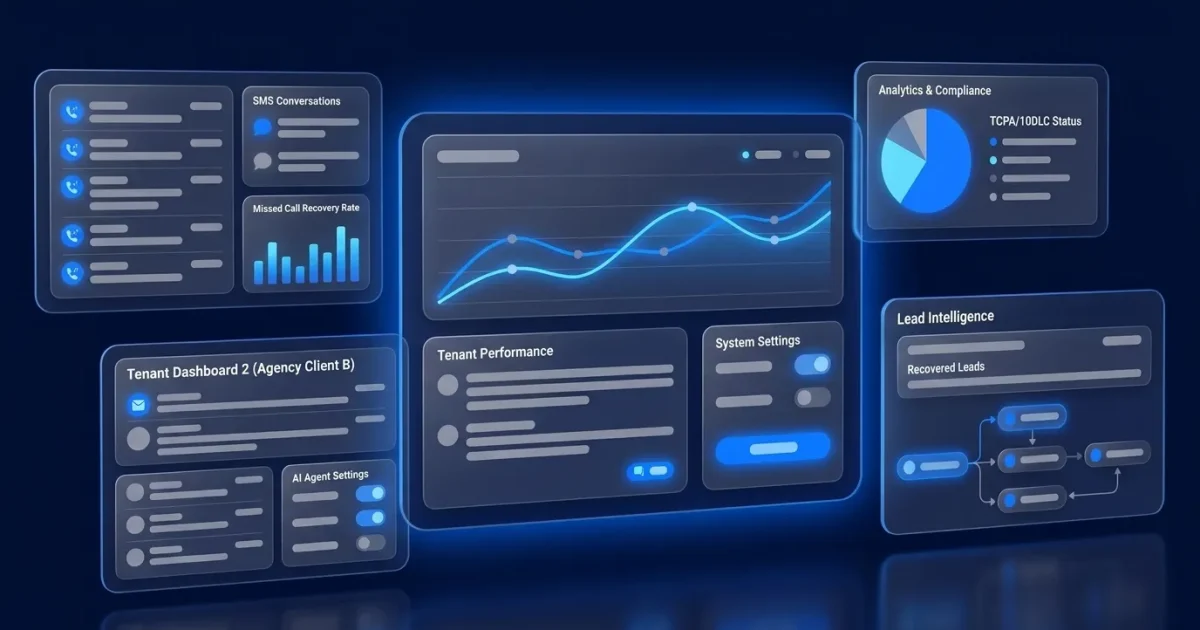
Multi-tenant missed call recovery software lets a parent account provision automated text-back, AI voice callbacks, and lead capture across many isolated client accounts or locations from one dashboard. Each tenant gets isolated phone numbers, conversation memory, and compliance enforcement, so Tenant A never sees Tenant B’s call logs, while the parent account controls billing, roles, and global rules.
Single-tenant text-back tools are built around one business, one number, and one conversation history. That model works until the second client arrives, because the architecture has no native concept of isolation. Once data starts to bleed across accounts, compliance ownership becomes ambiguous and billing turns into a manual process. The tool that closed deals for one client becomes a liability across a portfolio.
Multi-tenant missed call recovery software is built differently from the carrier layer up. Plura AI is its own FCC-licensed audio bridging carrier, which means phone numbers are provisioned on Plura’s carrier infrastructure at the origination layer, with Plura Connect, LLC serving as the Carrier of Record that anchors number registration across the platform. Branded caller ID is issued at origination, and compliance controls run inside the platform before any call or text leaves the network.
See Plura in a live multi-tenant demo and review how a real agency or franchise account operates.
Multi-Tenant Architecture: Parent, Tenant, Location, Role
A multi-tenant missed call recovery architecture uses a four-level hierarchy. The parent account owns billing, roles, and global compliance. Each tenant is an isolated client or business unit. Each location under a tenant gets its own phone numbers and business hours. Each role (admin, manager, agent) sees only the data its tenant scope permits. Phone numbers are provisioned per tenant and mapped to that tenant’s workflows.
The hierarchy has four levels, with phone numbers and roles scoped underneath them. Here is how each level controls data and configuration:
- Parent Account – Owns billing, user roles, global compliance rules, and platform configuration. Can provision new tenants, set default quiet hours, and enforce DNC scrubbing across all sub-accounts.
- Tenant – An isolated client, franchisee, or business unit. Has its own conversation history, CRM integrations, and workflow logic. Cannot see other tenants’ data.
- Location – A physical or logical sub-unit under a tenant. Gets its own phone numbers, business hours, and routing rules. Useful for franchise networks and multi-location enterprises.
- Role – Admin, manager, or agent. Scoped to the tenant or location level. Determines who can view logs, edit workflows, or export data.
Numbers are provisioned through Plura’s FCC-licensed carrier with branded caller ID and STIR/SHAKEN authentication applied at origination. This structure matters operationally. Many platforms that offer sub-account provisioning route voice through a third-party CPaaS (Communications Platform as a Service, the API-only telecom layer that providers like Twilio sell to vendors that do not own their own carrier). When the carrier is rented, branded caller ID depends on the reseller’s controls, and compliance cannot be enforced before the call leaves that network. Plura owns the carrier stack, so those controls are first-class platform features built into the platform.
How Tenant And Location Isolation Protect Client Data
Tenant isolation in missed call recovery depends on enforcement at multiple layers. Application-level filters scope every query to the current tenant. Database-level policies block cross-tenant reads even if application code fails. Per-tenant encryption keys protect sensitive data. The goal is that Tenant A never sees Tenant B’s call logs, SMS threads, or contact data, even when bugs or misconfigurations occur.
Three canonical isolation models exist in multi-tenant SaaS architecture, and each sits at a different point on the isolation-versus-operational-complexity curve:
- Shared Schema with Row-Level Security – Every tenant’s data lives in the same database tables with a tenant identifier on every row. Isolation is enforced at the database engine level via policies that automatically restrict queries to the current tenant context. This is the default pattern for roughly 80 percent of B2B SaaS in 2026 and offers low operational overhead and strong cost efficiency for many small tenants. The primary risk is cross-tenant data leakage if any query omits the tenant predicate, which is why database-level enforcement must pair with application-layer checks.
- Schema-Per-Tenant – Each tenant gets its own database schema acting as a namespace, with the same table structures. This model provides stronger logical isolation than shared-schema designs and fits mid-market or compliance-sensitive tenants. Migration complexity grows past roughly 50 tenants, because running schema migrations sequentially becomes slow without explicit parallelization tooling.
- Database-Per-Tenant – Each tenant gets physically separate database infrastructure. This model delivers the strongest isolation and removes noisy-neighbor risk, but every tenant becomes its own deployment. Teams reserve this approach for enterprise tenants with contractual physical-separation requirements. Per-tenant encryption and key management can use envelope encryption and per-tenant data keys stored in a key management system, which supports key rotation and tenant-level revocation.
Plura’s Stateful Conversation Database keys every interaction to a customer token (phone number, email, or ID) and persists it in one place. The Unified Inbox is the human-facing view of the same database, so every message on every channel appears in the correct tenant. The most common production multi-tenant architecture in 2026 is a hybrid, with pooled resources for standard tiers and stronger isolation for enterprise tiers that pay for physical separation, and Plura’s architecture follows that pattern.
White-Label Missed Call Recovery For Agencies And Networks
White-label missed call recovery lets agencies and resellers present a fully branded experience while Plura runs the carrier and AI infrastructure behind the scenes. The parent account provisions tenants, assigns phone numbers, and manages billing, while each client sees only its own branded dashboard.
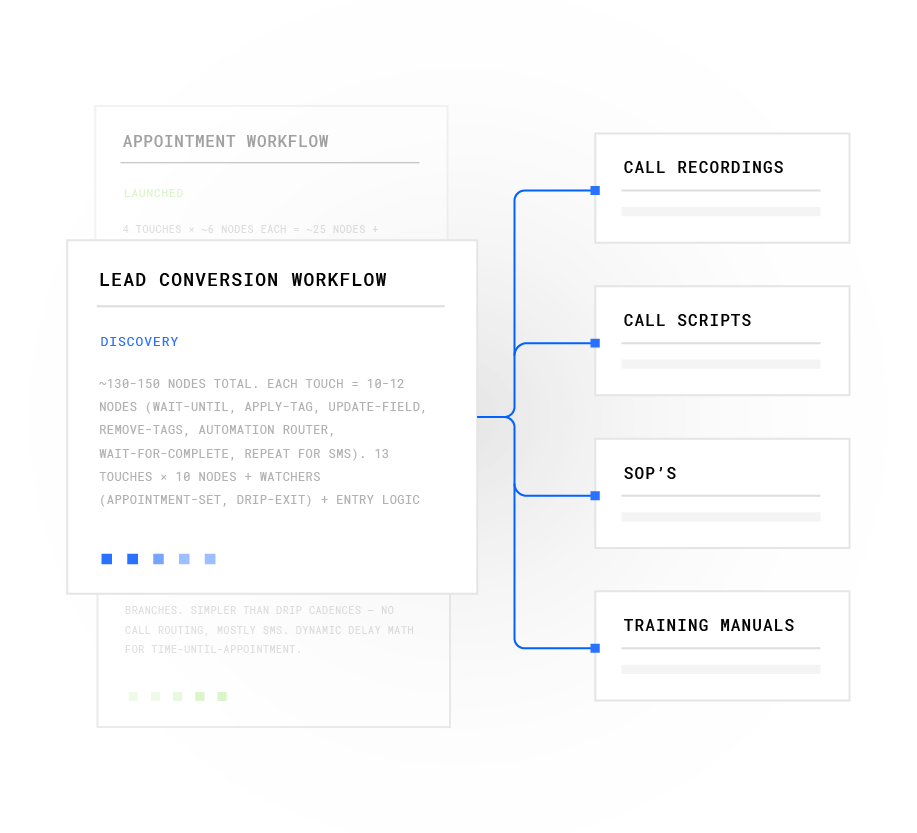
Plura’s no-code workflow builder lets agencies design per-tenant conversation logic without engineering resources. Each client account gets its own workflow configuration, its own phone numbers, and its own conversation history. The agency controls the parent account and sees aggregate performance across all tenants, while each client sees only its own data.
The operational impact is material. Account-manager capacity expands from 5-8 clients to 15-20 clients when AI handles lead contact and qualification across every client account at once. Agency profit margins often move from a 15-25 percent industry baseline to 35-50 percent with AI deployment.3
Plura’s annual contracts include a 90-day opt-out window. Plans and rates are published transparently, so agencies can model per-client economics before they commit.
Walk through white-label provisioning with Plura and see how a multi-client agency account is structured.
TCPA And 10DLC Responsibilities In Multi-Tenant Accounts
In a multi-tenant setup, the parent account typically owns platform-level compliance infrastructure, including DNC scrubbing, consent logging, and quiet-hours enforcement. Each tenant remains responsible for its own consent collection, message content, and regulatory obligations. Under 10DLC rules, each client business needs its own brand registration tied to its own EIN; a parent account cannot register all clients under one EIN.2
The compliance architecture in a multi-tenant missed call recovery platform has two distinct layers. The platform layer and the tenant layer operate independently, and mixing them up often creates regulatory exposure.
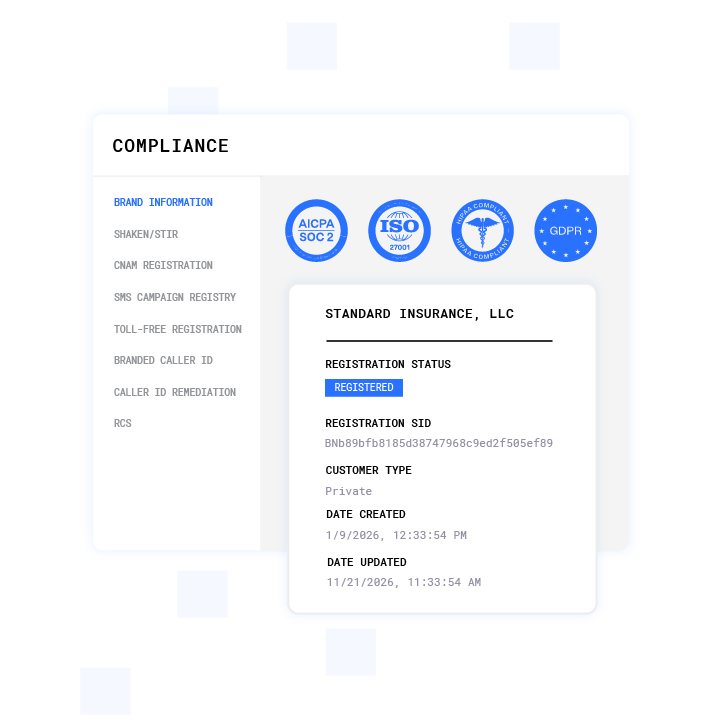
At the platform layer, Plura enforces DNC scrubbing, TCPA-litigator screening, automated quiet hours, and immutable consent logging inside the platform on every outbound contact, before dial. These controls map to specific rules. Consent requirements for calls and texts to wireless numbers come from the Telephone Consumer Protection Act at 47 U.S.C. § 227. Brand and campaign registration with The Campaign Registry comes from FCC 10DLC registration rules. Calling-hour restrictions and internal do-not-call list requirements come from 47 CFR 64.1200. Separate recordkeeping obligations for telemarketing come from the FTC Telemarketing Sales Rule at 16 CFR 310.5(a).2
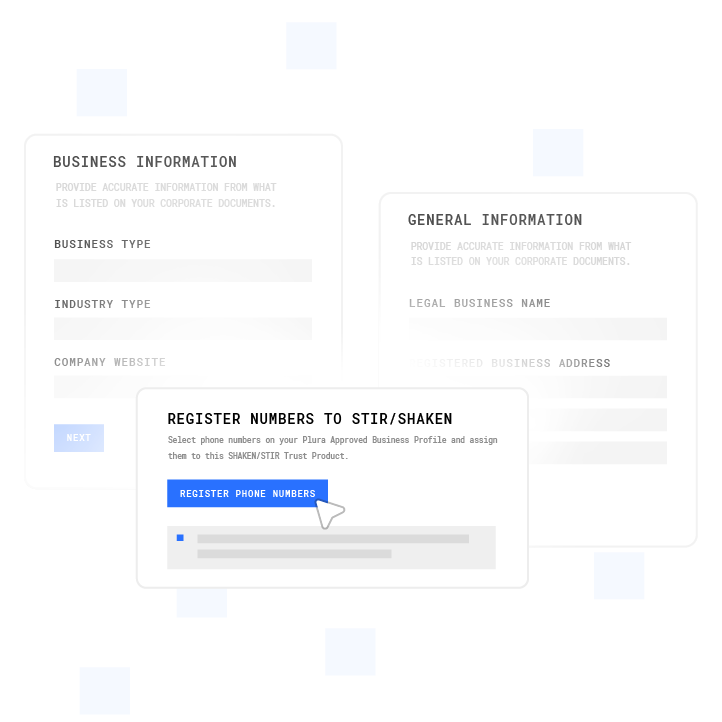
At the tenant layer, each client business owns its consent collection process, its message content, its 10DLC brand registration under its own EIN, and its campaign-level use case declarations. For a parent account sending on behalf of multiple clients, the platform must preserve sender-entity boundaries so opt-outs suppress future messages from the correct business across all of its sending routes.
Using Plura supports customer compliance and centralizes controls, but customers remain responsible for their own obligations. Readers with questions about their specific regulatory posture should consult the regulations directly or qualified legal counsel.
Build On Twilio Or Buy A White-Label Platform?
Building a production-ready AI voice agent on Twilio or another CPaaS typically takes 6-12 months of engineering, $300K-$500K or more in first-year costs, and 2-3 full-time engineers for ongoing maintenance.4 Buying a white-label platform delivers time-to-first-conversation in days, with carrier registration, compliance enforcement, and conversation infrastructure already in place. The trade-off centers on flexibility versus speed and operational burden.
The build-versus-buy decision breaks down across five operational dimensions:
- Carrier Registration – Building on a CPaaS requires completing A2P 10DLC brand and campaign registration, toll-free verification, SHAKEN/STIR registration, and Voice Integrity registration as separate steps through the CPaaS console. 10DLC campaign vetting typically takes 3-5 business days per campaign, with a $15 fee per vetting event and a 3-month minimum commitment per campaign. Multiplied across 20 client tenants, this registration overhead becomes a full-time operational task. Plura handles carrier registration as a platform service.
- Number Provisioning – Twilio’s number provisioning workflow requires teams to complete per-number configuration tasks beyond purchase, including A2P 10DLC, toll-free verification, or regulatory compliance steps for each number. At scale across many tenants, this work becomes engineering, not simple configuration. Plura provisions numbers per tenant through its own FCC-licensed carrier.
- Compliance Tooling – A CPaaS provides the transport layer. DNC scrubbing, TCPA-litigator filtering, consent logging, quiet-hours enforcement, and audit-ready exports are separate builds. Teams must build, integrate, and maintain those components. Plura’s compliance engine operates as a first-class platform layer.
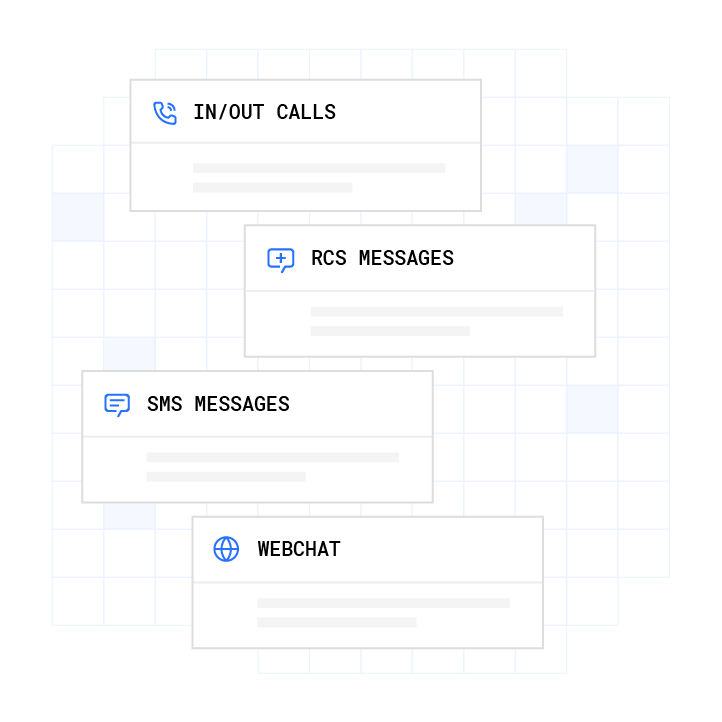
- Conversation Memory – Most AI voice and SMS tools built on third-party CPaaS layers cannot hold conversation context across more than a single channel. A customer who texted at 9 a.m. often appears as a stranger on the noon call unless the builder constructs and maintains a stateful database. Plura’s Stateful Conversation Database holds context across voice, SMS, RCS, and webchat by default.
- Ongoing Maintenance – Ongoing maintenance for custom Twilio AI communications integrations requires 2-3 full-time engineers.
The build path fits teams with dedicated engineering resources and requirements that no existing platform can satisfy. For agencies and franchise networks that need to scale quickly without building telecom infrastructure, the buy path delivers time-to-value in days rather than quarters. If you choose the buy path, the next step is selecting the platform category that matches your operating model.
Comparing Multi-Tenant Platform Models
Three categories of platform serve the multi-tenant missed call recovery market. The key difference is where each one sits on carrier ownership, compliance enforcement, and cross-channel conversation memory, which determines how much of the multi-tenant problem it actually solves.
Agency White-Label Platforms are built for resellers and marketing agencies. They offer sub-account provisioning, branded interfaces, and per-tenant billing. Most rely on third-party CPaaS for carrier infrastructure, which limits caller ID control to what the CPaaS reseller can provide and shifts compliance enforcement outside the platform. Conversation memory is typically channel-specific rather than cross-channel.
Enterprise Multi-Location Platforms are built for franchise networks and large enterprises. They offer centralized dashboards, per-location metrics, and system-level compliance enforcement. Many lack white-label reseller mechanics, which makes them a poor fit for agencies that need to provision branded client-facing interfaces. Franchises average a 67% missed call rate during peak hours, and enterprise platforms address that problem at the location level without always solving the agency reseller use case.
Telecom and API Infrastructure provides raw CPaaS building blocks. These tools offer maximum flexibility and minimal built-in functionality. Teams need significant engineering investment to reach production-ready multi-tenant missed call recovery. Carrier registration, compliance tooling, conversation memory, and tenant isolation all sit with the builder.
Multi-tenant missed call recovery software built on owned carrier infrastructure is the only architecture that scales past 15 accounts without leaking data or exposing the parent account to regulatory risk. Tenant isolation, per-tenant compliance enforcement, and stateful cross-channel memory are what make that scale possible.
Plura sits in a distinct position across these categories. As its own FCC-licensed carrier, it issues branded caller ID and applies STIR/SHAKEN authentication at origination. Its Stateful Conversation Database, described earlier, holds context across voice, SMS, RCS, and webchat. DNC scrubbing, TCPA-litigator screening, automated quiet hours, and immutable consent logging are enforced inside the platform before dial. The no-code workflow builder lets agencies configure per-tenant conversation logic without engineering resources.
Plura AI voice agents answer 100% of inbound calls across all franchise locations within two rings, and contact leads from websites, Google Business Profiles, or ad campaigns within 60 seconds via SMS or voice call. The 2026 Speed-to-Lead Benchmark found that the median B2B team takes 42 hours to respond to an inbound lead, and that five-minute responders convert at roughly 21% versus 2.3% for teams that wait 24 hours or more.
Conclusion: Choosing A Multi-Tenant Platform
Single-tenant missed call recovery tools break the moment a second client arrives. The architecture has no native concept of data isolation, compliance ownership becomes ambiguous, and billing turns manual. These are structural limitations that do not resolve with configuration changes.
Multi-tenant missed call recovery software built on owned carrier infrastructure is the only model that scales past 15 accounts without leaking data or exposing the parent account to regulatory risk. Tenant isolation, per-tenant compliance enforcement, and stateful cross-channel memory are the core requirements.
Plura operates as its own FCC-licensed carrier, runs a Stateful Conversation Database across voice, SMS, RCS, and webchat, and enforces DNC scrubbing, consent logging, and quiet hours inside the platform on every outbound contact. The no-code workflow builder lets agencies configure per-tenant conversation logic without engineering. The integrations directory covers 50+ tools across CRM, calendar, attribution, and data enrichment categories.
Map Plura’s multi-tenant architecture to your operation in a live session for your agency, franchise network, or enterprise platform.
Run your numbers through Plura’s ROI calculator to check projected return in real time.
Compare plans and rates side by side to model per-tenant economics before you commit.
1 Plura AI maintains SOC 2, HIPAA, ISO, and GDPR posture as part of its platform infrastructure. References to compliance frameworks in this article describe Plura’s platform capabilities and do not constitute a guarantee that any customer using Plura will themselves be compliant with applicable laws or standards. Customers remain solely responsible for their own regulatory obligations, certifications, consent management, recordkeeping, and the claims they make to their own end users. Consult qualified legal counsel for guidance specific to your use case.
2 This article describes regulatory frameworks at a general level and does not constitute legal advice. Laws and regulations vary by jurisdiction, change over time, and apply differently depending on facts and circumstances. Readers should consult qualified legal counsel before making compliance decisions.
3 Performance figures, customer outcomes, and industry statistics referenced in this article are drawn from cited third-party sources or Plura customer case studies. Individual results vary based on implementation, use case, industry, audience, and execution. Past or aggregate performance is not a guarantee of future results.
4 References to third-party products, services, companies, or research are made for informational and comparative purposes only. Plura AI is not affiliated with, endorsed by, or sponsored by any third party named in this article unless explicitly stated. Trademarks and product names referenced remain the property of their respective owners.
This article is provided for informational purposes only and reflects Plura AI’s understanding at the time of publication. Product capabilities, integrations, and specifications are subject to change. For the most current information, visit plura.ai.
This article was produced with the assistance of AI tools and reviewed by Plura AI prior to publication.