

Written by: Matt Beucler, CEO, Plura AI | Last updated: August 26, 2026
Key Takeaways
- Call center conversion rate equals qualified outcomes divided by live contacts. Every stage from lead capture to close has a KPI that exposes revenue leaks.
- Sub-5-second response through AI voice and SMS sharply increases contact and conversion rates. Leads reached within 5 minutes can be up to 100x more likely to connect than those reached after 30 minutes.
- Real-time AI coaching, cross-channel stateful memory, and first-call resolution tools cut repeat contacts, script drift, and customer friction that reduce conversion.
- Carrier-level compliance enforcement, including real-time DNC scrubbing, TCPA consent ledgers, and STIR/SHAKEN authentication, helps prevent costly violations while preserving strong contact rates.
- Plura AI delivers these capabilities on a single FCC-licensed, 100% U.S. infrastructure platform. See how Plura AI can close your funnel leaks in seconds.
How To Calculate Call Center Conversion Rate
Call center conversion rate follows a simple formula.
Conversion Rate = Qualified Outcomes / Live Contacts × 100
Each term needs a clear definition before the number becomes useful in operations.
- Qualified Outcomes: Pre-defined dispositions such as SALE, APPT (appointment), or XFER (live transfer) that represent a completed desired action for the campaign. Teams must set this definition before the campaign runs.
- Live Contacts: Human-answered calls only. Voicemails, abandoned calls, and IVR (Interactive Voice Response) deflections stay out of the denominator because they never represented a real conversion opportunity.
- Conversion Rate vs. Close Rate: Close rate uses qualified opportunities as the denominator and reads substantially higher. Operators should not treat the two metrics as interchangeable on the same reporting dashboard.
Outbound conversion rates vary by industry and lead quality. A solar company using Plura’s AI Lead Intelligence increased conversion rates from 6% to 18% with the same leads and offer.3 That shift shows how enrichment quality and response speed move the numerator without changing the denominator.
The KPI causal chain that governs outbound economics is: Dials Per Hour × Contact Rate = Contacts Per Hour, Contacts Per Hour × Conversion Rate = Leads Per Hour, Total Cost / Total Leads = Cost Per Lead. Plura’s ROI calculator models this chain against your actual inputs, replacing industry averages with your own numbers.
Speed-to-Lead Fixes That Protect Conversion
The first variable in that KPI chain, contact rate, depends heavily on how quickly your team responds to inbound leads. Leads contacted within 1 minute are 391% more likely to convert than those contacted after 24 hours. Velocify’s analysis of nearly 3.5 million leads found a 391% improvement in conversion rates when teams responded within 1 minute, with speed-to-call as the largest driver in the first 2 minutes after lead generation. According to the MIT/InsideSales.com Lead Response Management Study, leads contacted after 30 minutes are 100x less likely to connect than those contacted within 5 minutes.
Plura structures sub-5-second response through a clear workflow.
- A lead submits a form or inbound inquiry. The event fires to Plura’s platform through webhook or CRM integration.
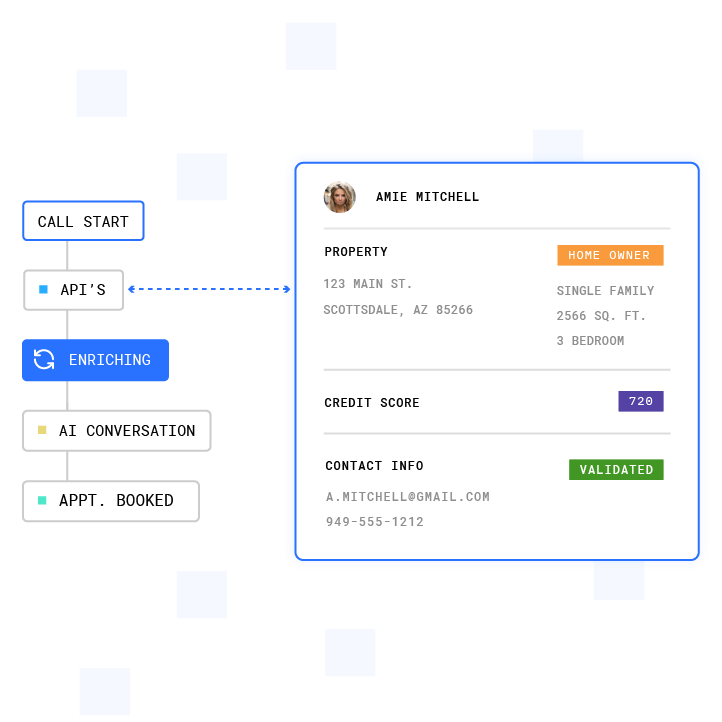
- Plura’s AI Lead Intelligence pings 30+ enrichment sources in parallel and appends property data, intent signals, and contact validation to the lead record before the first word is spoken.
- An AI SMS agent sends the first outbound text within seconds. At the same time, the AI Predictive Dialer initiates a voice call with branded caller ID authenticated through STIR/SHAKEN.
- The AI agent runs the qualification conversation using the enriched lead record. Human agents do not need ramp time for that first touch.
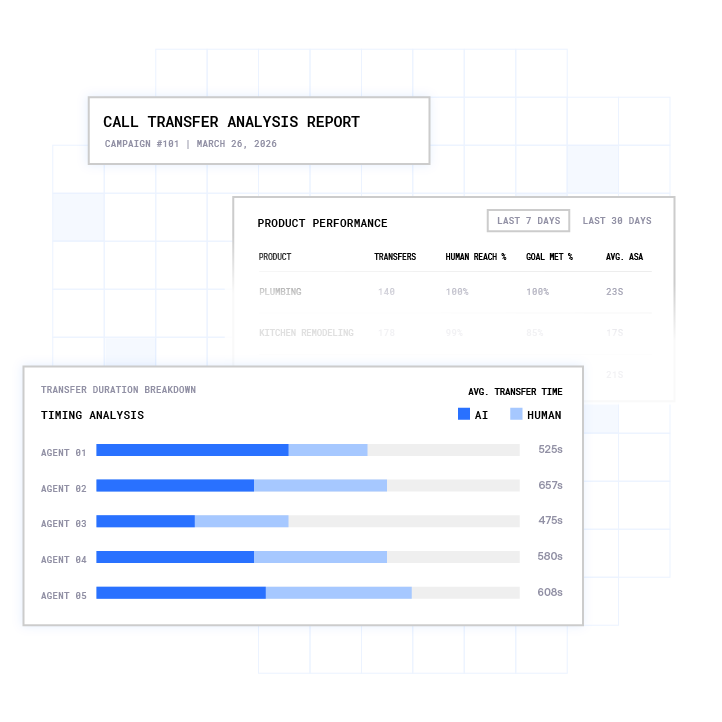
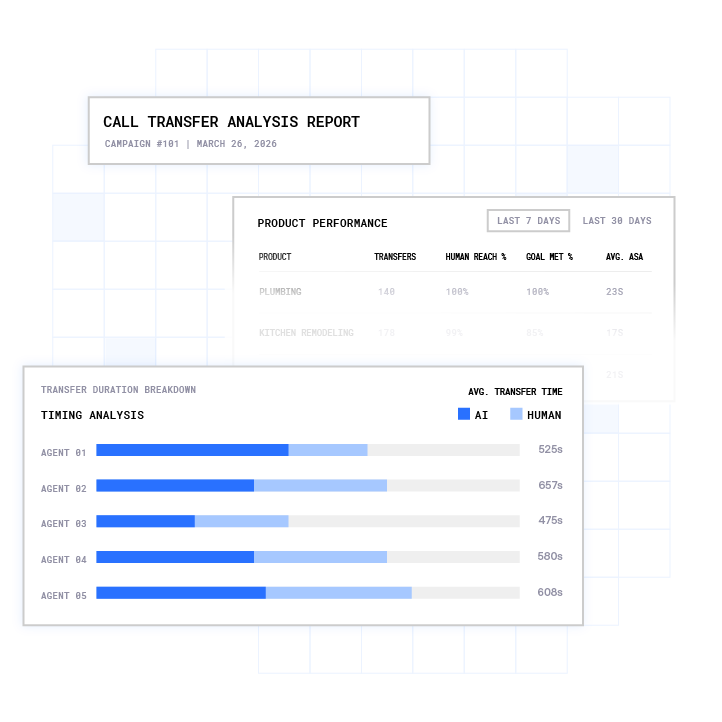
- When a qualification gate triggers, the AI warm-transfers the live contact to a U.S. agent with full conversation context already loaded.
Plura supports lead response times under 60 seconds with multichannel engagement across voice, SMS, RCS, and webchat, and cost per qualified lead in the $25 to $60 range. Organizations using AI for speed to lead often see response times drop from hours to seconds and connection rates increase by 3x to 5x.
First-Call Resolution Impact on Revenue
First Call Resolution (FCR) directly affects both cost and conversion. FCR is the percentage of contacts resolved without a repeat call, calculated as contacts resolved on first contact divided by total contacts, multiplied by 100. SQM Group reports an industry-average FCR rate of 70%.
FCR influences operations in several measurable ways.
- For every 1% improvement in FCR, operating costs decrease by 1% and customer satisfaction increases by 1%.
- When teams achieve FCR, customers are more likely to continue doing business with the organization. Failure to achieve FCR increases churn risk.
- Higher FCR can improve cross-selling results because satisfied customers stay engaged.
- A non-Gartner 2026 compilation notes a 15-25% FCR lift from AI-assisted agents. No 2025 Gartner research links AI-assisted agents to any specific FCR improvement range.
Plura’s Stateful Conversation Database acts as the primary FCR driver on the platform. Every interaction across voice, SMS, RCS, and webchat ties back to a single customer token. When a customer calls back, the AI and the human agent both see the full prior context, which removes the repeat-explanation cycle that often causes FCR failure.
Real-Time AI Coaching To Stop Script Drift
Script drift erodes conversion over time. An agent who follows the approved script on day one and improvises by day ninety will produce different outcomes on the same campaign. Plura’s real-time AI coaching layer addresses this at the conversation level instead of relying only on training.
The coaching workflow follows a consistent pattern.
- The AI monitors the live conversation against the approved script and objection-handling library.
- When a prospect raises a recognized objection, the system surfaces the approved response in real time for the agent or handles it directly in an AI-only flow.
- BATNA (Best Alternative to a Negotiated Agreement) guardrails define the floor and ceiling within which the AI can negotiate. Offers outside those bounds trigger an escalation rather than an improvised response.
- After the call, conversation intelligence logs which objection patterns appeared, which responses converted, and which script branches underperformed.
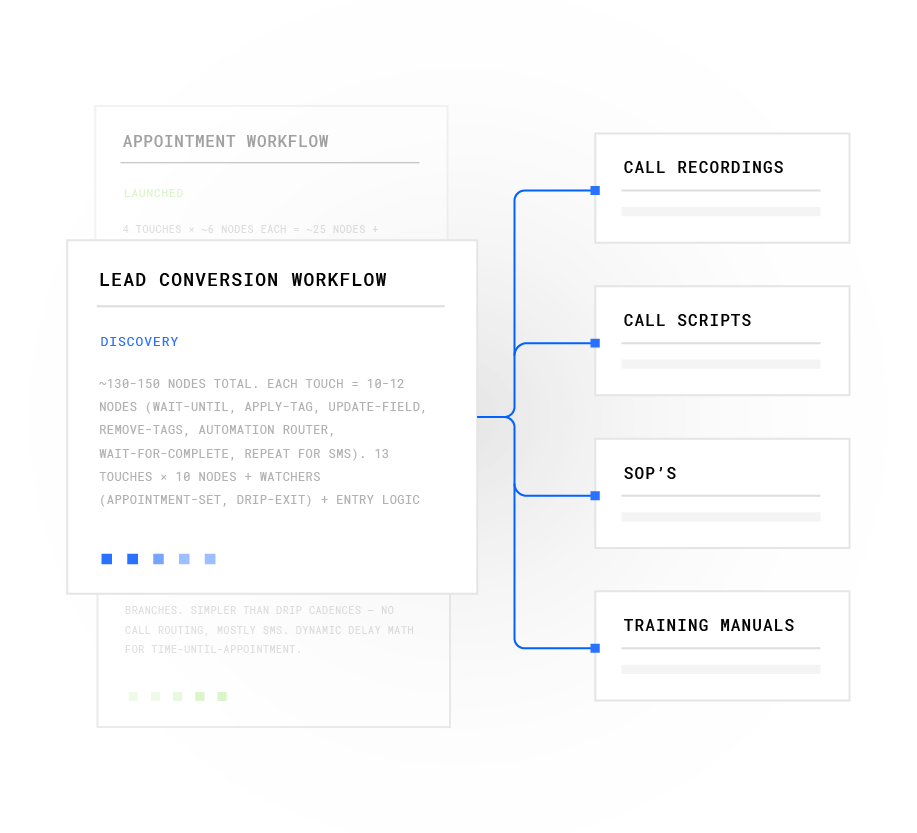
- The no-code workflow builder lets operators update script nodes and objection responses without an engineering deployment.
Solar and home services companies using AI agents with property data, energy usage estimates, and home valuations achieved 2x to 3x improvements in appointment set rates. That result reflects both enrichment quality and consistent script execution across every call.
Cross-Channel Stateful Memory For Seamless Journeys
Consistent script execution only delivers full value when customers avoid repeating themselves across channels. Most AI voice and SMS tools operate as separate products from separate vendors with separate memories. A customer who texted at 9 a.m. often has to re-explain their situation when the call arrives at noon, which creates friction and conversion loss.
Plura’s Stateful Conversation Database solves this by design. Every interaction across voice, SMS, RCS (Rich Communication Services), and AI webchat is tokenized to the customer by phone number, email, or ID. The AI reads and writes to the same database on every touchpoint. Pricing offers made, objections raised, qualification status, and sensitive-data redactions all persist across channels.
This architecture produces a clear operational result. An AI SMS agent that qualifies a lead at 9 a.m. hands off to the AI voice agent at noon with the full conversation already loaded. The human agent who takes the warm transfer sees the same record. No channel starts from zero. This cross-channel continuity supports FCR, reduces average handle time, and removes the re-qualification friction that often kills conversion between touches. Plura supports 7 to 12 follow-up touches across channels with full conversation transcripts available for ROI proof.
Compliance Guardrails That Protect Contact Rates
TCPA and DNC compliance is often treated as a constraint on outreach volume. On Plura’s platform, compliance is enforced as a first-class layer of the dialing stack, not as a post-campaign audit. That architectural choice, building compliance into the dialing layer instead of bolting it on afterward, helps prevent violations before they occur rather than flagging them after the damage is done.
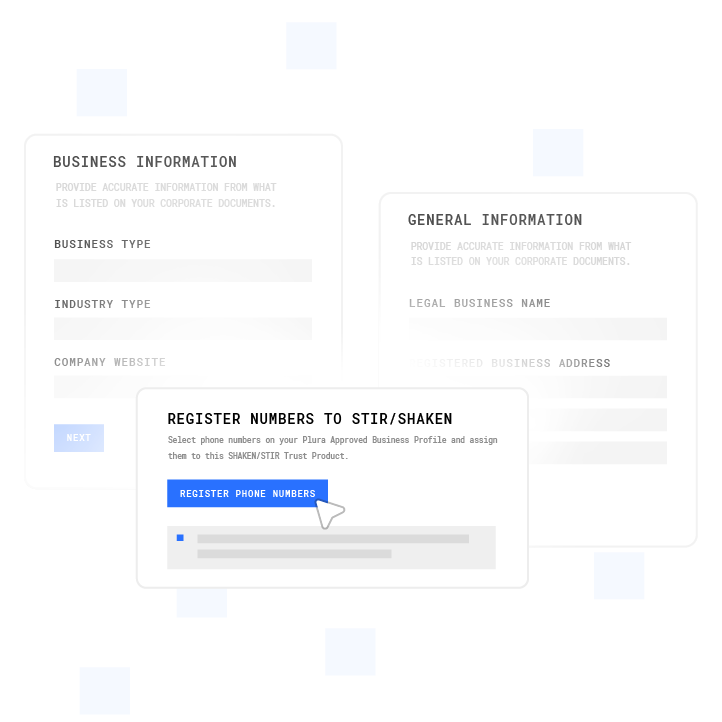
Plura’s compliance engine runs the same sequence on every outbound contact.
- Every number is checked against federal and state DNC registries in real time before dial. Non-compliant numbers are blocked before the first attempt.
- TCPA consent records are timestamped, immutable, and audit-ready. The FCC’s one-to-one consent rule, effective January 27, 2025, states that a single opt-in authorizes calls from exactly one named seller.2 Plura’s consent ledger captures this at the contact level.
- Quiet-hours rules apply automatically through time-zone detection on the contact record, applying state and federal calling-window restrictions to every campaign without manual configuration.
- STIR/SHAKEN authentication runs on every outbound call through Plura’s FCC-licensed carrier, which supports legitimate origination verification at the destination carrier.
- The compliance dashboard exports audit-ready reports in one click for legal review or regulatory inquiries.
TCPA violations can cost $500 to $1,500 per text or call. A 10,000-call non-compliant campaign can face up to $15 million in damages. Plura supports TCPA compliance, DNC compliance, SOC 2, HIPAA, ISO certification, GDPR, and SHAKEN/STIR caller ID verification.1 Customers remain responsible for their own regulatory obligations and the claims they make to their end users.
| Feature | Plura AI (carrier-owned) | Twilio-based API resellers | Offshore BPOs |
|---|---|---|---|
| FCC carrier license | Yes, FCC-licensed audio bridging carrier | No, routes through third-party CPaaS (Communications Platform as a Service) | Not applicable, human agent model |
| Real-time DNC scrubbing | Enforced at the carrier level before every dial | Typically a bolt-on or customer-managed layer | Varies by vendor, manual or batch processes common |
| Stateful cross-channel memory | Single Stateful Conversation Database across voice, SMS, RCS, and webchat | Channel memory typically siloed by product | Dependent on CRM configuration, no native cross-channel AI memory |
| 100% U.S. infrastructure | Voice origination, model hosting, data storage, and call recording on domestic infrastructure | Infrastructure location varies, foreign data routing possible | Operations and data handling offshore by definition |
| Branded caller ID | Issued directly at the carrier level under Plura’s own FCC license | Dependent on third-party CPaaS caller ID reputation | Not applicable |
| Uptime SLA | 99.9% uptime SLA with automatic failover | Dependent on underlying CPaaS SLA terms | Varies by contract, staffing-dependent availability |
CTA 2: Compare plans and rates at Plura pricing to see which tier fits your call volume and compliance requirements.
Frequently Asked Questions
What is the standard formula for call center conversion rate?
Call center conversion rate is calculated as qualified outcomes divided by live contacts, multiplied by 100. Qualified outcomes are pre-defined dispositions such as a completed sale, booked appointment, or live transfer. Live contacts are human-answered calls only, so voicemails, abandoned calls, and IVR deflections stay out of the denominator because they were never conversion opportunities. Teams must define qualified outcomes before the campaign runs. Comparing conversion rates across campaigns only makes sense when the denominator and outcome definitions stay consistent.
How much does response time affect call center conversion rates?
Response time has a strong and exponential impact on conversion. As noted earlier, Velocify’s analysis of 3.5 million leads confirmed the 391% conversion improvement from sub-1-minute response times. The MIT/InsideSales.com Lead Response Management Study found that 30-minute delays reduce connection likelihood by 100x and qualification odds by 21x compared to 5-minute response times. The current B2B average response time sits between 42 and 47 hours, which places most operations at the far end of the decay curve. Plura’s AI voice agents and AI SMS agents respond in under 5 seconds, 24 hours a day, seven days a week.
What is first-call resolution and why does it affect conversion?
First Call Resolution (FCR) is the percentage of customer contacts resolved without a repeat call, calculated as contacts resolved on first contact divided by total contacts, multiplied by 100. As noted earlier, SQM Group’s 2026 benchmarking found a 70% industry-average FCR rate, meaning 30% of customers must call back after first contact. Each repeat contact creates a conversion leak because customers who require a callback churn at rates 3 to 5 times higher than those resolved on the first contact. SQM Group data also shows benefits for cross-selling when teams achieve FCR. Plura’s Stateful Conversation Database carries full context across every channel and agent handoff, which supports FCR by removing the re-explanation cycle.
How does real-time DNC and TCPA enforcement work in a compliant AI dialer?
A compliant AI dialer checks every number against federal and state DNC registries at the moment of dial instead of relying only on a batch run before the campaign. This real-time check can catch numbers that registered on the DNC list or submitted opt-outs between the initial scrub and campaign launch. Consent records should be timestamped and tied to the specific number dialed, with the channel and disclosure language captured. Quiet-hours rules should apply the called party’s local time zone automatically. Plura’s compliance engine enforces these checks before every outbound contact and maintains an immutable consent ledger with one-click audit exports. Customers should consult qualified counsel regarding their own TCPA and DNC obligations.
What is the ROI difference between human agents and AI agents in a contact center?
Using the default inputs on Plura’s ROI calculator, a 15-agent operation paying $20 per hour with standard taxes, benefits, and commissions at 40% talk utilization costs $60,000 per month.3 Replacing that team with Plura at $15 per hour, 100% talk utilization, and 6 AI agents doing the equivalent work drops the monthly cost to $14,400. That shift produces $45,600 in savings in the first 30 days, $547,200 over 12 months, and $2,736,000 over 60 months. For higher-volume operations, Plura’s total cost of ownership of $700,000 per year replaces a traditional contact-center benchmark of $7 million on equivalent volume. Leaders can run their own numbers at Plura’s ROI calculator to model specific headcount and hourly rates.
Why does owning an FCC carrier license matter for call center conversion optimization?
Most AI voice platforms act as API resellers built on top of a third-party CPaaS like Twilio.4 These platforms cannot issue branded caller ID under their own identity, cannot enforce real-time DNC scrubbing at the carrier level, and cannot authenticate calls through STIR/SHAKEN under their own operating company number. The result often includes calls that present as “Spam Likely,” lower pickup rates, and compliance enforcement that lives outside the platform. Plura operates as its own FCC-licensed audio bridging carrier. Branded caller ID is issued directly at the carrier level. STIR/SHAKEN authentication runs on every outbound call. Real-time DNC scrubbing and TCPA-litigator filtering are enforced before the call leaves the network. These capabilities sit in the platform rather than as third-party add-ons and directly affect contact rate, pickup rate, and compliance posture at the same time.
Final CTA: Run your numbers at Plura’s ROI calculator and compare plans at Plura pricing. To see the platform in action, book a live demo with Plura.
1 Plura AI maintains SOC 2, HIPAA, ISO, and GDPR posture as part of its platform infrastructure. References to compliance frameworks in this article describe Plura’s platform capabilities and do not constitute a guarantee that any customer using Plura will themselves be compliant with applicable laws or standards. Customers remain solely responsible for their own regulatory obligations, certifications, consent management, recordkeeping, and the claims they make to their own end users. Consult qualified legal counsel for guidance specific to your use case.
2 This article describes regulatory frameworks at a general level and does not constitute legal advice. Laws and regulations vary by jurisdiction, change over time, and apply differently depending on facts and circumstances. Readers should consult qualified legal counsel before making compliance decisions.
3 Performance figures, customer outcomes, and industry statistics referenced in this article are drawn from cited third-party sources or Plura customer case studies. Individual results vary based on implementation, use case, industry, audience, and execution. Past or aggregate performance is not a guarantee of future results.
4 References to third-party products, services, companies, or research are made for informational and comparative purposes only. Plura AI is not affiliated with, endorsed by, or sponsored by any third party named in this article unless explicitly stated. Trademarks and product names referenced remain the property of their respective owners.
This article is provided for informational purposes only and reflects Plura AI’s understanding at the time of publication. Product capabilities, integrations, and specifications are subject to change. For the most current information, visit plura.ai.
This article was produced with the assistance of AI tools and reviewed by Plura AI prior to publication.