

Written by: Matt Beucler, CEO, Plura AI
Key Takeaways
- High-volume conversational AI works when you combine smart segmentation, a stateful conversation database, real-time DNC/TCPA checks, branded caller ID, and clear human escalation paths.
- Segmenting by intent, channel preference, and qualification status routes each contact to the right workflow and improves conversion when paired with real-time lead enrichment.
- A unified Stateful Conversation Database preserves context across voice, SMS, RCS, and webchat, which removes repetition and improves customer experience.
- Carrier-level compliance controls, branded caller ID, and explicit escalation workflows reduce legal risk and protect trust during high-volume outreach.
- Plura AI delivers these capabilities on 100% U.S. infrastructure, and you can see the platform in a live demo to evaluate impact on your outreach operations.
Audience Segmentation Before High-Volume Outreach
Segmentation decides which contacts receive which message, on which channel, and at which point in the buying journey. Without clear segments, high-volume campaigns create noise instead of pipeline. Effective segmentation for 500-plus daily interactions maps contacts to at least three variables: intent signal such as inbound form fill versus cold list, channel preference such as voice versus SMS versus webchat, and qualification status such as unqualified, in-progress, or sales-ready.
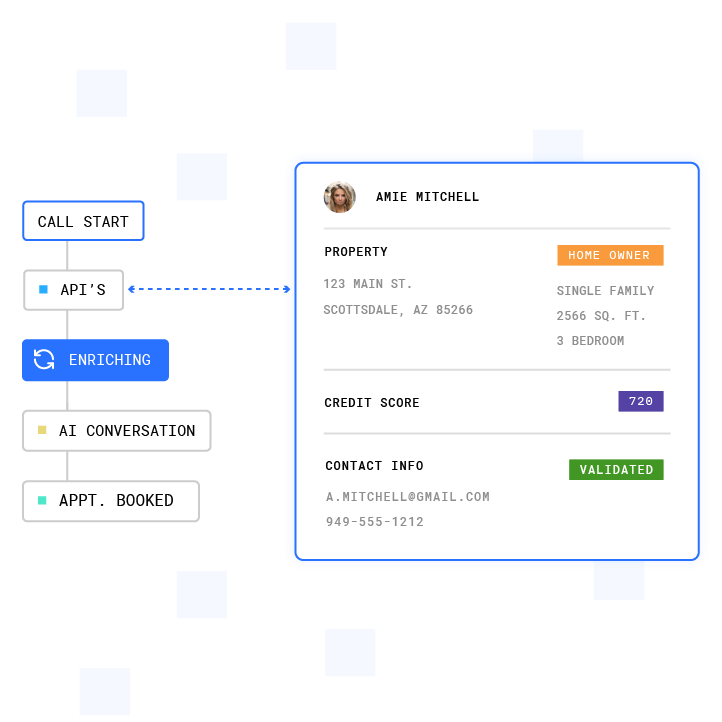
Plura’s AI Lead Intelligence layer enriches every contact with 30-plus data sources in real time during the conversation, covering IP data, email validation, business firmographics, and intent signals. That enrichment flows directly into workflow branching. The AI routes a high-intent inbound lead to a voice qualification flow while sending a cold re-engagement contact into an SMS cadence. Real-time lead enrichment can increase conversion rates when applied at the moment of first contact.
Unified Conversation Context Across Every Channel
Context loss is the most expensive operational failure in high-volume outreach. Most customers expect not to repeat themselves when switching between support channels, yet many AI platforms run voice and SMS as separate products with separate memories.
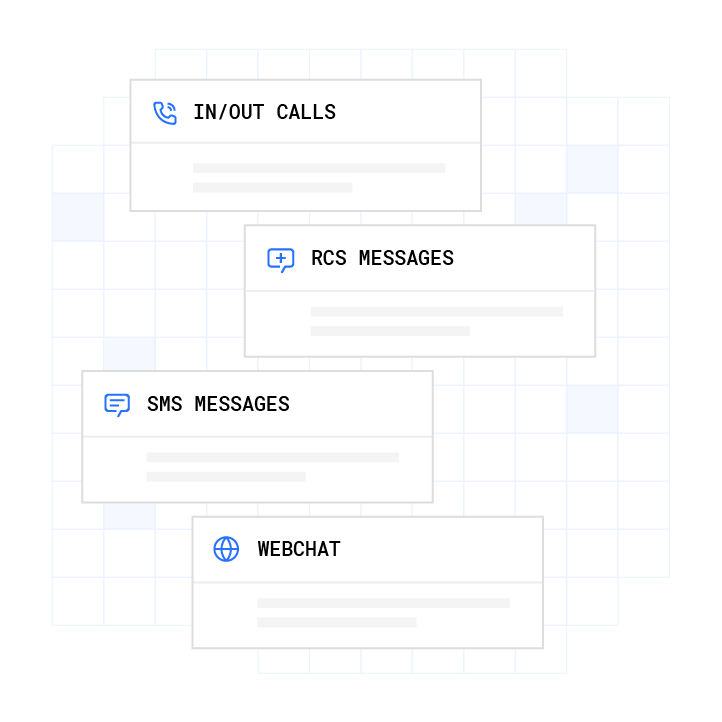
Plura’s Stateful Conversation Database keys every interaction to a customer token such as phone number, email, or ID and persists it across all four channels. An AI agent that sent an SMS at 9 a.m. can pick up the voice call at noon already knowing what was offered, what was objected to, and what remains open. This unified stateful inbox maintains full conversation history across voice, SMS, webchat, and RCS, so neither the AI nor the human agent ever starts from zero. Research on omnichannel deployments shows that businesses with strong omnichannel strategies retain 89% of customers versus 33% for disconnected systems.3
Real-Time DNC and TCPA Checks at Carrier Level
TCPA violations carry statutory damages of $500 to $1,500 per unsolicited call or text, with class action settlements averaging $6.6 million in 2023.2 At 500-plus daily interactions, a single compliance gap compounds quickly.
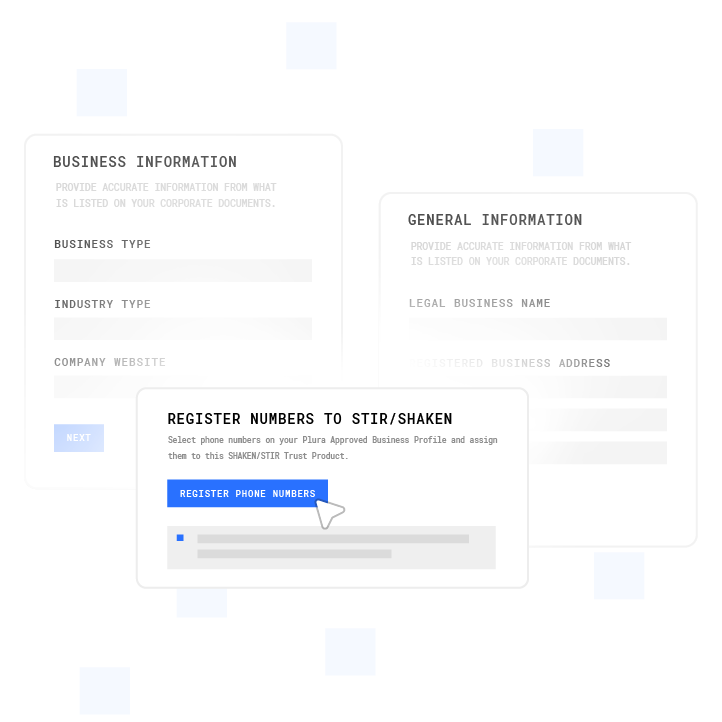
Many AI voice platforms bolt compliance onto a third-party Communications Platform as a Service layer they do not own. Plura is its own FCC-licensed audio bridging carrier. Every outbound contact is checked against federal and state DNC registries in real time before dial. TCPA consent records are timestamped, immutable, and audit-ready. Quiet-hours rules apply automatically through time-zone detection. Plura integrates with The Blacklist Alliance’s TCPA Litigation Firewall for real-time DNC scrubbing and litigation protection. The FCC’s One-to-One Consent Rule was vacated by the Eleventh Circuit before taking effect and was formally removed by the FCC in July 2025. Consult qualified counsel on how these frameworks apply to your specific campaigns.2
Carrier-level compliance protects you from regulatory exposure, but it does not solve the pickup problem. Even fully compliant calls get screened when they lack branded caller ID.
See Plura’s real-time DNC scrubbing and TCPA checks in a live demo.
Branded Caller ID for Higher Pickup Rates
Calls labeled “Spam Likely” rarely get answered, and Apple’s iOS 26 call-screening layer intercepts unfamiliar numbers before they ring through. This challenge requires a carrier-level solution rather than a simple software patch.
Plura issues branded caller ID directly through its FCC-licensed carrier. Calls present with the company’s name and the reason for the call. SHAKEN/STIR caller ID verification authenticates every outbound call at origination. Plura’s AI also communicates with iOS 26’s call-screening layer, which converts screened calls into pickups. Twilio-based API resellers cannot match this behavior because they inherit Twilio’s caller ID reputation instead of issuing their own.4
Escalation Paths and Warm Human Handoff
Escalation design often determines whether high-volume deployments succeed. An AI that cannot hand off cleanly erodes the customer experience it was meant to improve. Healthy escalation benchmarks include a balance of planned handoffs with fewer forced escalations and high transfer success rates where the human agent receives full transcript, intent, and account state.
Plura’s workflow canvas includes explicit escalation nodes that define exactly when and how the AI hands off to a human. When a conversation falls outside defined paths, a sensitive disclosure occurs, or a high-stakes objection triggers a BATNA floor, the AI warm-transfers to a U.S. agent with full context already loaded. The Unified Inbox gives the human agent the same memory the AI was reading from, so the customer does not repeat details.
Consistent Scripts and Disclosures Across Locations
Script drift quietly kills conversion in multi-location and multi-client operations. Performance gaps of 3-5x between best and worst locations3 in franchise networks often trace directly to inconsistent greeting, qualification, and disclosure language.
Plura’s no-code workflow canvas enforces identical conversation logic across every location or client account. Greeting nodes, qualification gates, sensitive-data redaction rules, and disclosure language sit at the system level and do not drift at the unit level. For agencies managing 15-plus clients, the same enforcement applies across every campaign at once, with centralized dashboards tracking per-client performance.
Outcome Metrics That Matter Beyond Response Rate
Response rate measures activity, while high-volume operators need metrics that measure outcomes. The core set for 500-plus daily interactions includes several specific indicators.
- Automated Resolution Rate (ARR): Percentage of interactions handled start to finish without human involvement. Agentic AI platforms achieve 70-85% resolution rates only in best cases with deep integration and action capabilities, while most deployments reach 30-60%, and basic or AI-powered chatbots typically achieve 28-68% containment.3
- Cost per Resolution: Total support costs divided by genuinely resolved interactions, with AI-handled calls typically costing less than escalated calls to a human agent.
- Repeat Contact Rate: Percentage of contacts reaching out again within 72 hours. A healthy benchmark sits under 15%, and high repeat rates signal deflection rather than resolution.
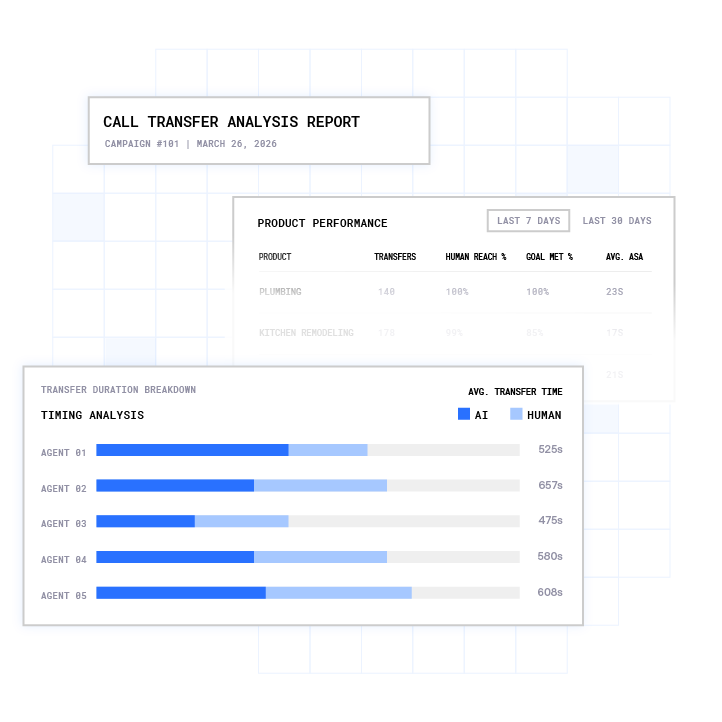
- Transfer Success Rate: Share of escalated calls that deliver full context to the human agent, with a benchmark above 90%.
- Pipeline contribution: Plura customers report 47% average pipeline growth3 after deployment.
For appointment-driven workflows, Plura’s healthcare deployments deliver the no-show improvement cited earlier through automated confirmation and reminder sequences.
Continuous Workflow Iteration Like CRO
Deployed AI workflows behave like live campaigns, not finished products. Conversation quality drifts, objection patterns change, and conversion rates flatten when workflows sit untouched. Operators who compound ROI treat conversation engineering the same way growth teams treat Conversion Rate Optimization, with continuous iteration against real call data.
Plura’s AI Conversation Intelligence layer analyzes every interaction across all four channels to surface what scripts close, what objections recur, and what conversion paths win. Workflow iterations deploy on the no-code canvas without redeploying the underlying AI. Every Plura annual contract includes a 90-day opt-out window, which places the iteration commitment on the platform rather than locking operators into a static build.
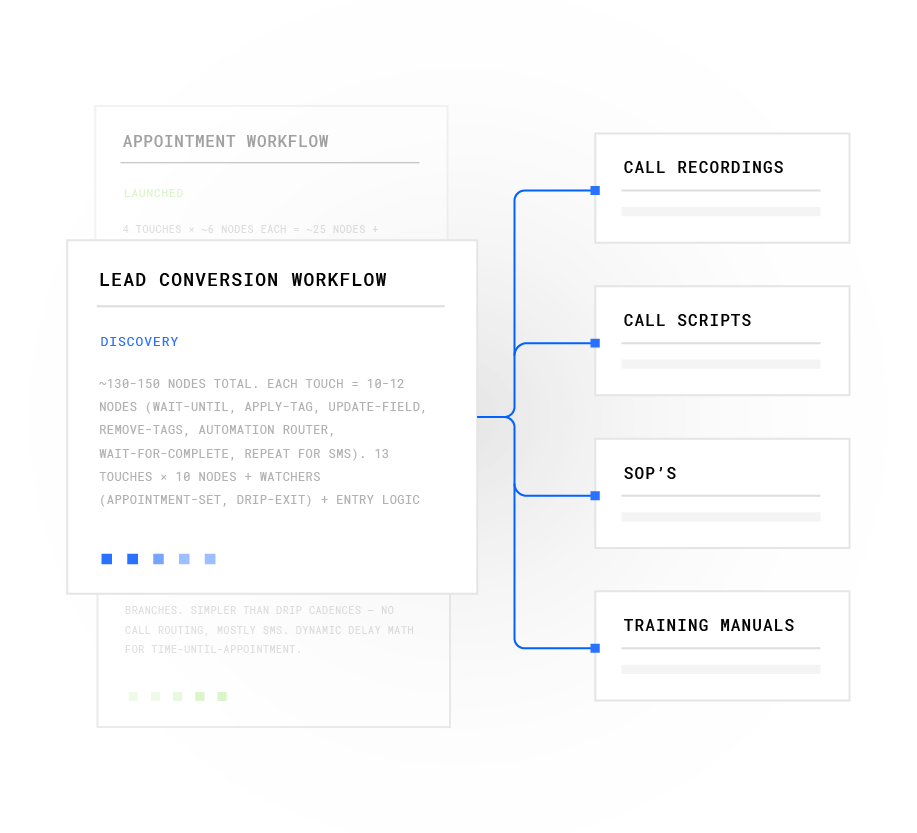
Watch how Plura’s no-code canvas handles workflow changes in a live environment.
CRM and Calendar Integration for Operational Teams
Conversational AI that does not write back to the CRM creates a data silo. Operators need every qualified lead, booked appointment, and conversation transcript to land in the systems their sales and operations teams already use.
Plura integrates with 50-plus tools across CRM such as HubSpot, Salesforce, and Zoho, calendars such as Calendly, Cal.com, and Google Calendar, payment processors such as Stripe and Shopify, document signers such as DocuSign and PandaDoc, and attribution platforms such as Cometly, Ringba, and Retreaver.4 The AI reads the right customer record, books the correct calendar slot, fires the right post-conversation event, and reports back into existing dashboards. The full directory is at plura.ai/integrations.
Scaling Into Peak Seasons Without Extra Headcount
Medicare Annual Enrollment Period, tax season, and Black Friday all create volume spikes that human contact centers cannot absorb without hiring months in advance. AI platforms can handle large surges in interaction volume during peak periods without the linear headcount increases traditional contact centers require.
Plura’s AI agents run at 100% talk utilization with no taxes, benefits, commissions, or training ramp. The default ROI scenario on Plura’s calculator shows the 6-to-15 agent replacement ratio mentioned earlier, with 30-day savings of $45,600. At enterprise scale, total cost of ownership runs $300,000-$700,000 annually against a traditional contact-center benchmark of $4 million-$7 million.3
TCO Comparison: Traditional Contact Center vs. Plura
| Cost Category | Traditional Contact Center | Plura AI Platform |
|---|---|---|
| Annual TCO (enterprise scale) | $4M-$7M | $300K-$700K |
| Monthly cost (15-agent equivalent) | $60,000 | $14,400 |
| Talk utilization rate | 40% (human average) | 100% |
| Peak season scaling | Requires advance hiring | Instant, no headcount increase |
| Offshore regulatory exposure | High (FCC NPRM CG Docket No. 26-52) | None (100% U.S. infrastructure) |
| Agent turnover cost | 35-45% annual turnover | None |
Channel Use Cases for High-Volume Operators
| Channel | Primary High-Volume Applications | Key Performance Signal |
|---|---|---|
| AI Voice | Inbound qualification, outbound follow-up, warm transfer to licensed agent | Sub-5-second first contact vs. 47+ hour industry standard |
| AI SMS | Abandoned-cart recovery, appointment confirmations, re-engagement cadences | Cost per qualified lead $25-$60 vs. $85-$200 traditional3 |
| AI RCS | In-thread contract signing, payment requests, personalized video recap | 3x higher engagement vs. SMS, 80% read rate3 |
| AI Webchat | Inbound lead qualification, meeting booking, real-time page-context conversations | Higher conversion than static webforms, with full transcript for downstream analytics |
Frequently Asked Questions
Impact of FCC NPRM (CG Docket No. 26-52) on Conversational AI
The FCC’s Notice of Proposed Rulemaking, CG Docket No. 26-52, proposes capping offshore customer-service calls at 30% of total volume and prohibiting offshore handling of sensitive consumer data including passwords, multi-factor authentication codes, Social Security numbers, banking data, and card data.2 Companion federal legislation includes the Keep Call Centers in America Act (S.2495) and the Foreign Robocall Elimination Act (S.2666). At the state level, New York’s Call Center Jobs Act carries penalties up to $10,000 per day, New Jersey has a mirror statute, Connecticut bans offshore handling on state contracts, Missouri issued an offshore-disclosure executive order, and Florida restricts offshore handling of medical information.
For operators running conversational AI on platforms that route voice through foreign infrastructure or third-party CPaaS providers with offshore data handling, the NPRM creates direct compliance exposure. Plura runs on 100% U.S. infrastructure by architecture. Voice origination, model hosting, data storage, and call recording all sit on domestic infrastructure. Operators should consult qualified counsel on how the NPRM and companion legislation apply to their specific vendor contracts and data flows.
How Plura Supports Compliance Frameworks Without Offshore Exposure
Plura’s compliance engine functions as a first-class layer of the platform rather than a bolt-on. Every outbound contact is checked against federal and state DNC registries in real time before dial. TCPA consent records are timestamped, immutable, and exportable for audit. Quiet-hours rules apply automatically through time-zone detection on the contact’s location. HIPAA-aligned encryption, access controls, and audit logging cover protected health information across all four channels. SOC 2 certification covers the underlying infrastructure with continuous monitoring and third-party audits. ISO certification and GDPR coverage apply for operators with European operations. SHAKEN/STIR caller ID verification authenticates every outbound voice call at the carrier level.1
Because Plura is its own FCC-licensed carrier, these controls apply at origination rather than after the fact through a third-party reseller. Plura supports customer compliance posture, and customers remain responsible for their own regulatory obligations, certifications, and the claims they make to their end users.
Meaning of the 5-Minute/100x and 60-Second/391% Benchmarks
These benchmarks quantify the impact of lead response speed on connection and conversion. Harvard Business Review research found that companies responding to a prospect within five minutes are 100 times more likely to connect than those waiting 30 minutes. A separate benchmark shows that leads contacted within 60 seconds are 391% more likely to convert than those contacted after 24 hours. Both figures appear on Plura’s ROI calculator at plura.ai/calculator.
The industry standard for first contact on an inbound lead is 47-plus hours, driven by manual SDR queues, time-zone gaps, and human agents who can only work one channel at a time. Plura’s AI agents respond in under 5 seconds across voice, SMS, RCS, and webchat, 24 hours a day, 7 days a week, on every channel in parallel. For operators running 500-plus daily interactions, the compounding effect of that speed differential drives the 3x average ROI in 90 days that the platform delivers.
Conclusion
High-volume conversational AI best practices function as an infrastructure decision, not a simple feature checklist. Operators running 500-plus daily interactions need a platform that owns the carrier stack, supports compliance at origination, preserves context across every channel in a single stateful database, and iterates conversation workflows continuously against real outcomes. Plura AI is built for that operating reality on 100% U.S. infrastructure, with a 90-day opt-out window in every annual contract.
Experience the full Plura platform in a live environment by booking your demo.
Run your numbers through Plura’s calculator to check your ROI in real time.
Compare plans and rates side by side on the Plura pricing page.
1 Plura AI maintains SOC 2, HIPAA, ISO, and GDPR posture as part of its platform infrastructure. References to compliance frameworks in this article describe Plura’s platform capabilities and do not constitute a guarantee that any customer using Plura will themselves be compliant with applicable laws or standards. Customers remain solely responsible for their own regulatory obligations, certifications, consent management, recordkeeping, and the claims they make to their own end users. Consult qualified legal counsel for guidance specific to your use case.
2 This article describes regulatory frameworks at a general level and does not constitute legal advice. Laws and regulations vary by jurisdiction, change over time, and apply differently depending on facts and circumstances. Readers should consult qualified legal counsel before making compliance decisions.
3 Performance figures, customer outcomes, and industry statistics referenced in this article are drawn from cited third-party sources or Plura customer case studies. Individual results vary based on implementation, use case, industry, audience, and execution. Past or aggregate performance is not a guarantee of future results.
4 References to third-party products, services, companies, or research are made for informational and comparative purposes only. Plura AI is not affiliated with, endorsed by, or sponsored by any third party named in this article unless explicitly stated. Trademarks and product names referenced remain the property of their respective owners.
This article is provided for informational purposes only and reflects Plura AI’s understanding at the time of publication. Product capabilities, integrations, and specifications are subject to change. For the most current information, visit plura.ai.
This article was produced with the assistance of AI tools and reviewed by Plura AI prior to publication.