
Written by: Matt Beucler, CEO, Plura AI
Key Takeaways
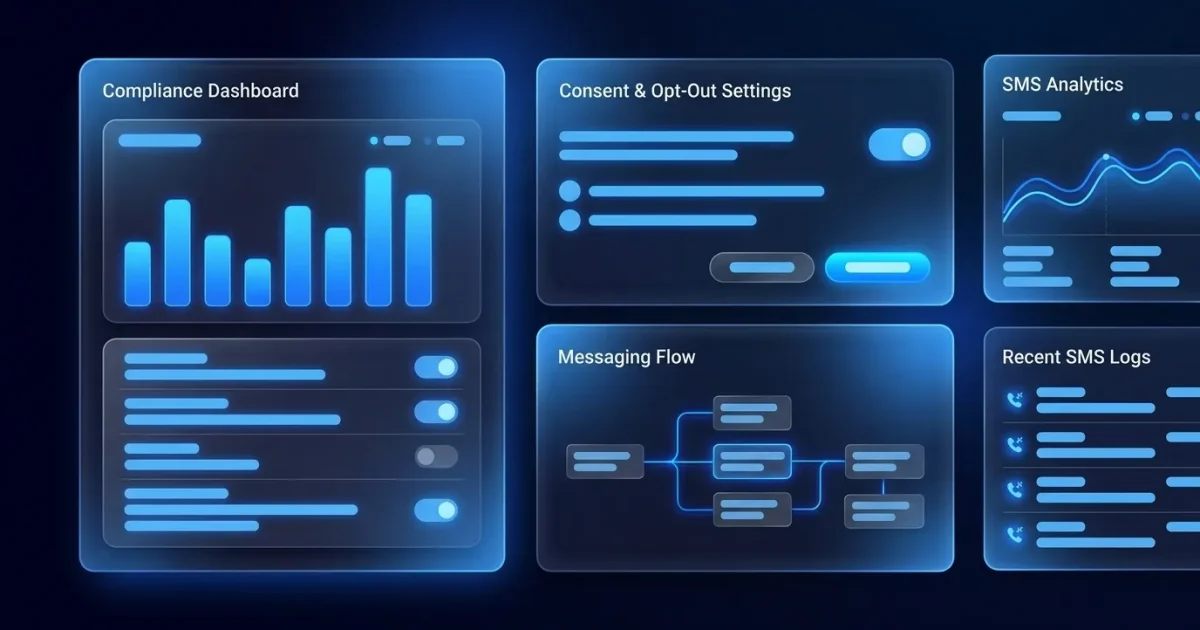
- AI SMS compliance follows TCPA, A2P 10DLC, and CTIA rules that apply to human senders, and enforcement must work at machine scale.
- Every AI-generated message should pass a real-time compliance gate that checks consent, DNC status, quiet hours, opt-outs, and content before send.
- Express written consent should use a dedicated SMS checkbox, be timestamped, and live in a centralized registry for at least four years.
- Opt-out requests should be recognized in free-form language and suppressed instantly across all numbers and systems to prevent new violations.
- Plura AI’s carrier-grade platform embeds these controls at the network level, and you can book a live demo to see how automated compliance runs before any message leaves your system.
Defining AI SMS Compliance in Practical Terms
AI SMS compliance covers the legal, carrier, and industry rules that govern SMS messages initiated, managed, or generated by AI agents. The regulations themselves are established. TCPA, 10DLC, and CTIA guidelines applied to business SMS long before AI. AI changes how you enforce those rules at scale.
A human sender can learn to check a consent record before sending a text. An AI agent operating across thousands of conversations needs a technical control layer instead of training alone. That layer must enforce consent verification, opt-out suppression, quiet hours, and content filtering before every send. Without it, an AI SMS program faces the same statutory penalties as any other non-compliant sender, multiplied by higher volume.
The stakes are concrete. A single non-compliant campaign to 5,000 contacts carries theoretical TCPA exposure of $2.5 million to $7.5 million3. Real-world settlements show the pattern. Clover Network paid $15 million in 2024 for over a million unsolicited marketing texts without consent, and Cash App settled for $12.5 million in 2025 over referral program texts sent without clear consent.
The Core Legal Framework for AI SMS
Three regulatory layers govern AI SMS in the United States. Each operates independently, and a failure in any one of them creates exposure.2 Consult qualified counsel for advice specific to your situation.
- TCPA (47 U.S.C. § 227): The federal statute that restricts autodialed or prerecorded calls and texts to wireless numbers.2 It requires prior express written consent for marketing messages, requires honoring opt-out requests, and provides a private right of action with statutory damages of $500 to $1,500 per violation. The FCC’s February 2024 Declaratory Ruling confirmed that AI-generated voices fall under the TCPA’s “artificial or prerecorded voice” provisions, which brings AI systems within the statute’s scope.
- A2P 10DLC: The carrier-mandated registration framework through The Campaign Registry (TCR).2 Every business sending application-to-person SMS must register a brand (legal entity) and campaign (use case) before sending. As of February 2025, major U.S. carriers block 100% of unregistered A2P 10DLC traffic. Registration functions as a prerequisite for delivery.
- CTIA Messaging Principles: Voluntary industry guidelines enforced contractually by carriers through filtering, campaign suspension, and number blocking. CTIA calls for express consent, immediate opt-out processing, and sender identification on all messages. CTIA standards exceed federal law in several areas, including opt-out timing.
These rules apply regardless of whether a human or AI sends the message. Carriers increasingly match actual message content against what was registered in real time, so AI-generated content should stay within the approved campaign registration.
The compliance rules for SMS messaging, summarized for featured snippet capture:
- Obtain prior express written consent before sending marketing messages (TCPA)
- Register your brand and campaign through The Campaign Registry (10DLC)
- Honor STOP and opt-out requests immediately, within seconds for automated systems (CTIA)
- Include clear sender identification and opt-out instructions on every message (CTIA)
- Respect quiet hours, typically 8 AM to 9 PM in the recipient’s local time zone (TCPA)
- Avoid prohibited content categories: sex, hate, alcohol, firearms, tobacco (CTIA SHAFT)
- Disclose AI-generated content where required by state or industry guidelines
Express Written Consent for AI SMS
Under 47 CFR 64.1200(f)(9), the FCC defines prior express written consent as an agreement in writing, bearing the signature of the person called, that clearly authorizes the sender to deliver marketing messages and identifies the telephone number. The disclosure should be clear and conspicuous, state that consent is not a condition of purchase, and identify the specific seller. Electronic signatures qualify where valid under contract law.
AI can help verify and document consent, and AI-generated consent that fails legal standards creates risk. The burden of proof for consent in TCPA litigation sits with the sender. A database row that reads “opted in: true” with no timestamp is a liability, not evidence.
Practical steps for AI-driven consent capture:
- Capture consent with an unchecked, dedicated SMS checkbox, kept separate from email or account creation
- Record the timestamp, IP address, exact disclosure language, and the URL or channel where consent was given
- Store records in a centralized consent registry instead of fragmented CRM records, so the system can query them fast enough at send time
- Retain consent records for at least four years to cover the TCPA statute of limitations
AI Disclosure and Transparency in Messaging
Disclosure that a message comes from an AI or automated system continues to evolve at both the federal and state levels. The FCC’s August 2024 proposed rules would require businesses to disclose intent to use AI-generated calls when obtaining consent and would mandate consumer disclosure of AI-generated voices in each instance, though these rules remain proposed as of this writing.
Teams can build AI disclosure into SMS workflows now to reduce exposure and align with CTIA best practices:
- Include AI disclosure in the opt-in confirmation message, not only in the initial consent form
- Ensure the privacy policy explicitly states that messages may be initiated by automated systems
- Monitor state-level disclosure requirements, because some states and industry guidelines may call for specific AI disclosures beyond federal rules
Opt-Out and Suppression Management for AI SMS
Under FCC rules effective April 2025, consumers may revoke consent by any reasonable method, not just keyword replies, and revocations must be honored within a reasonable time capped at ten business days. CTIA guidelines are stricter and call for immediate opt-out processing with suppression at the platform level.
AI SMS operations introduce specific opt-out failure modes that human-managed programs rarely encounter:
- AI agents should recognize free-form opt-out expressions such as “please stop texting me” or “wrong number,” in addition to STOP keyword replies
- Suppression should propagate to all systems within the same session, because a revocation logged but not pushed system-wide before the next send can create a fresh TCPA violation
- Opt-outs apply to the brand across the program. A customer who texts STOP to one number should be suppressed across all numbers sending the same program
Compliance Gate Architecture for AI SMS
A compliance gate is a technical layer between the AI and the SMS provider that enforces compliance rules before any message is sent. This pattern separates resilient AI SMS operations from exposed ones. Without a gate, the AI can generate and queue messages that violate consent, quiet hours, or content rules. These messages may go out before any human reviewer sees them.
Key components of a compliance gate:
- Consent verification: Query a centralized consent registry synchronously before every send instead of relying on periodic batch checks. A list that was clean yesterday can contain a revocation recorded this morning.
- DNC scrubbing: Check against federal and state Do-Not-Call (DNC) registries in real time, plus internal suppression lists.
- Quiet hours enforcement: Apply recipient local time zone, not sender time zone or area code. Number portability makes area codes unreliable for time zone detection.
- Opt-out list checking: Verify that the number has not opted out since the last send.
- Content filtering: Confirm that AI-generated content stays within registered campaign parameters and avoids SHAFT categories (sex, hate, alcohol, firearms, tobacco).
The following pseudocode illustrates a compliance gate running synchronously before every send:
function complianceGate(message, recipient, campaign): if not consentRegistry.hasValidConsent(recipient, campaign.seller): block("No valid consent on file") if dncRegistry.isListed(recipient.number): block("Number on DNC registry") if suppressionList.contains(recipient.number): block("Number opted out") if not quietHours.isWithinWindow(recipient.timezone): block("Outside quiet hours") if not contentFilter.passes(message, campaign.useCase): block("Content outside registered campaign") if not aiDisclosure.isIncluded(message): block("Missing AI disclosure") return allow(message) See the compliance gate architecture in a live Plura demo to watch it running inside a carrier-grade AI SMS platform.
AI SMS Compliance Checklist for 2026
- Register for 10DLC: brand registration under your legal EIN, and campaign registration per use case.
- Obtain express written consent with an unchecked, dedicated SMS checkbox.
- Include AI disclosure in the opt-in confirmation and privacy policy.
- Implement real-time DNC scrubbing against federal and state registries.
- Honor opt-outs within seconds and propagate suppression across all systems instantly.
- Enforce quiet hours by recipient local time zone, such as 8 AM to 9 PM or stricter state rules.
- Keep AI-generated content within registered campaign parameters.
- Audit your AI SMS flows regularly, sampling 50 to 100 records monthly.
- Retain consent and opt-out records for at least four years.
- Verify opt-in URLs remain live and carrier-verifiable at all times.
How Plura AI Supports AI SMS Compliance
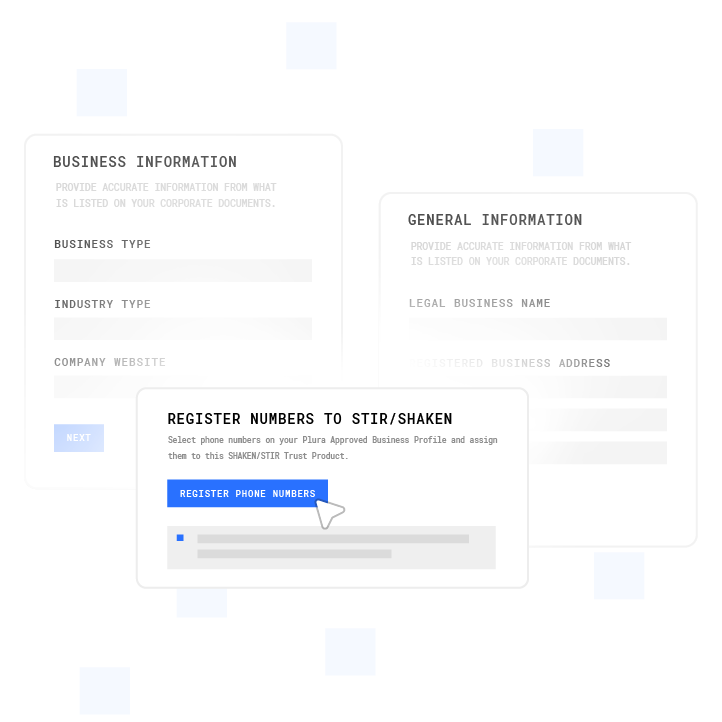
Plura AI is an FCC-licensed carrier. It does not wrap a third-party Communications Platform as a Service (CPaaS). That distinction matters for compliance. When controls run at the carrier level, before messages leave the network, there is no gap between the AI’s output and the compliance check. The gate operates inside the platform.
Key compliance support features in Plura’s platform:
- Real-time DNC scrubbing against federal and state registries before every send, with TCPA-litigator list filtering.
- Immutable consent logging with timestamped, audit-ready consent records that capture who opted in, when, and what they saw.
- 10DLC registration managed through Plura’s carrier infrastructure.
- Automated quiet hours enforcement through time-zone detection on the recipient, not the sender.
- SOC 2 Type II and ISO certification, HIPAA alignment, with 50+ state rule sets pre-loaded in Plura’s compliance engine.1
Plura’s AI SMS platform runs on 100% U.S. infrastructure with carrier-grade compliance support built in. Every outbound contact is checked against federal and state DNC registries in real time before send. Consent records are timestamped, immutable, and audit-ready. The dashboard exports audit-ready reports in one click.
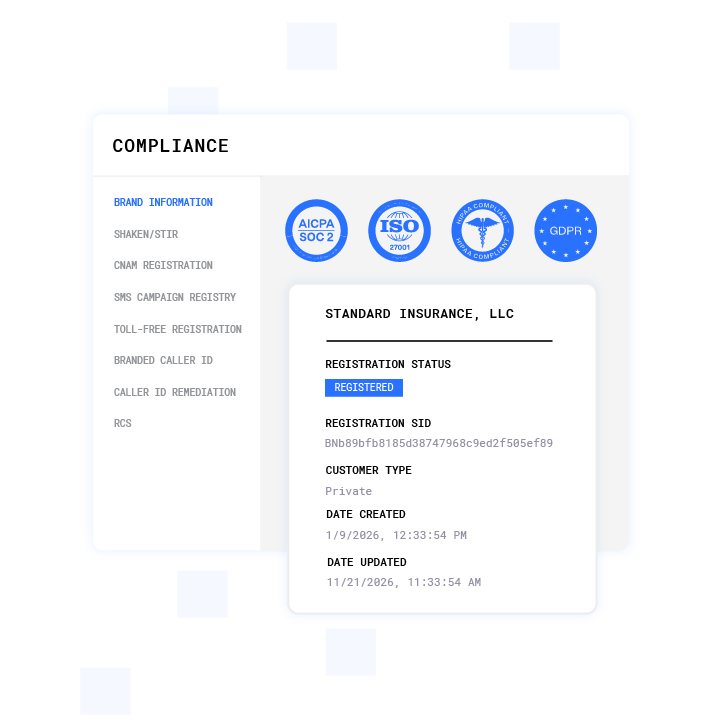
Plura supports customer compliance but does not remove customer obligations. You control how consent is collected, what messages say, and who is authorized to send them. Plura provides the infrastructure. Compliance posture downstream remains your responsibility.
Plura is HIPAA-aligned with these controls built into the platform.1
To evaluate cost, you can compare plans and rates side by side, or run your numbers through Plura’s calculator to see ROI in real time.3
Frequently Asked Questions
What are the compliance rules for SMS messaging?
SMS compliance in the United States operates across three layers. The TCPA requires prior express written consent before sending marketing messages to wireless numbers, requires honoring opt-out requests, and restricts sending to 8 AM to 9 PM in the recipient’s local time zone. A2P 10DLC requires brand and campaign registration through The Campaign Registry before any business SMS is sent from a 10-digit long code. CTIA Messaging Principles, enforced contractually by carriers, require explicit opt-in consent, immediate opt-out processing, sender identification on every message, and avoidance of prohibited content categories summarized as SHAFT: sex, hate, alcohol, firearms, and tobacco. Violations of any layer carry distinct consequences. TCPA violations carry statutory damages of $500 to $1,500 per message with no aggregate cap. 10DLC non-compliance results in carrier blocking. CTIA violations result in filtering, campaign suspension, or number blocking.
Are SMS messages HIPAA compliant?
SMS messages can be sent in a HIPAA-aligned manner when the platform provides end-to-end encryption, access controls, and audit logging for protected health information (PHI). Plura is HIPAA-aligned with these controls built into the platform.1 HIPAA compliance itself remains the customer’s responsibility. You should have a Business Associate Agreement (BAA) in place with any vendor handling PHI, and you should ensure your messaging workflows protect PHI at every stage. Using a HIPAA-aligned platform does not make your program HIPAA compliant. Your policies, training, and data handling practices shape your compliance posture.
How do I get express written consent for AI SMS?
Express written consent under the TCPA uses an unchecked, dedicated SMS checkbox with a clear disclosure naming your brand, describing the types of messages and their frequency, stating “Msg and data rates may apply,” and providing STOP and HELP instructions. The disclosure should state that consent is not a condition of purchase. For each subscriber, record the timestamp of consent, the IP address or device identifier, the exact disclosure language shown, and the URL or channel where consent was given. Store these records in a centralized consent registry instead of fragmented CRM records, and retain them for at least four years. As detailed earlier, each entry should include full metadata, because a bare “opted in: true” flag is not a defensible consent record.
What is 10DLC registration and why does it matter?
10DLC, or 10-Digit Long Code, is the carrier-mandated registration framework for business SMS in the United States. Every business sending application-to-person (A2P) SMS registers its brand, which is the legal entity with its EIN, and each campaign, which is the use case such as marketing, appointment reminders, or account notifications, through The Campaign Registry (TCR). As mentioned earlier, carriers block 100% of unregistered A2P traffic at the network level. Registration functions as a prerequisite for delivery. Common rejection reasons include EIN mismatches with IRS records, opt-in URLs that are not publicly accessible, sample messages that do not match the declared use case, and missing STOP or HELP instructions. Campaigns registered under older requirements may also need re-verification as carrier standards evolve.
How do I handle STOP and opt-out requests with AI?
AI systems should recognize free-form opt-out expressions, not just STOP keyword replies. Under FCC rules effective April 2025, consumers may revoke consent by any reasonable method, and senders cannot designate an exclusive means of revocation. Suppression should propagate to all systems within the same session, because a revocation that is logged but not pushed system-wide before the next send can create a fresh TCPA violation. Opt-outs apply to the brand across all numbers and campaigns, not just the number that received the STOP reply. CTIA guidelines call for a single opt-out confirmation message after suppression, after which no further messages should be sent. Platforms should also capture revocations from non-SMS channels, including web forms, email, and phone calls, and propagate them to the SMS suppression list in near real time.
What are the penalties for TCPA violations in AI SMS?
TCPA violations carry statutory damages of $500 per message for standard violations and $1,500 per message for willful or knowing violations, with no aggregate cap on total liability. Because damages are calculated per message, a single non-compliant campaign scales exposure directly with list size. As noted earlier, a single campaign to 5,000 contacts can carry theoretical exposure of $2.5 million to $7.5 million, with real-world settlements such as Clover and Cash App in the tens of millions. TCPA class action filings rose nearly 95% year over year through mid-2025, and litigation activity has continued to climb into 2026. Beyond statutory damages, carriers impose operational penalties including filtering, throttling, campaign suspension, and account termination, which can shut down a messaging program regardless of whether a TCPA claim is ever filed.
Conclusion and Next Steps for AI SMS Programs
AI does not change the rules of SMS compliance. TCPA, 10DLC, and CTIA apply to every message, whether a human or an AI agent sends it. AI changes how you enforce those rules at scale. The compliance gate architecture, covering consent verification, DNC scrubbing, quiet hours, opt-out checking, and content filtering, provides the technical pattern that keeps AI SMS operations within regulatory bounds. Each layer of the gate should run synchronously before every send. Removing any one layer leaves a gap the others do not cover.
Review your current AI SMS workflows against the 2026 checklist above. If any layer of the compliance gate is missing, the exposure is real and scales directly with volume.
Plura’s FCC-licensed carrier infrastructure places these controls inside the platform, enforced before any message is sent. Watch carrier-grade compliance support in a Plura demo to see how it works in practice. You can also compare plans and rates and run your numbers through Plura’s calculator to evaluate ROI.
1 Plura AI maintains SOC 2, HIPAA, ISO, and GDPR posture as part of its platform infrastructure. References to compliance frameworks in this article describe Plura’s platform capabilities and do not constitute a guarantee that any customer using Plura will themselves be compliant with applicable laws or standards. Customers remain solely responsible for their own regulatory obligations, certifications, consent management, recordkeeping, and the claims they make to their own end users. Consult qualified legal counsel for guidance specific to your use case.
2 This article describes regulatory frameworks at a general level and does not constitute legal advice. Laws and regulations vary by jurisdiction, change over time, and apply differently depending on facts and circumstances. Readers should consult qualified legal counsel before making compliance decisions.
3 Performance figures, customer outcomes, and industry statistics referenced in this article are drawn from cited third-party sources or Plura customer case studies. Individual results vary based on implementation, use case, industry, audience, and execution. Past or aggregate performance is not a guarantee of future results.
This article is provided for informational purposes only and reflects Plura AI’s understanding at the time of publication. Product capabilities, integrations, and specifications are subject to change. For the most current information, visit plura.ai.
This article was produced with the assistance of AI tools and reviewed by Plura AI prior to publication.