
Written by: Matt Beucler, CEO, Plura AI
Key Takeaways
- An AI text to call dialer converts written scripts into live conversations through five core components: script ingestion, TTS rendering, speech recognition, telephony, and CRM write-back.
- Platform ownership of an FCC-licensed carrier shapes caller ID quality, spam labeling risk, per-minute economics, and real-time compliance enforcement before dial.
- Strict pre-dial compliance sequences, including DNC scrubbing, consent logging, quiet hours, and STIR/SHAKEN authentication, reduce regulatory exposure for outbound campaigns.
- AI dialers can run at 100% talk utilization versus 40% for human teams, which can reduce a 15-agent operation from $60,000 to $14,400 per month.3
- Plura AI owns its FCC-licensed carrier and runs the full enforcement layer inside the platform; book a live demo to see how the pipeline works end-to-end.
How A Text Script Becomes A Live Call
The pipeline from written script to live conversation runs through five sequential stages. Each stage must perform within a tight latency budget for the call to feel natural. A tuned pipeline delivers time to first audio in the 500-800ms range. A naive sequential pipeline where each stage waits for the previous one can exceed two to three seconds.
- Script ingestion. The approved script and objection branches load into workflow nodes. Each node carries hard limits that define what the agent can and cannot do.
- Text-to-speech rendering. The agent’s spoken output is generated from the script and live conversation context. Streaming TTS begins generating audio from the first available tokens instead of waiting for the complete response text, which reduces latency at scale.
- Speech recognition on the live call. The prospect’s speech is transcribed in real time using streaming ASR (Automatic Speech Recognition). Batch transcription adds 600-1,200ms before the LLM (Large Language Model) call fires and makes sub-second latency unreachable without streaming.
- Telephony origination. The call leaves the platform over the carrier. Whether the platform owns its carrier or rents from a CPaaS (Communications Platform as a Service) layer shapes caller ID issuance, spam labeling exposure, and per-minute economics.
- CRM write-back. Transcript, disposition, and outcome sync to the system of record. Plura’s integrations cover HubSpot, Salesforce, Zoho, and 50+ additional tools.
Interruption handling is a separate production requirement. When a prospect speaks over the agent, the system must execute three actions simultaneously:
- Fast cancellation of in-progress inference
- Immediate TTS playback stop
- Partial state management recording what the agent actually said before interruption
The first of those actions depends on the underlying infrastructure. On shared serverless infrastructure, request cancellation may not free GPU capacity immediately, while on dedicated infrastructure cancellation is immediate.
Plura’s AI voice agent handles calls in English or Spanish and logs every conversation to a stateful database for cross-channel context. A prospect who texted at 9 a.m. is the same contact when the call comes at noon, and the agent continues the conversation without re-introduction.
How To Automate Phone Calls With AI
The operational sequence for deploying an AI text to call dialer follows six steps.
- Ingest the approved script and map objection branches into workflow nodes.
- Configure the AI voice agent’s TTS voice, speech recognition model, and language coverage.
- Connect the dialer to the list source and set pacing, retry, and time-zone rules.
- Run the compliance sequence before dial: DNC scrub, consent check, quiet hours, STIR/SHAKEN.
- Originate the call over the carrier and hand live answers to the agent.
- Write transcript, disposition, and outcome back to the CRM.
Speed at step four determines whether the platform scales or stalls. Contacting a lead within five minutes makes them up to 100 times more likely to connect. A 60-second response lifts conversions by 391%.
See the full pipeline in a working demo to watch the flow from script ingestion to live call.
The Carrier Layer: Why Ownership Determines Everything
Carrier ownership sits at the center of AI dialer performance. Most AI voice platforms are built as wrappers on top of a third-party CPaaS. The CPaaS handles origination, caller ID, and termination, and the AI vendor passes those costs through to the customer.
Owning the carrier versus renting it changes four operational outcomes. Those outcomes are caller ID issuance, spam labeling, per-minute economics, and exposure to the FCC’s posture on offshore infrastructure.
Plura is its own FCC-licensed audio bridging carrier. Plura owns its telecom infrastructure and holds an FCC carrier license, while platforms that depend on Twilio or similar CPaaS providers operate as a software layer without a carrier license.4 Plura issues branded caller ID at the carrier level and runs STIR/SHAKEN authentication at the carrier level on every outbound call through its own FCC-licensed carrier.
The FCC’s Eighth Report and Order, which took effect September 18, 2025, describes limits on originating service providers that contract with a third party to sign calls on their behalf unless the provider independently determines attestation levels and uses its own certificate. Pure resellers that do not control their network infrastructure cannot claim partial or complete STIR/SHAKEN implementation in their Robocall Mitigation Database filings.
| Attribute | Carrier-Owning Platform | CPaaS-Wrapper Platform |
|---|---|---|
| Caller ID issuance | Issued at the carrier level under the platform’s own identity (Plura) | Rented through a third-party CPaaS layer |
| DNC enforcement timing | Real-time scrub inside the platform before dial | Bolted on after the call leaves the platform |
| Per-minute economics | Set by the platform’s own carrier rates | Wrapper tax passed through to the customer |
Compliance As A Pre-Dial Enforcement Sequence
The relevant frameworks include 47 U.S.C. § 227 (the Telephone Consumer Protection Act, or TCPA), the National DNC Registry, and the TRACED Act, which is the statutory basis for STIR/SHAKEN caller ID authentication.2 Operators should consult the regulation text and qualified counsel to understand their own obligations under these frameworks.
Plura runs the following enforcement sequence on every outbound contact:
- Real-time DNC registry check before dial. Every number is checked against federal and state DNC registries before the first dial attempt. Non-compliant numbers are blocked before origination.
- Immutable, timestamped consent records. Consent records are logged with timestamps and cannot be altered, which supports audit-ready exports on demand.
- Time-zone-based quiet hours. Calling-window restrictions enforce automatically through time-zone detection on the contact, applying state and federal rules to every campaign.
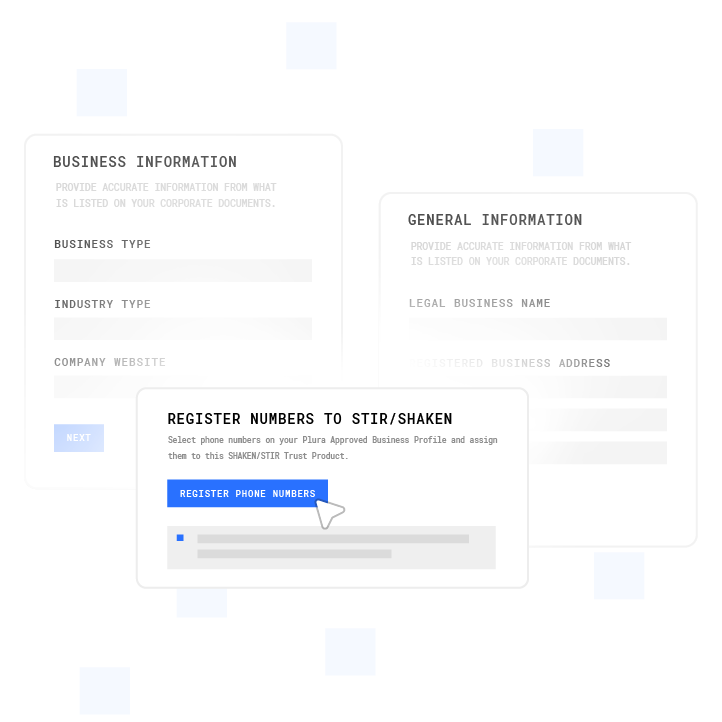
- STIR/SHAKEN authentication at origination. Every outbound call is authenticated using Plura’s own carrier certificate.
Plura supports customer compliance with TCPA compliance, DNC compliance, HIPAA, SOC 2, and GDPR frameworks.1 Customers remain responsible for their own regulatory obligations and the claims they make to their end users.
Unit Economics: Cost Per Connected Conversation
Unit economics for AI dialers hinge on talk utilization. Human agents in a contact center environment typically operate at 40% talk utilization, which means they are in active conversation for roughly 40% of their paid hours. An AI dialer operates at 100% talk utilization because it does not wait between calls.
Using the scenario from Plura’s ROI calculator:
- A 15-agent operation at $20 per hour with 25% taxes, benefits, and commissions at 40% talk utilization costs $60,000 per month.3
- Replacing that team with Plura at $15 per hour, 100% talk utilization, with 6 Plura agents doing the equivalent work costs $14,400 per month.
- 30-day savings: $45,600
- 12-month savings: $547,200
- 60-month savings: $2,736,000
At higher volume, the same model produces a total cost of ownership of $700,000 per year, replacing a traditional contact-center cost structure of $7 million, according to Plura’s executive communications strategy guide. For a 50-seat equivalent contact center, traditional offshore operations cost $35,000-$50,000 monthly, while AI contact centers cost $8,000-$15,000 monthly.
Run your numbers through Plura’s cost savings calculator to check your ROI against your current headcount and talk-utilization rate.
Failure Modes And Human Escalation Paths
Production AI dialers need clear behavior for off-script situations. Plura’s managed workflows address this through four mechanisms:
- Workflow guardrails. Each conversation node carries hard limits. The agent cannot deviate from the defined path without triggering an escalation rule.
- BATNA-style negotiation floors and ceilings. BATNA (Best Alternative to a Negotiated Agreement) defines the boundaries inside which the agent may negotiate. Offers outside those boundaries trigger a transfer or a hold.
- Field-level redaction. Sensitive data including PHI (Protected Health Information), PII (Personally Identifiable Information), and payment data is redacted at the field level before it leaves the platform’s infrastructure.
- Warm transfer to a U.S. agent. Unfamiliar requests, sensitive disclosures, and high-stakes objections route to a live U.S. agent with full conversation context already loaded.
Human handoff functions as a workflow gate for situations where a human is the right tool. The AI handles volume. The human handles exceptions.
Where AI Dialers Fit Among Power And Predictive Dialers
Failure handling and escalation also clarify how AI dialers compare to other dialer types. The three dialer types serve different operational profiles. The first mention of AI predictive dialer links to Plura’s dedicated product page for operators evaluating that specific configuration.
| Dialer Type | Simultaneous Calls | Abandoned-Call Risk | Best Fit |
|---|---|---|---|
| Power dialer | 1 at a time, agent is live before the call connects | None, nothing dials until a rep is free | Teams that cannot staff a dedicated compliance function, complex B2B sales where dead air is a brand risk |
| Predictive dialer | 2-6, algorithm-led, over-dials ahead of available reps | Medium, FCC rules cap abandoned calls at 3% per campaign over 30 days | High-volume outbound with pacing infrastructure and a compliance operations function |
| AI dialer | Multi-line, the AI agent handles the conversation, not a human rep | Managed inside the platform before dial, compliance enforced at origination | Operators replacing human seats with AI agents at scale |
The structural difference between a predictive dialer and an AI dialer is what sits on the other end of the connected call. A predictive dialer over-dials ahead of available human reps and connects the first live answer to a waiting agent. An AI dialer replaces the human seat entirely. The agent handles the conversation from greeting to disposition, and compliance is enforced inside the platform before dial.
See how the AI dialer runs a live call from script to CRM write-back.
Frequently Asked Questions
Are AI Phone Calls Illegal?
The legal framework governing automated and AI-driven outbound calls in the United States is primarily 47 U.S.C. § 227, the Telephone Consumer Protection Act, along with FCC implementing regulations codified at 47 C.F.R. § 64.1200.2 The TCPA describes restrictions on the use of autodialers and prerecorded or artificial voice messages, with different rules applying to mobile phones versus residential landlines, and to advertising calls versus informational calls. The National DNC Registry, managed by the FTC and enforced by both the FCC and FTC, adds a separate layer of restrictions on telemarketing calls. Whether a specific AI calling program fits within these frameworks depends on the consent obtained, the type of call, the numbers being dialed, and the applicable state laws in the jurisdictions where calls are placed. Operators should consult qualified legal counsel before deploying any outbound AI calling program.
What Does An AI Dialer Cost Per Connected Call?
The calculator scenario above shows the cost gap: $60,000 per month for 15 human agents versus $14,400 for the equivalent Plura deployment. That produces a 30-day savings of $45,600. At the component level, production AI voice agent deployments typically run $0.12-$0.15 per connected minute once speech recognition, LLM inference, TTS, and telephony are bundled, according to published cost analyses from DestiLabs.4 The correct comparison metric is cost per connected conversation, because the headline per-minute rate often excludes multiple billable components.
How Does An AI Text To Call Dialer Handle Unscripted Objections?
Workflow guardrails define what the agent can do at each conversation node. When a prospect’s response falls outside the defined paths, the system has three options. It can apply BATNA-style negotiation floors and ceilings if the situation is a negotiation variant within a defined range. It can flag the conversation in the Unified Inbox for review. It can warm-transfer the call to a U.S. agent with full conversation context already loaded.
The agent does not improvise on outcomes that matter. Sensitive disclosures, unfamiliar requests, and high-stakes objections route to a human by design.
What Is The Difference Between An AI Dialer And A Predictive Dialer?
A predictive dialer over-dials ahead of available human reps using statistical pacing algorithms. When a live person answers, the call routes to a waiting human agent. The FCC caps abandoned calls at 3% of live pickups per campaign over any 30-day period, and each abandoned call carries statutory damages under the TCPA. An AI dialer replaces the human seat entirely. The AI agent handles the conversation from greeting to disposition, which removes the pacing gap between answered calls and available reps. Compliance is enforced inside the platform before dial rather than managed as a post-dial reporting function.
How Does Caller ID Affect Connect Rates On An AI Dialer?
Caller ID presentation affects whether a prospect answers the call before the AI agent can speak. Calls that display “Spam Likely” or an unfamiliar number are often screened or ignored. Spam labels are generated by carrier analytics engines that weigh STIR/SHAKEN attestation as one signal among traffic patterns and complaint data. Full A-attestation reduces suspicion but does not remove spam labeling risk on its own.
Platforms that own their FCC carrier license can issue branded caller ID at the carrier level and run STIR/SHAKEN authentication using their own certificate, which produces a stronger attestation signal than a CPaaS-wrapper platform renting caller ID from a third party. Plura issues branded caller ID directly through its FCC-licensed carrier on every outbound call.
Conclusion: AI Text To Call Dialers As Production Infrastructure
An AI text to call dialer operates as a five-component pipeline running on a carrier layer that either owns the telecom infrastructure or rents it. The carrier layer shapes caller ID issuance, spam labeling, per-minute economics, and compliance enforcement timing. Platforms that own their carrier can enforce compliance before dial, while platforms that rent from a CPaaS typically bolt compliance on after the call leaves the network.
Plura AI owns its FCC-licensed carrier, runs 100% U.S. infrastructure by architecture, and enforces DNC scrubbing, consent logging, quiet hours, and STIR/SHAKEN authentication inside the platform before dial. The AI voice agent handles calls in English or Spanish, logs every conversation to a stateful database, and warm-transfers to a U.S. agent when a workflow gate triggers.
Run your numbers through Plura’s ROI calculator to check your savings against your current headcount in real time.
Compare plans and rates side by side on the Plura pricing page.
See a live AI contact center on FCC-licensed infrastructure and follow the pipeline from written script to live outbound call.
1 Plura AI maintains SOC 2, HIPAA, ISO, and GDPR posture as part of its platform infrastructure. References to compliance frameworks in this article describe Plura’s platform capabilities and do not constitute a guarantee that any customer using Plura will themselves be compliant with applicable laws or standards. Customers remain solely responsible for their own regulatory obligations, certifications, consent management, recordkeeping, and the claims they make to their own end users. Consult qualified legal counsel for guidance specific to your use case.
2 This article describes regulatory frameworks at a general level and does not constitute legal advice. Laws and regulations vary by jurisdiction, change over time, and apply differently depending on facts and circumstances. Readers should consult qualified legal counsel before making compliance decisions.
3 Performance figures, customer outcomes, and industry statistics referenced in this article are drawn from cited third-party sources or Plura customer case studies. Individual results vary based on implementation, use case, industry, audience, and execution. Past or aggregate performance is not a guarantee of future results.
4 References to third-party products, services, companies, or research are made for informational and comparative purposes only. Plura AI is not affiliated with, endorsed by, or sponsored by any third party named in this article unless explicitly stated. Trademarks and product names referenced remain the property of their respective owners.
This article is provided for informational purposes only and reflects Plura AI’s understanding at the time of publication. Product capabilities, integrations, and specifications are subject to change. For the most current information, visit plura.ai.
This article was produced with the assistance of AI tools and reviewed by Plura AI prior to publication.