
Written by: Matt Beucler, CEO, Plura AI
Updated September 2026
Key Takeaways
- RCS Business Messaging compliance is a multi-layered stack that includes brand verification, carrier approval, documented consent, opt-in and opt-out mechanics, quiet hours, and use-case restrictions on top of existing TCPA/10DLC programs.
- Agent registration requires Google partner approval followed by separate carrier vetting for each network, with use-case binding that prevents approved transactional agents from carrying marketing messages.
- Consent must be informed, specific, recorded, and revocable per channel, with audit trails capturing timestamps, disclosure versions, and revocation paths retained for at least four years.
- Non-compliance risks include carrier blocking, agent suspension, spam throttling, and TCPA exposure with statutory damages of $500 to $1,500 per message plus potential class actions averaging $6.6 million.
- See how Plura enforces RCS compliance before send on 100% U.S. infrastructure.
RCS Agent Registration and Carrier Approval
RCS agent registration functions as a role-qualification gate, not a simple technical signup. Per Google’s RBM developer documentation, an organization that wants to create, manage, or operate agents must register under the “RCS Solution Provider” service category before accessing the RCS for Business Developer Console.4 Carrier approval then follows separately for each network.
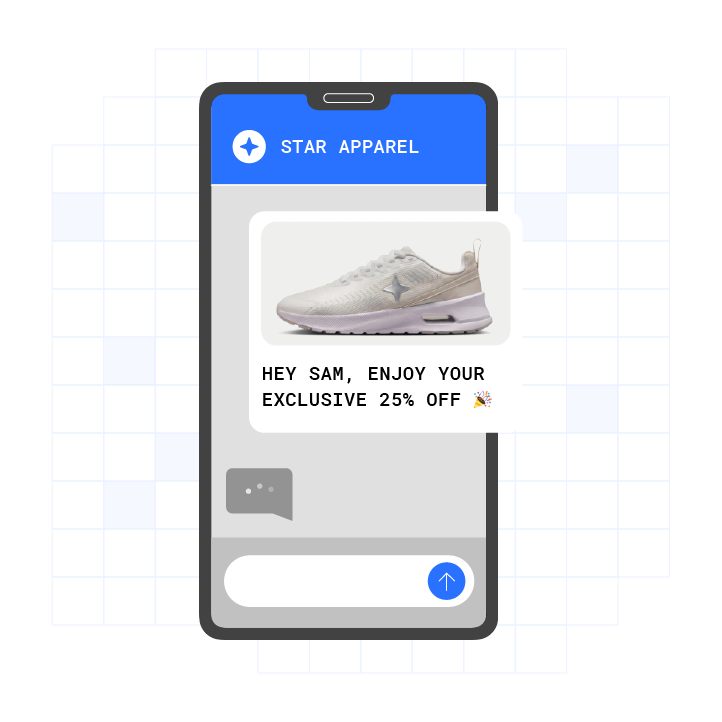
The operational sequence runs as follows:
- Submit the RCS for Business Partner Registration Interest Form, selecting “RCS Solution Provider” as the service category. The form requires organization details including the public name of your company, company website, company description, and primary countries of operation, along with a named technical point of contact providing their name, job title, corporate email, and phone number. Gmail addresses and group accounts are explicitly disallowed, so the partner account owner must use an individual account tied to a corporate email.
- Google reviews the application and contacts qualifying applicants with next steps to complete registration. After partner registration is approved, a provider can access the RCS for Business Developer Console, set up a partner account, and build its first agent.
- The partner creates an agent inside the Developer Console by specifying the brand it represents, the agent name, hosting region, billing category, and use case. Branding details such as logo, colors, description, and contact information are added to the agent’s profile after creation.
- Each carrier reviews the agent launch request against its own criteria, including whether the agent’s branding aligns with carrier standards and whether the use case and billing category match the agent’s intended behavior. Per Google’s RBM carrier documentation, when a carrier rejects an agent launch it must provide a reason, which Google shares with the agent owner.
- Once approved, the agent moves to Launched status and can start interacting with the carrier’s end users. On Google-managed carriers the agent becomes reachable about 30 minutes after the status changes to Launched.
Google’s RCS for Business carrier documentation defines agent lifecycle statuses on a carrier network including Pending (awaiting review), Launched (approved and able to send messages to end users), Rejected (doesn’t meet review criteria), Suspended (temporarily blocked from sending traffic), and Reactivated (a suspended agent returned to Launched status), alongside an additional Terminated or Unlaunched status. Agent approval is per use case and attaches to the agent itself. An agent approved for transactional messaging cannot legitimately carry marketing. Sending outside the approved use case risks suspension of the agent.
Plura’s compliance engine enforces use-case boundaries at the platform level and blocks sends that fall outside the registered agent’s approved category before they reach the carrier.
RCS Business Messaging Requirements: Consent and Opt-In
Once an agent is approved and launched, the next compliance layer is consent. RCS Business Messaging consent must be informed, specific, recorded, and revocable. TCPA (47 U.S.C. § 227) governs automated messaging to mobile numbers, and prior express consent applies whether the message travels as SMS or RCS.2 Under FCC rules (47 C.F.R. § 64.1200(a)(1)-(2)), prior express written consent is required for telephone calls or texts delivering an advertising or telemarketing message using an autodialer or artificial or prerecorded voice, though the Fifth Circuit’s 2026 decision in Bradford v. Sovereign Pest Control held that the TCPA’s text requires only prior express consent, oral or written.
“Informed, specific, recorded, revocable” translates to concrete record-keeping requirements. A compliant RCS opt-in audit trail must include the timestamp, the source of consent (such as a specific web form), and the exact language the user agreed to, with records retained for at least four years under the TCPA’s statute of limitations. Compliance teams should capture these consent-record fields:
- Timestamp of consent (date, time, and time zone)
- Source of consent (URL of the page or keyword opt-in mechanism)
- Exact disclosure language shown at the time, stored as a version-controlled snapshot
- Channel agreed to (RCS is a separate channel from SMS, and consent is per channel)
- Revocation path (how the contact can opt out and which keywords trigger it)
The FCC’s prior express written consent definition is codified at 47 C.F.R. § 64.1200(f)(9). It requires a written agreement bearing the signature of the person called that clearly authorizes the seller to deliver advertisements or telemarketing messages using an automatic telephone dialing system or an artificial or prerecorded voice. The agreement must identify the telephone number to which such messages may be delivered and include a clear and conspicuous disclosure that the person is not required to sign the agreement as a condition of purchasing any property, goods, or services. Consent for RCS is generally per channel, and consent records must show which channel and message type the person agreed to. In many markets, a valid SMS opt-in can cover RCS messages if the sender, message type, and purpose remain unchanged.
Under the FCC’s 2024 TCPA Consent Order (FCC 24-24), callers must honor company-specific do-not-call and revocation-of-consent requests within a reasonable time not to exceed 10 business days after receipt.2 Using the words “stop,” “quit,” “end,” “revoke,” “opt out,” “cancel,” or “unsubscribe” via reply text message constitutes a per se reasonable means to revoke consent. Callers must also treat other reply texts as valid revocation requests if a reasonable person would understand them to convey a request to revoke consent. The FTC’s Telemarketing Sales Rule (16 C.F.R. Part 310) requires sellers and telemarketers to obtain the customer’s express informed consent before billing and to make required oral disclosures in the sale of goods or services.
Plura’s AI SMS platform captures and stores consent records with timestamps and disclosure versions, and its opt-out keyword handling covers all FCC-recognized revocation terms. Consult qualified counsel for guidance on how these frameworks apply to your specific program.
RCS Compliance vs. SMS Compliance: The TCPA/10DLC/RBM Crosswalk
RBM compliance overlaps with A2P SMS programs on registration registries, consent standards, quiet-hours enforcement, and use-case restrictions, and it diverges on approval sequence (Google brand verification followed by carrier approval), agent-level use-case binding, and real-time reputation monitoring. Operators must budget for both approvals when running RCS with SMS fallback. The table below breaks down each compliance dimension side by side so operators can see where the two programs align and where they require separate workstreams.
Review Plura’s SMS/RCS guidelines for the full framework operators use when running both channels in parallel.
Is RCS Messaging HIPAA Compliant?
Base RCS is not end-to-end encrypted, and RBM by itself does not satisfy HIPAA.2 A covered entity must implement reasonable and appropriate administrative, physical, and technical safeguards under the HIPAA Security Rule, including the technical safeguards at 45 C.F.R. 164.312 and administrative safeguards at 45 C.F.R. 164.308, layered on top of any carrier protocol or business-messaging platform, with some specifications such as encryption being addressable rather than strictly mandated. Apple confirmed in May 2026 that iOS 26.5 adds end-to-end encrypted RCS messaging, but the encryption applies to one-on-one conversations between iPhones and Android devices, while cross-platform group chats remain unprotected.
Covered entities layer several controls on top of the carrier protocol:
- A covered entity must obtain satisfactory assurances, documented through a written contract or other arrangement (a Business Associate Agreement), before permitting a business associate to create, receive, maintain, or transmit PHI on its behalf, per 45 C.F.R. 164.502(e) for PHI and 45 C.F.R. 164.308(b)(1) for electronic PHI.
- Under 45 C.F.R. 164.312, HIPAA’s encryption implementation specifications are addressable rather than mandatory, and the rule does not name specific algorithms. A widely recommended and commonly adopted baseline is AES-256 encryption at rest and TLS 1.2 or higher (with TLS 1.3 preferred) in transit, consistent with NIST guidance.
- Access controls limiting ePHI access to authorized persons, audit controls to record and examine system activity, integrity controls, authentication procedures, and automatic logoff.
- Under 45 C.F.R. 164.308(a)(1)(ii)(A), covered entities and business associates must conduct an accurate and thorough risk analysis assessing the potential risks and vulnerabilities to the confidentiality, integrity, and availability of ePHI, and this risk analysis must be documented as required by 45 C.F.R. 164.316(b)(1).
- Administrative safeguards including a designated security official and workforce training, per 45 C.F.R. 164.308(a)(2) and 164.308(a)(5)(i).
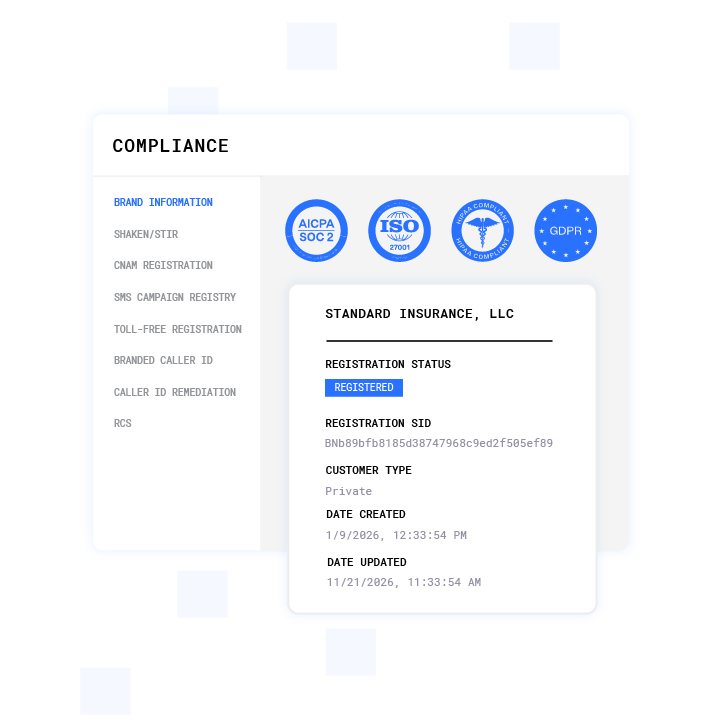
HHS OCR states that no vendor can claim HHS or OCR certification of HIPAA-compliant messaging. Plura supports compliance for healthcare operators with HIPAA-aligned infrastructure, SOC 2 certification, and signed BAAs, and customers remain responsible for their own compliance posture.1 Consult qualified counsel for guidance on how HIPAA applies to your specific messaging workflows.
1
Walk through Plura’s HIPAA-aligned messaging workflows with a live demo.
RCS Opt-In and Opt-Out Requirements: Practical Language Examples
A compliant RCS opt-in clearly states that the recipient is agreeing to receive messages from the business. It must identify the business by its registered or DBA brand name, describe the message types, indicate expected frequency, disclose that message and data rates may apply, and include both HELP instructions and opt-out (STOP) instructions. Under the FCC’s TCPA consent-revocation rules effective April 11, 2025, callers must honor opt-out requests within a reasonable time not to exceed 10 business days of receipt, and the FCC granted a limited waiver delaying until April 11, 2026 the requirement that a revocation made in response to one type of message apply to all future robocalls and robotexts from that caller on unrelated matters.
Adaptable opt-in language:
“I agree to receive [message type] messages via RCS/SMS at the number provided from [Business Name]. Message frequency varies. Message and data rates may apply. Reply STOP to cancel, HELP for help. Consent is not a condition of purchase. See [Privacy Policy URL] and [Terms URL].”
Adaptable opt-out confirmation language:
“Reply STOP to cancel. Reply HELP for help. After opting out, you will receive one final confirmation message and no further marketing messages.”
Revocation mechanics to implement before launch:
- STOP, QUIT, END, CANCEL, UNSUBSCRIBE, OPT OUT, and REVOKE must all be treated as valid opt-out keywords per FCC 24-24.
- As noted earlier, FCC 24-24 requires callers to honor opt-out requests within 10 business days. The operational implication for RCS is that opt-out processing must be automated and auditable.
- After an opt-out, a business may send at most one confirmation or clarification message, provided it is sent within five minutes of receiving the opt-out request and contains no marketing or promotional content.
- On iOS 18+, the RCS Business Messages toggle does not return an opt-out indicator to the brand, which creates a consent-record gap where a user has effectively opted out but the brand’s system may not record a formal opt-out event.
Plura’s AI customer service texting platform handles STOP, HELP, and all FCC-recognized revocation keywords automatically, with opt-out events logged to an immutable consent record.
RCS Compliance Risks and Carrier Suspension
RCS compliance risks include carrier blocking, agent suspension or removal, spam flags, and consent-record gaps. These risks are governed by the CTIA Messaging Principles and Best Practices and U.S. Mobile Network Operator requirements. Google assigns every RCS for Business agent a reputation score (High, Medium, or Low) based on user feedback and spam reports and applies reputation-based traffic limits, such as restricting the number of initial messages an agent can send per user within a rolling 28-day period, particularly for promotional agents in India. These controls make noncompliance consequences faster and more visible than SMS.
Per Google’s RBM carrier documentation, a suspended agent is temporarily blocked from sending traffic for reasons including behaving erratically, generating spam, or violating the Acceptable Use Policy. The carrier must provide a reason for the suspension, which Google shares with the agent owner. A suspended agent can be reactivated to return it to Launched status.
Specific failure modes operators should monitor:
- Spam flags and throttling: If an RCS agent’s block rate exceeds roughly 3 to 5 percent, the agent is at risk of being throttled, and sustained high complaint rates can result in suspension or permanent removal from the RCS ecosystem.
- No-notification spam reports: For RCS, when a user blocks an agent and reports the message as spam, the agent-blocking information is stored locally on the device and is not shared with Google to maintain user privacy, so the brand or agent host receives no notification and brand visibility for this opt-out method is “None.”
- Consent-record gaps: The iOS RCS Business Messages toggle does not return an opt-out indicator to the brand, so a user may have opted out without the brand’s system recording a formal opt-out event.
- Use-case mismatch: Sending outside an agent’s approved use case violates Google’s Communication Services policies and risks immediate suspension of the agent, which removes the branded, verified sender identity from that agent’s messages.
- Brand identity inconsistency: Failing to maintain a consistent brand identity across RCS registration and message content can lead to suspension of sender rights.
- TCPA violations: TCPA violations carry statutory damages of $500 per negligent violation and up to $1,500 per willful or knowing violation, per unsolicited call or text, and the average TCPA class action settlement has been reported at approximately $6.6 million (Womble Bond Dickinson, 2018).3
Plura’s compliance engine monitors block and complaint rates in real time and surfaces spikes before they trigger carrier throttling, with audit-ready exports available in one click.
RCS Business Messaging Compliance Requirements: Operational Checklist
- Complete Google RBM partner registration under the “RCS Solution Provider” service category with a corporate email address. Gmail addresses are disallowed.
- Submit brand verification with legal entity details, brand name, logo, colors, contact information, and messaging use case for carrier vetting.
- Obtain carrier approval for each network where the agent will launch. Run this in parallel with 10DLC registration, because RCS verification is typically the longer process.
- Capture documented consent with timestamp, source, disclosure version, channel agreed to, and revocation path for every contact.
- Implement STOP, QUIT, END, CANCEL, UNSUBSCRIBE, OPT OUT, and REVOKE keyword handling, and honor opt-outs within 10 business days per FCC 24-24.
- Enforce quiet-hours rules through time-zone detection on every contact, applying the federal 8 a.m. to 9 p.m. local-time window plus any carrier or state overlays.
- Maintain a publicly accessible privacy policy stating that phone numbers and messaging consent are not shared with third parties for marketing purposes, and link it in the agent profile.
- Monitor block and complaint rates in real time and investigate spikes before they trigger carrier throttling or suspension.
- Retain consent, opt-out, message, and revocation records for at least four years under the TCPA statute of limitations (28 U.S.C. § 1658). The FTC Telemarketing Sales Rule (16 C.F.R. 310.5(a)) extends that to five years, and revocation records are often kept indefinitely because opt-out preferences represent permanent restrictions on contacting consumers.
Compare Plura’s pricing and compliance features side by side to see how they map to your program requirements.
Conclusion
RCS Business Messaging compliance is a stack that sits on top of the TCPA/10DLC program you already run. That stack includes brand and agent verification, carrier approval, documented consent, opt-in and opt-out mechanics, quiet hours, use-case restrictions, and sector overlays. Each layer has its own registry, its own approval clock, and its own failure mode. Running them in parallel, documenting consent at the channel level, and monitoring block rates in real time are the operational disciplines that keep an RBM program off the suspension list.
Plura AI is the FCC-licensed carrier platform that runs RCS on 100% U.S. infrastructure with compliance enforced inside the platform before send. Plura supports customer compliance and customers remain responsible for their own obligations.
Compare Plura’s pricing and compliance features side by side to see how they map to your program requirements.
Run your numbers through Plura’s ROI calculator to check your ROI in real time.3
Walk through the full RBM compliance stack with an operator who has built it from the carrier up.
1 Plura AI maintains SOC 2, HIPAA, ISO, and GDPR posture as part of its platform infrastructure. References to compliance frameworks in this article describe Plura’s platform capabilities and do not constitute a guarantee that any customer using Plura will themselves be compliant with applicable laws or standards. Customers remain solely responsible for their own regulatory obligations, certifications, consent management, recordkeeping, and the claims they make to their own end users. Consult qualified legal counsel for guidance specific to your use case.
2 This article describes regulatory frameworks at a general level and does not constitute legal advice. Laws and regulations vary by jurisdiction, change over time, and apply differently depending on facts and circumstances. Readers should consult qualified legal counsel before making compliance decisions.
3 Performance figures, customer outcomes, and industry statistics referenced in this article are drawn from cited third-party sources or Plura customer case studies. Individual results vary based on implementation, use case, industry, audience, and execution. Past or aggregate performance is not a guarantee of future results.
4 References to third-party products, services, companies, or research are made for informational and comparative purposes only. Plura AI is not affiliated with, endorsed by, or sponsored by any third party named in this article unless explicitly stated. Trademarks and product names referenced remain the property of their respective owners.
This article is provided for informational purposes only and reflects Plura AI’s understanding at the time of publication. Product capabilities, integrations, and specifications are subject to change. For the most current information, visit plura.ai.
This article was produced with the assistance of AI tools and reviewed by Plura AI prior to publication.