
Written by: Matt Beucler, CEO, Plura AI
Updated June 2026
Key Takeaways for Lead Response in 2026
- Podium’s AI targets under 60-second lead response, but sub-5-second contact on FCC-licensed U.S. infrastructure delivers 3-5x higher connection rates and a 391% conversion lift over delayed outreach.3
- Lead response time is the most controllable variable in top-of-funnel conversion, and tracking both median and average response time gives a more accurate performance picture.
- Sub-5-second Tier 1 performance requires an FCC-licensed carrier stack with real-time DNC screening, STIR/SHAKEN authentication, branded caller ID, and a stateful conversation database across all channels.
- Responding within 5 minutes yields up to a 100x better connection rate than 30-minute delays, so the 60-second benchmark now functions as the competitive floor rather than the ceiling in 2026.
- Plura AI delivers carrier-grade sub-5-second response and supports compliance; start a conversation with Plura AI to see the performance difference firsthand.
Tiered Lead Response Performance Levels for 2026
- Sub-5-second (Tier 1 – Carrier-Grade): First contact fires before a human agent opens a queue. This level requires an FCC-licensed carrier stack, a stateful conversation database, and real-time DNC (Do Not Call) screening. Connection rates increase 3x to 5x versus hour-delayed outreach.
- Under 60 seconds (Tier 2 – Platform-Grade): Leads contacted within 1 minute are 391% more likely to convert than those contacted after 24 hours.3 Many teams reach this tier with AI-powered multichannel orchestration.
- Under 5 minutes (Tier 3 – Competitive Floor): Companies responding within five minutes are 100x more likely to connect with a prospect than those waiting 30 minutes.3 High-volume operators in 2026 treat this as the minimum viable threshold.
- 60 seconds to 47+ hours (Tier 4 – Industry Average): The Podium AI lead response time currently targets under 60 seconds, while the broader industry average of 47+ hours sits far below the conversion economics modern operators require. Lead conversion rates drop 10x after the first 5 minutes.
Defining Lead Response Time Across Channels
Lead response time is the elapsed duration between a prospect’s first expression of interest, such as a form fill, inbound call, or SMS opt-in, and the first meaningful contact from a sales or service agent. Speed to lead is defined as the time between a prospect’s expression of interest and the first meaningful contact from sales, and it is the single most controllable variable in top-of-funnel conversion.
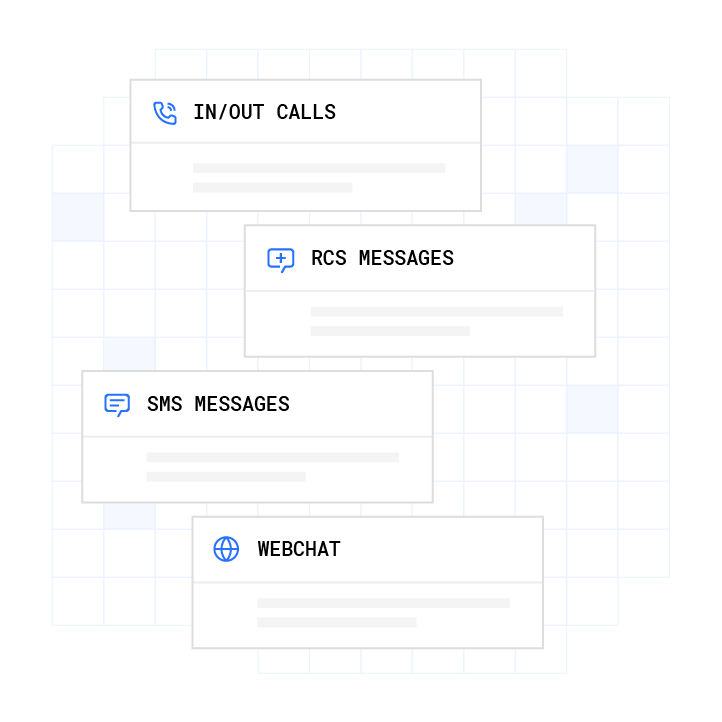
The same measurement applies across every inbound channel: voice, SMS, RCS, and webchat. A lead that submits a web form at 2:47 p.m. and receives a call at 2:47:04 p.m. has a 4-second lead response time. A lead that submits the same form and receives a call the next morning has a response time measured in hours, and the conversion probability has already collapsed.
What “Good” Lead Response Time Looks Like in 2026
A good average response time in 2026 is under 60 seconds for Tier 2 performance and under 5 seconds for Tier 1. Podium’s AI lead response time currently targets under 60 seconds and sits at Tier 2 performance but does not reach Tier 1 economics.4 Research shows that responding to prospects within five minutes is 100x more effective than responding within 30 minutes, so the 60-second standard clears the 5-minute floor but leaves significant conversion lift on the table compared with sub-5-second contact.
For regulated verticals including healthcare, insurance, financial services, and legal, “good” also includes compliance posture. A fast response that fires on a number in a TCPA (Telephone Consumer Protection Act) litigator database or a state DNC registry does not qualify as a good response.2 Average response time must be measured alongside compliance screening latency to produce a meaningful benchmark.
Run your numbers through Plura’s calculator to check your ROI in real time.
How To Track Median Versus Average Response Time
Accurate response-time targets depend on accurate measurement, and the choice between median and average response time shapes how you interpret performance. Average response time is the arithmetic mean, calculated as the sum of all individual response times divided by the total number of leads. It is easy to calculate and easy to misread. A single lead that waited 6 hours because a rep was in a meeting will pull the average up significantly and can hide the fact that 95% of leads were contacted in under 30 seconds.
Median response time is the midpoint value when all response times are sorted in ascending order. Half of leads were contacted faster than the median, and half were contacted slower. The median resists outliers and gives a more accurate picture of typical performance. For contact-center SLA reporting, median response time usually functions as the more operationally honest metric.
To track both correctly, instrument your unified inbox or CRM to timestamp two events per lead. Capture the inbound trigger event, such as form submission, call arrival, or SMS opt-in, and the first outbound contact event, such as call placed, SMS sent, or chat initiated. Export those timestamps at the campaign level. Calculate average by summing the deltas and dividing by lead count. Calculate median by sorting the deltas and identifying the middle value. Report both, flag the gap between them, and investigate any lead where response time exceeded your SLA threshold.
Platforms that share a stateful conversation database across voice, SMS, RCS, and webchat can instrument this automatically, because every inbound trigger and every outbound contact writes to the same data layer with the same timestamp format.
Lead Response Time Calculator and Revenue Impact
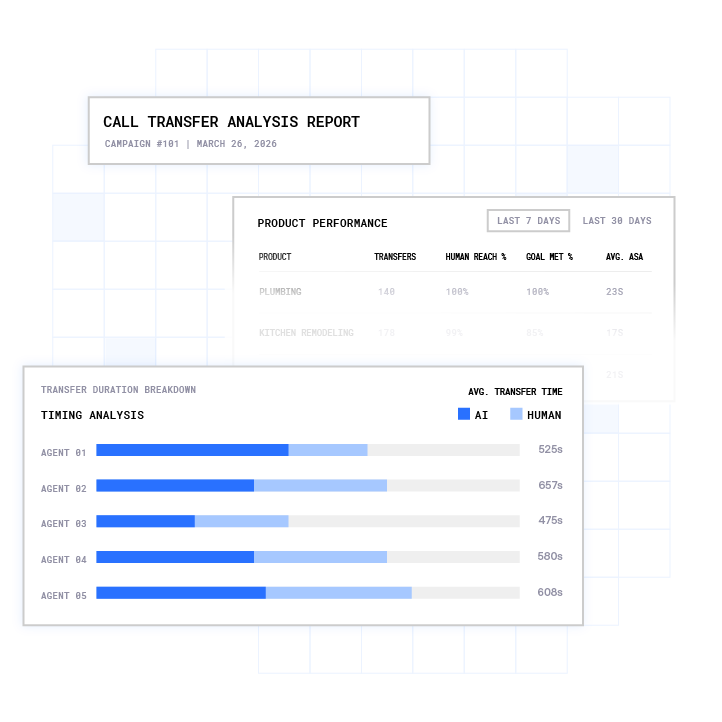
A lead response time calculator converts raw timestamp data into business metrics such as contact rate, conversion rate, and cost per qualified lead. Contacting a lead within 5 minutes makes them up to 100x more likely to connect, and responding within 60 seconds can lift conversions by 391%. Those multipliers feed the calculator and turn timing data into revenue projections.
The calculation framework is straightforward. Take your current average response time and identify which tier it falls into from the list above. Apply the corresponding conversion multiplier to your current close rate, then multiply the result by your average deal value. The difference between your current revenue output and the output at Tier 1 response time represents the opportunity cost of slower infrastructure.
Run your numbers through Plura’s calculator to check your ROI in real time.
Step-by-Step Plan To Implement Sub-5-Second Response
- Map every inbound channel to a single stateful conversation database. Voice, SMS, RCS, and webchat should write to the same data layer. A lead who texted at 9 a.m. and calls at noon should not have to re-identify. The database forms the foundation, and every other workflow depends on it.
- Configure real-time DNC and TCPA-litigator screening before first contact. Every outbound contact should be checked against federal and state DNC registries before the dial fires. TCPA-litigator list filtering blocks numbers associated with serial plaintiffs. TCPA violations can cost $500 to $1,500 per text or call,2 so pre-contact screening becomes a critical step in any sub-5-second workflow.
- Enable branded caller ID and STIR/SHAKEN at the carrier layer. STIR/SHAKEN (Secure Telephone Identity Revisited / Signature-based Handling of Asserted information using toKENs) is the FCC caller authentication framework. Branded caller ID presents the company name instead of an unfamiliar number. Both functions require carrier-level access, not a third-party bolt-on.
- Set workflow guardrails that allow instant handoff or escalation. Define the conditions under which the AI agent transfers to a human, such as high-value objections, sensitive disclosures, or out-of-scope requests. Guardrails keep the AI on-script and protect the customer experience at the moments that matter most.
- Instrument median-versus-average tracking in the unified inbox. Timestamp every inbound trigger and every outbound contact event. Report median and average separately. Flag SLA breaches automatically so the operations team can investigate root causes instead of discovering them in a monthly review.
- Run continuous workflow tuning against conversion outcomes. Sub-5-second response functions as the starting point, not the finish line. Analyze which conversation paths close, which objections recur, and which channel sequences produce the highest contact rate. Iterate the workflow weekly against actual conversion data.
Infrastructure and Compliance for Reliable Sub-5-Second Performance
Sub-5-second response reflects an infrastructure outcome, not just a software configuration. The latency between an inbound lead event and the first outbound contact is determined by the carrier layer, not the application layer. An AI agent built on a third-party CPaaS (Communications Platform as a Service, the API-only telecom layer that providers like Twilio sell to AI vendors that do not own their own carrier) inherits that CPaaS routing latency, caller ID reputation, and compliance posture.
Reliable sub-5-second performance requires several specific elements. An FCC-licensed audio bridging carrier must originate voice traffic domestically. STIR/SHAKEN authentication must run at origination. Branded caller ID should be issued at the carrier level. Real-time DNC scrubbing needs to run before the dial fires. A stateful conversation database must hold context across channels so the AI agent does not introduce re-identification latency on the second or third touch.
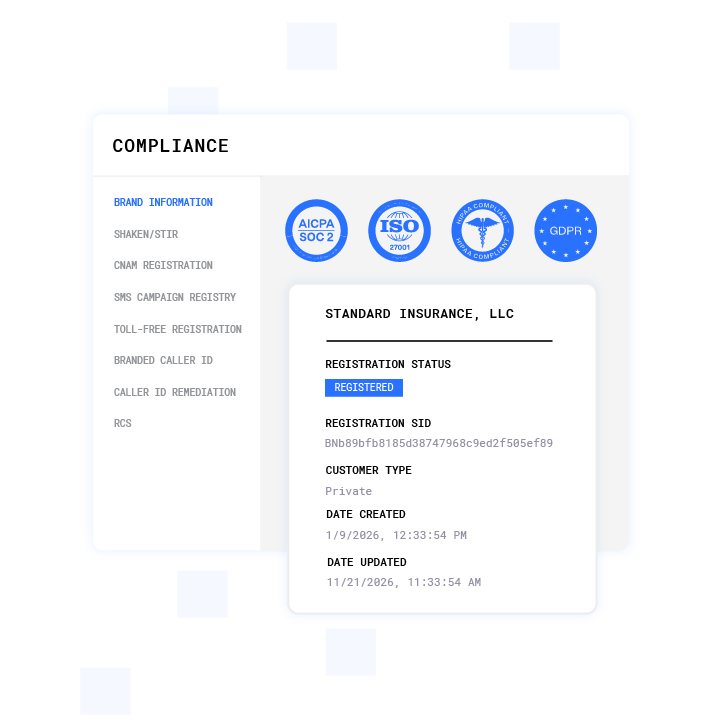
On the compliance side, Plura AI’s compliance framework includes SOC 2 compliant infrastructure, TCPA and STIR/SHAKEN enforcement, integration with Blacklist Alliance for DNC screening, and Number Verifier for caller ID reputation.1 These layers work together, with infrastructure security, carrier-level protections, and pre-contact screening forming a single chain. Because compliance requirements vary by vertical and jurisdiction, operators in regulated industries should consult qualified counsel regarding their specific obligations under TCPA, HIPAA (Health Insurance Portability and Accountability Act), and applicable state rules.2 Plura supports compliance; downstream obligations remain with the operator.
100% U.S. infrastructure also functions as a 2026 regulatory consideration for many operators. The FCC’s Notice of Proposed Rulemaking (NPRM, CG Docket No. 26-52) describes potential restrictions on offshore handling of sensitive consumer data. State laws in New York, New Jersey, Connecticut, Missouri, and Florida already restrict offshore handling of medical, financial, and consumer data. Any sub-5-second architecture that routes voice or data through offshore infrastructure carries regulatory exposure that domestic-only infrastructure avoids by design.
Comparing API-Reseller Architectures and FCC-Licensed Carrier Stacks
Most AI voice and SMS platforms on the market today operate as API resellers. They wrap a third-party CPaaS, typically Twilio or a similar provider, with an AI conversation layer.4
An API-reseller platform cannot issue branded caller ID at the carrier level because it does not own the carrier. It cannot enforce real-time DNC scrubbing at origination because the origination layer belongs to a third party. It may not satisfy the FCC’s proposed foreign-infrastructure restrictions if its CPaaS vendor routes traffic through offshore nodes. It also cannot hold conversation context across voice, SMS, RCS, and webchat by default if those channels are served by different underlying vendors with different data models.
An FCC-licensed carrier stack owns the origination layer directly. Voice traffic routes through the platform’s own licensed infrastructure. Branded caller ID is issued directly. STIR/SHAKEN authentication runs at origination. DNC scrubbing fires before the dial, not after. Compliance is enforced at the carrier level instead of bolted on as a software layer above a third-party telecom. The result is lower per-minute economics, higher pickup rates, and a compliance posture that does not depend on a vendor the platform does not control.
Compare plans and rates side by side at plura.ai/pricing.
Measurement Formulas and 2026 Response Time Benchmarks
Two benchmarks anchor most lead response time conversations in 2026. Contacting a lead within 5 minutes makes them up to 100x more likely to connect. Leads contacted within 1 minute are 391% more likely to convert than those contacted after 24 hours. Together, these figures establish the economic case for sub-5-second infrastructure, because the Tier 1 conversion multiplier is large enough to justify infrastructure investment many times over.
The measurement formula for response time ROI uses those multipliers directly. Take your current close rate, multiply it by the Tier 1 conversion multiplier, and then multiply by your average deal value. Subtract your current close rate multiplied by average deal value. The result equals the monthly revenue opportunity at sub-5-second response. Apply that figure against the cost difference between your current infrastructure and a carrier-grade AI platform to calculate payback period.
For median tracking, sort all lead response times for a given period in ascending order. The value at position (n+1)/2 for an odd count, or the average of positions n/2 and (n/2)+1 for an even count, is the median. Report this figure weekly alongside average response time. A widening gap between median and average usually signals outlier events, such as after-hours leads or channel-specific delays, that require workflow attention.
Frequently Asked Questions
How does Podium lead response time compare to sub-5-second performance?
Podium’s AI lead response time currently targets under 60 seconds for first contact. Sub-5-second performance, delivered by FCC-licensed carrier-grade platforms like Plura, fires the first contact before a human agent could open a queue. The conversion economics differ significantly. The 5-minute threshold produces a 100x connection rate advantage over 30-minute response, and the 60-second threshold produces the 391% conversion lift discussed earlier. The 60-second benchmark clears the 5-minute floor but does not reach the conversion performance of sub-5-second Tier 1 infrastructure.
Why does median response time matter more than average for contact center reporting?
Average response time is distorted by outliers. A single lead that waited 6 hours pulls the average up even if 95% of leads were contacted in under 30 seconds. Median response time is the midpoint of all response times sorted in order, which makes it resistant to outliers and more representative of typical performance. Contact center leaders should report both metrics and investigate any significant gap between them, because that pattern usually signals a specific channel, time-of-day, or workflow failure rather than a systemic problem.
What infrastructure does a platform need to reliably deliver sub-5-second lead response?
Sub-5-second response requires an FCC-licensed audio bridging carrier for domestic voice origination, STIR/SHAKEN authentication at the carrier layer, branded caller ID issued directly rather than through a third-party reseller, real-time DNC and TCPA-litigator screening before the dial fires, and a stateful conversation database that holds context across voice, SMS, RCS, and webchat. Platforms built on third-party CPaaS infrastructure inherit that vendor’s routing latency and cannot enforce compliance at origination. The carrier layer, not the AI conversation layer above it, determines response time.
How does compliance screening affect lead response time without adding latency?
Real-time DNC scrubbing and TCPA-litigator list filtering add a screening step before every outbound contact. On platforms where compliance functions as a software layer above a third-party telecom, that screening step introduces latency because it runs as a separate API call outside the origination path. On carrier-grade platforms where compliance is enforced at origination, the screening runs in parallel with the dial setup instead of sequentially before it, which removes the latency penalty. The result is sub-5-second response with pre-contact screening instead of a trade-off between speed and compliance posture.
What is the ROI difference between 60-second and sub-5-second lead response for a high-volume operator?
The ROI difference depends on deal value and volume, but the conversion multipliers are large enough to produce significant outcomes at most scales. The 391% conversion lift from 60-second versus 24-hour response, applied to a 500-lead-per-day operation with a $2,000 average deal value, produces a material monthly revenue delta. The infrastructure cost of a carrier-grade AI platform, which can replace both CPaaS fees and some human agent labor in the response queue, often produces a payback period measured in weeks rather than quarters for operators above the 500-daily-interaction threshold. Plura’s ROI calculator at plura.ai/calculator runs the specific numbers for any input scenario.
Conclusion: Moving Beyond the 60-Second Benchmark
The 60-second benchmark was a meaningful standard when human agents were the only option. In 2026, it functions as the competitive floor, not the ceiling. Sub-5-second first contact on FCC-licensed U.S. infrastructure, with real-time DNC screening, branded caller ID, STIR/SHAKEN authentication, and a stateful conversation database shared across voice, SMS, RCS, and webchat, produces conversion economics that 60-second and 5-minute benchmarks cannot match.
The measurement framework stays simple. Track median and average response time separately, apply the 100x and 391% conversion benchmarks to your current deal economics, and calculate the revenue gap between your current tier and Tier 1 performance. The infrastructure requirements stay specific. Own the carrier layer, support compliance at origination, and hold conversation context across every channel by default.
Plura AI delivers sub-5-second response on 100% U.S. infrastructure, with SOC 2, HIPAA, ISO certification, TCPA compliance, DNC compliance, and STIR/SHAKEN caller ID verification built into the carrier stack, not bolted on above it.1 The 90-day opt-out window in every annual contract puts the performance commitment on the line.
Run your numbers through Plura’s calculator to check your ROI in real time.
Compare plans and rates side by side at plura.ai/pricing.
1 Plura AI maintains SOC 2, HIPAA, ISO, and GDPR posture as part of its platform infrastructure. References to compliance frameworks in this article describe Plura’s platform capabilities and do not constitute a guarantee that any customer using Plura will themselves be compliant with applicable laws or standards. Customers remain solely responsible for their own regulatory obligations, certifications, consent management, recordkeeping, and the claims they make to their own end users. Consult qualified legal counsel for guidance specific to your use case.
2 This article describes regulatory frameworks at a general level and does not constitute legal advice. Laws and regulations vary by jurisdiction, change over time, and apply differently depending on facts and circumstances. Readers should consult qualified legal counsel before making compliance decisions.
3 Performance figures, customer outcomes, and industry statistics referenced in this article are drawn from cited third-party sources or Plura customer case studies. Individual results vary based on implementation, use case, industry, audience, and execution. Past or aggregate performance is not a guarantee of future results.
4 References to third-party products, services, companies, or research are made for informational and comparative purposes only. Plura AI is not affiliated with, endorsed by, or sponsored by any third party named in this article unless explicitly stated. Trademarks and product names referenced remain the property of their respective owners.
This article is provided for informational purposes only and reflects Plura AI’s understanding at the time of publication. Product capabilities, integrations, and specifications are subject to change. For the most current information, visit plura.ai.
This article was produced with the assistance of AI tools and reviewed by Plura AI prior to publication.