
Written by: Matt Beucler, CEO, Plura AI
Key takeaways for virtual AI call centers in 2026
- A virtual AI call center uses conversational AI to manage high-volume voice, SMS, RCS, and webchat on U.S. infrastructure while keeping context, consent records, and regulatory alignment intact.
- Plura AI is the only platform built on an FCC-licensed domestic carrier, which enables sub-5-second responses, carrier-level branded caller ID, and support for 2026 U.S. compliance rules.
- AI agents deliver 24/7 availability, 100% talk utilization, and zero turnover, which cuts costs sharply compared to traditional human-staffed contact centers.
- Regulatory changes, including the FCC NPRM and state onshoring laws, now favor platforms that run entirely on domestic infrastructure with real-time DNC scrubbing and immutable consent logging.5
- Discover how Plura AI can transform your call center operations with a live demo.
How a virtual AI call center works in practice
A virtual AI call center is a software platform that uses artificial intelligence to conduct voice calls, send SMS and RCS messages, and manage webchat sessions on behalf of a business. It does this without requiring a proportional human workforce to handle each interaction. The AI agent greets callers, qualifies leads, answers questions, negotiates within defined parameters, and routes complex situations to a human agent when the workflow calls for it.
The critical distinction in 2026 is infrastructure ownership. Most platforms marketed as virtual AI call centers are API resellers built on top of third-party CPaaS (Communications Platform as a Service) providers. They do not own the carrier stack, cannot issue branded caller ID at the carrier level, and cannot enforce compliance at origination. Plura AI owns its telecom infrastructure and holds an FCC carrier license, whereas platforms like Synthflow depend on Twilio and operate as a software layer without a carrier license.4
AI-run call centers in 2026: capabilities and impact
Given the infrastructure requirements outlined above, AI can run a call center in 2026 when the right foundation is in place. AI agents now handle inbound qualification, outbound follow-up, appointment scheduling, negotiation flows, and warm transfers to human agents. They do this at volumes no human team can match at equivalent cost. AI contact centers provide 24/7/365 availability and a 0% turnover rate, compared to 30-45% annual turnover for traditional operations.
The performance gap is measurable. Contacting a lead within 5 minutes makes them up to 100 times more likely to connect, and a 60-second response lifts conversions by 391% (industry research published on plura.ai/calculator).3 The industry standard for first contact on an inbound lead is 47+ hours. That delay is where revenue disappears.
In healthcare, AI-driven appointment management and follow-up workflows support up to a 40% improvement in no-shows. That metric directly affects revenue per provider seat and schedule utilization.
See Plura in action with a live demo focused on your call volume and use cases.
Regulatory landscape for AI calling in 2026
AI-powered calling operates within a defined regulatory framework. The primary federal statutes governing outbound voice and SMS include the TCPA (Telephone Consumer Protection Act, 47 U.S.C. § 227), the DNC (Do Not Call) registry rules administered by the FTC and FCC, and the CAN-SPAM Act (15 U.S.C. § 7701 et seq.) for electronic messaging.2 STIR/SHAKEN (Secure Telephone Identity Revisited/Signature-based Handling of Asserted information using toKENs) caller-ID authentication is now a baseline carrier requirement under FCC orders implementing the TRACED Act.
The FCC has proposed additional rules requiring terminating providers to transmit verified caller name or other caller identity information for presentation on a consumer’s handset whenever they transmit an indication that a call has received an A-level attestation. The same rulemaking proposes measures to identify foreign-originated calls and address spoofing of U.S. telephone numbers for calls originating outside the United States.
Operators should consult qualified legal counsel regarding their specific obligations under TCPA, DNC, and applicable state rules. TCPA violations carry statutory damages of $500 to $1,500 per unsolicited call or text, with class action settlements averaging $6.6M in 2023. Plura supports customer compliance through pre-loaded rule sets, real-time DNC scrubbing, and immutable consent logging, but customers remain responsible for their own regulatory obligations.
Virtual AI call center cost per minute and total cost of ownership
The economics of a virtual AI call center differ from traditional contact centers at every scale point. Human agents carry fixed costs regardless of call volume: payroll, taxes, benefits, commissions, real estate, and a 30-50% annual turnover cycle that forces perpetual rehiring and retraining. AI agents run at 100% talk utilization with no overhead per seat.
| Model | Monthly Cost (50-seat equivalent) | Annual TCO | Turnover Rate |
|---|---|---|---|
| Traditional offshore BPO | $35,000-$50,000 | $1.0M-$1.9M (50-agent) | 30-45% annually (as noted earlier) |
| Onshore human contact center | Significantly higher | Significantly higher | 30-50% annually |
| Plura AI virtual AI call center | $14,400 (15-agent equivalent scenario) | $300,000-$700,000 | 0% |
In a default 15-agent scenario at standard ROI calculator inputs, a human team at $20/hour with taxes, benefits, and 40% talk utilization costs $60,000/month. Six Plura agents replacing those 15 humans at $15/hour and 100% talk utilization cost $14,400/month. That shift produces $45,600 in 30-day savings and $547,200 over 12 months.
Use Plura’s ROI calculator to model your own cost and savings in real time.
Hybrid AI and human call center workflow
Most production deployments in 2026 run a hybrid model where AI handles the high-volume, repeatable portion of every conversation and humans handle the exceptions. The workflow runs in a clear sequence rather than in parallel.
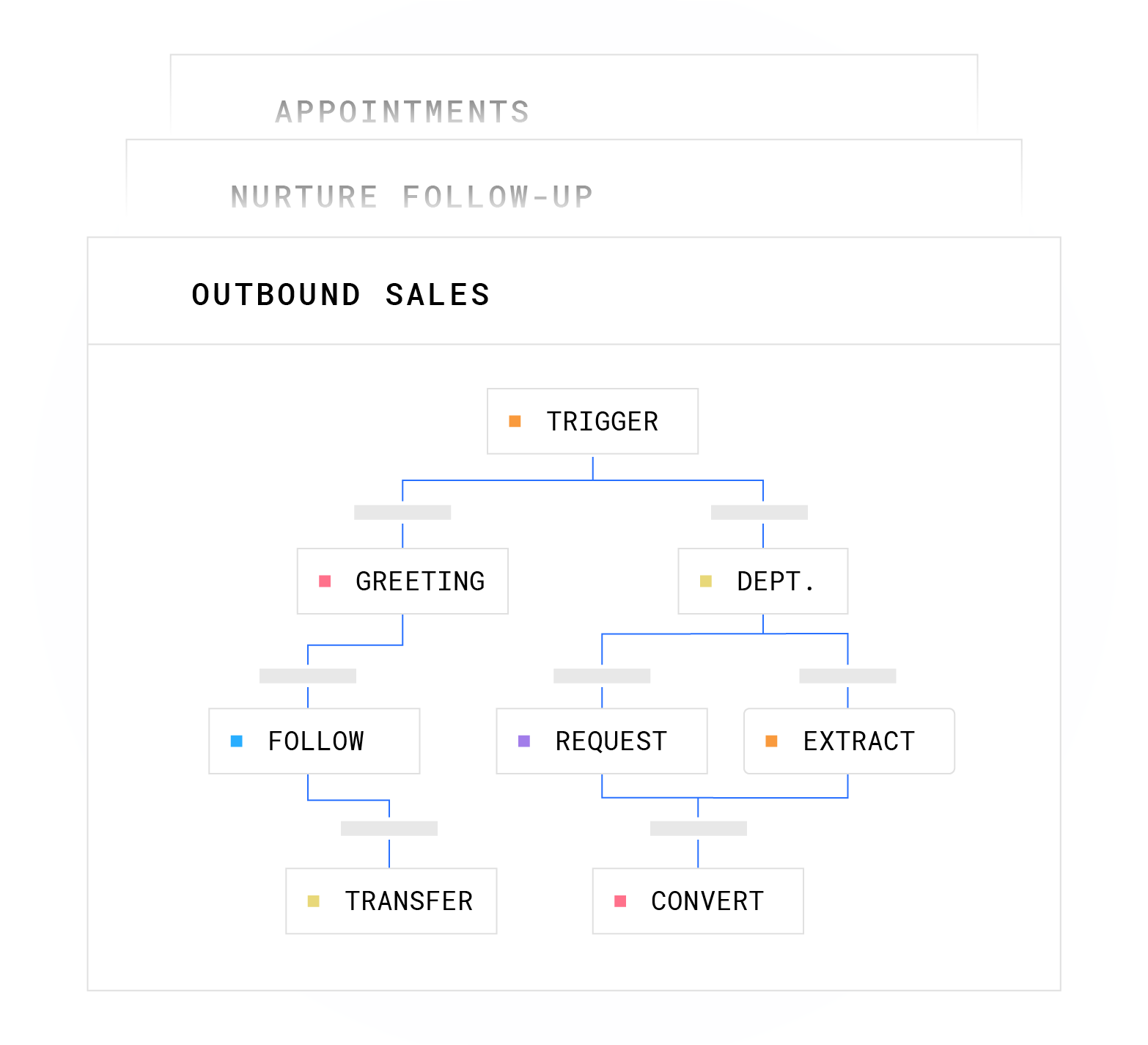
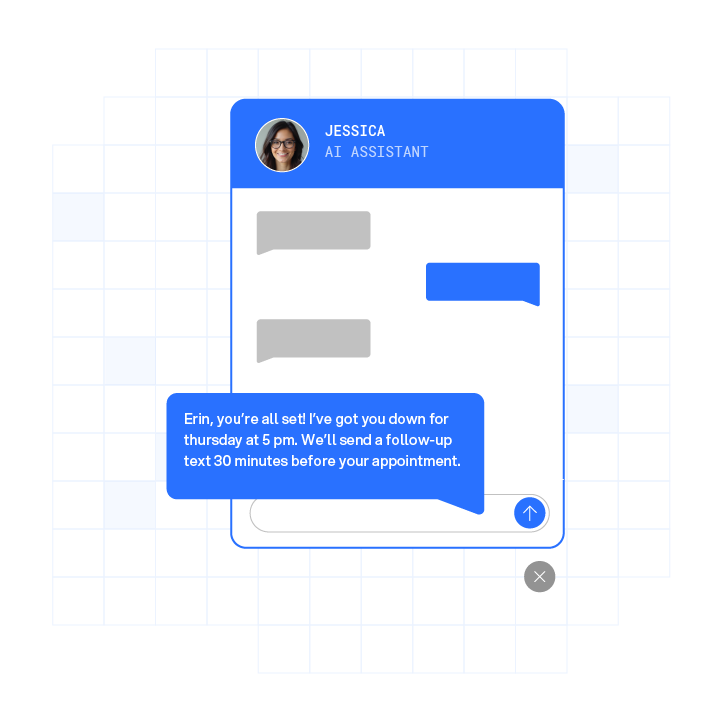
- Inbound or outbound trigger. A lead submits a form, calls in, or enters an SMS flow. Plura’s AI agent responds in under 5 seconds across the appropriate channel, which keeps the lead engaged before they move on.
- AI qualification. With the lead engaged, the agent runs the qualification script, enriches the lead with 30+ real-time data sources, and captures consent records with timestamps. This step builds the context needed for intelligent routing.
- Stateful context build. Every response is written to the Stateful Conversation Database, keyed to the customer’s phone number, email, or ID. Because the history is stored, if the customer texted at 9 a.m. and calls at noon, the AI already knows what was said.
- Escalation gate. When a workflow node triggers a transfer condition, such as a high-value deal, sensitive disclosure, or unresolved objection, the AI warm-routes the call to a U.S. human agent with full conversation context already on screen. That handoff prevents customers from repeating themselves.
- Human resolution. The agent sees the Unified Inbox view of the same Stateful Conversation Database the AI read from. This shared view lets the human resolve the issue faster because the full history is visible.
- Post-call action. After the conversation, the AI fires post-conversation events such as CRM updates, calendar bookings, SMS follow-ups, or RCS document sends, depending on workflow configuration. These actions close the loop without manual effort.
FCC NPRM and state onshoring rules for call centers
The regulatory environment for offshore call center operations has shifted materially since 2025. The FCC’s Notice of Proposed Rulemaking (NPRM, CG Docket No. 26-52) proposes capping offshore customer-service calls at 30% and prohibiting offshore handling of sensitive consumer data, including passwords, multi-factor authentication codes, Social Security numbers, and banking and card data.
Companion federal legislation extends the perimeter. The Keep Call Centers in America Act (S.2495) and the Foreign Robocall Elimination Act (S.2666) address both labor displacement and foreign-originated call fraud. At the state level, New York’s Call Center Jobs Act carries penalties up to $10,000 per day for covered violations, New Jersey has enacted a mirror statute, Connecticut restricts offshore handling in state contracts, Missouri issued an executive order requiring offshore-call disclosure, and Florida restricts offshore handling of medical information.
Plura runs on 100% U.S. infrastructure by architecture. Voice origination, model hosting, data storage, and call recording all sit on domestic infrastructure, which means no offshore exposure under the NPRM, state onshoring laws, or foreign-adversary-nation prohibitions. Customers should consult qualified counsel to assess their own obligations under applicable federal and state rules.
Branded caller ID and spam label remediation
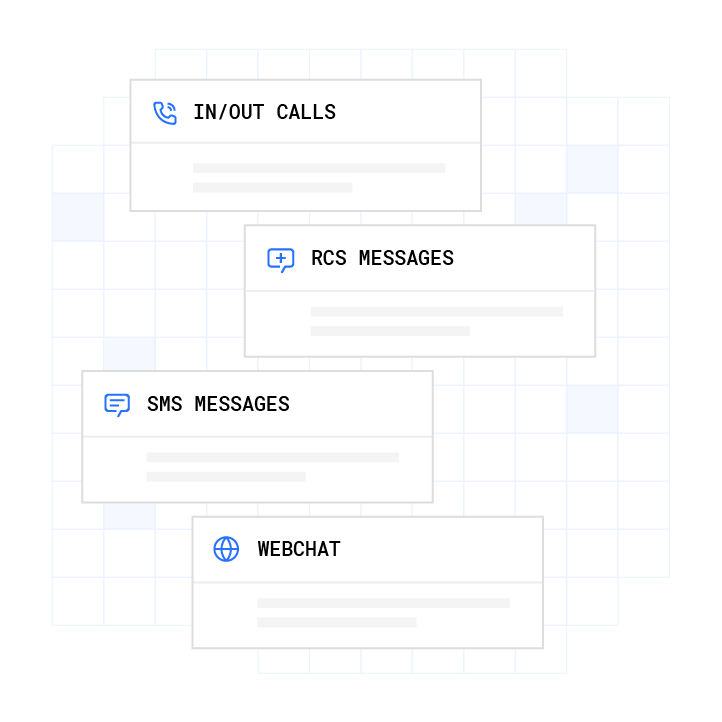
Spam labels are a carrier-level problem. When a call presents as “Spam Likely” or an unfamiliar number, it rarely gets answered. Plura supports voice, SMS, RCS, and webchat natively with FCC-licensed carrier status, which means branded caller ID is issued at the carrier level, not bolted on through a third-party reseller.
STIR/SHAKEN authentication runs on every outbound call. Under the A-level attestation rules proposed by the FCC, discussed earlier, Plura’s carrier-level authentication helps ensure calls present with verified identity information. Plura’s AI also communicates with Apple’s iOS 26 call-screening layer, so calls present with the company’s name and the reason for the call rather than being intercepted before they ring through.
Platforms built on third-party CPaaS inherit the caller-ID reputation of the CPaaS provider, not their own. Carrier-provisioned branded caller ID is not available on platforms that lack a carrier license.
Stateful conversation database across every channel
Most AI voice tools and AI SMS tools are separate products from separate vendors with separate memories. A customer who texted a question at 9 a.m. often has to re-explain themselves when the call comes at noon. That friction is not only a UX problem, it is a conversion problem.
Compliance engine capabilities for high-volume outreach
Plura’s compliance engine functions as a core layer of the platform rather than a post-launch checkbox. Every outbound contact is checked against federal and state DNC registries in real time before dial. Consent records are timestamped, immutable, and audit-ready. Quiet-hours rules enforce automatically through time-zone detection. HIPAA-aligned encryption, access controls, and audit logging cover protected health information across all four channels. SOC 2 and ISO certification cover the underlying infrastructure.1 The compliance dashboard exports audit-ready reports in one click.
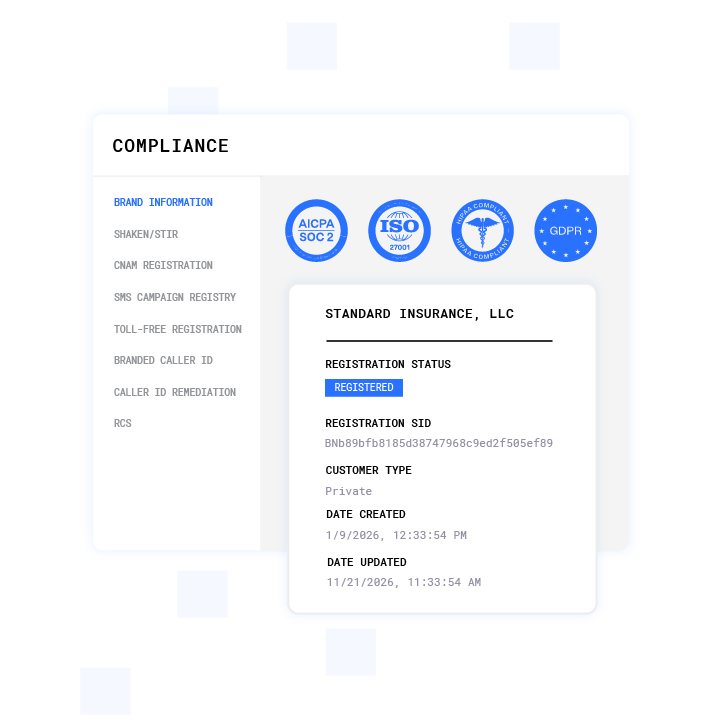
Plura provides HIPAA and SOC 2 compliance support and integrates with The Blacklist Alliance’s TCPA Litigation Firewall for real-time Do Not Call scrubbing and litigation protection. Beyond the certifications noted above, Plura supports customer compliance across TCPA, DNC, GDPR, SHAKEN/STIR caller ID verification, and CAN-SPAM requirements. Customers remain responsible for their own certifications and regulatory obligations.
How to evaluate virtual AI call center providers
Five core questions separate infrastructure owners from CPaaS wrappers.
1. Does the provider hold an FCC carrier license? If voice routes through Twilio or another third-party CPaaS, the provider cannot issue branded caller ID at the carrier level, cannot enforce compliance at origination, and carries foreign-infrastructure exposure under the FCC NPRM. Building a production-ready AI voice agent on Twilio APIs typically takes 6 to 12 months and costs $300K to $500K or more in first-year engineering and infrastructure, plus 2 to 3 full-time engineers for ongoing maintenance.
2. Is conversation memory stateful across channels? A platform that treats voice, SMS, and webchat as separate products with separate memories cannot deliver a continuous customer experience or support cross-channel compliance records.
3. Where does data reside? Under the FCC NPRM and applicable state laws, sensitive consumer data handled offshore creates compliance exposure. Ask for architecture documentation, not a promise.
4. How is compliance enforced? Real-time DNC scrubbing, immutable consent logging, and quiet-hours enforcement should be platform-native, not third-party add-ons. Review the audit export before signing.
5. What does the contract include? Plura’s annual contracts include a 90-day opt-out window. If the deployment is not delivering, customers are not held to the full term. Pricing tiers start at $5,000/month (Multi), $7,500/month (Agency), and custom (Enterprise), all billed monthly on annual contracts.
Conclusion: building a resilient AI contact center
A virtual AI call center built on third-party CPaaS wrappers cannot meet 2026 regulatory or performance demands. The FCC NPRM, state onshoring laws, STIR/SHAKEN authentication requirements, and the economics of sub-5-second lead response all point to the same requirement. Providers need to own the carrier stack, hold conversation memory across channels, and run on U.S. infrastructure by architecture.
Plura AI is built by a team with 28+ years of enterprise telephony and call center expertise. It is the only virtual AI call center platform that owns its FCC-licensed domestic carrier, issues branded caller ID at the carrier level, maintains a Stateful Conversation Database across voice, SMS, RCS, and webchat, and delivers a TCO of $300,000-$700,000 while replacing traditional contact-center cost structures.
Model your ROI with Plura’s calculator.
Review plans and rates on the pricing page.
Frequently Asked Questions
What makes a virtual AI call center different from a traditional call center?
A virtual AI call center replaces the human-agent layer for high-volume, repeatable interactions with AI agents that operate 24/7 at 100% talk utilization. These agents have no turnover, no training ramp, and no linear cost scaling. Traditional contact centers carry fixed costs per seat regardless of call volume, including payroll, taxes, benefits, commissions, real estate, and a 30-50% annual turnover cycle that forces perpetual rehiring.
AI agents scale instantly into peak seasons without advance hiring. Another structural difference is channel memory. A well-built virtual AI call center maintains context across voice, SMS, RCS, and webchat in a single stateful database, so a customer who texted in the morning is recognized when they call in the afternoon. Most traditional contact centers and most CPaaS-wrapper AI tools do not maintain that cross-channel context.
How does an FCC carrier license affect AI call center performance?
An FCC carrier license means the platform originates and terminates voice traffic on its own infrastructure rather than renting capacity from a third-party CPaaS provider. The operational consequences are significant. Branded caller ID can be issued at the carrier level, so calls present with the company’s name rather than “Spam Likely” or an unfamiliar number.
STIR/SHAKEN authentication runs at origination, which aligns with FCC requirements and improves delivery rates at the terminating carrier. Real-time DNC scrubbing and TCPA consent enforcement can be built into the call path rather than bolted on as a third-party add-on. Because all voice traffic stays on domestic infrastructure, the platform avoids offshore exposure at the infrastructure layer under the FCC NPRM and state onshoring laws. Platforms that route voice through Twilio or another CPaaS inherit that provider’s caller-ID reputation and cannot issue branded caller ID at the carrier level.
What compliance frameworks does Plura support?
Plura supports customer compliance with TCPA, DNC, HIPAA, SOC 2, ISO certification, GDPR, SHAKEN/STIR caller ID verification, and CAN-SPAM. Every outbound contact is checked against federal and state DNC registries in real time before dial. Consent records are timestamped, immutable, and audit-ready. Quiet-hours rules enforce automatically through time-zone detection.
HIPAA-aligned encryption, access controls, and audit logging cover protected health information across voice, SMS, RCS, and webchat. The compliance dashboard exports audit-ready reports in one click. Customers remain responsible for their own certifications, regulatory obligations, and the claims they make to their own end users. Plura provides the infrastructure, and compliance posture downstream of that remains the customer’s responsibility. Operators with specific questions about their obligations under TCPA, HIPAA, or applicable state rules should consult qualified legal counsel.
How does the FCC NPRM affect businesses currently using offshore call centers?
The FCC’s Notice of Proposed Rulemaking (CG Docket No. 26-52) proposes capping offshore customer-service calls at 30% of total volume and prohibiting offshore handling of sensitive consumer data, including passwords, multi-factor authentication codes, Social Security numbers, and banking and card data. Companion federal legislation, including the Keep Call Centers in America Act (S.2495), extends the regulatory perimeter.
State laws in New York, New Jersey, Connecticut, Missouri, and Florida already restrict offshore handling of medical, financial, and consumer data, with penalties in some states reaching $10,000 per day. Businesses currently operating under offshore BPO contracts should assess their exposure against the proposed federal rules and existing state statutes with qualified legal counsel. Operators who migrate to a platform running on 100% U.S. infrastructure by architecture remove the offshore-exposure question at the infrastructure level.
How quickly can a virtual AI call center go live?
Deployment timelines depend on conversation complexity. A straightforward inbound qualification flow typically goes live in days. A multi-step intake workflow, such as a 25-question health-history survey with conditional routing, runs closer to one to two months because the workflow logic requires design, validation, and pilot testing on real calls before full go-live.
Plura’s onboarding sequence covers a discovery audit of the customer’s business and call economics, intake of sample calls and existing scripts, an overnight build of a dynamic conversation mockup, a review and iteration session, engineering build of the production workflow, a pilot test on a subset of real calls, and full go-live. Annual contracts include a 90-day opt-out window. If the deployment is not delivering, customers are not held to the full term.
1 Plura AI maintains SOC 2, HIPAA, ISO, and GDPR posture as part of its platform infrastructure. References to compliance frameworks in this article describe Plura’s platform capabilities and do not constitute a guarantee that any customer using Plura will themselves be compliant with applicable laws or standards. Customers remain solely responsible for their own regulatory obligations, certifications, consent management, recordkeeping, and the claims they make to their own end users. Consult qualified legal counsel for guidance specific to your use case.
2 This article describes regulatory frameworks at a general level and does not constitute legal advice. Laws and regulations vary by jurisdiction, change over time, and apply differently depending on facts and circumstances. Readers should consult qualified legal counsel before making compliance decisions.
3 Performance figures, customer outcomes, and industry statistics referenced in this article are drawn from cited third-party sources or Plura customer case studies. Individual results vary based on implementation, use case, industry, audience, and execution. Past or aggregate performance is not a guarantee of future results.
4 References to third-party products, services, companies, or research are made for informational and comparative purposes only. Plura AI is not affiliated with, endorsed by, or sponsored by any third party named in this article unless explicitly stated. Trademarks and product names referenced remain the property of their respective owners.
5 This article contains forward-looking statements regarding industry trends, technology adoption, and future capabilities. These statements reflect current expectations and are subject to change. Plura AI undertakes no obligation to update forward-looking statements except as required.
This article is provided for informational purposes only and reflects Plura AI’s understanding at the time of publication. Product capabilities, integrations, and specifications are subject to change. For the most current information, visit plura.ai.
This article was produced with the assistance of AI tools and reviewed by Plura AI prior to publication.