
Written by: Matt Beucler, CEO, Plura AI
Updated July 2026
Key Takeaways for 2026 Dialer Operators
- Predictive dialers use algorithms to forecast agent availability and dial multiple numbers at once, connecting only live answers to free agents for up to 40% fewer no-shows.
- Key compliance requirements in 2026 include a 3% abandonment cap, STIR/SHAKEN caller-ID authentication, and real-time DNC scrubbing to reduce TCPA exposure.
- AI-powered platforms like Plura AI deliver 100% talk utilization versus roughly 40% for human agents, cutting labor costs while supporting regulatory compliance.3
- Plura’s owned FCC carrier, stateful cross-channel memory, and 100% U.S. infrastructure reduce exposure to proposed offshore rules and simplify TCPA, HIPAA, and SOC 2 alignment.1
- Ready to eliminate offshore exposure and simplify compliance? See how Plura’s AI Predictive Dialer handles your outbound programs.
How Predictive Dialers Operate in Production
- Pacing algorithm. The dialer monitors active agents, average call duration, and historical answer rates to calculate a dialing ratio, typically 1.2 to 2.0 simultaneous calls per available agent. The ratio adjusts in real time, at least twice daily, based on list freshness and time-of-day patterns.
- Simultaneous dialing. The system places multiple outbound calls before any agent is confirmed free. When more calls connect than agents are available, the excess become abandoned calls, so pacing discipline becomes the central compliance variable.
- Answer detection (AMD). Answering Machine Detection analyzes the audio stream to distinguish a live human voice from a voicemail greeting, busy signal, or disconnected number. Calls routed to agents are live-answer only.
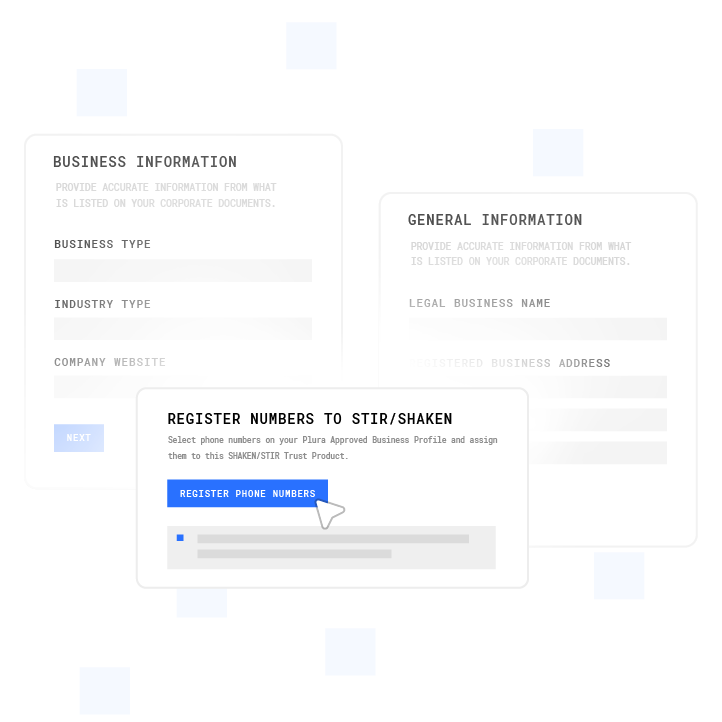
- Intelligent routing. Confirmed live answers route to the next available agent. STIR/SHAKEN (Secure Telephone Identity Revisited / Signature-based Handling of Asserted information using toKENs) authentication, the FCC-mandated caller-ID verification framework, runs on every outbound call to reduce spam labeling.
- Wrap-up logging. Post-call disposition, transcript, and outcome data write to the conversation record. On Plura, this feeds the Stateful Conversation Database so every subsequent touchpoint on any channel inherits the full prior context.
An ATDS (Automated Telephone Dialing System) is the legal classification the TCPA (Telephone Consumer Protection Act, 47 U.S.C. § 227) uses to define regulated dialing equipment, which becomes important when evaluating compliance obligations in the next section.
Are Predictive Dialers Legal? FCC Rules in 2026
Predictive dialers operate under a layered federal and state framework that continues to evolve. The core federal rules as of July 2026 are summarized below.2
3% abandonment cap. FCC rules require predictive dialers to keep abandoned calls below 3% of answered calls per campaign over any 30-day period, where an abandoned call is one where a person answers but no agent connects within two seconds. Violations can trigger penalties under the TCPA. The FCC’s October 2025 Further Notice of Proposed Rulemaking (FNPRM) proposes modifying or eliminating this safe harbor, but no final rule has been adopted as of this writing.
Revocation rules. The FCC’s broad revocation-of-consent rule, requiring a single opt-out to stop all robocalls and robotexts from the same sender, has been delayed to January 31, 2027. Operators should consult qualified counsel on current consent-revocation obligations and how to structure programs ahead of that deadline.
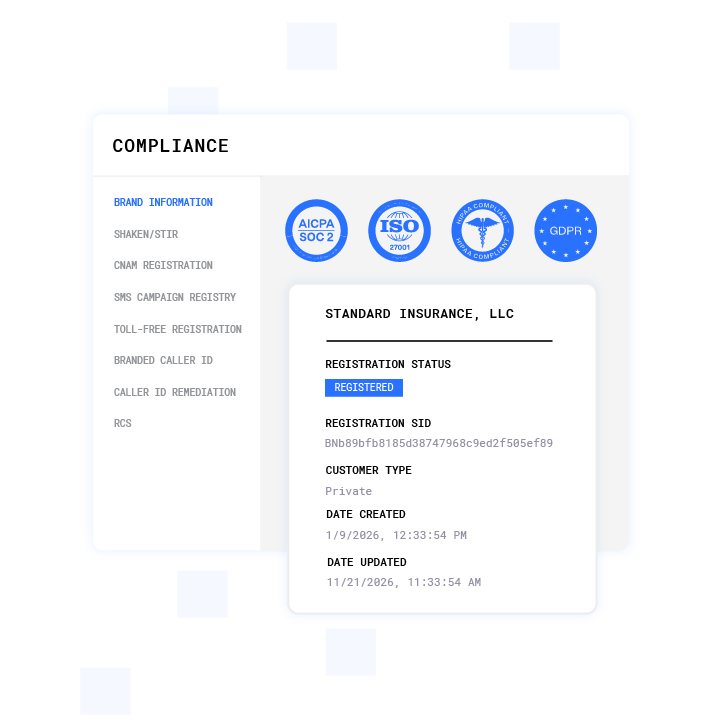
STIR/SHAKEN. The TRACED Act directs carriers to authenticate caller IDs. The October 2025 FNPRM further proposes requiring terminating providers to display a caller’s verified name whenever they display A-level STIR/SHAKEN attestation, which makes anonymous robocalling harder and raises the stakes for branded caller ID.
Offshore caps (proposed). FCC NPRM FCC 26-16, published April 23, 2026 (CG Docket No. 26-52), proposes a cap on offshore customer-service call volume, start-of-call disclosures for overseas-routed calls, and a prohibition on offshore handling of sensitive data including passwords, Social Security numbers, and payment information. Reply comments closed June 22, 2026, and no final order has been issued.
State rules. States including Florida and Oklahoma impose stricter requirements than federal TCPA. Eleven states maintain their own DNC lists. Operators should review state-specific obligations with qualified counsel.
Cost and ROI Benchmarks for AI Dialers
Predictive dialer economics change significantly when AI agents replace human agents on the same volume. Traditional operations for a 100-seat contact center carry substantial annual costs. The same volume on Plura costs $300,000 to $700,000.
The gap comes from talk utilization. Human agents in a typical contact center run at roughly 40% talk utilization, while Plura AI agents run at 100% talk utilization, with 6 AI agents replacing the output of 15 human agents at $14,400 per month versus $60,000 per month for the human team.
In a default 15-agent scenario, the 30-day ROI is $45,600, which compounds to $547,200 over 12 months and $2,736,000 over 60 months as the cost advantage accumulates.3 These projections become even more favorable when factoring in the cost of 35-45% annual agent turnover, which forces perpetual retraining cycles on top of base payroll.
Use Plura’s calculator to model your own headcount, volume, and ROI assumptions in real time.
Choosing Between Predictive, Progressive, Power, and Preview Dialers
Each dialer type trades off speed, compliance risk, and team-size requirements differently, so platform selection should match campaign goals and risk tolerance.
Predictive dialers dial 1.2 to 2.0 numbers per agent simultaneously, raising talk time to 45-50 minutes per agent hour. They carry the highest compliance risk because pacing errors produce abandoned calls. They suit teams of 15 or more agents running high-volume campaigns such as debt collection, mass lead generation, and outbound surveys.
Progressive dialers place one call per agent only when the agent is confirmed available, which produces near-zero abandoned calls. They deliver 35-40 minutes of talk time per agent hour and suit teams of 5 to 15 agents in compliance-heavy sectors like healthcare and financial services.
Power dialers dial sequentially at a 1:1 ratio, increasing talk time from roughly 15-20 minutes per hour (manual) to 40-50 minutes per hour with zero abandoned-call risk. They are the standard choice for B2B outbound sales teams.
Preview dialers present the contact record to the agent before any call is placed, so the agent reviews context and initiates the call manually. Talk time runs 20-28 minutes per agent hour, but conversation quality is highest because agents enter every call prepared.
The table below compares infrastructure characteristics relevant to platform selection. Consult qualified counsel on compliance obligations specific to your dialing program.
| Dimension | Plura AI | Third-Party CPaaS Wrapper |
|---|---|---|
| Carrier infrastructure | Owned FCC carrier license, voice originates on Plura’s domestic infrastructure | Depends on third-party CPaaS (e.g., Twilio), operates as a software layer without a carrier license4 |
| Stateful cross-channel memory | Yes, remembers previous interactions, preferences, and outcomes across voice, SMS, RCS, and webchat | No, context resets between channels and sessions |
| Branded caller ID | Carrier-level issuance, calls present with company name and call reason | Reseller-level, inherits CPaaS caller-ID reputation |
| Real-time DNC scrubbing | Built-in, integration with The Blacklist Alliance’s TCPA Litigation Firewall for real-time scrubbing and litigation protection4 |
Compliance Engine Requirements for 2026
A predictive dialer compliance engine in 2026 needs to address several overlapping frameworks. The following describes what those frameworks cover; operators should consult qualified counsel on their specific obligations under each.
TCPA and DNC. The TCPA describes prior express written consent for autodialed telemarketing messages to mobile numbers, clear caller identification at the start of each call, opt-out mechanisms on prerecorded messages, and calling-window restrictions of 8:00 AM to 9:00 PM in the recipient’s local time zone.2 National DNC Registry scrubbing typically occurs at least every 31 days. Eleven states maintain their own DNC lists.
HIPAA. Voice, SMS, and webchat conversations involving protected health information involve end-to-end encryption, access controls, and audit logging under 45 CFR Parts 160, 162, and 164. Plura supports HIPAA-aligned handling of protected health information across all four channels.1
SOC 2 and data security. Plura’s compliance framework includes SOC 2-aligned infrastructure with continuous monitoring, penetration testing, and third-party audits.1
State onshoring. The FCC’s proposed offshore caps (FCC 26-16) remain a proposal. Active state laws in New York, New Jersey, Connecticut, Missouri, and Florida already restrict offshore handling of medical, financial, and consumer data. Plura runs on 100% U.S. infrastructure by architecture, so voice origination, model hosting, data storage, and call recording all sit on domestic infrastructure.
Review Plura’s pricing page to compare plans, channels, and usage tiers side by side.
AI Predictive Dialer Advantages for Contact Centers
The economic case for AI-enhanced predictive dialing rests on four structural differences from legacy platforms.
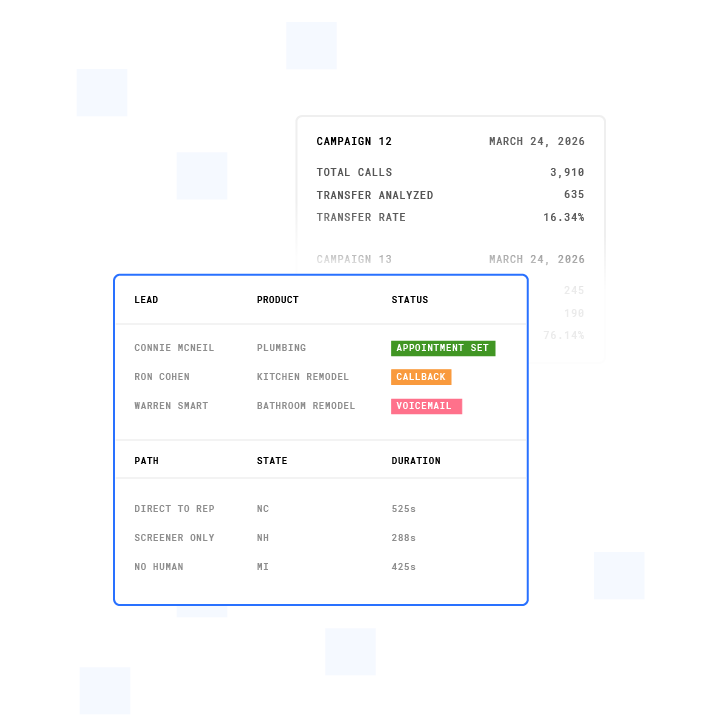
Logarithmic cost scaling. Human contact centers scale linearly, where more volume requires proportional headcount, payroll, benefits, and real estate. Plura’s logarithmic cost scaling, the $300,000-$700,000 TCO mentioned earlier, comes from AI agents running at 100% talk utilization with no taxes, benefits, commissions, or retraining cycles.
Sub-5-second response. Plura’s AI agents contact leads in under 5 seconds. Contacting a lead within 5 minutes makes them up to 100x more likely to connect, and a 60-second response lifts conversions by 391%. The industry standard for first contact on an inbound lead is more than 47 hours.
100% U.S. infrastructure. Every component of Plura’s stack, including voice origination, model hosting, data storage, and call recording, runs on domestic infrastructure. This reduces exposure to the proposed FCC offshore caps, state onshoring laws, and foreign-adversary-nation prohibitions without requiring configuration changes.
Stateful cross-channel memory. Plura’s AI architecture remembers previous interactions, preferences, and outcomes across channels. A lead who received an SMS at 9 a.m. does not re-explain themselves when the predictive dialer reaches them at noon. That context accumulates with every interaction and compounds conversion advantage over time.
Implementation Checklist for Predictive Dialers
- List hygiene. Validate and enrich phone data before campaign launch. Validated data improves connect rates by 2-3x compared to stale lists on the same dialer engine.
- Consent audit. Document the source, timestamp, and method of consent for every number in the campaign. Retain records for at least five years per FTC Telemarketing Sales Rule recordkeeping guidance.
- DNC scrubbing. Scrub against the National DNC Registry and applicable state DNC lists before every campaign launch, and configure real-time scrubbing at the point of dial.
- Carrier registration. Register numbers through TCR (The Campaign Registry) for SMS and through the FCC’s Robocall Mitigation Database for voice to reduce spam labeling.
- Pacing calibration. Start at a conservative ratio of 1.2 to 1.5 calls per agent and monitor abandonment rate by hour. Adjust pacing twice daily based on list freshness and answer-rate data.
- Quiet-hours configuration. Enforce calling windows using the called party’s actual time zone, not area code alone. Apply state-specific windows where they are stricter than the federal 8:00 AM to 9:00 PM standard.
- Opt-out processing. Configure automated suppression of opt-out requests across all channels within 10 business days. Build suppression logic that survives vendor handoffs.
- 90-day review. Audit abandonment rate, right-party-contact rate, conversion per dial-hour, and cost per qualified outcome at 30, 60, and 90 days. Adjust workflow logic based on actual call transcripts.
Frequently Asked Questions
What is the 3% abandonment rule for predictive dialers in 2026?
The FCC’s TCPA rules cap abandoned calls at the 3% threshold described earlier, measured as answered calls where no agent connects within two seconds. Violations can create penalties under the TCPA, with potential class-action exposure on top. The FCC’s October 2025 FNPRM proposes modifying or eliminating this safe harbor, but no final rule has been adopted as of July 2026. Operators should consult qualified counsel on current obligations and on how to monitor pacing to stay within the threshold.
How does an owned FCC carrier affect predictive dialer compliance?
Most AI voice platforms route calls through a third-party CPaaS like Twilio, which means branded caller ID, DNC scrubbing, and STIR/SHAKEN authentication sit in bolt-on layers managed outside the platform. Plura owns its FCC-licensed audio bridging carrier, so branded caller ID is issued at the carrier level, STIR/SHAKEN authentication runs on every outbound call at origination, and real-time DNC scrubbing functions as a first-class layer of the platform rather than a third-party add-on. This matters operationally because compliance enforcement happens before the call is placed, not after the fact. It also matters under the proposed FCC offshore rules and foreign-adversary-nation prohibitions, since Plura’s entire stack runs on U.S. infrastructure by architecture.
What is the difference between a predictive dialer and a progressive dialer?
A predictive dialer dials multiple numbers per agent simultaneously using an algorithm that forecasts when agents will finish current calls. This produces 45-50 minutes of talk time per agent hour but carries compliance risk from abandoned calls when predictions are imperfect. A progressive dialer places one call per agent only when the agent is confirmed available, which produces near-zero abandoned calls and 35-40 minutes of talk time per agent hour. Predictive dialers suit high-volume teams of 15 or more agents running standardized campaigns. Progressive dialers suit smaller teams in compliance-heavy sectors like healthcare and financial services where abandoned-call risk is unacceptable.
What do the proposed FCC offshore call center rules mean for outbound dialing operations?
FCC NPRM FCC 26-16 (CG Docket No. 26-52), published April 23, 2026, proposes capping offshore customer-service call volume, requiring start-of-call disclosures for overseas-routed calls, and prohibiting offshore handling of sensitive data including passwords, Social Security numbers, and payment information. The rules remain a proposal with no final order issued as of July 2026. Operators using offshore BPOs for outbound dialing should consult qualified counsel on exposure under the proposed rules and evaluate whether their current vendor infrastructure would satisfy the sensitive-data restrictions if the rules are finalized.
What team size is needed for a predictive dialer to deliver positive ROI?
Predictive dialers require statistical scale to keep abandonment rates within the FCC’s 3% cap. Most industry analysis puts the minimum viable team size at 8 to 10 concurrent agents, with the algorithm performing best at 15 or more. Below 8 agents, the pacing algorithm lacks enough data to predict availability accurately, which increases abandoned-call risk without delivering proportional talk-time gains. For smaller teams, power or progressive dialers often deliver better economics and lower compliance risk. For operations replacing human agents with AI, the calculus shifts, since Plura’s AI Predictive Dialer runs at 100% talk utilization and 6 AI agents can replace the output of 15 human agents at a fraction of the cost.
Conclusion: Structuring Predictive Dialing for 2026
Predictive dialer call center automation delivers measurable talk-time gains and cost reductions when the platform owns its carrier infrastructure, maintains stateful memory across every channel, and enforces compliance at the point of dial rather than bolting it on afterward. The 2026 regulatory environment, including the proposed FCC offshore caps under CG Docket No. 26-52, the pending revocation-of-consent rule delayed to January 31, 2027, and active state onshoring laws in five states, increases the operational cost of getting the infrastructure layer wrong.
Plura AI’s AI Predictive Dialer runs on its own FCC-licensed carrier, delivers 100% U.S. infrastructure by architecture, and shares a Stateful Conversation Database across voice, SMS, RCS, and webchat. The result is the $300,000-$700,000 TCO profile described earlier, replacing traditional contact-center economics, with compliance support integrated into every dial.
1 Plura AI maintains SOC 2, HIPAA, ISO, and GDPR posture as part of its platform infrastructure. References to compliance frameworks in this article describe Plura’s platform capabilities and do not constitute a guarantee that any customer using Plura will themselves be compliant with applicable laws or standards. Customers remain solely responsible for their own regulatory obligations, certifications, consent management, recordkeeping, and the claims they make to their own end users. Consult qualified legal counsel for guidance specific to your use case.
2 This article describes regulatory frameworks at a general level and does not constitute legal advice. Laws and regulations vary by jurisdiction, change over time, and apply differently depending on facts and circumstances. Readers should consult qualified legal counsel before making compliance decisions.
3 Performance figures, customer outcomes, and industry statistics referenced in this article are drawn from cited third-party sources or Plura customer case studies. Individual results vary based on implementation, use case, industry, audience, and execution. Past or aggregate performance is not a guarantee of future results.
4 References to third-party products, services, companies, or research are made for informational and comparative purposes only. Plura AI is not affiliated with, endorsed by, or sponsored by any third party named in this article unless explicitly stated. Trademarks and product names referenced remain the property of their respective owners.
This article is provided for informational purposes only and reflects Plura AI’s understanding at the time of publication. Product capabilities, integrations, and specifications are subject to change. For the most current information, visit plura.ai.
This article was produced with the assistance of AI tools and reviewed by Plura AI prior to publication.