
Starting November 25, 2026, a STOP reply no longer has to mean stop everything. Under the FCC's new TCPA order, FCC 26-67, an opt out from an informational call or text can be limited to that one category of message. An opt out from anything that contains marketing still ends all of your marketing calls and texts.
That split is easy to describe and hard to run. Your AI agent has to read each reply, work out which message it answered, and apply the right scope on every channel before the next call or text goes out. Below are eight TCPA opt out examples your voice, SMS and RCS agents will meet in the first week, with the response we recommend for each one.
The short answer: if the message had any marketing in it, stop all marketing. If the customer clearly named one informational category, you may stop only that category, on every channel. If you can't tell, stop everything consent based.
How do you decide what a STOP covers?
Every example below runs through the same two questions. Ask them in this order.
- 01Did the message the customer answered contain any marketing? Even one promotional line counts. If yes, the opt out revokes consent for all of your advertising and telemarketing calls and texts.
- 02If not, did the customer clearly point at one informational category? Payment reminders, fraud alerts and appointment reminders are typical categories. If yes, you may limit the opt out to that category. If no, or if you aren't sure, treat it as a request to stop everything consent based.
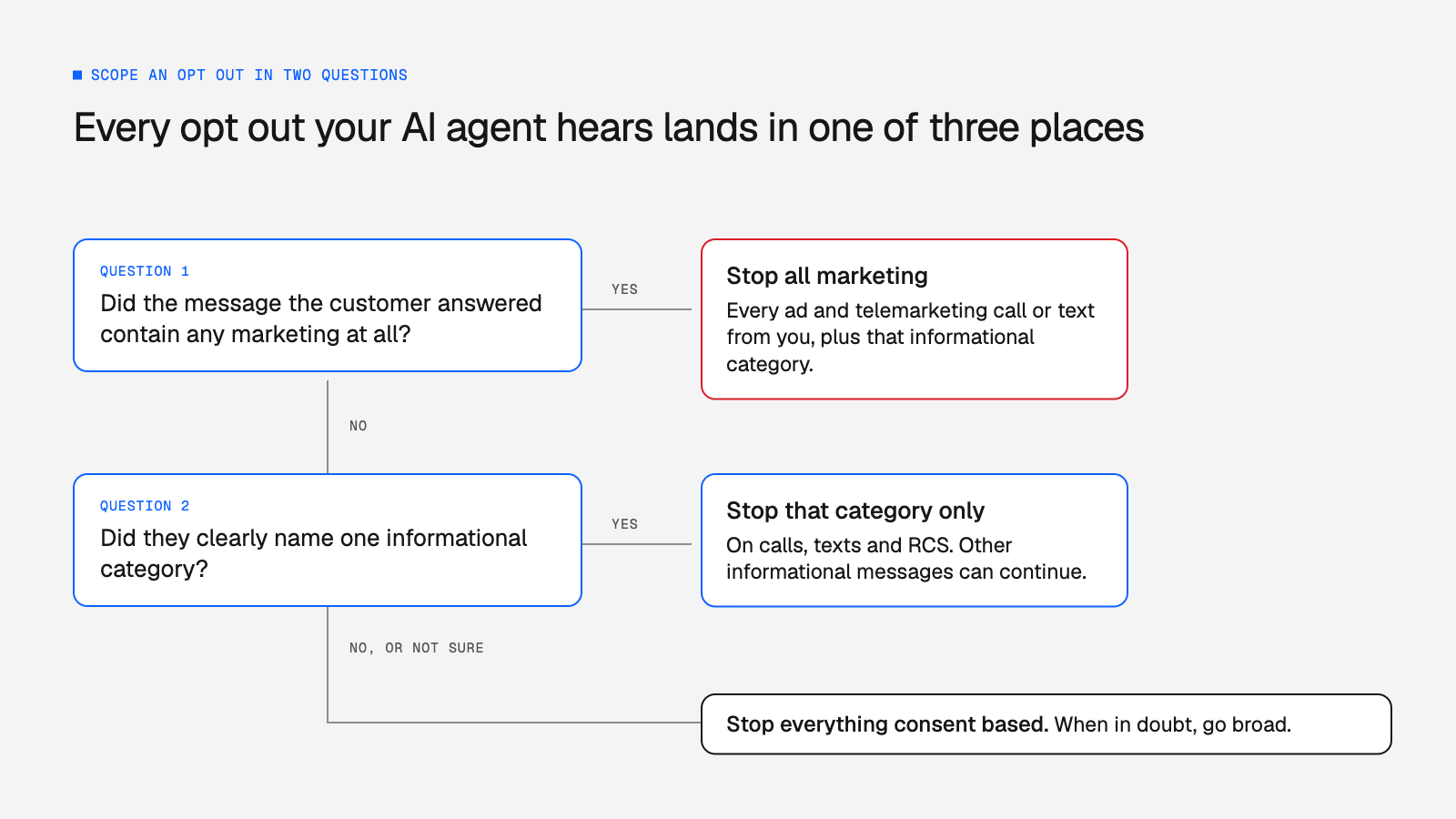
The narrow option is a choice, not a requirement. The rule lets you limit an informational opt out to its category. It never forces you to keep sending the rest, so going broad is always allowed.
8 TCPA opt out examples for AI agents
1. STOP to a clean payment reminder
The message: “Hi Dana, your $84 payment is due Friday. Reply C to confirm.”
The reply: STOP
The right response: the reminder had no advertising in it, so this is an informational opt out. You may stop payment reminders only and keep sending the fraud alerts and appointment reminders Dana consented to. Record the payment reminder opt out on her contact so every agent sees it.
2. STOP to the same reminder with one upsell line
The message: the same reminder, plus “Ask about our premium plan!”
The reply: STOP
The right response: the message now contains advertising, so the STOP revokes consent for every marketing call and text you send Dana. We also recommend stopping payment reminders, since that is the message she answered.
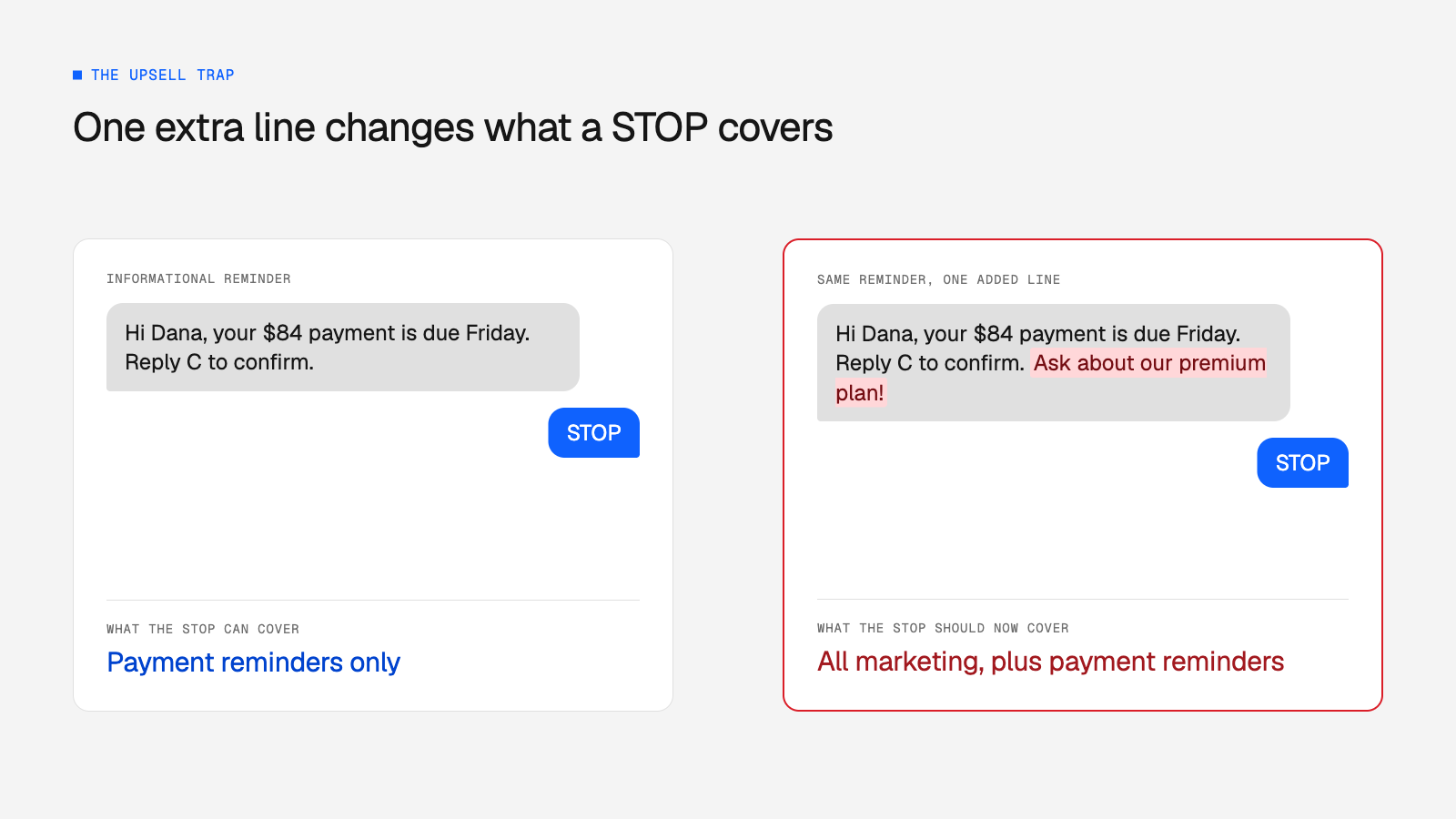
Why this hits AI agents harder: a person who goes off script makes this mistake once. An AI agent running a sloppy prompt can repeat it on every message it sends, all day, before anyone reads the logs. Lock your informational scripts so offers and promotions can't slip in.
3. “Take me off your list”
The message: any outbound text or call.
The reply: “Take me off your list.”
The right response: the customer named no category, so go broad. Stop all consent based calls and texts to that contact. Guessing the narrowest scope is how you end up messaging someone who wanted out of everything.
4. “Quit calling me about my bill”
The message: an informational billing reminder call.
The reply: “Quit calling me about my bill.”
The right response: the customer named the subject. If the call carried no marketing, you can limit the opt out to billing reminders and keep other categories running. Save the exact words so the scope you chose is easy to explain later.
5. An angry reply with no keyword
The message: an appointment reminder text.
The reply: “Leave me alone!!!” or something less printable.
The right response: there is no standard keyword here, but the intent is obvious. Treat it as an opt out, and because it names no category, apply the broadest scope. Keyword filters miss replies like this. Your AI agent should catch an opt out in any wording, including angry or profane ones.
6. STOP by text, then a voice call is queued
The message: a payment reminder text on Monday. Your voice agent has a payment reminder call scheduled for Wednesday.
The reply: STOP, by text.
The right response: cancel the Wednesday call. The amended rule talks about a category of informational calls and texts and doesn't split it by channel, so the conservative reading is that a payment reminder opt out that arrives by text also covers payment reminder calls and RCS messages.
Receives the STOP, sets the payment reminder opt out on the contact record and, if you use them, sends a confirmation with no marketing in it.
7. An opt out through a method you didn't designate
The message: you designated reply STOP as your exclusive opt out method and disclose it in every text.
The reply: an email to your support team asking you to stop texting.
The right response: honor it anyway. From November 25 you may designate one or more exclusive opt out methods, as long as you disclose them clearly on every call or text. Callers who designate nothing must still honor any reasonable means. Honoring a stray request costs you one contact and removes an argument. Confirm your policy with counsel.
8. You want to confirm the opt out
The message: any text.
The reply: STOP.
The right response: a confirmation text is optional. If you send one, it can only confirm the opt out, with no offers or promotions, and one sent within five minutes is presumed to fall within the customer's prior consent. Something like “You won't get more payment reminders from us.” is enough.
TCPA opt out cheat sheet
The same eight scenarios on one screen. Save it for your prompt reviews.
TCPA opt out examples and the scope to apply
Scenario
What the customer said
What to stop
What can continue
Clean payment reminder
STOP
Payment reminders
Other informational categories
Reminder with an upsell
STOP
All marketing, plus payment reminders
Other informational categories
No category named
Take me off your list
Everything consent based
Nothing
Billing call
Quit calling me about my bill
Billing reminders
Other informational categories
Angry reply
Leave me alone!!!
Everything consent based
Nothing
Cross channel
STOP by text
That category on calls, texts and RCS
Other informational categories
Undesignated method
Email to support
Treat it like any other opt out
Depends on the scope
Confirmation
STOP
Per the scope above
One confirmation text, no marketing
Clean payment reminder
What the customer said
STOP
What to stop
Payment reminders
What can continue
Other informational categories
Reminder with an upsell
What the customer said
STOP
What to stop
All marketing, plus payment reminders
What can continue
Other informational categories
No category named
What the customer said
Take me off your list
What to stop
Everything consent based
What can continue
Nothing
Billing call
What the customer said
Quit calling me about my bill
What to stop
Billing reminders
What can continue
Other informational categories
Angry reply
What the customer said
Leave me alone!!!
What to stop
Everything consent based
What can continue
Nothing
Cross channel
What the customer said
STOP by text
What to stop
That category on calls, texts and RCS
What can continue
Other informational categories
Undesignated method
What the customer said
Email to support
What to stop
Treat it like any other opt out
What can continue
Depends on the scope
Confirmation
What the customer said
STOP
What to stop
Per the scope above
What can continue
One confirmation text, no marketing
What should an AI agent log for every opt out?
The FCC added no new recordkeeping duty in this order. If an opt out is ever disputed, you'll still want these five things on file for each one:
- The exact words the customer used, and the channel
- The date and time it arrived
- Which message it answered, and how that message was classified
- The scope your agent applied
- When suppression took effect on each channel
Speed matters too. The rule allows a reasonable time, up to 10 business days, to honor an opt out. A good AI platform suppresses before the next message goes out.
What could change after November 25?
Still open at the FCC: the same order asks for comment on a shorter deadline (for example 7 business days), a required one step way to stop everything alongside category opt outs, and mandatory two way texting. Comments are due November 25, 2026 and replies December 28, 2026. None of it is law yet, so build your flows so they can absorb it.
Get the full rule breakdown and the free audit prompt
How Plura handles opt outs across channels
Plura keeps one record per contact that tracks consent by category, and every AI voice, SMS and RCS agent checks it before a flow starts. Tag an opt out once and journeys skip that contact for that category, while the categories they still want keep running. See how it works on our compliance page.
Map your workflows to the new rules in 30 minutes
This article is general information, not legal advice. TCPA obligations depend on your messages, consent records and use case. Confirm your setup with your own counsel.
Products mentioned